












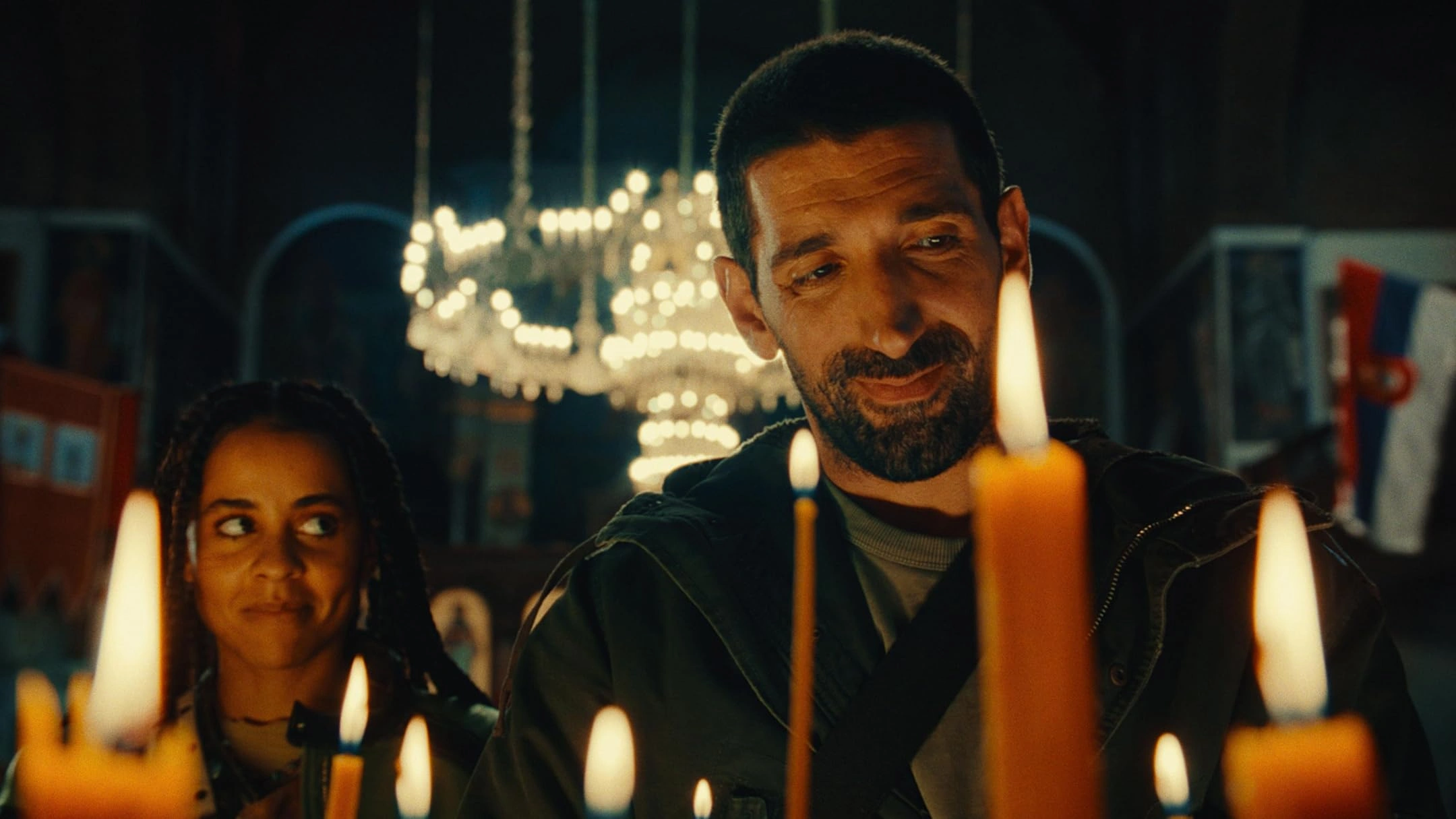

Recovery in Thea Gajić’s feature debut has the texture of unpaid council calls, frayed band rehearsals, and a daughter studying her father for signs of weather. Surviving Earth resists the grand tragic architecture often imposed on addiction stories, partly because Vlad’s danger is so ordinary. He does not need a villain. He has a phone, a housing problem, a musical ambition, a family history, and the ancient human talent for making one bad choice feel temporarily sensible.
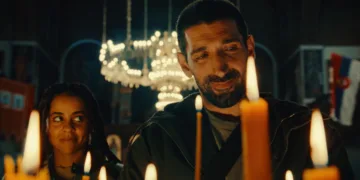
Slavko Sobin plays Vlad, a recovering heroin addict living in Bristol after fleeing the Yugoslav wars. By day, he works as a drug counsellor, speaking to users with the authority of someone who knows the room from both sides. By night, he plays harmonica in a Balkan folk band with colleagues from work. Somewhere between those two versions of himself sits the man his daughter Maria, played by Olive Gray, wants back.
This is where Gajić’s personal connection to the material matters without needing to be advertised inside every scene. The film feels written from proximity. It knows the choreography of watching someone you love: the half-second after a joke when you check if the smile will hold, the silence after a dinner remark, the fear that tenderness may be the prelude to damage.
Vlad Against the Ordinary
Vlad’s great enemy is daily life. This sounds almost comic, until the film shows how rent, family calls, pride, nostalgia, and boredom can gather into a private militia. His council contact is saved as “Council: DO NOT PICK UP,” which is funny in the grim way adult life is funny (someone should invent horror out of voicemail). The joke also tells us everything. Vlad does not solve pressure. He renames it, avoids it, then lets it grow teeth.
Sobin gives him a charisma that can turn very quickly into threat. When Vlad is playing harmonica, his body seems to recover an older rhythm, one tied to culture, memory, and performance. He wants the band to headline larger shows, to be seen properly, to escape the smallness of support slots and local gigs. Then the dream starts becoming practical. A bigger audience, a promoter with the wrong manner, a rehearsal that does not bend to his ego, and Vlad begins sabotaging the very future he claims to want.
Call it relapse weather: the pressure system that forms before the act itself. Gajić is smart enough to treat relapse as atmosphere before event. Vlad’s past as a Serbian soldier is never simply backstory decoration. It sits in his posture, in the way he stiffens when challenged, in the flash of menace Sobin finds with a small change in the eyes. His Skype calls with his mother and brother deepen that pressure, especially when money and guilt enter the conversation. He left. He survived. Neither fact has freed him.
Maria’s Wary Love
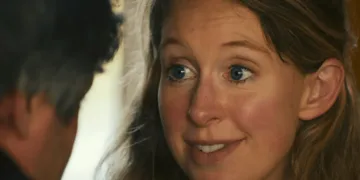
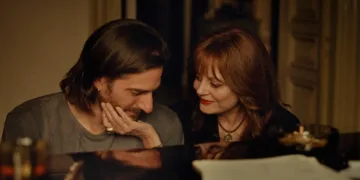
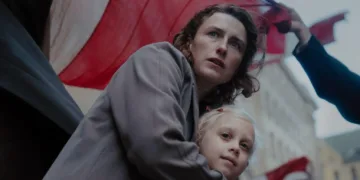
Maria’s scenes with Vlad give Surviving Earth its most painful intelligence. Olive Gray plays her as someone who wants to believe in her father and has paid before for believing too soon. Her admiration is real. She is an artist, drawn to Vlad’s creativity and to the Serbian cultural inheritance he carries through music. Yet her body often knows what her hope refuses to process.
The dinner scene with Maria and her mother, played by Ann Ogbomo, is especially sharp because Gajić allows old injuries to move around the table without turning them into speeches. Vlad wants a restored family, or thinks he does. Maria’s mother has already placed a boundary he keeps trying to treat as negotiable. Maria sits between them, alert to every shift in tone. The scene does not need a blow-up to hurt. It hurts because everyone knows the pattern and nobody can fully stop performing their assigned role in it.
Gray’s performance is built from small calibrations. When Vlad is charming, she softens, almost against her better judgment. When his anger leaks through, her face closes with the tired speed of recognition. The tragedy is not that Maria does not love him enough. The tragedy is that love has become a form of risk assessment.
Bristol, Music, and the Shape of Shelter
Olan Collardy’s cinematography gives Bristol a lived-in physical presence: rehab offices, estates, streets, small venues, and Vlad’s reddish flat, which feels like both refuge and trap. The flat is warm in colour, but warmth does not equal safety. Bills still exist there. Avoided calls still ring there. Memory, annoyingly, has no respect for interior design.
The music scenes provide the film’s bursts of movement. Vlad’s harmonica is not a symbolic prop sitting politely in the frame; it is his method of staying assembled. The Balkan folk performances give him “something to look forward to,” part of the little survival triangle he clings to: something to do, someone to love, something ahead. Hugo Brijs’ music helps these passages breathe, though the band’s creative world could have used a little more room. A few performances end right when the film seems ready to let the music argue for Vlad in a language cleaner than speech.
Gajić’s restraint is both the film’s strength and its occasional limitation. Surviving Earth can become heavily patient, particularly when Vlad’s spiral settles into familiar beats of avoidance, shame, and repair. The lighter eccentricities, such as his suspicion of self-service checkouts and digital payment, hint at a richer comic friction between Vlad and the modern world. More of that would have sharpened the darkness rather than softened it.
Still, the film’s refusal of spectacle gives it force. Vlad’s collapse is not presented as a cinematic thunderclap. It arrives through the dull arithmetic of pressure. One ignored call. One bruised ego. One drink too many. One daughter watching the weather change again.
The British indie drama Surviving Earth made its UK and Irish theatrical premiere on April 24, 2026, following its initial festival run at events like SXSW and the Edinburgh International Film Festival. The feature debut from writer-director Thea Gajić is a deeply personal, poignant portrait based on the life of her late father. The narrative follows Vlad, a Yugoslavian refugee and talented harmonica player who built a fragile peace in Bristol working as a drug counsellor. When he starts a Balkan music band with his friends, the shadows of past trauma, war, and addiction resurface, testing his relationship with his devoted daughter, Maria. The movie is distributed by Metis Films and screened across select independent cinemas.
Where to Watch Surviving Earth (2026) Online
Full Credits
Title: Surviving Earth
Distributor: Metis Films
Release date: April 24, 2026
Rating: 15
Running time: 96 minutes
Director: Thea Gajić
Writers: Thea Gajić
Producers and Executive Producers: Aleksandra Bilić, Sophie Reynolds, Jamie Clark, Farhana Bhula, Louise Ortega
Cast: Slavko Sobin, Olive Gray, Stuart Martin, Peter Coonan, Toni Gojanović, Ann Ogbomo, Arthur McBain
Director of Photography (Cinematographer): Olan Collardy
Editors: Izabella Curry
Composer: Hugo Brijs
The Review
Surviving Earth
Surviving Earth refuses the easy theatre of addiction and studies the smaller terror: a man who can survive war, migration, heroin, then be nearly undone by rent calls, wounded pride, and a bad gig negotiation. The film is sometimes too patient for its own good, and its music world could use fuller breath. Still, Thea Gajić and Slavko Sobin find the frightening arithmetic of recovery: one day at a time, with yesterday always waiting in the hall.
PROS
- Slavko Sobin’s volatile lead performance
- Olive Gray’s wary tenderness as Maria
- Addiction handled without spectacle
- Bristol locations feel lived-in
- Music gives Vlad shape and refuge
CONS
- Some music scenes feel too brief
- Heavy tone could use sharper lightness
- Supporting figures orbit Vlad closely
- Pacing may test patience