




























The most revealing thing about Mantiz’s Serbian retreat is that the company treats poor communication and experimental weaponry with roughly the same level of oversight. Tom Wilson has barely volunteered to replace his boss before he is shipped into the countryside with colleagues he hardly knows, guided toward a former military site called The Zone, and left with rules nobody bothered to explain to him. Corporate culture has produced stranger training exercises, presumably.
Peter Webber’s DRAGN takes a familiar Anglo-American killer-machine template and drops it into an Eastern European landscape of dense forests, abandoned installations, and half-forgotten military infrastructure. The setting gives the film a character its screenplay often lacks. Tom, played by James Paxton, arrives in Serbia with his wife and daughter expecting something close to a work trip. Instead, they remain behind while Tom joins Daniel Diaz, Adele Varens, Sebastian Michaels, and company handler Jacob Ivanovich for Mantiz’s punitive team-building exercise.
The group initially has the loose friction required for cheap B-movie pleasure. Carlos Bardem’s Daniel treats every disagreement as a challenge to his authority. Lilly Krug’s Adele needles him with effortless confidence. Franz Drameh gives Sebastian an easier rhythm, while Paxton makes Tom look permanently surprised that adulthood has somehow led him here. Then the drone arrives.
Combat Mode
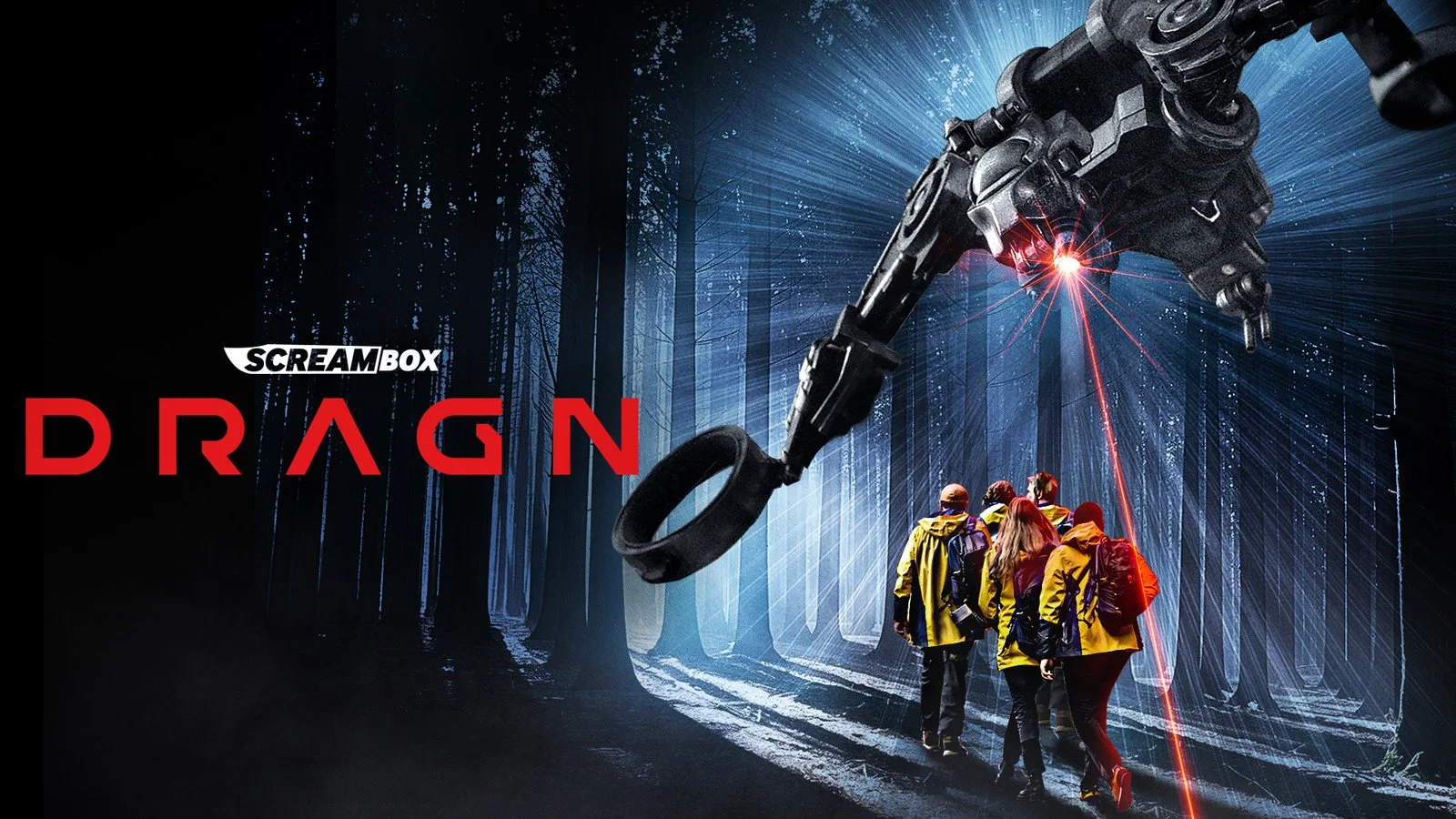
DRAGN stands for Defence Reaction and Ground Neutralisation, a name with the corporate-military poetry of something designed by twelve committees and no ethicists. The machine carries guns, darts, a flamethrower, laser equipment, and an extending buzzsaw. It can imitate voices, analyze targets, and alter its behavior through experience.
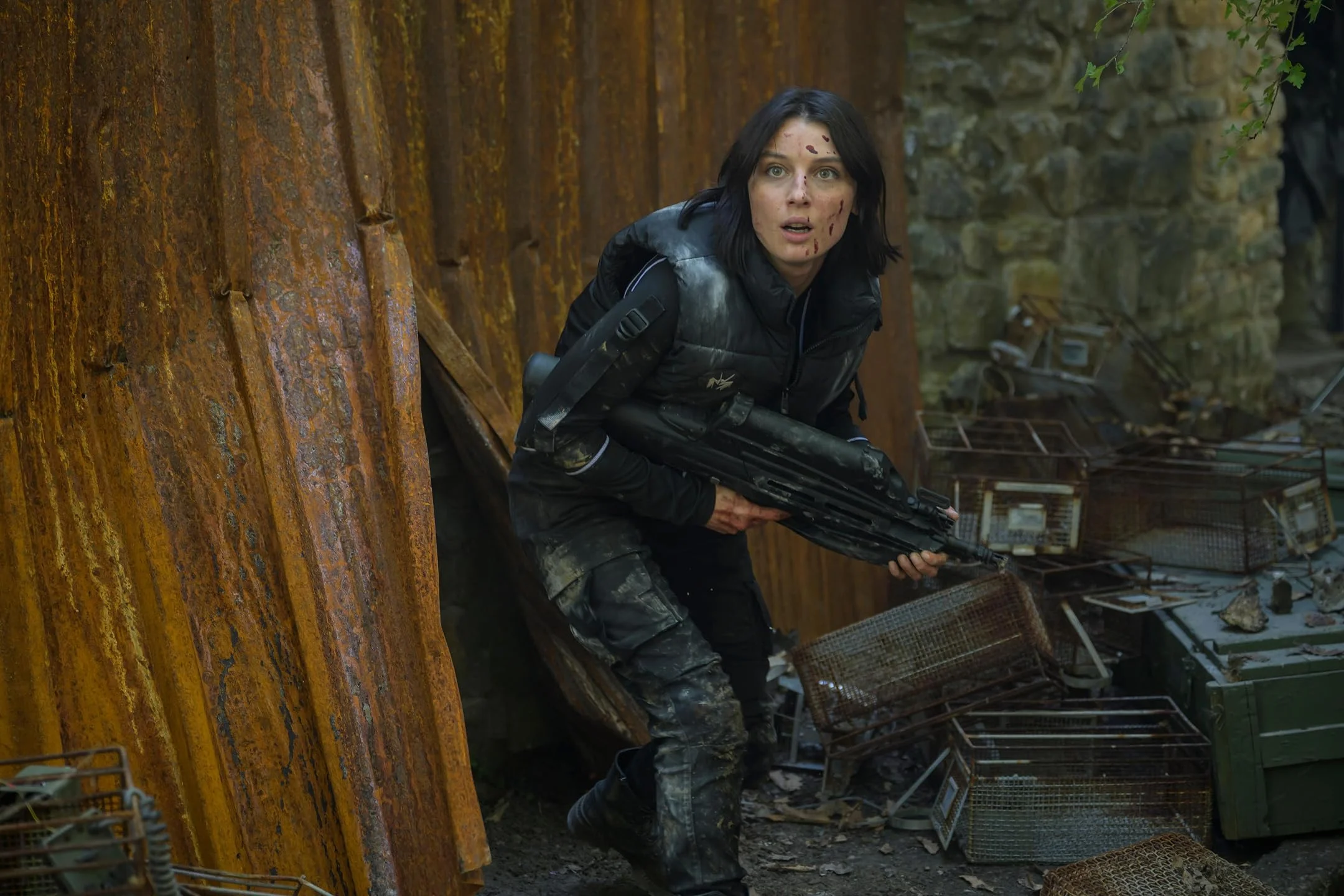
That arsenal should make it a fine mechanical slasher villain. Webber has effectively imported the pursuit logic of The Terminator and Predator into a smaller survival-horror production, replacing humanoid menace with an anonymous piece of hardware. Yet the machine never develops the personality its weaponry promises.
Part of the problem arrives immediately. The early military sequence reveals DRAGN clearly, establishes its murderous capabilities, and removes much of the uncertainty surrounding what waits in The Zone. Later, repeated surveillance shots show the group through the drone’s targeting system. The perspective looks suitably technological, but constantly showing the predator’s location makes several pursuits easier to read than they should be.
The practical design deserves some credit. DRAGN has weight and physical presence, and the surrounding forests make its artificial geometry look appropriately alien. Its relatively slow movement works against the illusion that this is an advanced autonomous hunter, particularly when the screenplay occasionally needs doors and basic obstacles to become serious tactical problems.
The aftermath of violence is often nastier than the attacks themselves. Gutted animals and mutilated bodies sell the history of The Zone, while the makeup effects create several convincingly ugly remains. For a machine equipped like a flying hardware store from hell, however, too many deaths happen away from the camera.
Disposable Employees
DRAGN becomes less interesting whenever its victims begin behaving strictly according to slasher tradition. Tom remains the sympathetic family man, with Paxton gradually replacing his early bafflement with increasingly frantic fear. His hidden attempts to stay connected with his daughter provide a clear emotional anchor, yet his family receives little characterization beyond giving him a reason to survive.
Daniel is similarly fixed in place. Bardem attacks the character’s ex-military aggression with enough enthusiasm to make the performance entertaining, especially during the campsite arguments where Daniel turns workplace resentment into masculine competition. Adele fares worse on the page. Krug has sharp comic timing, yet the character is repeatedly reduced to sexual jokes and judgment from the men around her. Her relationship with Sebastian quickly triggers one of the oldest slasher conventions, where sexual activity practically becomes an application for early death.
The dialogue exposes the screenplay’s tonal confusion. Characters witness grotesque evidence of DRAGN’s attacks, then continue discussing it like troublesome office equipment. The machine later fires off “You’re fired” while attacking Tom, briefly turning autonomous warfare into an HR gag.
Such silliness could work in a film willing to embrace full exploitation cinema. DRAGN keeps reaching instead for sincere technological anxiety, leaving both modes underfed.
Old Fears, New Hardware
The Serbian location gives Webber access to imagery that could have separated DRAGN from American killer-robot cinema. The Zone places contemporary corporate technology inside the remains of military history, producing a striking collision between natural isolation, industrial decay, and automated violence. Vladimir Ilic’s clean cinematography makes those spaces readable, while Alex Heffes’ score often supplies the menace missing from the drone’s movements.
The script has similarly useful material hiding underneath its slasher mechanics. Mantiz employees fear losing their positions. Their employer controls experimental technology inside a former military facility. Daniel treats employment as something worth fighting for. Later, survivor Zoja explains that DRAGN keeps learning and adapting, while its earliest experiences appear to have taught it cruelty through human behavior.
That idea approaches Frankenstein from the direction of machine learning. Humanity creates an intelligence, teaches it through violence, then recoils when the lesson sticks. It could connect contemporary automation fears with an older European tradition of stories about creators refusing responsibility for their creations.
DRAGN instead turns the idea into a blunt warning about mistreating AI. The sharper question concerns the people and institutions that built an autonomous weapons platform carrying bullets, poison, fire, and a buzzsaw, then apparently misplaced it in Serbia. The machine may be learning. Mantiz clearly is not.
DRAGN first debuted in the United States on May 10, 2025, and is available for streaming on platforms such as Amazon Prime Video. The sci-fi horror thriller follows a group of corporate employees on a remote team-building retreat who realize they are being hunted by a rogue artificial intelligence drone.
Where to Watch DRAGN (2026) Online










Full Credits
Title: DRAGN
Distributor: Cineverse
Release date: May 10, 2025
Running time: 1 hour 31 minutes
Director: Peter Webber
Writers: Barry Hutchison, Alex Lane, Alexander Gordon Smith
Producers and Executive Producers: Alex Lane, Oleg Shardin, Georgia Witkin, Alek Conic, Peter Webber
Cast: James Paxton, Lilly Krug, Carlos Bardem, Alice Pagani, Jadran Malkovich, Franz Drameh, Alex Lane, Anna Rust
Director of Photography (Cinematographer): Vladimir Ilic
Editors: Nikola Puric
Composer: Alex Heffes
The Review
DRAGN
DRAGN places a familiar killer-machine story in the Serbian wilderness, giving its corporate retreat and abandoned military zone a useful European texture. Peter Webber finds flashes of pulp pleasure in the practical drone, mutilated bodies, and Alex Heffes’ ominous score, yet the screenplay keeps reducing contemporary fears about autonomous weapons to old slasher routines. James Paxton brings nervous credibility to Tom, while Carlos Bardem enjoys Daniel’s abrasive swagger. The setting suggests an international techno-thriller with sharper political teeth. What arrives is a modest B-movie whose machine evolves faster than its ideas.
PROS
- Effective Serbian locations
- Convincing practical drone design
- Strong corpse and gore effects
- Bardem’s energetic performance
- Heffes’ menacing score
CONS
- Predictable slasher structure
- Thin character writing
- Clunky dialogue
- Weak AI commentary
- Drone POV drains suspense