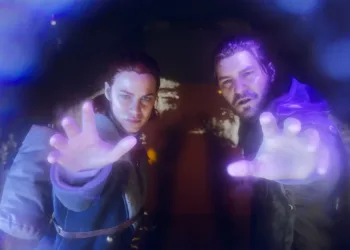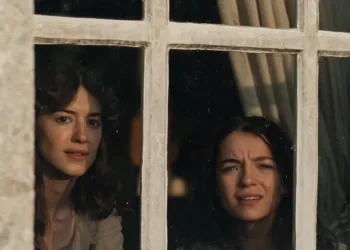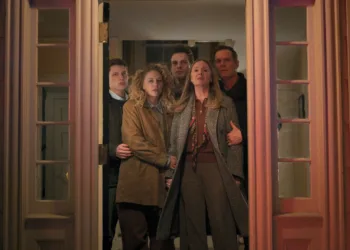

























Samuel Beckett trapped four people inside a room and let repetition become its own form of punishment. Alejo Moguillansky takes that dramatic machinery apart in Pin de Fartie, scattering pieces of Fin de Partie, better known in English as Endgame, across several relationships, locations, and layers of performance.
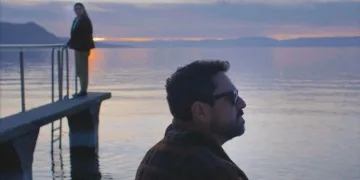
The clearest echo comes through Otto (Santiago Gobernori), a blind man living beside Lake Léman in Switzerland, and Cleo (Cleo Moguillansky), the young woman who guides him while absorbing his constant demands. Their exchanges borrow the rhythms of Hamm and Clov, filled with petty questions, irritation, dependence, and routines that seem capable of repeating forever.
Changing the setting makes a fascinating difference. Beckett enclosed his characters physically. Moguillansky puts Otto and Cleo beside an enormous lake and under wide skies. They can walk anywhere, yet their relationship keeps circling the same arguments.
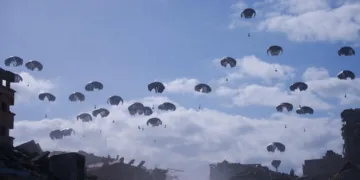
Loud aircraft passing overhead introduce hints of conflict somewhere beyond the frame, preserving the play’s apocalyptic unease without rebuilding its original room. The movie then cuts away and reveals people producing narration and Foley effects. Reality has already sprung a leak.
Couples Playing Parts
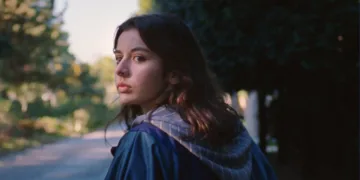
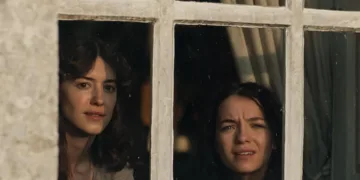
Pin de Fartie keeps asking what happens when two people recognize that somebody else may have written the shape of their relationship. Laura Paredes and Marcos Ferrante play actors who meet regularly in Buenos Aires to rehearse Fin de Partie. Their scenes initially seem straightforward compared with Otto and Cleo’s absurd sparring. They arrive, read, repeat passages, and slowly develop an attraction that neither can cleanly separate from the characters they perform.
That uncertainty gives these passages their emotional weight. A rehearsal normally creates distance between actor and role. Here, repetition erodes it. Their affection begins to feel suspiciously scripted, as if Beckett has reached through the pages and started arranging their gestures.
A stranger variation appears when Moguillansky himself plays the son of a blind pianist portrayed by Margarita Fernández. She asks him to read the play aloud, and he gradually notices uncomfortable similarities between their situation and Beckett’s characters. The film then takes one of its strangest detours when he discovers a tennis player who resembles him and has a Beckett quotation tattooed on his arm.
I like how little Moguillansky tries to rationalize this development. The coincidence feels like something the filmmakers stumbled across and decided was too strange to ignore. For a movie obsessed with predetermined structures, such accidents offer welcome disorder.
The Hands Behind the Curtain
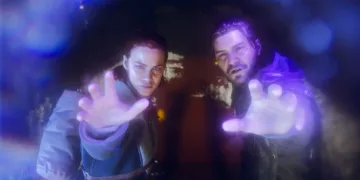
The recording studio provides the movie’s clearest explanation of its own storytelling method. Luciana Acuña narrates and rearranges events while musician Maxi Prietto converts ideas from the story into playful folk-inflected songs. We hear characters struggling for agency, then watch other people manufacture the sounds and words surrounding them.

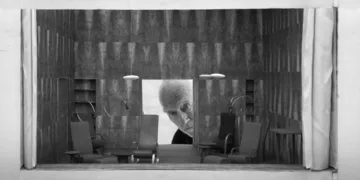
Moguillansky extends that idea through filmmakers manipulating toy trains, cardboard moons, and miniature scenery. These images turn authorship into a physical activity. Someone moves the train. Someone places the moon. Someone decides which character leaves.
That device can also become restrictive. The movie piles narration, literary references, repeated dialogue, songs, rehearsals, and stories inside stories into an elaborate construction. Viewers who know Endgame will immediately recognize the transformations. Anyone arriving without that reference point may spend stretches decoding the mechanism instead of feeling what happens inside it.
The recurring use of Beethoven’s Moonlight Sonata demonstrates both sides of Moguillansky’s approach. Fernández performs or revisits the piece until repetition changes its character. Something initially beautiful becomes familiar, then slightly oppressive. The music starts behaving like Beckett’s dialogue, circling until comfort and confinement become difficult to separate.
Dancing Near the End
The most joyful scene may also be the simplest. Otto and Cleo move together along the lakeside promenade, skipping in rhythm while the sunset burns behind them. After so much talk about dependence and exhaustion, their movement briefly breaks the pattern. The camera does not need another layer of narration to explain it.
That moment also reveals why the Swiss photography matters. The mountains and water do not function merely as pretty backgrounds. Their openness keeps mocking the emotional captivity of people who appear free to leave.
Moguillansky connects that captivity to contemporary Argentina as political references become increasingly direct. The film’s anxiety about endings begins stretching beyond individual relationships toward artistic and cultural survival. Cinema, theater, music, and performance become activities people continue practicing while institutions and circumstances around them appear increasingly unstable.
That makes Pin de Fartie fit comfortably within El Pampero Cine’s taste for structural experimentation. Its playfulness can become self-enclosed, especially when another Beckett quotation or narrative layer arrives before the previous one has fully landed. Still, scenes such as the hesitant rehearsals between Paredes and Ferrante, the tennis-player tangent, Prietto’s ridiculous songs, and Otto and Cleo skipping beside the lake keep puncturing the machinery.
Beckett’s characters wait for an ending they cannot control. Moguillansky keeps handing his characters opportunities to step sideways, miss their cues, fall in love, play Beethoven again, or simply keep moving while somebody else is still trying to write the scene.
Pin de Fartie premiered at the Venice Film Festival on August 30, 2025, with festival screenings continuing internationally. The Argentine feature serves as a playful cinematic remix of Samuel Beckett’s play Endgame, weaving together distinct character dynamics and theatrical rehearsals.
Full Credits
Title: Pin de Fartie
Distributor: El Pampero Cine
Release date: August 30, 2025 (Venice Film Festival)
Running time: 1 hour 46 minutes
Director: Alejo Moguillansky
Writers: Luciana Acuña, Alejo Moguillansky, Mariano Llinás
Producers and Executive Producers: Laura Citarella, Ezequiel Pierri
Cast: Santiago Gobernori, Cleo Moguillansky, Laura Paredes, Marcos Ferrante, Luciana Acuña, Laura López Moyano, Fernando Tur, Margarita Fernández, Alejo Moguillansky
Director of Photography (Cinematographer): Inés Duacastella, Tebbe Schöning
Editors: Alejo Moguillansky, Mariano Llinás
Composer: Maxi Prietto
The Review
Pin de Fartie
Pin de Fartie treats Endgame like material scattered across an editing table, then tests how many new relationships can emerge from the same dramatic pieces. Alejo Moguillansky’s switches between Otto and Cleo, the rehearsing actors, and the pianist with her son give Beckett’s repetitions surprising warmth, especially when dance, music, and strange coincidences interrupt the intellectual games. The construction can grow insular, particularly for viewers unfamiliar with the play, yet its best passages make adaptation feel mischievously alive.
PROS
- Inventive fragmented structure
- Strong Otto and Cleo chemistry
- Playful use of sound and music
- Beautiful Swiss lakeside photography
CONS
- Beckett knowledge helps considerably
- Meta-fiction can feel insular
- Some repetitions become exhausting