






















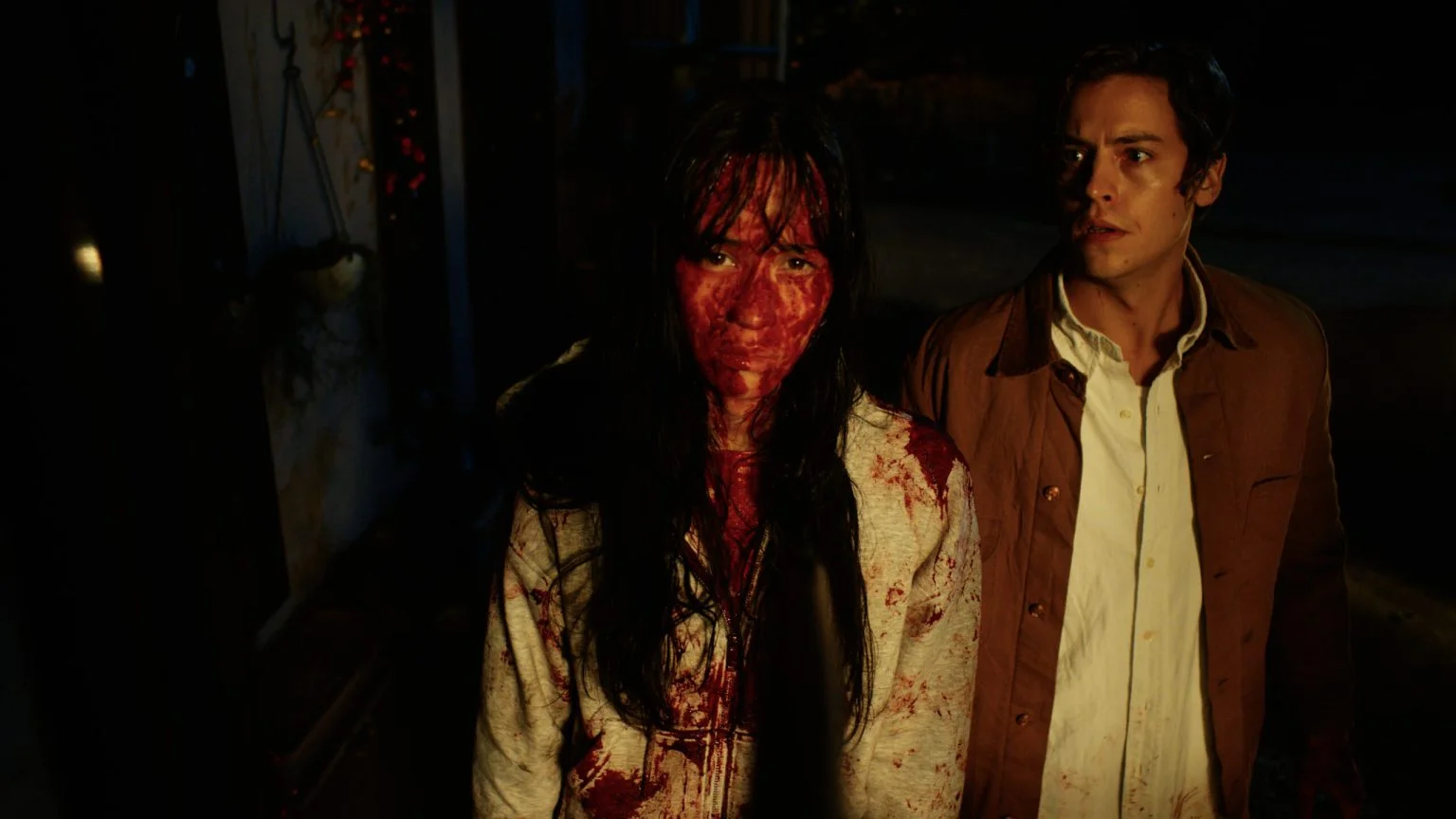

Carter runs through a crowded Tokyo shopping street with one clue to the whereabouts of his stolen phone: the music in his Bluetooth earbuds. As the connection breaks up and returns, he can judge his distance from the thief. Writer-director Eugene Kotlyarenko lets us hear that change along with him. The soundtrack becomes a way to follow the action, giving the audience a simple problem to solve in the middle of a frantic chase.
Other passages in Vintage Violence demand a different kind of attention. Split screens show an event from multiple angles, while livestream comments and messages compete with the people on screen. During Carter’s opening broadcast, the chat supplies pieces of his history almost faster than they can be read. I like the idea that his audience knows him through scattered remarks rather than a tidy introduction, though the speed makes some of those details easy to miss. The stolen-phone chase shows how clearly Kotlyarenko can direct our attention when he wants to.
Carter (Cole Sprouse) is an urban exploration livestreamer who discovers a cache of valuable vintage jeans during a broadcast. Izumi (Kiko Mizuhara), watching from Japan, contacts him with a plan to sell them there. Their messages and video calls turn the proposed deal into a flirtation before they meet. That quick movement from viewer to confidante gives the film its early momentum: Carter has reason to trust Izumi, and she has reason to keep him interested. Once he arrives with the denim, those reasons become harder to separate.
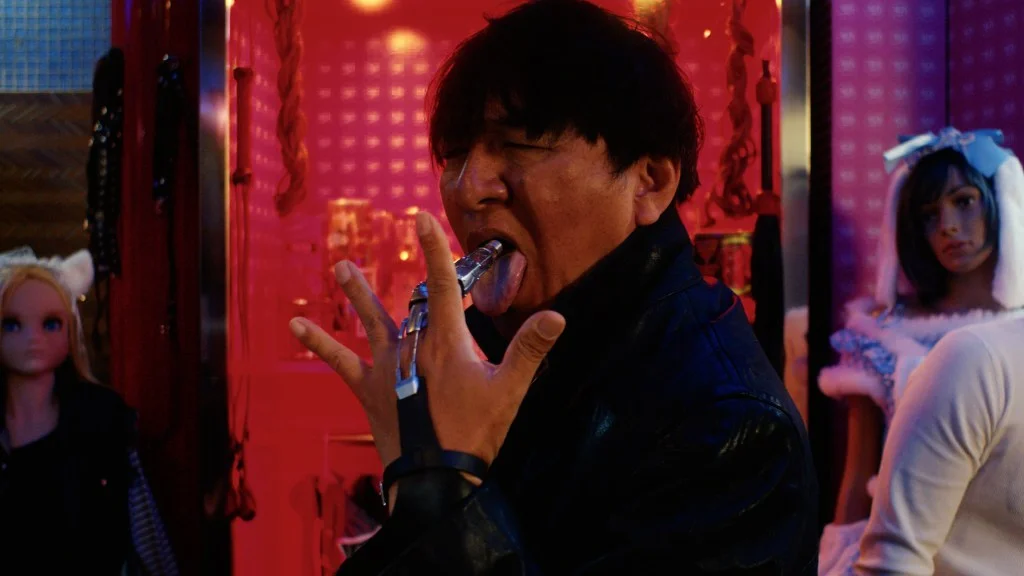
Hiro (Nijiro Murakami), Izumi’s boyfriend, has plans for the jeans too, and the bag’s disappearance draws Carter and Izumi into a dispute involving two yakuza figures. Edoga (Hio Miyazawa) prizes denim so extravagantly that he has covered a room with it. Ko (Pierre Taki) carries an older grievance against Edoga and a modified finger that makes him dangerous at close range.
The film keeps adding betrayals, pursuers, and gruesome complications. Some of these turns are funny precisely because everyone treats an armful of old jeans as a life-changing fortune. Keeping track of who has the bag can become less interesting than seeing what Kotlyarenko has devised for the next encounter.
Sprouse helps give that disorder a human scale. Carter’s comparatively steady reactions leave room for the gangsters’ theatrical threats to be amusing, and his interest in Izumi remains understandable after their online courtship.
Mizuhara brings enough warmth and quick thinking to suggest that Izumi’s attraction might be real even as she pursues the sale. Their scenes have a lively uncertainty, although some of Izumi’s decisions seem timed chiefly to deliver Carter into further trouble. The romance asks for an emotional trust that the plotting does not always allow them time to build.
Kotlyarenko is interested in what changes when an online relationship acquires physical consequences. From separate countries, Carter and Izumi can choose what to reveal through a message or a camera. In Tokyo, Hiro’s debts and the people pursuing the denim put pressures on their connection that neither can edit out. The film has a sharp premise for a romance there. Yet each promising pause between them is vulnerable to another interruption, so the distance between their first conversations and their later choices feels larger than the frantic pace admits.
Cinematographer Sean Price Williams follows the characters through crowded streets and confined interiors, while abrupt music cues and the noise of Tokyo keep the action in a near-constant state of motion. The split screens sometimes make that motion easier to grasp by showing how separate viewpoints meet.
At other times, the cuts arrive before an image or a joke has had much chance to register. The graphic violence has a similar rhythm: an outrageous injury can be startlingly funny, then another arrives before the first has settled. For a film moving this quickly, Vintage Violence can be surprisingly tiring.
Its play with Japanese gangster-film excess is part of the pleasure, especially when Edoga’s denim fixation gives the violence an absurd object. The recurring jokes about Carter being a foreigner are less inventive, and the cartoonish American embassy encounter stretches the same point further. Those scenes briefly make the film’s crowded approach feel repetitive: adding another insult or eccentric figure does little to change Carter’s predicament. Ko’s finger, by comparison, gives his history with Edoga a physical presence that can affect a scene the moment he enters it.
I kept thinking back to the earbud chase because its sound does so much with so little. Carter cannot see the phone, and every broken note forces him to listen and adjust his route. After a film spent showing us people distracted by other people’s feeds, there is something satisfying about watching him pay close attention.
Vintage Violence world-premiered in September 2026 at the Toronto International Film Festival. The mixed-media caper follows a disgraced American livestreamer who travels to Japan to sell a rare cache of vintage denim, only to cross paths with dangerous local Yakuza elements.
Full Credits
Title: Vintage Violence
Distributor: Toronto International Film Festival / Independent
Release date: September 2026 (Toronto International Film Festival)
Running time: 1 hour 45 minutes (105 minutes)
Director: Eugene Kotlyarenko
Writers: Eugene Kotlyarenko
Cast: Cole Sprouse, Kiko Mizuhara, Nijiro Murakami, Pierre Taki
Director of Photography (Cinematographer): Sean Price Williams
The Review
Vintage Violence
Vintage Violence is at its best when its restless style helps us follow the action, as in a chase guided by the sound of Carter’s Bluetooth earbuds. The split screens, quick cuts, and grotesque gangsters offer plenty to enjoy, though the film grows tiring when each new interruption crowds out the last. Sprouse and Mizuhara make the romance appealing; the plot gives it too little room to develop.
PROS
- Clever sound design in the stolen-phone chase
- Playful use of screens and livestreams
- - Appealing performances from Sprouse and Mizuhara
CONS
- Some details move too quickly to register
- Repeated interruptions weaken the romance
- - Foreigner jokes and embassy scene wear thin