






















Miku is Airi’s older sister, though she now looks younger. She died years ago and still appears at the age she was then, glimpsed in a car mirror or a darkened screen. Airi has continued to grow older with her sister beside her. Their conversations have an ease that makes the arrangement feel almost practical, provided you don’t think too long about what each woman can see in the other’s face.
I initially took that ease as a small act of defiance against the usual ghost story. Airi (Moeka Hoshi) does not regard the dead as intruders. Miku (Kurumi Inagaki) offers her company and advice while she travels Japan helping restless spirits move on. Yet the reflections put a visible limit on their closeness. Miku can speak to Airi from the other side of a surface; Airi cannot turn around and find her sister standing there. Dave Boyle lets them chat without insisting that every exchange become a lesson in grief, which makes the distance harder to dismiss.
Airi’s latest job takes her to an isolated former hotel owned by Teiko (Tae Kimura). Teiko has painted the spirit she claims to have seen there: a man with a terrible gap where his mouth should be. Her son Gunji (Kento Kaku) doubts Airi can help, while Miku senses enough to warn her away. Airi stays. She has dealt with ghosts before, and their needs, she believes, are usually easier to understand than the desires of living people.
Hoshi gives that belief a physical life. Airi is guarded around Teiko and Gunji, then remarkably comfortable on her own in the house. She makes food, plays music, drinks and dances. The corridors may be long and ominous, and the figure Teiko painted looks awful, but Airi behaves like someone who has finally been left in peace. Boyle holds the audience between her composure and the building’s warnings. We can see the shape of a haunting without being permitted the usual certainty about how frightened we ought to feel.
It would be easy to mistake her calm for perfect judgment. I did, for a while. Then Airi follows the spirit’s repeated path upstairs and finds him clawing at a cabinet. His frightening appearance tells her little about his purpose. When he grabs her during a visit to the spirit world and leaves a mark on her arm, the danger is real, but it still does not explain what he wants. Airi’s experience gives her a way to investigate; it cannot spare her from making assumptions about what she finds.
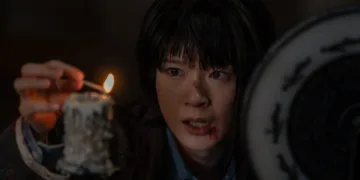
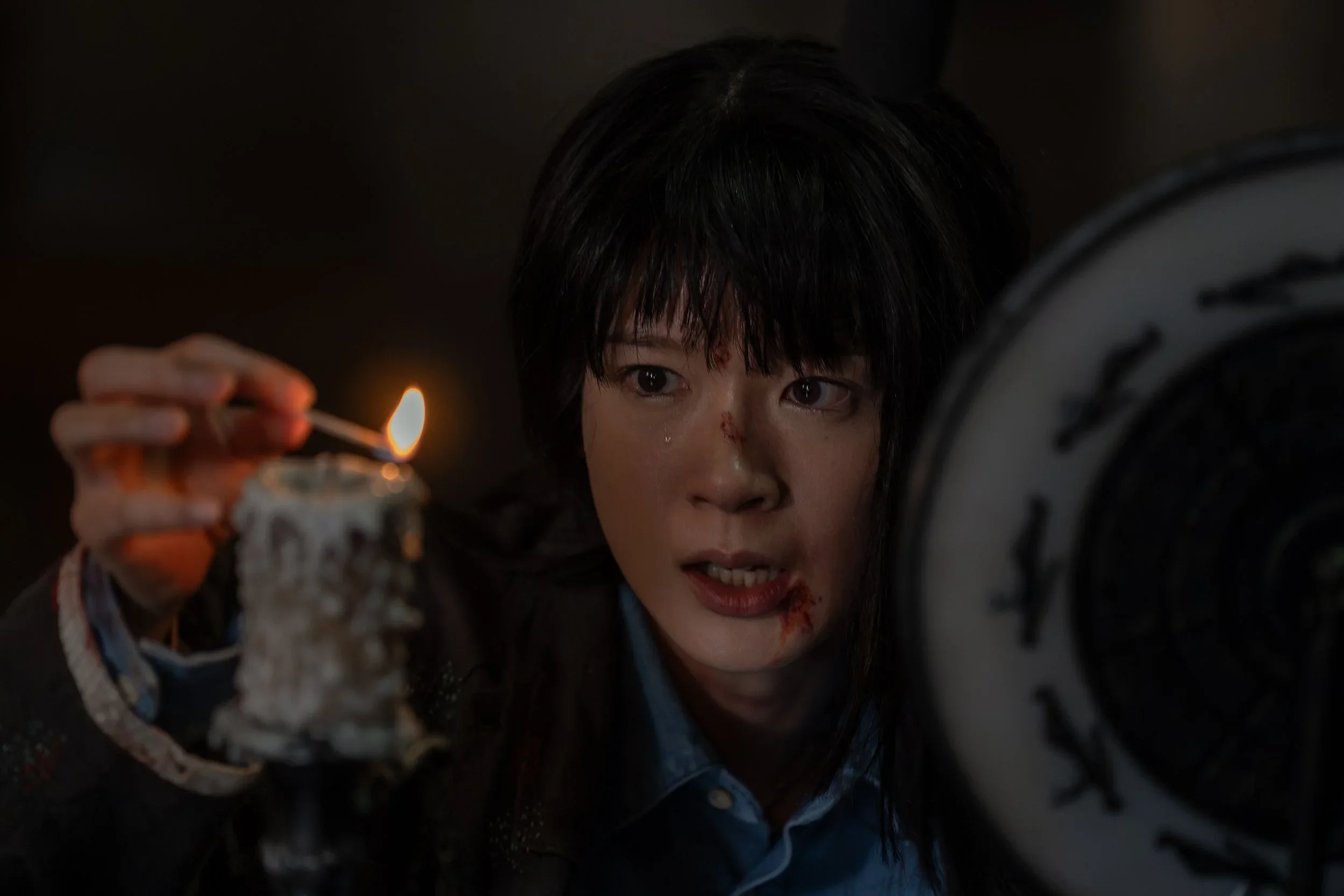
The film’s rituals make that distinction unusually clear. Airi uses a candle, a mirror, a lock of hair and a spinning device to cross the veil, then moves through the house while her body remains behind. The procedure has steps and limits, including her insistence on working during daylight. Each return to the other side feels like an inquiry she has chosen to undertake, with the risk of being unable to return given a tangible form. Elsewhere, a clock appears fixed while the spirit repeats his route. Time is behaving strangely throughout the house, but the most affecting example remains Miku’s unchanged face.
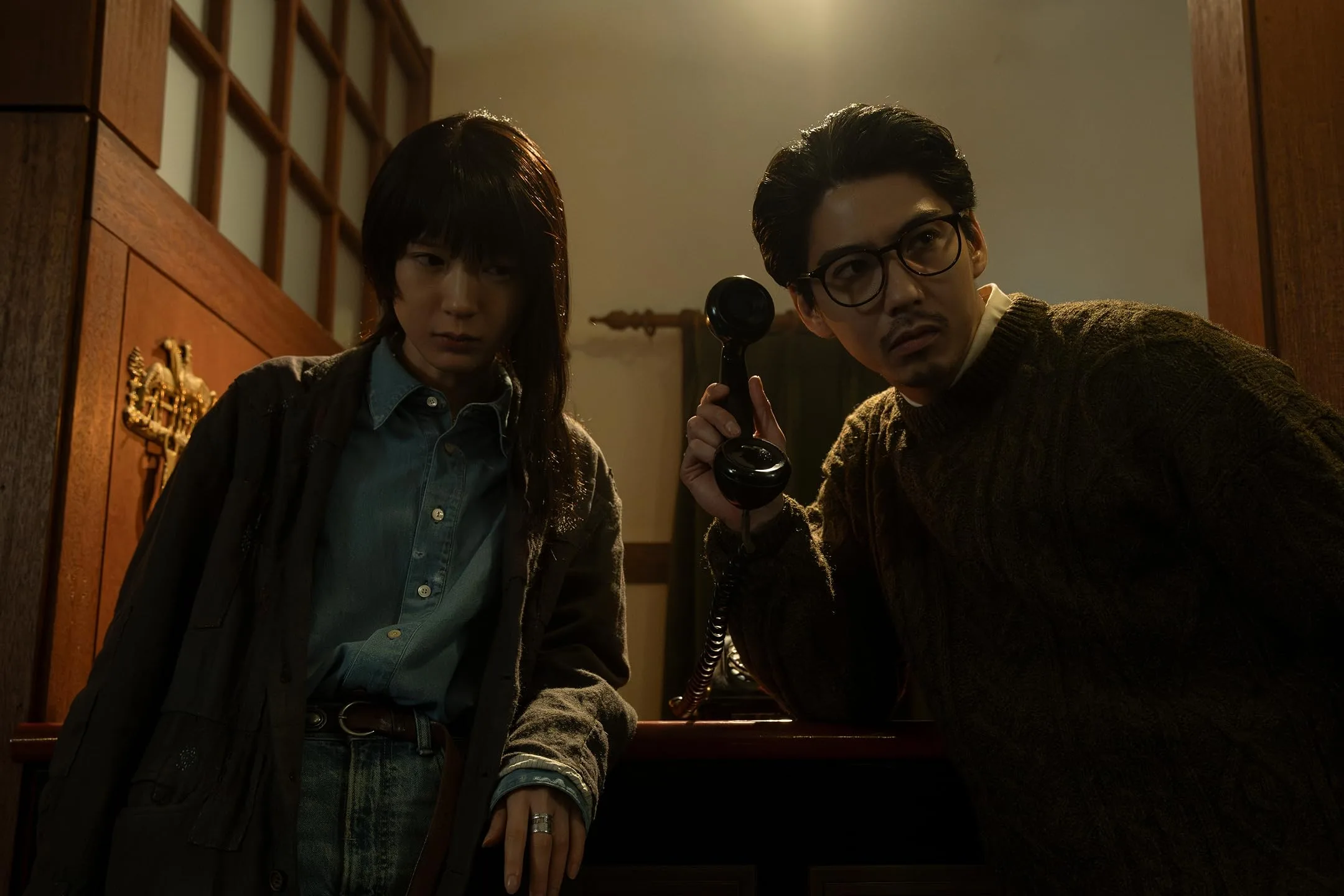
That thought needs testing, too. Airi’s bond with Miku is affectionate, and it would be cruel to reduce her sister to a symptom of an inability to let go. Miku warns her about the job, and their easy talk suggests a relationship sustained through years of ordinary companionship. Yet Airi appears most at home with someone who cannot share her present in full. Boyle leaves room for both truths. The sisters have found a way to remain together; that way has a cost neither can entirely see from her side of the glass.
As Airi investigates the house’s history, the question of whom to fear changes shape. Boyle first directs our attention toward a grotesque ghost, then asks us to reconsider the living people and past actions around him. Airi’s distrust of the living gains substance without turning the apparition into a harmless misunderstanding. His grip hurts her. His repeated attempts to reach the cabinet also ask for an explanation. The mystery is most absorbing while both facts remain unsettled, and the long corridors give her time to pursue a figure whose face seems to have answered the question before she has asked it.
The patience has a cost. Airi’s solitary drinking and dancing tells us something about how readily she makes herself at home in an empty building, but Boyle lingers long enough that her investigation briefly loses pressure. The later violence supplies a much sharper threat, at the expense of some of the uncertainty that made the first part so pleasurable to watch. Hoshi keeps Airi engaged and alert through that change. Still, the sisters’ conversational intimacy has done more work than the film’s account of Airi’s inner life, and the later demands on their bond expose the difference.
What stays with me is Airi’s willingness to return upstairs after seeing the mark on her arm. She knows by then that the dead can hurt her. She also knows that a wound is a poor explanation for why someone keeps reaching toward a cabinet.
Never After Dark is a supernatural horror-thriller written and directed by Dave Boyle, which premiered at SXSW 2026 before its theatrical release on September 25, 2026, by Magnolia Pictures. The film follows Airi (played by Moeka Hoshi), a wandering medium who guides restless spirits out of the living world, until a routine exorcism at an isolated country inn unleashes a terrifying entity that turns the living into her greatest threat.
Where to Watch Never After Dark (2026) Online

Full Credits
Title: Never After Dark
Distributor: Magnolia Pictures
Release date: September 25, 2026
Rating: R
Running time: 105 minutes
Director: Dave Boyle
Writers: Dave Boyle
Producers and Executive Producers: Dave Boyle, Kento Kaku, Kosuke Tsutsumi, Todd Brown, Aram Tertzakian, Nate Bolotin, Maxime Cottray, Toshiyuki Suzuki
Cast: Moeka Hoshi, Kento Kaku, Kurumi Inagaki, Mutsuo Yoshioka, Bokuzo Masana, Tae Kimura
Director of Photography (Cinematographer): Patrick Ouziel
Editors: Chieko Suzaki
Composer: Jonathan Snipes
The Review
Never After Dark
Never After Dark makes Airi’s confidence with ghosts both its pleasure and its question. Moeka Hoshi’s composed performance, the sisters’ conversations through reflections, and a mystery that asks us to look past a terrifying face give Boyle’s patient approach real force. The pace sometimes slackens, and the later violence narrows the uncertainty that made the investigation so absorbing. Still, Airi’s refusal to mistake danger for an answer stays with me.
PROS
- Hoshi’s quietly assured performance
- Affecting sisterly bond through reflections
- A ghost mystery that rewards closer attention
CONS
- Some idle stretches slow the investigation
- Later revelations reduce the mystery’s ambiguity
- Airi’s inner life needs greater depth near the end