



















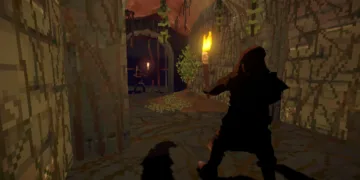
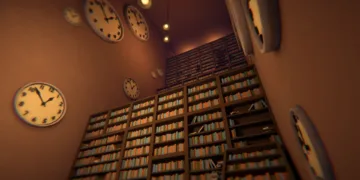

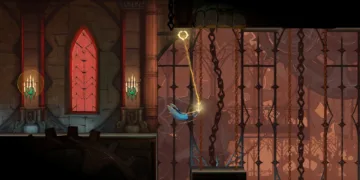



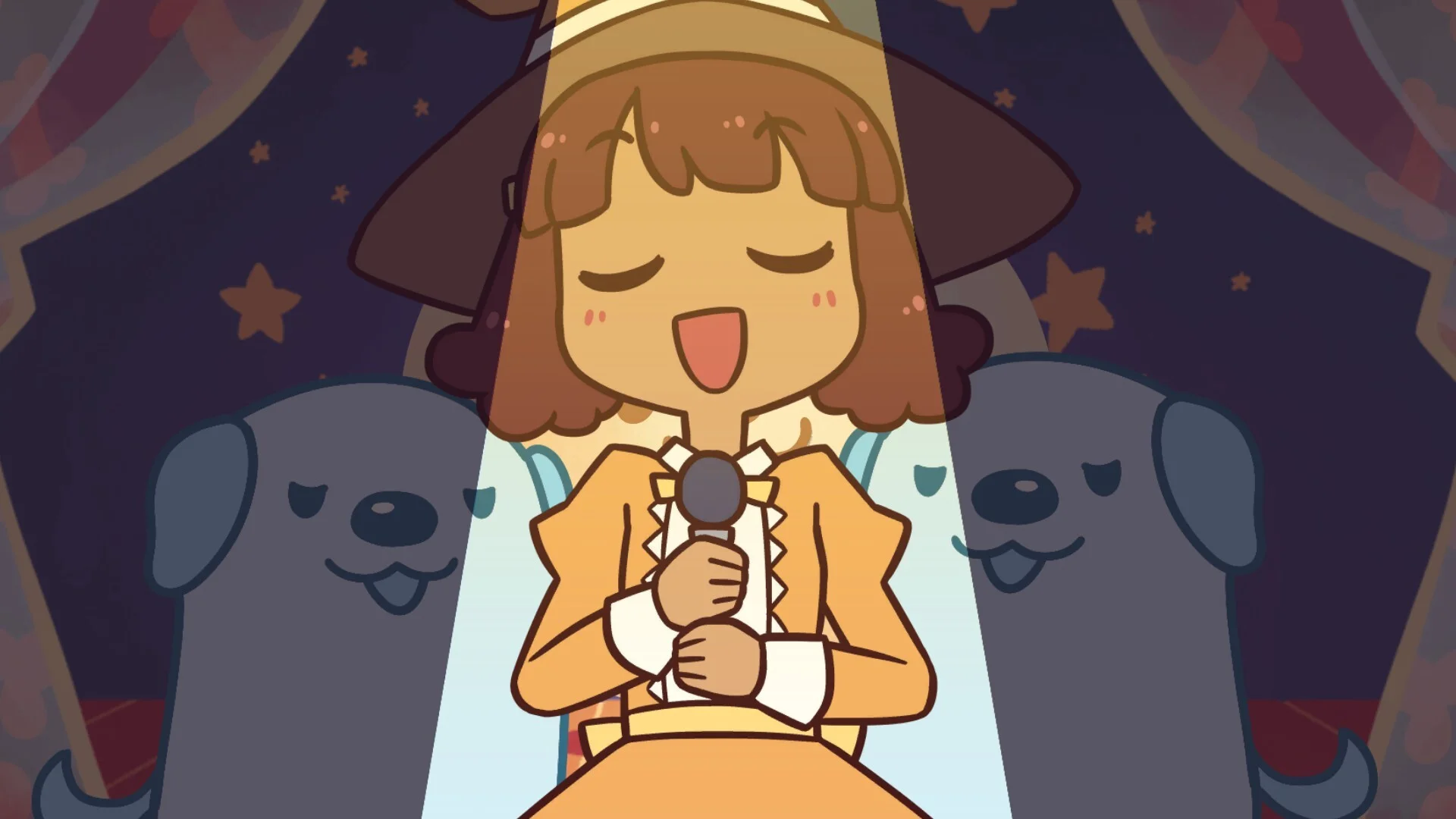

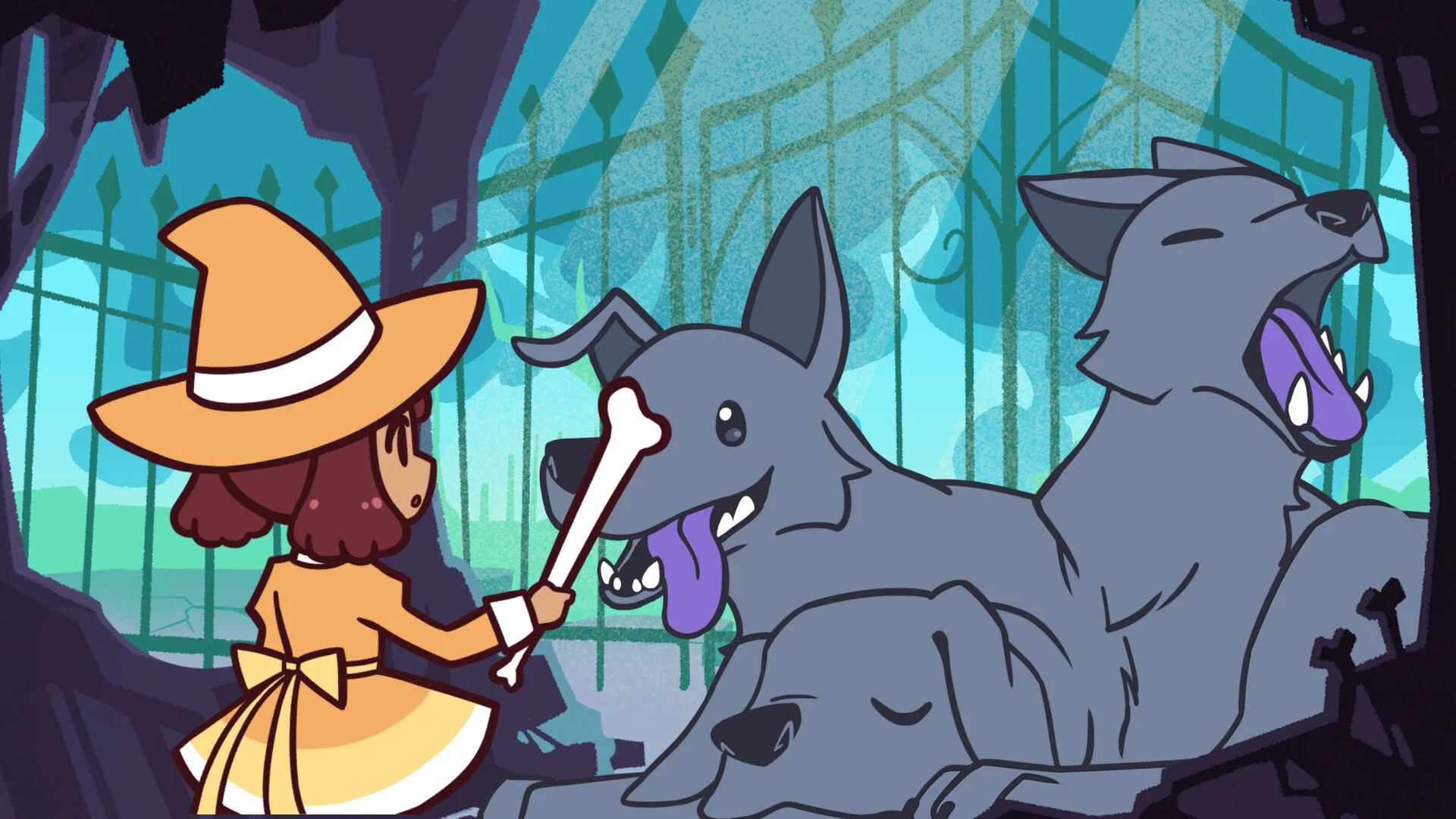
Trust in the Doggie Underworld is apparently measured by rhythm. Before Claire can search for her missing familiar, Pup, Cerberus makes her prove her credentials by playing with his three heads, each operating on a different wavelength.
One sleeps, one wants attention, and one treats gatekeeping like a serious profession. Passing their rhythm challenge establishes the rule that carries Puppergeist through its roughly hour-long campaign: if Claire wants a dog to trust her, she has to meet it through play.
That gives Serenity Forge’s rhythm and visual novel hybrid a clean mechanical foundation. Claire enters the underworld looking for Pup, meets a demon named Lunne, then travels through five compact areas populated by canine spirits. Each dog brings a story, an activity, and a rhythm challenge.
The format is simple enough to grasp immediately, which suits a game sold for around five dollars and designed to be finished in one sitting. Its brevity keeps the premise from wearing thin. It also means several systems disappear just when they seem ready to grow.
Keeping the Beat
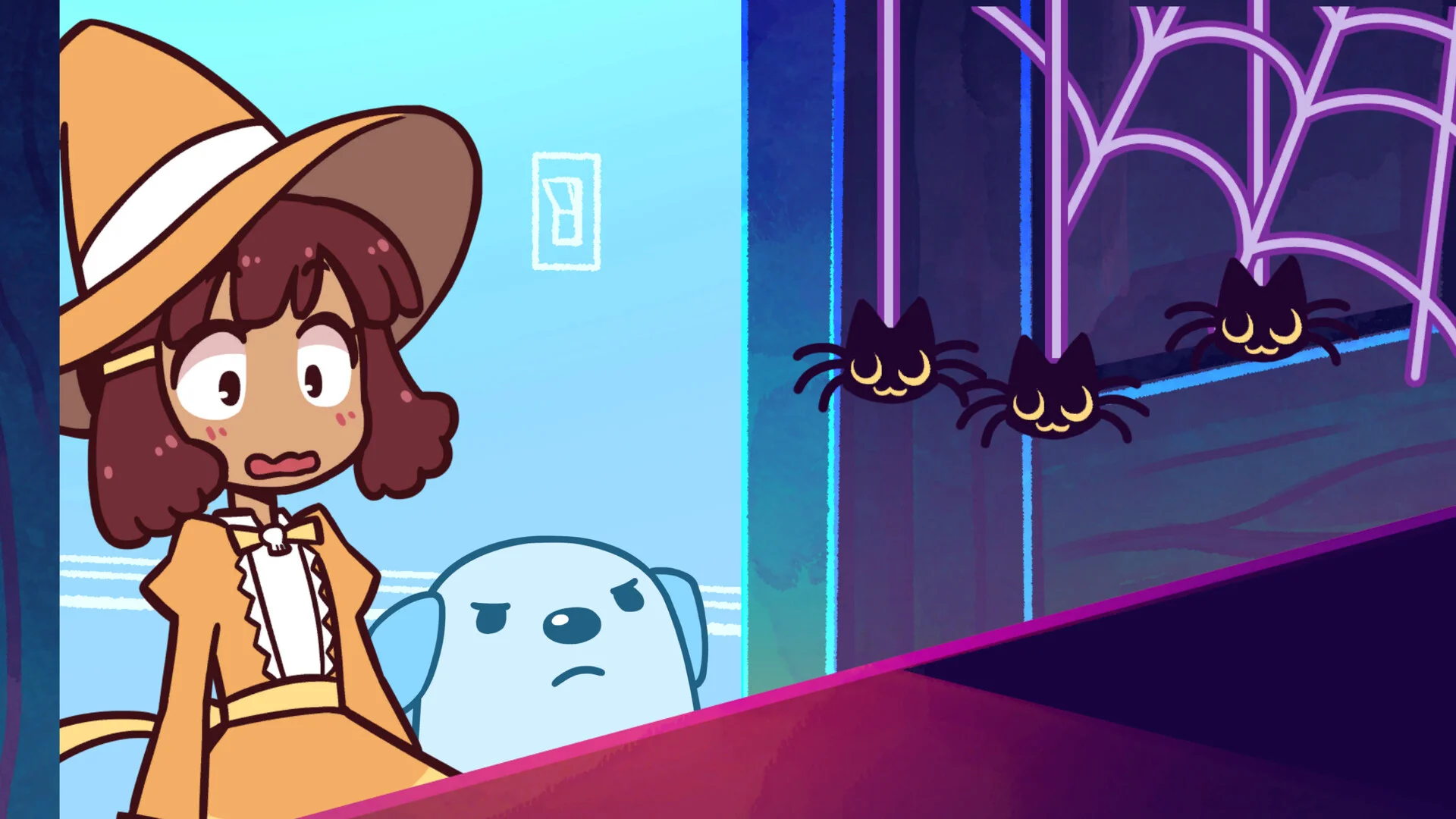
The smartest design decision in Puppergeist is connecting each rhythm pattern to something a dog might actually want Claire to do. Fetch asks you to react to balls arriving at different tempos. Tug-of-war follows a harder musical pulse, with barks and howls affecting the rhythm. Other encounters involve petting, grooming an unkempt coat, or dealing with mice and spiders.
Mechanically, these activities are variations on a narrow input vocabulary. You are still listening for timing and pressing buttons correctly. The presentation around those inputs changes enough that the same action rarely feels like the same task. That distinction matters in a rhythm game this small. Adding new buttons would create complexity. Changing the meaning of the button creates variety.
Each activity includes a tutorial, and skipping one is a bad bargain. Timing rules can change significantly between encounters, while some visual feedback is subtle enough that listening becomes essential. Latency calibration helps compensate for different displays.
The scoring system is equally sensible. Performances are graded from Woof through Good Boy to Top Dog, yet Good Boy is sufficient for progression. Players interested primarily in the story rarely have to grind against a troublesome sequence, while rhythm-game regulars have Top Dog rankings to chase.
Replay support is where the system loses some thoughtfulness. Completed mini-games can be revisited, but there is no convenient level-select screen. Reaching an early challenge from a later area requires walking Claire backward through the world. For a game whose principal optional objective is improving scores, making score chasing inconvenient is a strange little self-inflicted wound.
Every Puppergeist Has a Story
The rhythm mechanics gain weight from what happens between them. Several spirits Claire encounters do not fully understand that they are dead. The Doggie Underworld resembles a giant park, so running, playing, and waiting for their people can still feel normal. Claire gradually has to help them recognize what happened.
Others carry harsher memories. Cookie recalls neglect and her attempts to earn affection from an owner who would not give it. Her challenge is surrounded by cheerful cartoon artwork, yet her expressions and dialogue make the cruelty clear. Another dog needing its damaged coat trimmed turns grooming from a cute interaction into evidence of how it was treated while alive.
This is where the game’s mechanical structure pays off. Puppergeist could have delivered each backstory through dialogue and moved Claire forward automatically. Instead, it asks the player to perform a small act of care. Pet the dog correctly. Play fetch. Clean its fur. Match its rhythm. The inputs are uncomplicated, but they place participation between hearing a dog’s pain and resolving the encounter.
Claire is going through the same process from another direction. She believes she is searching for Pup, while every dog she helps makes her engage with separation and loss. Lunne keeps that progression from becoming relentlessly sad, with lighter exchanges giving Claire someone to bounce against during the quieter stretches.
The visual novel side has far less mechanical confidence. Dialogue proceeds on rails, with no meaningful choices about what Claire says, how she comforts a spirit, or how she investigates its history. Giving players a few consequential conversational decisions could have reinforced the game’s central idea of earning trust. Instead, narrative interaction mostly means pressing the button that reveals the next line.
Colour, Music, and Missing Space
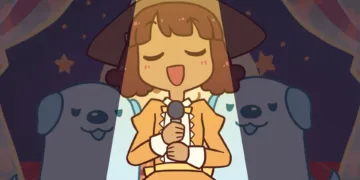
Serenity Forge keeps the underworld bright rather than macabre. Claire’s hair resembles dog ears, Lunne has a tiny horn and playful demonic design, and the puppergeists communicate much of their personality through oversized expressions. During one fetch sequence, Claire becomes visibly upset and the dog disappears into the background before returning to comfort her.
The animation turns a completed mini-game into a reciprocal gesture. Claire came here to help the dogs, and suddenly one helps her. The polish is inconsistent. A few movements, including one dog’s stiff jumping animation, look far rougher than the expressive sequences surrounding them.
Music does heavier mechanical work. Petting Fido comes with a playful rhythm, tug-of-war shifts toward rock riffs and drums, and the pest-clearing sequence adopts spookier instrumentation. Those changes give each challenge an audible identity before the input pattern has fully settled in your hands.
Five levels barely give that design room to escalate. There are no alternate characters to explore different rhythm abilities, no difficulty settings reshaping familiar stages, and little structure around high-score competition beyond replaying encounters. Lunne, especially, feels like an obvious candidate for a second playable moveset that never arrives. An hour is enough for Puppergeist to prove that playing with a dead dog can function as narrative interaction. It is barely enough time to discover what else that system could have done.
The Review
Puppergeist
Puppergeist turns a very simple rhythm loop into an effective emotional system. Petting, fetching, grooming, and tug-of-war work because each activity is attached to a dog whose history gives the input meaning. The forgiving Good Boy threshold keeps the story moving, while Top Dog scores offer light mastery for stronger rhythm players. Its weaknesses sit around that loop: dialogue has little agency, replaying earlier stages requires tedious backtracking, and the five-level campaign ends before its mechanics can properly develop. Still, the connection between play and grief gives this tiny game real purpose.
PROS
- Rhythm games tied to character stories
- Varied dog-themed activities
- Forgiving progression requirements
- Strong music-to-mechanic pairing
- Expressive hand-drawn presentation
CONS
- Very short campaign
- Minimal dialogue agency
- No convenient level select
- Uneven animation quality