





















The police encounter that sends Suleyman to prison gives the later raid in Attack on Paradise an awkward political inheritance. Before officers storm the apartment block where his mother lives, other officers have already treated him as a suspect on sight. Seven years separate those encounters.
For Suleyman, returning to his Antwerp home means discovering that criminal occupation has followed an earlier abuse of authority. The building belongs to Prince now, with armed subordinates controlling access to its floors. Bob Colaers places his protagonist between two forces accustomed to deciding where he may go, then gives him an objective neither institution particularly values: getting his mother to safety.
That positioning changes the familiar architecture of the siege film. In the Indonesian action landmark The Raid, the fortified apartment block is the destination of a police operation. Here, the police operation interrupts a homecoming. Suleyman knows the place through family attachment before he encounters it as a succession of hostile rooms.
The distinction matters because the building’s residents cannot simply regard an assault as liberation. Gunfire from either side threatens the woman he has come to see. The Antwerp setting gives this borrowed genre structure a specific social friction: a man criminalized through racist policing must survive both the criminal takeover of his home and the authorities’ attempt to reclaim it.
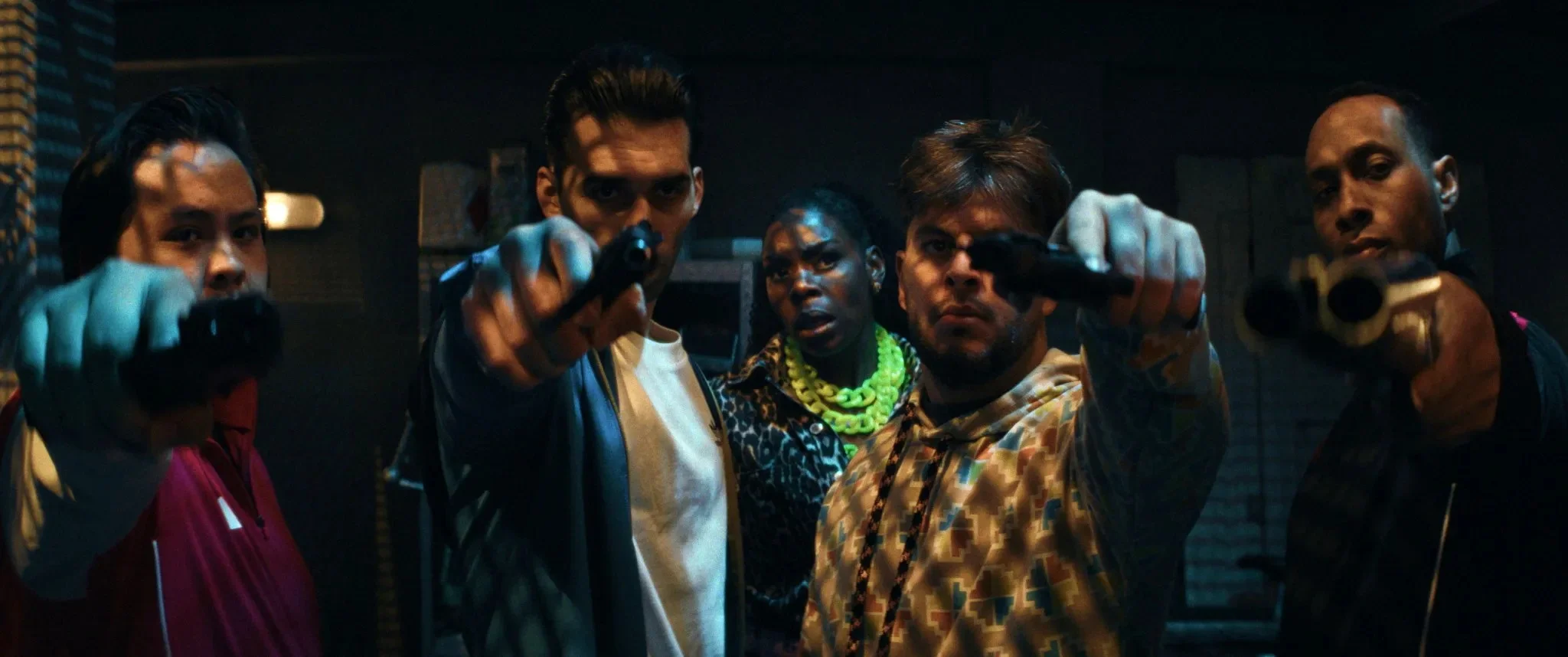
Saïd Boumazoughe, who also helped create and write the film, makes Suleyman’s return appealingly uncomfortable. His mother, played by Fatima Khanfour, moves from delight at seeing him to fury over his absence. The emotional turn refuses him the uncomplicated welcome an action hero might expect.
He has suffered, but she has spent those years without him. Boumazoughe’s sensitivity gives the exchange weight without immobilizing the film in regret. Her need for insulin then makes his obligation immediate and practical. Saving her involves the ordinary work of looking after someone, violently obstructed.
The partnership with rookie officer Yasmine is strongest when it stays close to that practical register. Clara Cleymans gives her professional determination a personal counterweight through the daughter established before the raid. Suleyman wants his mother safe; Yasmine wants Prince brought down and has colleagues’ doubts about her competence to contend with.
Their interests overlap without becoming identical. During pauses, conversations about his mother and her daughter give their cooperation something to rest on beyond the next armed opponent. The absence of a romance helps. They can recognize responsibilities in each other without the screenplay converting recognition into attraction.
There is still an unresolved tension in making a sympathetic officer the companion of a man introduced through police racism. Their mutual rescues can establish trust between these two people; they cannot retrospectively make his treatment an isolated misunderstanding. The film is more persuasive at the scale of assistance than reconciliation. Someone needs help, another person provides it, and the next decision becomes possible. In this respect, its multicultural Antwerp exists through relationships rather than a declaration of inclusiveness.
Once the ascent takes over, the building acquires a second cultural vocabulary: the successive encounters of an action game. Prince’s lieutenants divide the climb into recognizable challenges, with different physiques, weapons, and personal connections supplying changes in texture. Suleyman’s former lover complicates the opponent roster; Jamal Ben Saddik’s Lion supplies imposing physical force.
This resemblance to game levels is useful as a description of organization, without requiring a claim that the film adapts any particular game. Each new space promises another local problem. The limitation is equally familiar: progress toward the person at the top can become easier to anticipate than the individual fights.
The best environmental choices give that progression some comic resistance. A knife fight on a waterbed makes an unstable domestic furnishing part of the encounter’s identity. The fire-extinguisher incident, with resistance producing an accidental death, allows survival to look improvised and ungainly.
Elsewhere, night vision and an elevator-shaft route change how the building can be seen or traversed. These devices make the action enjoyable through circumstance rather than through an uninterrupted demonstration of superior technique. Suleyman can take punishment and find an opening, which gives Boumazoughe room to play exasperation alongside toughness.
Steven Vanvolsem’s colored lighting pushes the apartment block away from sober social realism, bathing its criminal interiors in conspicuous artificial hues. That stylization makes sense beside the exaggerated opponents and elaborate room-to-room obstacles.
Maxim Lany and Jonas Nuttin’s movement from ominous brass toward electronic propulsion supports the same transformation. A place introduced through deprivation and family attachment becomes an entertainment machine. The film’s pleasures depend on accepting that conversion, while its earlier scenes give us reasons to remain uneasy about it.
Prince embodies both the pleasure and the restriction of this approach. Achmed Akkabi’s reactions when the Lion destroys an opponent are funny because he appears to claim ownership of someone else’s strength. The boss’s authority briefly looks like a performance maintained by the bodies around him.
Yet the lieutenants’ conspicuous traits can leave him less memorable than the obstacles protecting him. A crowded criminal hierarchy supplies encounter variety without necessarily supplying dramatic depth. As the ascent continues, the neighborhood that matters to Suleyman increasingly contracts into a collection of dangerous rooms.
The protagonists’ injuries create a related problem at the level of the body. Boumazoughe and Cleymans communicate fatigue, but the punishment they survive often has little practical effect on what they can attempt next. Exaggeration belongs comfortably in this film’s comic action register; the difficulty comes from the urgency established elsewhere.
His mother needs insulin because a body has limits that affection cannot negotiate away. Suleyman’s own body is granted much looser terms. Each further recovery makes her predicament feel less connected to the physical rules governing the man trying to reach her.
Paradise premiered at the Fantasia International Film Festival in July 2026 before its theatrical release across Belgium and the Netherlands in September 2026. Directed by Bob Colaers, the gritty action-thriller follows a former convict named Suleyman whose attempt at a fresh start is violently derailed, plunging him into a brutal underworld conflict.
Full Credits
Title: Paradise
Distributor: Kinepolis Film Distribution (KFD), Independent Films, Blue Finch Films Releasing
Release date: July 19, 2026 (Fantasia International Film Festival), September 17, 2026 (Belgium & Netherlands)
Rating: 16
Running time: 1 hour 36 minutes (96 minutes)
Director: Bob Colaers
Writers: Saïd Boumazoughe, Sven Huybrechts, Salahdine Ibnou Kacemi
Producers and Executive Producers: Yves Van de Paer, Kobe van Steenberghe, Hendrik Verthé
Cast: Saïd Boumazoughe, Clara Cleymans, Achmed Akkabi, Fatima Khanfour, Jamal Ben Saddik, Soroush Helali, Salahdine Ibnou Kacemi, Imanuelle Grives
Director of Photography (Cinematographer): Steven Vanvolsem
Editors: Brian Ent
Composer: Maxim Lany
The Review
Paradise
Attack on Paradise gives the siege thriller a persuasive Antwerp identity through Suleyman’s fraught homecoming and uneasy alliance with Yasmine. Boumazoughe and Cleymans make family responsibility worth caring about, while improvised violence supplies welcome comic energy. The climb becomes predictable, Prince struggles to rival his lieutenants, and injuries lose their power to threaten. Still, the film finds personality in the distance between reclaiming a building and protecting someone who lives there.
PROS
- Antwerp setting meaningfully reshapes the siege formula.
- Family exchanges ground the central performances.
- Environmental action makes room for inventive physical comedy.
- Suleyman and Yasmine build credible, practical trust.
CONS
- Severe injuries carry limited consequences.
- Prince is overshadowed by his lieutenants.
- The floor-by-floor ascent becomes predictable.