




























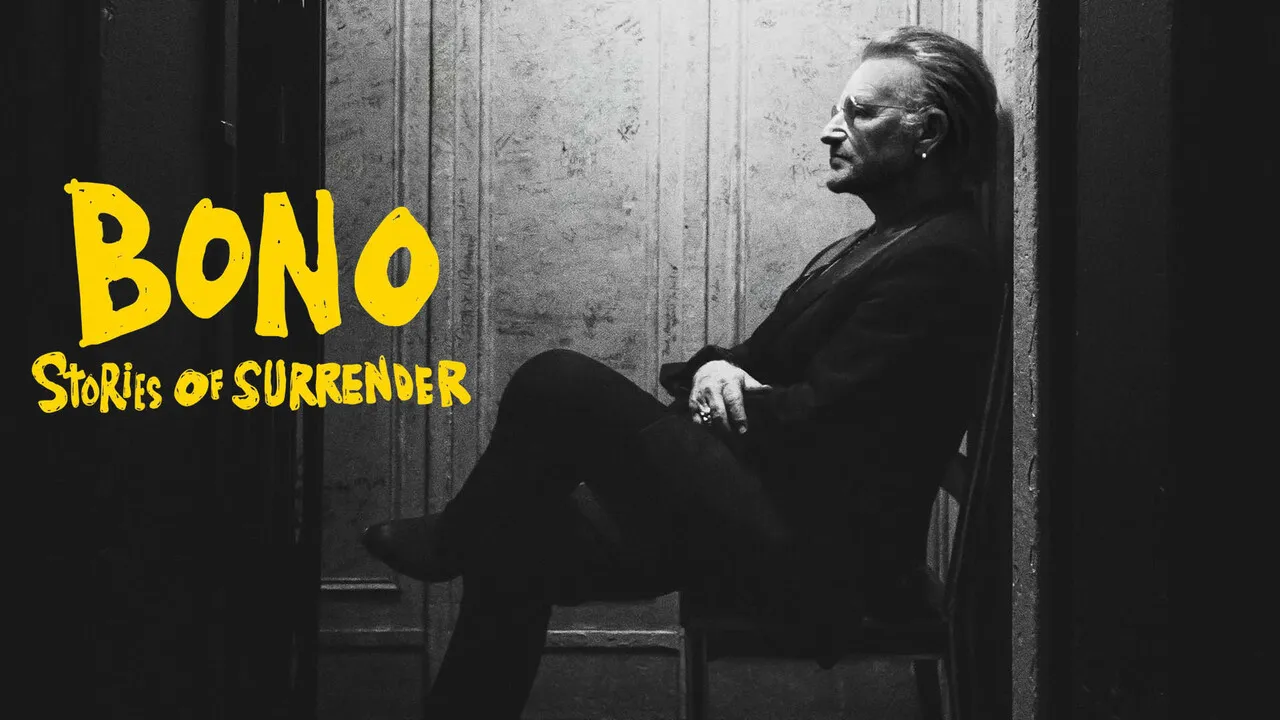

In its arresting black-and-white palette, Bono: Stories of Surrender unfolds as a solitary confession given theatrical weight. The film captures the stripped-down essence of Bono’s one-man stage show, where spotlight and shadow trace the contours of a life lived in pursuit of meaning.
Adapted from Surrender: 40 Songs, One Story, this filmed performance first took shape at New York’s Beacon Theatre. There, Bono transformed memoir pages into spoken-word sequences, punctuated by pared-back renditions of U2 anthems. The transition from intimate theater to cinematic medium hinges on director Andrew Dominik’s discerning eye and Erik Messerschmidt’s sculptural lighting. Their collaboration shifts a bare stage into a philosophical arena, inviting viewers to ponder mortality, ambition, and the silent spaces between confession and art.
At its core, the film promises an inward gaze: an invitation to witness an artist confronting his own myths. Monologue and melody entwine in a sparse setting—just a microphone, a table, a handful of chairs—each object charged with memory. As Bono navigates grief, fame, and conviction, the camera lingers on the moment his voice falters, reminding us that even legends are haunted by uncertainty.
Sculpting Silence in Light and Shadow
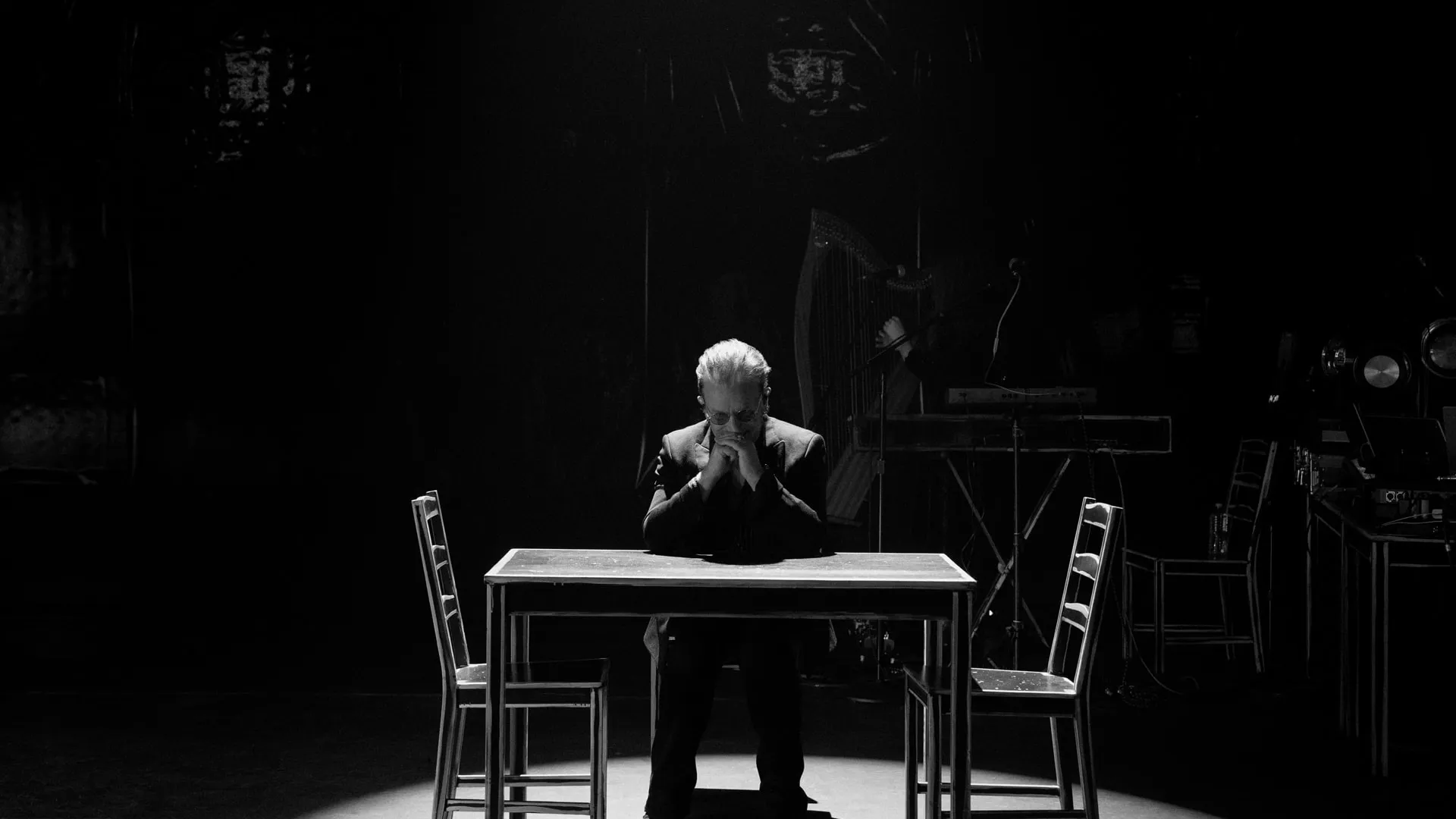
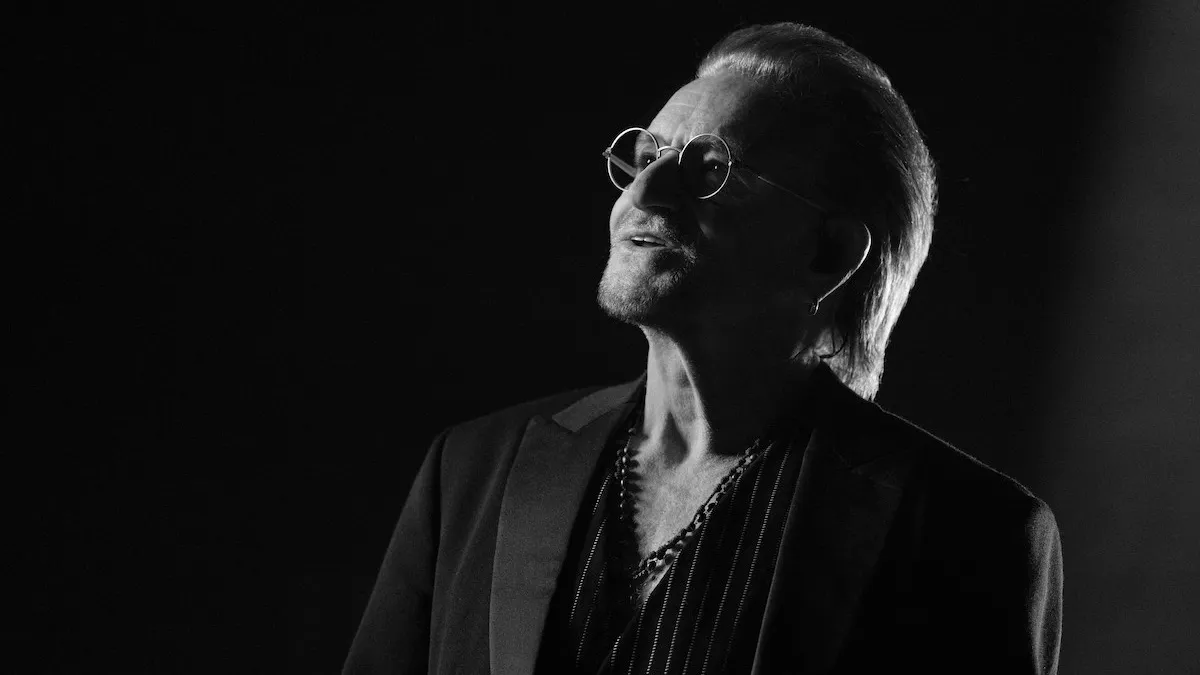
Andrew Dominik’s visual strategy carves Bono’s presence from darkness, transforming bare stage into an arena of introspection. Photographed in stark black-and-white, the film employs high-contrast lighting to trace muscle and bone, casting Bono as both subject and specter. At times he dissolves into silhouette—an echo of Kierkegaard’s notion that the self is forever half-hidden—while shafts of brightness sketch the contours of confession. Each chiaroscuro interplay whispers of mortality and memory.
The camera’s gaze shifts with purpose. During moments of intimate revelation, static close-ups draw us into Bono’s interior world: the tight frame tightening our own pulse. When recollections expand—childhood grief, brush with death—Dominik retreats to wide shots, allowing the geometry of table, chairs, and empty space to become silent interlocutors. Editing rhythm mirrors the mind’s uneven heartbeat: measured cuts linger on a faltering breath, then accelerate as music rises, echoing Nietzsche’s dance between Apollonian form and Dionysian abandon.
Theatrical machinery steps beyond mere ornamentation. Overhead rigs glow like constellations, LED panels pulse in sync with narrative beats, punctuating revelations as if the cosmos itself conspires in Bono’s story. What might read as stagecraft instead feels like ritual: light as lexicon, shadows as questions.
Dominik doesn’t simply film a performance—he elevates the minimal into mythic, where every glint of metal or flicker of bulb underscores the tension between artifice and authenticity. In this sparsely furnished realm, lighting rigs assume dramatic agency, guiding eyes and emotions through corridors of doubt and desire. Here, cinema becomes meditation, each shot inviting us to wonder whether the boundaries between performer and observer ever truly exist.
Memory’s Contours on an Empty Stage
The film begins with a pulse—Bono’s own, laid bare by the revelation of a heart-valve scare. In that “All That Jazz” moment, vulnerability detonates the myth of invincibility. It is an invitation to ponder finitude: when life’s fragility becomes a catalyst for confession, every subsequent story carries the gravity of mortality.
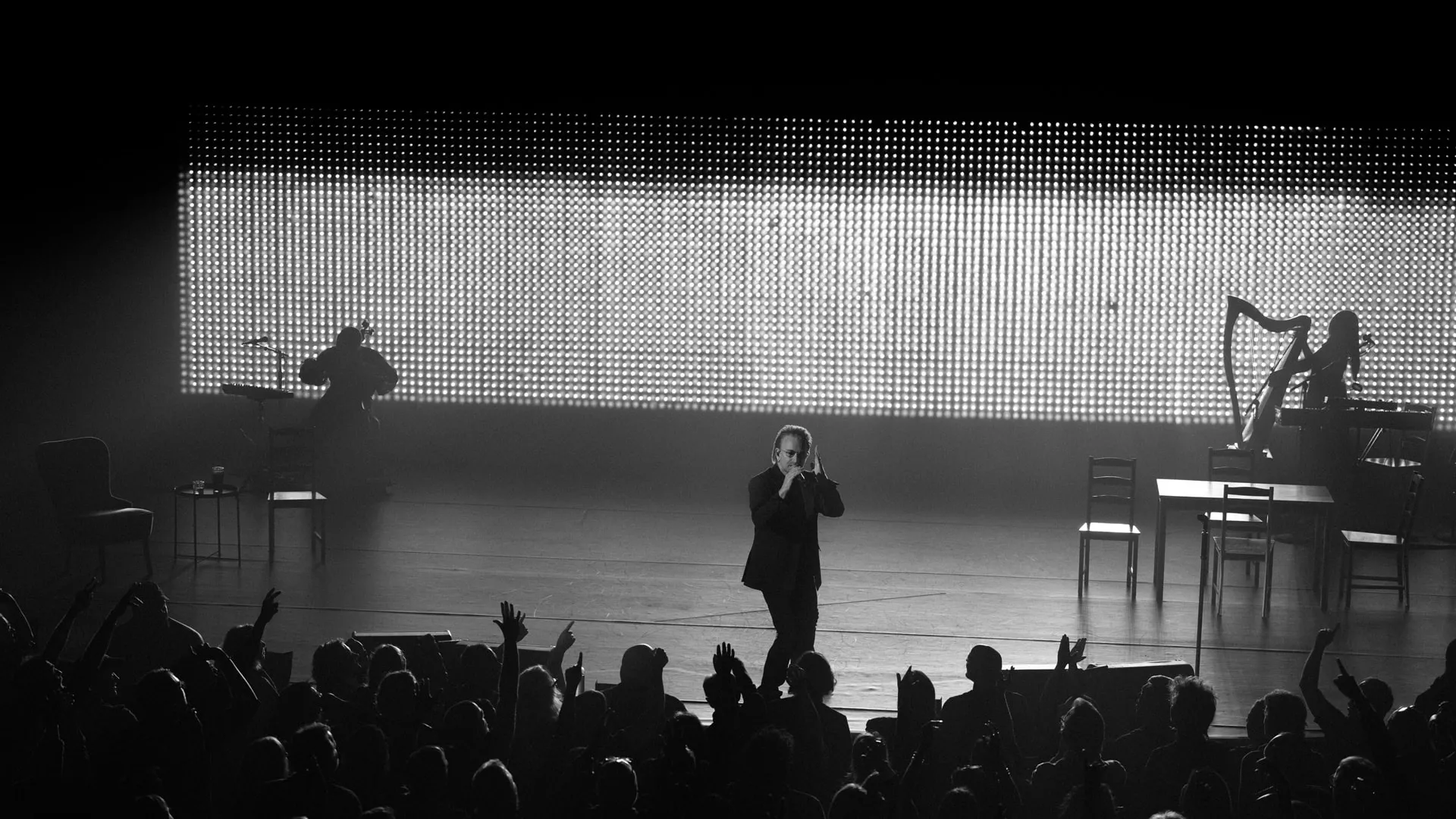
From here, narrative threads unravel into childhood’s shadowed corridors. At fourteen, he loses his mother—an absence that echoes like a question without an answer. The empty chair opposite him morphs into the specter of Iris Hewson, her sudden departure casting a long, cold silence over his psyche. In his father’s presence, words falter. Reenacted dialogues with Bob Hewson reveal ritualized tension: perfunctory questions, veiled reproach, love concealed behind stoic reserve. One imagines Sartre’s gaze meeting the other, each refusing to fully disclose the self.
Then the genesis of U2 emerges as collective defiance against that silence. In a rehearsal room thick with possibility, Bono’s impassioned riff on a PI LTD record sparks The Edge’s reply—a raw, cascading guitar line that births “I Will Follow.” Three chairs become avatars for bandmates—Mullen, Clayton, Evans—silent witnesses to a shared dream. Their emptiness underscores the paradox of collaboration: together yet alone.
Midway through, the spotlight shifts to Bono’s grown self wrestling with the ethics of influence. His advocacy for famine relief and debt forgiveness collides with whispers of performative charity. He names his own hypocrisy, then leans into it—prompting us to ask whether motive or outcome defines moral worth. In this half-lit chamber, activism becomes an existential experiment: can sincerity survive on a stage? Uncertainty lingers in every pause, every creaking chair—a reminder that the story we tell others is also a story we must face within.
The Geometry of Presence
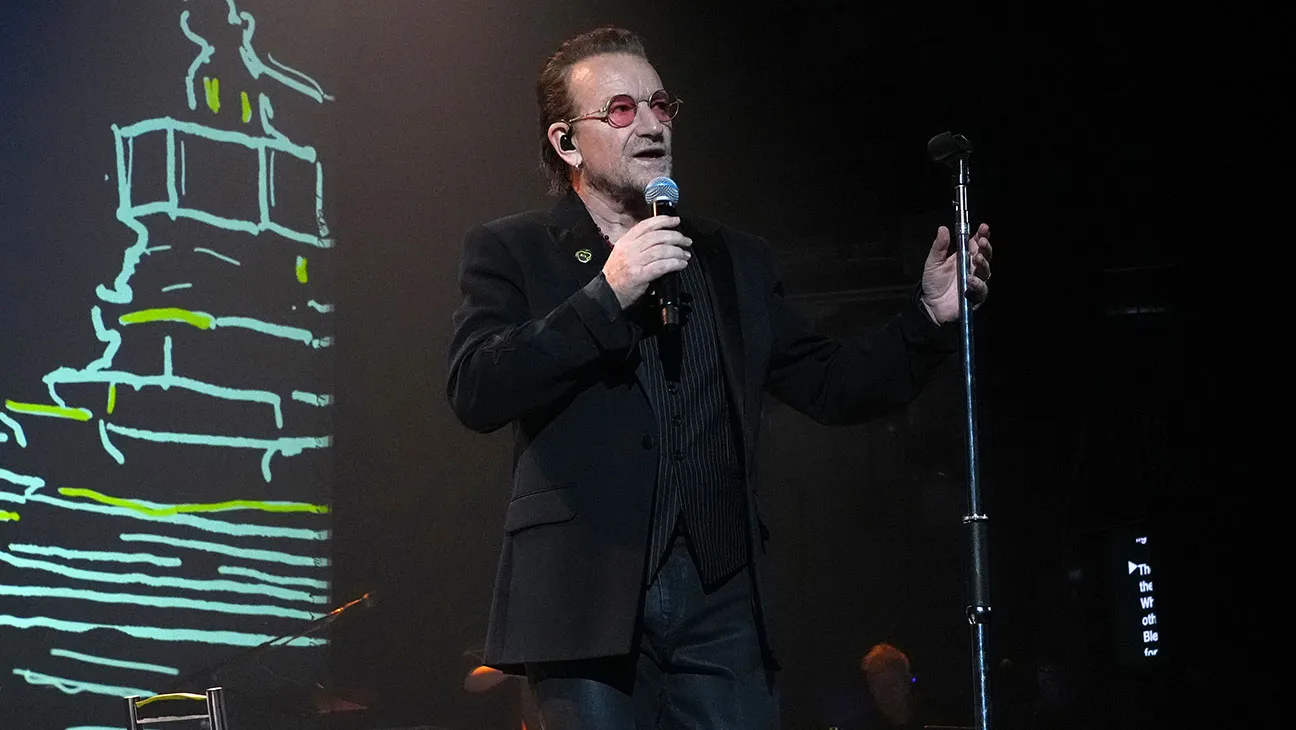
A lone table and five chairs sit like relics on an otherwise empty stage, each furnishing charged with memory’s weight. They become altars for recollection—one holds the specter of a lost mother, another the silent counsel of a father, the rest standing in for comrades in sound. A solitary microphone stands sentinel, its slender silhouette a reminder that every confession here must pass through a single throat.
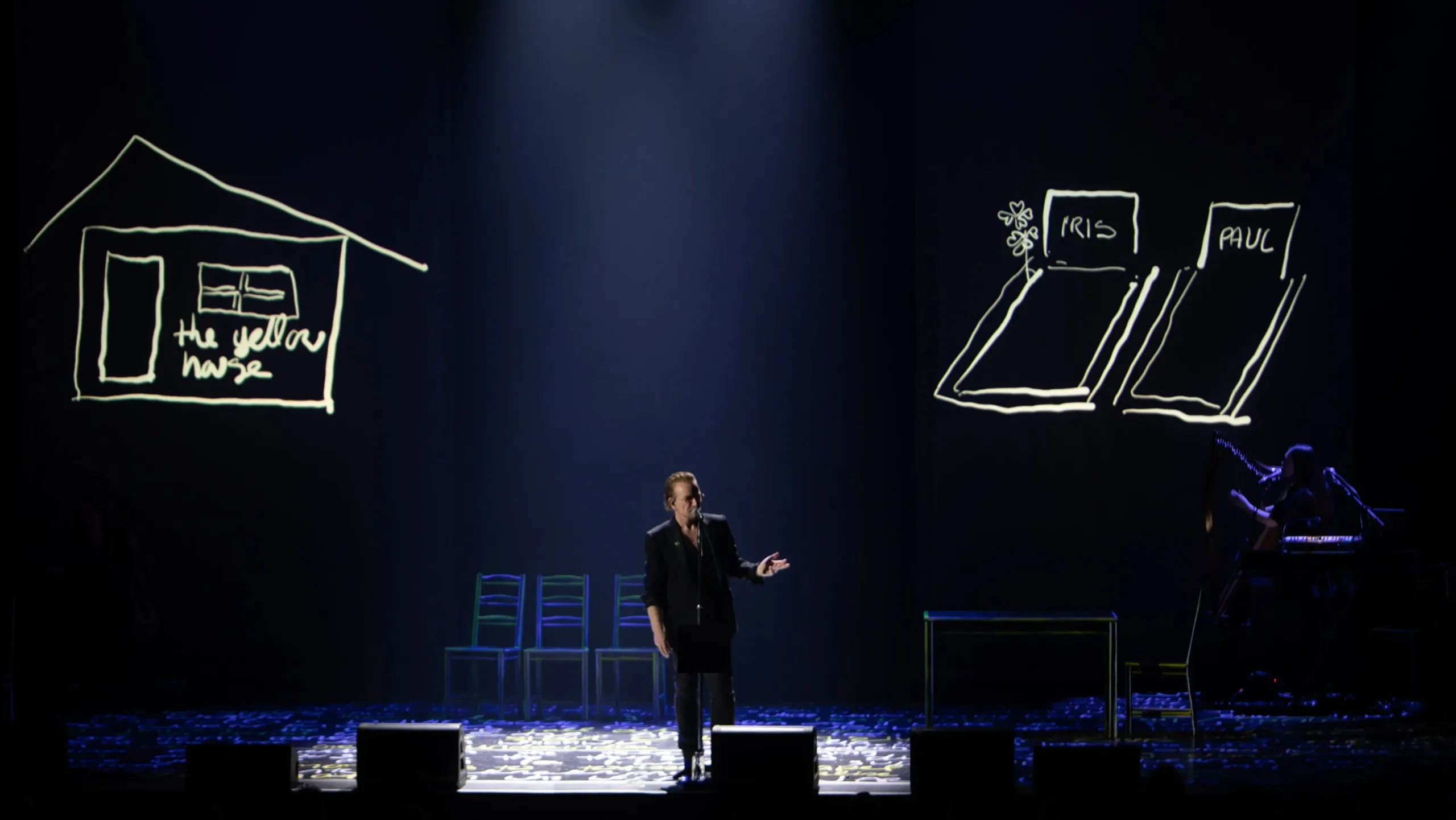
Against this skeletal tableau, supporting musicians emerge as tonal architects. The cello’s low lament weaves around Bono’s voice, anchoring confession in gravity. Harp arpeggios shimmer like distant stars—fleeting yet essential—while keyboards punctuate emotional beats with crystalline clarity.
At times, a percussive hint from behind the LED backdrop underscores a moment of unease, like a heartbeat in the dark. Visual interplay between singer and ensemble unfolds with choreographed subtlety: a glance toward the cellist, a nod to the keyboardist, binding each note to human presence.
Bono often breaks the fourth wall, leaning into the audience’s gaze with a conspiratorial smirk or a wry aside. His direct addresses—questions cast like stones—invite us to catch them, to toss them back in silent reply. Humor surfaces unexpectedly: a self-deprecating quip about navel-gazing here, a playful mimicry of an operatic legend there, dissolving tension so that vulnerability can seep through the cracks. In this calibrated minimalism, stagecraft and heart merge, rendering the void between performer and observer strangely intimate.
Echoes of the Unspoken
Bono’s set list unfolds like a catechism of yearning. Opening with “Vertigo,” he harnesses its restless riff to signal disquiet—a reminder that certainty can spiral into vertigo itself. “Pride” follows, its familiar chant reframed as a question: what does conviction demand when memory bleeds grief? By the time “With or Without You” drifts across the stage, nostalgia yields to raw inquiry, each stretched note asking: can love endure absence? “Sunday Bloody Sunday” closes this canon of confession, transforming collective history into a mirror for personal scars.
Stripped-down arrangements underscore these revelatory arcs. Cello lines slither through “Pride,” their mournful resonance a subterranean pulse beneath Bono’s voice. Harp flourishes in “With or Without You” shimmer like fractured glass—beautiful yet cutting. Subdued percussion taps like a distant heartbeat, propelling each song without overwhelming its fragility. The effect echoes Heidegger’s notion that music reveals Being in its temporal finitude: each note both arrives and vanishes, marking our passage through time.
Vocally, Bono veers between plaintive restraint and impassioned release. Phrases linger in the air, as if testing the weight of confession before letting go. In “Sunday Bloody Sunday,” a single sustained vowel stretches across the auditorium, fracturing collective memory into individual resonance.
These interludes do more than punctuate monologue; they illuminate it. When Bono recounts his mother’s sudden death, the cello’s low moan drapes his words in elegy. After describing his advocacy’s moral paradox, a simple piano motif emerges, suggesting both regret and resolve. Familiar melodies thus gain new tributaries of feeling—where once they galvanized stadiums, here they trace the contours of an inner landscape scarred by loss and longing.
The Ache of Becoming
At the heart of Stories of Surrender lies a tremor of self-questioning. Bono’s memoir-turned-monologue becomes a crucible for identity, each anecdote forging a link between past and present. He stands at the threshold between the self he fashioned under stadium lights and the private soul he still seeks. Like Camus’ Sisyphean hero, he pushes the boulder of legacy uphill, only to watch it roll back under public expectation. That persistent tension—between crafted persona and fragile individual—echoes through every confession.
Loss carves deeper lines in Bono’s narrative. His mother’s death at fourteen bleeds into his music’s marrow, an absence that became both muse and wound. The empty chair for Iris is not mere prop but monument to longing. His father’s silence, too, becomes a murmur in the background, spurring ambition born of need: to be seen, to be heard. Their barbed exchanges unfold as Oedipal ritual—an uneasy dance of reproach and yearning. In this dynamic, vulnerability and drive entwine, suggesting that creativity often sprouts from relational fractures.
Yet the film’s most unsettling inquiry concerns altruism’s shadow. Bono labels himself “hypocrite,” confessing that philanthropy can become a mask rather than a mission. He grapples with the paradox of intent versus impact: does the purity of motive matter if hunger is relieved?
This admission fractures the viewer’s comfort, stirring questions about performative compassion. Here, activism and artistry converge in existential crucible—where sincerity and spectacle blur, and we’re left wondering whether true empathy exists outside the search for self-redemption. In these thematic undercurrents—of identity, of mourning, of moral disquiet—Stories of Surrender becomes a meditation on what it means to become.
Between Vaulted Arches and Whispered Confessions
In place of thunderous arenas, Stories of Surrender opts for hushed proximity. The shift from U2’s cathedral-like stadiums to a modest stage recalibrates our expectations: here, vulnerability trumps volume. Every crack in Bono’s voice becomes audible revelation, each faltering phrase a testament to fragility. The stripped-back format wields a quiet power, as if the glow of a single bulb can pierce the soul more effectively than a thousand lights.
Emotional chords resonate unevenly, striking both seasoned devotees and curious newcomers. A fan who once chanted “With or Without You” under a night sky may now find the song’s slow unraveling stirring fresh ache. Someone unfamiliar with Bono’s mythos might catch the pulse of grief that underlies his anecdotes—an ache unbound by celebrity. Shared human themes—loss, longing, the quest for atonement—surface in moments when music and monologue intertwine, pulling us into spaces we seldom admit.
This section—with its emphasis on lighting, set, and thematic through-lines—serves as a compass for any writer approaching the film. It outlines how intimate staging counters grand spectacle, where emotional beats land, and which narrative guideposts anchor interpretation. In doing so, it ensures that even without direct exposure to the original performance, a critic can navigate the work’s cinematic impact and forge a connection between artist and audience.
Full Credits
Director: Andrew Dominik
Writer: Andrew Dominik
Producers: Jon Kamen, Dave Sirulnick, Dede Gardner, Brad Pitt, Jeremy Kleiner
Executive Producers: Bono, Jennifer Pitcher, Kelly McNamara, Lasse Järvi
Cast: Bono, Jacknife Lee, Kate Ellis, Gemma Doherty
Director of Photography (Cinematographer): Erik Messerschmidt
Bono: Stories of Surrender premiered on May 30, 2025, on Apple TV+ and is also available in Apple Immersive Video format on Apple Vision Pro, marking the first feature-length film released in this format.
The Review
Bono: Stories of Surrender
Bono: Stories of Surrender transforms memoir into meditation, revealing cracks beneath the rock-star façade. Its spare staging and thoughtful pacing invite genuine intimacy, even as moments of self-conscious performance remind us of the artifice beneath confession. Though its philosophical depths occasionally feel rehearsed, the film’s stark imagery and heartfelt musical interludes cast a lingering spell.
PROS
- Intimate glimpse into Bono’s psyche
- Striking black-and-white visuals
- Poignant, stripped-down musical moments
- Poetic, self-reflective narration
- Minimalist staging that heightens focus
CONS
- Occasional sense of performative artifice
- Limited variation in staging visuals
- Pacing dips in extended monologues
- Reliance on well-known hits over rarities
- Philosophical depth sometimes skims the surface







