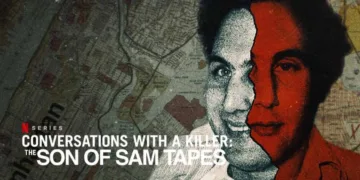































In the vast and ever-churning content library of streaming television, the true-crime docuseries has become a genre unto itself, complete with its own predictable beats and audience expectations. The latest entry into this canon, Conversations with a Killer: The Son of Sam Tapes, arrives with a familiar premise but a uniquely chilling artifact at its center.
The series chronicles David Berkowitz’s murderous rampage across New York City during 1976 and 1977, a period when the city’s spirit was already frayed. Its narrative engine is a set of unsettling audio recordings from 1980, wherein journalist Jack Jones interviews the killer. These tapes promise direct access into a disturbed mind.
Berkowitz’s seemingly random attacks on young people, often in parked cars, injected a potent strain of paranoia into a metropolis already grappling with its own decline, turning every lover’s lane into a potential crime scene.
The Banality of Male Rage
The series hinges on the disquieting experience of hearing David Berkowitz describe his own atrocities. His voice is not that of a raving monster but of someone calmly, almost bureaucratically, recounting a series of choices. This rational tone is profoundly more disturbing than any theatrical villainy, forcing a confrontation with the true nature of his violence. The documentary constructs a psychological portrait rooted in familiar, almost archetypal, pathologies of male violence.
We are guided through a childhood fractured by the discovery of his adoption and a deep-seated resentment toward women, which he connects to his biological mother. The series successfully argues that a life of perceived slights and simmering inadequacy curdled into a homicidal rage that demanded an audience.
This exploration of toxic masculinity feels both specific to its time and uncomfortably resonant today. Berkowitz becomes a case study in the danger of the quiet, unassuming man, the person whose most terrifying quality was his sheer ordinariness. This depiction challenges our cultural desire for monsters to be easily identifiable.
He was the postal worker next door, a fact that speaks to contemporary anxieties about the violence that can fester behind a facade of normalcy. Moments of internal contradiction, like when he decided to help a stranded couple he had planned to murder, reveal a man pathologically twisted around a need for positive validation, a flicker of humanity that makes his subsequent actions even more horrifying.
A City as Character and Crucible
The documentary wisely expands its lens beyond the killer to capture the crumbling social fabric of 1970s New York City. Through grainy archival footage and stark photography, the series portrays a city teetering on bankruptcy, riddled with crime, and stewing in a potent brew of civic anxiety. This landscape of decay was not merely a backdrop; it was the fertile ground in which public fear took root and flourished, a physical manifestation of institutional failure.
The police investigation is shown as a flawed, frustratingly human endeavor, hampered by a lack of inter-precinct coordination and technology. The series subtly critiques the police culture of the era, where detectives describe female victims first by their beauty, a detail that underscores a pervasive, casual misogyny. The true turning point, however, was not police work but Berkowitz’s own intervention.
His taunting letters to the press, particularly to columnist Jimmy Breslin, transformed him from an anonymous shooter into the mythic “Son of Sam.” The series expertly dissects how the media, locked in a circulation war, helped construct the very monster that haunted the city’s headlines, turning public terror into a marketable commodity. This feedback loop between killer, press, and public created a spectacle of fear, a dark chapter in the history of American media that set a precedent for decades to come.
The True-Crime Formula and Its Unsettling Echo
Director Joe Berlinger employs a polished and now-standard toolkit for this kind of production, one that defines the Netflix true-crime aesthetic. The narrative is a slick, propulsive blend of the core audio tapes, archival news clips, moody reenactments, and reflective commentary from the original detectives and survivors. The reenactments are used with restraint, serving to build atmosphere rather than to explicitly depict the violence.

While effective, this polished packaging of real-world horror raises questions about how the genre conditions us to consume tragedy as entertainment. The series’ structure, cutting between Berkowitz’s 1980 confessions and the chronological terror he unleashed, creates a steady rhythm of dread that mirrors our modern, fragmented way of processing information.
By centering the killer’s voice, the documentary walks a fine ethical line, risking the marginalization of his victims. It gestures toward their stories but remains fundamentally anchored to the man who took their lives. The inclusion of a 2024 phone call with a now-elderly Berkowitz adds a strange, regretful coda. Is it a moment of genuine reflection, or the final, pathetic bid for relevance from a man whose entire identity was built on infamy?
The series offers no easy resolution, instead presenting the killer’s self-serving narrative and leaving the viewer to grapple with its authenticity. It is a quiet reflection on our own consumption of these stories and the chilling reality that evil often speaks with a deceptively rational voice.
Full Credits
Director: Joe Berlinger
Producers: Gareth Ahrens, Deryck Broom, Gabriella Gallus, Ganeesh Genus, Laura Diana Macleod, Justus McLarty, Emma McNamara, Anthonie Scholtz, Zakia Smith, Tim Young
Executive Producers: Bill Badgley, Joe Berlinger, Bud Brutsman, Heidi Burke, Jen Isaacson, Jon Kamen, Rachael Profiloski
Cast: Jack Jones, Mary Murphy, Joseph Borrelli, Richard Edmonds, Lawrence Klausner, John Comparetto, Manny Grossman, Marlin Hopkins
Director of Photography (Cinematographer): Jeff Hutchens
Editors: Cy Christiansen, Josh Earl, John Kilgour, Anthony Pietropaoli, Rebeccah Pope, Elyza Veta
Composer: Justin Melland
The Review
Conversations with a Killer: The Son of Sam Tapes
Conversations with a Killer: The Son of Sam Tapes is a masterfully produced, deeply unsettling docuseries that leverages its unique audio archive to chilling effect. While it expertly captures the paranoia of 1970s New York and critiques the media’s role in myth-making, it adheres closely to the established true-crime formula. The series is a compelling, if ethically complex, watch that forces a confrontation with the banal reality of evil, even as it risks centering the killer over his victims.
PROS
- The use of David Berkowitz's actual audio interviews is genuinely chilling and provides the series its narrative core.
- It masterfully paints a portrait of 1970s New York City, making the urban environment a central character.
- The analysis of how the media and police inadvertently helped build the "Son of Sam" legend is sharp and insightful.
- Production values are high, with a slick blend of archival footage, reenactments, and modern interviews.
CONS
- It follows a familiar true-crime template that can feel formulaic for seasoned viewers of the genre.
- By focusing so intently on the killer's perspective, the stories and humanity of the victims feel comparatively marginalized.
- The series raises, but never fully resolves, the ethical dilemma of providing a platform for a killer's narrative.
- For those already knowledgeable about the case, it offers few new factual revelations.







