




























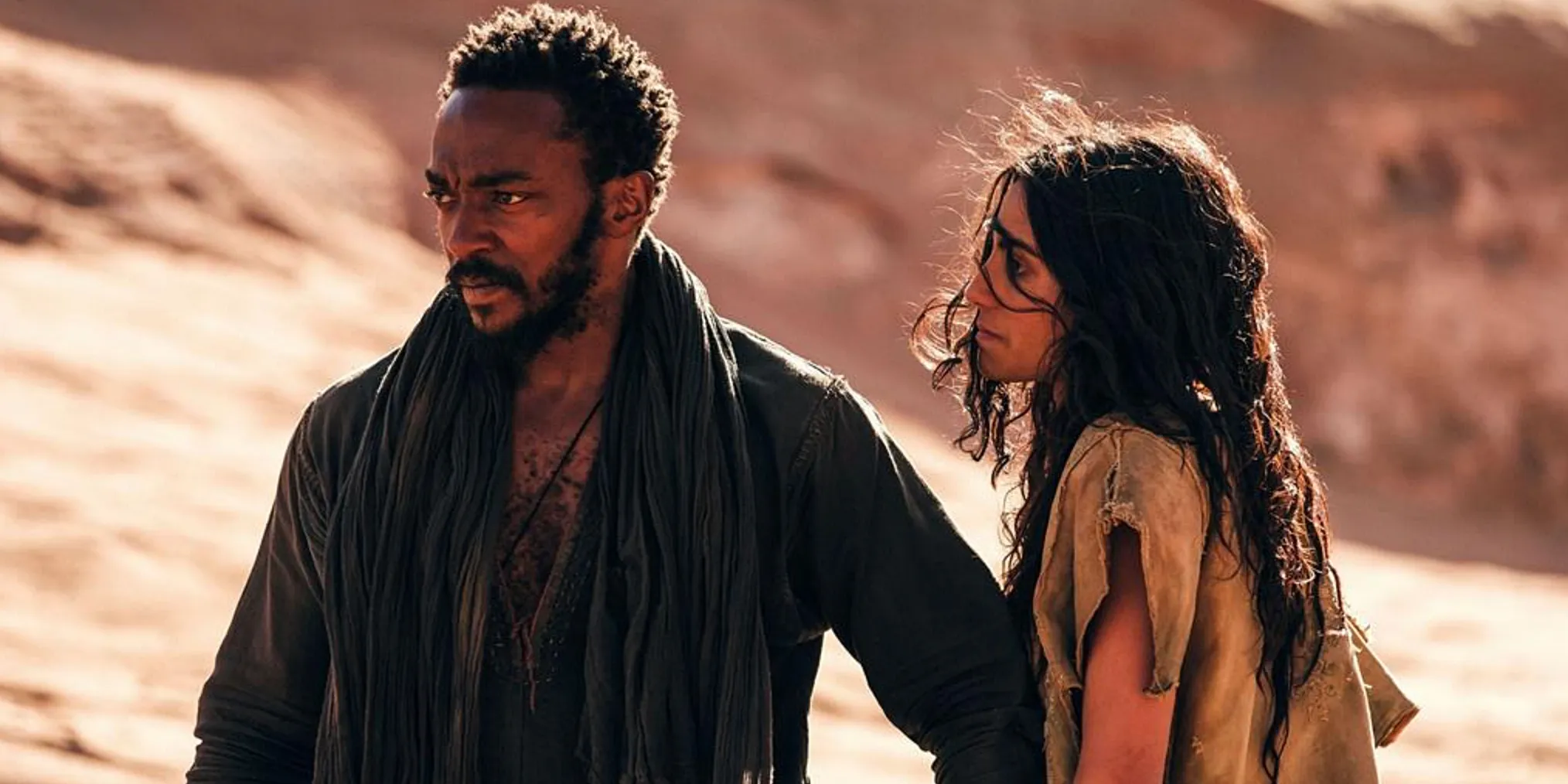

The desert does not recognize royalty. It is a vast, geological equalizer, a place where titles are scoured away by the wind and survival becomes the only meaningful currency. This is the truth that ignites Desert Warrior, a historical epic that uses the unforgiving Arabian peninsula of the 7th century as its crucible. The film is less a chronicle of a specific historical event and more a meditation on the nature of defiance in a world governed by absolutes.
It begins with an emperor’s whim, a demand that a king surrender his daughter, Princess Hind, to a life of gilded servitude. The refusal is quiet but total, an act that erases a kingdom and casts its last remnants into the wilderness.
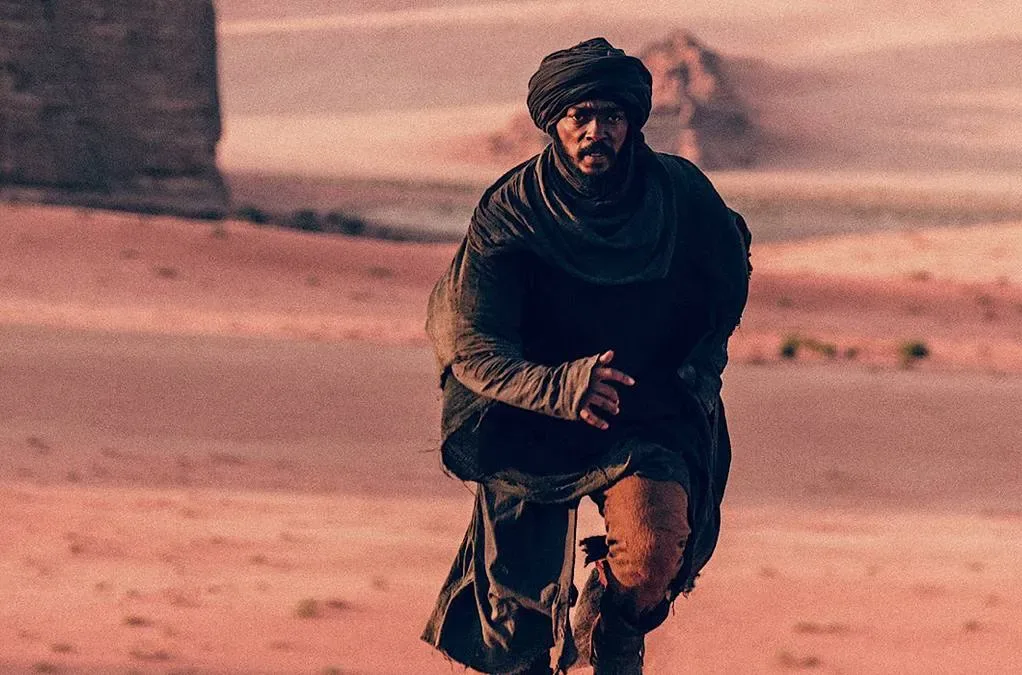
Here, in the sun-bleached expanse, they encounter a nameless Bandit, a man whose identity is as barren as the landscape he traverses. He is a creature of pure transaction, a fitting guide for a world where honor is a commodity and freedom is negotiated one sand dune at a time. The ensuing conflict is framed not merely as a rebellion, but as a test of what it means to exist when stripped of everything but will.
The Austere Canvas
The film’s most articulate voice is its visual language. The cinematography does not simply capture the Saudi Arabian landscape; it submits to it, treating the terrain as a primordial force that dictates all human action. Director Rupert Wyatt and cinematographer Guillermo Garza frequently employ sweeping, static compositions that render the characters as minute figures, their grand struggles reduced to a frantic scurrying against an immense, indifferent backdrop.
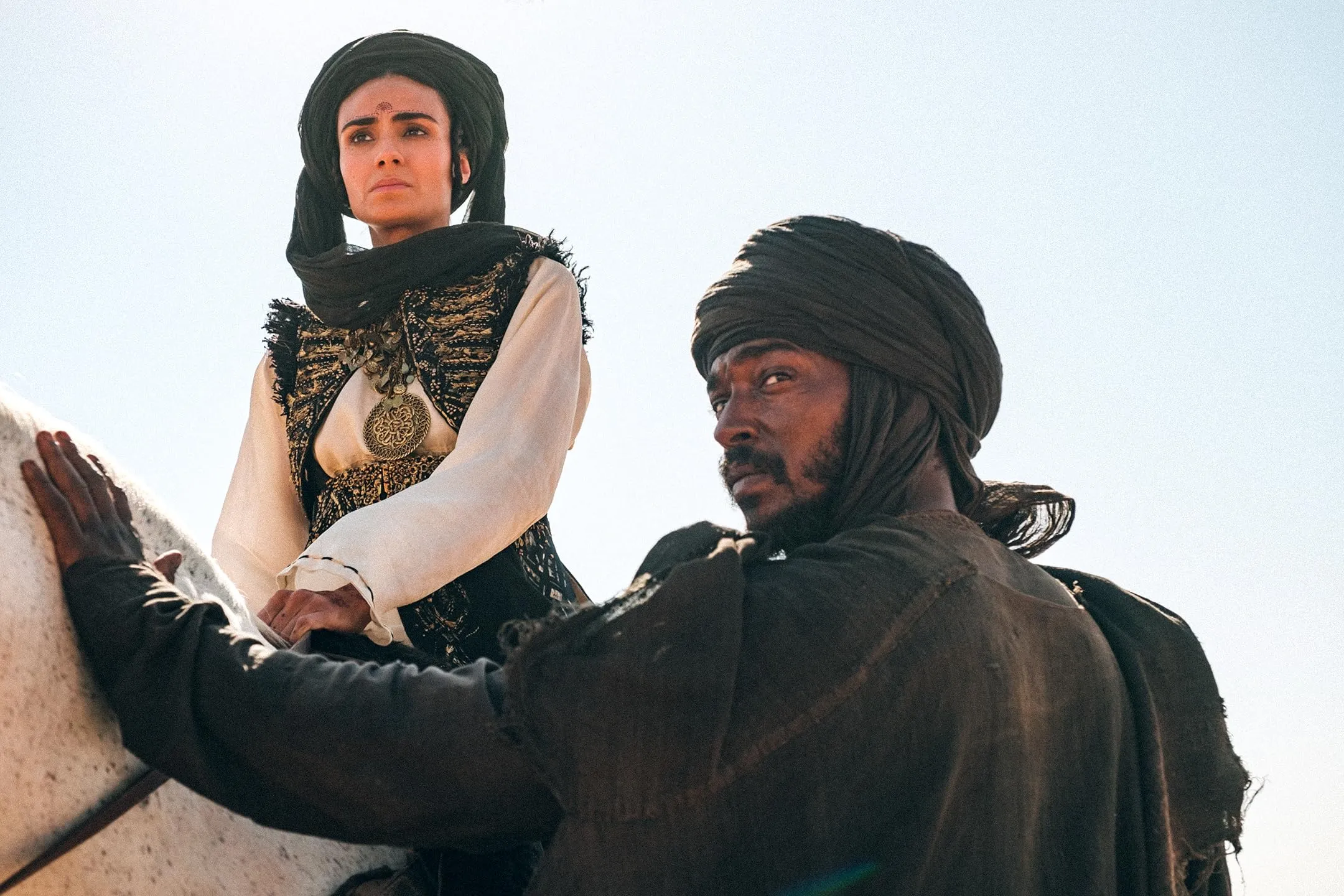
This perspective of geological time constantly puts the human drama in its place. These vast tableaus are punctuated by moments of intense sensorial detail: extreme close-ups on the cracked leather of a rein, the intricate weave of a carpet, or the sweat beading on a weathered face. These tactile shots ground the overwhelming scale in a physical, immediate reality, reminding us that empires rise and fall on the strength of such fragile materials.
This is a world painted with a palette of elemental extremes. The light is a physical presence, with the harsh midday sun acting as a visual abrasive, bleaching the color from the frame until the world appears as a stark, monochromatic etching. This creates a visual ecosystem of survival and exhaustion. The film builds a powerful motif from silhouettes, particularly of lone figures on horseback against the dying sun, their forms reduced to archetypal shapes moving through a world of severe contrasts.
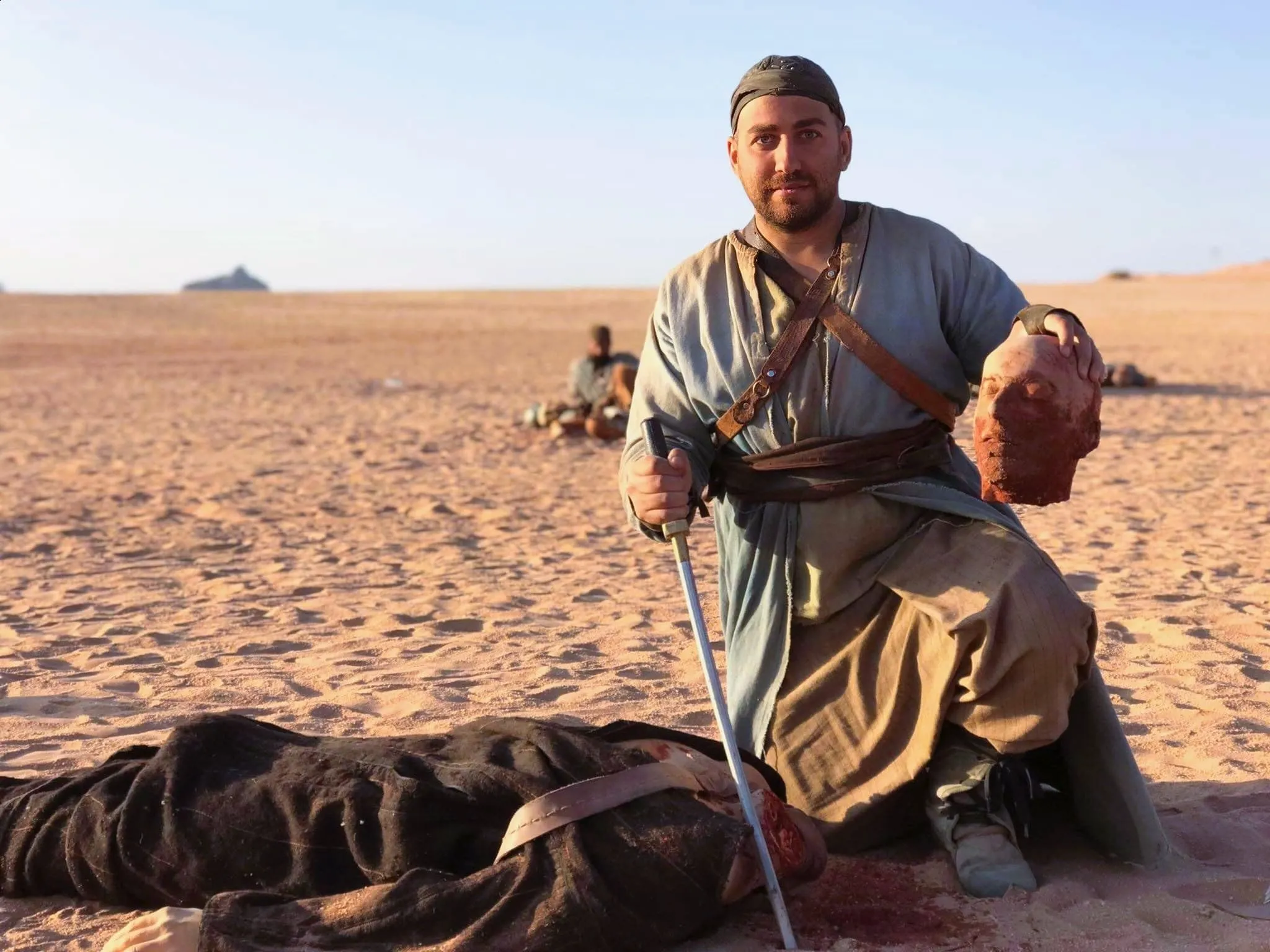
The deep, sharp shadows cast by rock formations are not just incidental; they are active narrative spaces, pockets of suspense and concealment that evoke a kind of desert chiaroscuro, a stage for ambushes and secret meetings. This visual philosophy is supported by a staunch commitment to tangible spectacle. The battle sequences possess an authentic physical weight, populated by hundreds of extras whose movements feel authentically chaotic. The daring and clearly perilous stunt work involving horses and camels lends a visceral, pre-digital heft to the action, creating a world that feels genuinely, painfully real.
Figures in a Landscape
The individuals who move through this unforgiving landscape are less fully realized people and more archetypal vessels for the film’s thematic concerns. They are figures defined by their function within a grand, almost mythic structure. Anthony Mackie’s Bandit is a direct descendant of the solitary ronin or the Man With No Name, a creature of pure, amoral pragmatism. His identity is a void; he has no past and articulates no future, making him a perfect mirror for the existential emptiness of the desert itself.
His motivations are a constant question, a narrative blank that keeps him perpetually unpredictable. Princess Hind begins as a political object, a symbol of her father’s honor, but is forced by circumstance into the role of a revolutionary. Her transformation from a protected royal to a military leader is the film’s central character arc, though it is depicted with a curious lack of psychological interiority.
We see the events that forge her, but we are rarely granted access to the internal process of that transformation. The emperor’s commander, Jalabzeen, serves as the unwavering instrument of a distant tyrant’s will, his brutality a simple and uncomplicated force of nature, like a sandstorm.
This lack of psychological depth results in a strikingly reserved emotional style. The film maintains a clinical distance from its subjects, presenting their alliances as contracts of necessity founded on mutual interest rather than deeply felt bonds. This creates a transactional, almost cold atmosphere that prevents any easy emotional investment. One might argue this affective void is a deliberate choice, a reflection of a brutal world where sentiment is a fatal liability.
Or it might simply be a failure of the script. The effect is to turn the viewing experience into a more intellectual exercise, a study of strategy and survival rather than an emotional immersion. The film’s lineage is clearly traced to the Western, reframed with different cultural signifiers. It is a classic frontier tale of disparate, feuding tribes forced to unite against an encroaching, monolithic empire, with the Bandit serving as the quintessential outsider caught between worlds. It is, for all intents and purposes, a neo-Bedouin Western.
The Rhythm of Violence
The film’s narrative operates on a rhythm of two distinct movements. It begins as a lean, tense chase picture, its energy tightly focused on the singular, primal goal of escape. The story is compact, the stakes clear and personal. This taut structure then dissolves into a more sprawling and ponderous second half, which expands into a full-blown war epic.
The focus shifts from the survival of individuals to the logistics of coalition-building and the grand choreography of military strategy. This change in cadence is jarring, and the film seems to lose some of its narrative discipline as the intimate story of its central characters becomes subsumed by the impersonal mechanics of war. It is a film with a clear structural identity crisis, caught between being a character study and a historical pageant.
The auditory design is one of the film’s more effectively realized elements. The pointed use of absolute silence before an eruption of violence is a recurring and powerful technique. This auditory vacuum creates a space of almost unbearable anticipation, making the eventual chaos of battle feel more shocking and impactful. Dan Levy’s score complements this approach by largely avoiding soaring melodic themes.
Instead, it builds a textural soundscape, employing metallic, percussive elements that sound like the clang of a distant forge, an almost anachronistic industrial noise in an ancient world. The composition of the action sequences alternates between the macro and the micro. High-angle drone shots provide a strategic, god’s-eye view of the battlefield, rendering the armies as elegant, deadly patterns.
This clarity is then abandoned in the close-quarters combat, which is edited with a flurry of disorienting rapid cuts. This choice successfully conveys the perceptual overload of a real fight but comes at the cost of spatial coherence, often leaving the viewer unsure of the brutal geography of the melee.
Desert Warrior is a historical action-drama epic set in seventh-century Arabia, featuring an immense battle between an exiled princess’s forces and a despotic emperor. The film, which boasts a budget of approximately $150 million, is a landmark production for Saudi Arabia’s MBC Studios and was primarily filmed in the country’s Neom and Tabuk regions. It held its world premiere at the 21st Zurich Film Festival on September 28, 2025. As of now, the movie is not yet available for wide public release or general streaming and is expected to follow a festival run before its theatrical and subsequent streaming availability.
Full Credits
The Review
Desert Warrior
Desert Warrior is a work of immense visual ambition, a spectacle of sand and steel that treats the Arabian desert as its true protagonist. While its commitment to tangible, large-scale action is admirable and its sound design is cleverly implemented, the film's human element remains as barren as its landscape. The characters are cold archetypes moving through a stunning but emotionally vacant world, resulting in an epic that impresses the eye but rarely engages the heart. It is a grand, austere, and ultimately hollow cinematic monument.
PROS
- Breathtaking cinematography that masterfully utilizes the Saudi Arabian landscape.
- Impressive commitment to practical effects and large-scale, tangible action sequences.
- Sophisticated and effective sound design, particularly its use of silence.
- A strong, austere visual aesthetic and a clear directorial vision.
CONS
- Emotionally distant characters who function more as archetypes than relatable individuals.
- A disjointed narrative structure that shifts unevenly from a tense thriller to a slow-paced war epic.
- The script lacks psychological depth, preventing strong audience investment.
- Close-quarters combat editing can be chaotic and disorienting.