







![Kingdom Hearts Collection [I-III] Review](https://gazettely.com/wp-content/uploads/2026/10/Kingdom-Hearts-Collection-I-III-1-360x180.webp "Kingdom Hearts Collection [I-III] Review: KHII Holds Steady as Newer Entries Fluctuate 33")






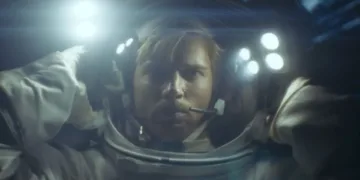
The act of creation carries real risk. When an artist pours life experience into a canvas or script, they open themselves to having that work used against them. Director Spider One’s fourth feature, Big Baby, tracks that vulnerability through screenwriter Adam Lewis (Brandon Scott). Adam is left reeling after critics dismantle his previous film.
In response he abandons subtlety and begins drafting a straightforward slasher centered on a hulking, axe-wielding killer in an infant mask, christened Big Baby. The film establishes a meta-horror premise as the line between Adam’s fiction and his life blurs.
The killer begins to appear in the real world, forcing Adam to defend his sanity and the safety of his wife, Kate (Krsy Fox). The movie combines psychological terror and slasher set pieces to examine the damage public scrutiny can inflict within the entertainment industry.
The Psychological Toll of Creative Ambition
The narrative structure insists on the pressure creators face to perform both commercially and critically. Adam’s dilemma is a clear one: pursue layered, complex storytelling or deliver a “mindless gorefest” that will attract mass attention. That conflict fuels the film’s horror engine. The emotional weight of Adam’s downward arc quickly corrodes his domestic life, recalling stories about artists who unravel under the burden of their work.
Pacing functions as a primary storytelling tool. The film spends considerable time on Adam’s writing process and his rising paranoia. This slower build lets tension accumulate in a natural manner, so the plunge into intense horror feels earned instead of arbitrary.
The transition from quiet character drama to psychological collapse remains steady, avoiding abrupt tonal shifts. The story emphasizes the experience—the psychological effect of Adam’s creation taking hold—over a strict accounting of how the phenomenon manifests. That focus on subjective terror gives the film a dreamlike unease that preserves ambiguity as a driving source of fear.
Authentic Chemistry and Character Investment
The film’s strongest asset is the chemistry between its leads, which anchors the emotional stakes. Brandon Scott delivers a commanding Adam, moving from a frustrated artist wounded by ego to a man showing clear psychological fracture. That trajectory secures audience investment.
Krsy Fox provides a necessary counterpoint as Kate. Her portrayal pushes back against passive tropes; she reads as active, supportive, and believable, and her patience frays under Adam’s unraveling. She functions as the moral and emotional guide in a destabilized world. The easy, lived-in rapport between Scott and Fox comes through in extended conversational scenes. That authenticity raises the stakes.
Because the filmmakers commit to the reality of this relationship, the fictional violence that intrudes on their lives lands with stronger emotional force. Watching their bond strain matters because the connection feels earned. The film demonstrates how grounded relationship dynamics can deepen genre consequences.
The Visceral Execution of the Meta-Slasher
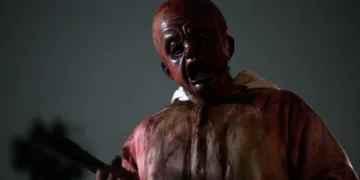
Big Baby the figure sticks in the mind thanks to an immediate visual impact and a distinctive mask. The killer carries an unsettling aesthetic suited to franchise potential. The film backs its violent moments with tactile honesty, favoring practical effects for gore. Those sequences work effectively and include knowing nods to genre classics without sliding into imitation. The physicality of the kills keeps the horror raw and tactile, a quality often missing from digitally smoothed effects.

Placement of the violence influences story momentum. The film concentrates its most intense slasher action in the final act. That concentration maps onto Adam’s complete collapse, but it produces an uneven rhythm. Viewers seeking steady brutality across the runtime may find the middle section slow, then face a sharp surge at the end. A related problem concerns the meta-universe’s logistics.
The film preserves ambiguity about the rules that govern Big Baby—whether the figure is a thought, a spirit, or a reality shaped by Adam’s pen—and that deliberate vagueness leaves the final sequence feeling somewhat untethered. Despite structural quirks, Big Baby is arguably Spider One’s strongest directorial output to date. It is an entertaining, brave cinematic effort that succeeds by centering a character-driven study of trauma over conventional horror mechanics.
The meta-slasher horror film Big Baby is the fourth feature film directed and written by musician Spider One (Michael David Cummings), who is known for his work with the band Powerman 5000. The film stars Brandon Scott as Adam Lewis, a horror screenwriter whose newest fictional creation, the killer Big Baby, begins manifesting in his real life, endangering his wife Kate (Krsy Fox). Notably, the project boasts Cher and her son Chaz Bono as executive producers. Big Baby had its world premiere at Screamfest LA on October 9th, 2025. As of the current date, the general release platform (theaters, VOD, or streaming service like Shudder) is not specified, but its production company is OneFox Productions.
Full Credits
Director: Spider One
Writers: Spider One
Producers and Executive Producers: Krsy Fox, Spider One, Cher, Chaz Bono, Tyler Connolly, Terry Poor, Wendy Berry, Mark Berry
Cast: Brandon Scott, Krsy Fox, Adam Marcinowski, Jordan Elsass, Radek Lord, Torio Van Grol, Kate Freund, Cameron Cowperthwaite, Kirby Bliss Blanton, Nelson Leis, Chaz Bono, Catherine Corcoran, Sierra McCormick
Director of Photography (Cinematographer): Andy Patch
Composer: Alexander Taylor
The Review
Big Baby
Big Baby succeeds as an inventive exploration of creative burnout and the psychological impact of criticism. The film is elevated by the authentic, lived-in chemistry between Brandon Scott and Krsy Fox, whose relationship firmly anchors the story. While the execution of its meta-universe rules is frustratingly loose and the slasher action is unevenly distributed, the solid practical effects and strong thematic core make it a commendable effort. It represents a significant stride forward for director Spider One.
PROS
- Strong lead performances and authentic, lived-in chemistry between the actors.
- Compelling thematic focus on the psychological toll of creative pressure and critical reception.
- Effective shift in tone from character drama to intense psychological horror.
- Visceral horror execution using solid practical effects.
- The Big Baby killer has a distinctive and memorable design.
CONS
- Slasher sequences are heavily backloaded into the final act, leading to uneven pacing.
- The rules and logistics of the meta-universe remain deliberately ambiguous, potentially frustrating viewers.
- The film uses the common trope of the protagonist not being believed by others.