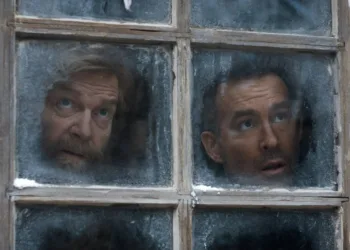
















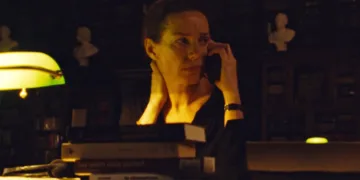














Quiet In Class, a three-part HBO Max docuseries, probes institutional failure inside a society that markets itself as modern and humane. The subject is a catastrophic breach of duty at the Internationella Engelska Skolan in Karlstad, Sweden. The figure at the center, labeled only as a “youth recreational director,” functions as a stand-in for a deeper decay in oversight and care.
Time works like a grim metronome. Around 2015, the director began predatory activity that included covertly photographing and filming students, with material later appearing on adult sites. Between 2017 and 2023, the school received multiple credible warnings.
That sequence reads like negligence written on a calendar. The series underscores how administrators treated alarms from parents and students as noise rather than signal. More than 160 students suffered the consequences. The opening image fixes a procedural mood and stamps the year 2017 with a title card: “THE FIRST WARNING.”
The Scandinavian Paradox: Institutional Blindness
The docuseries maps what I would call institutional auto-anesthesia. Administrative conduct reaches past passivity into something that looks like selected stillness. Students and parents filed reports in writing and in person, describing sexualized discomfort and disturbing behavior. The school’s described reactions ranged from dismissal to open laughter, as if reputation management doubled as pedagogy.
Refusal to sit for formal interviews leaves the administration’s viewpoint as a collage of partial phone exchanges. Absence becomes evidence. After one parent finally contacted the police, the school reportedly responded with a raise for the predator and a reassignment to younger children. That chain of decisions reduces public education to a parody of safety policy, a case study in how an institution can sabotage its stated mission.
Survivor testimony supplies the moral axis of the series. These accounts carry weight and clarity, tracing a consistent pattern of unease. The women who speak grant the film its gravity, a set of lights cutting through an officially sanctioned fog.
This scandal asks for a new look at the “progressive haven” myth attached to Scandinavian systems. Efficient and equitable institutions are often treated as self-correcting machines. Quiet In Class shows how bureaucratic inertia travels well across borders. Local media, police, and multiple authorities appear silent or hesitant, forming a distributed failure with many small switches turned to off.
The Predator-Acolyte: A Narrative Deviation
The structure shifts with the arrival of an anonymous tipster. This outsider uncovers the director’s online material and tries the obvious channels: principal, press. Stonewalled, he turns into a DIY investigator and links the content back to the school employee.
Then the story swivels. The would-be whistleblower emerges as a predator as well. He first appears with a disguised voice, then reveals his own attachment to adult material and a “thrill of the hunt” that mixes justice theater with fixation. He reportedly asks the director for more content and later faces arrest.
The result reads like a bait-and-switch. Generous screen time goes to this figure, which diffuses the sharper focus on state and school failure. The core narrative concerns systemic responsibility; the parallel portrait of the tipster feels like a side alley with a neon sign. The edit raises a practical question: how did this secondary figure alter accountability for the school? The film does not establish that link with clarity, so the subplot plays like spectacle inside a story that requires institutional analysis.
Aesthetics of Exploitation and Chronological Lacunae
Visual strategy presents problems. Heavy reliance on reenactments, especially those depicting the director in covert acts or generating discomfort, risks an unsteady line between illustration and spectacle. These scenes aim to convey experience, yet repetition nudges the project toward unease for its own sake. Do these staged moments clarify patterns, or do they pad minutes and monetize disquiet?
Pacing stretches thin. Three episodes strain the material, creating the impression of either surplus runtime or premature release. The film signals an unfinished ledger. Key outcomes remain offscreen. The viewer is left asking about legal fallout, potential lawsuits from parents, and any financial or criminal responsibility assigned to the institution. Without those endpoints, the cultural force of the series remains provisional.
Across the whole, the work balances a harsh tension. Survivor voices arrive with respect and necessity. The added presence of the predatory whistleblower and the frequent reenactments push in an opposing direction. The method favors chronological listing, presenting what occurred without sustained inquiry into the administration’s psychological or structural motives. Prevention receives little oxygen. The documentary records the facts of harm. It stops before offering a framework that might keep the next warning from becoming another title card.
Quiet in Class is a three-part documentary mini-series centered on a devastating scandal involving a youth recreation director at the Internationella Engelska Skolan in Karlstad, Sweden. The series details how over 160 children were abused through secret filming and photography over eight years, and how school administrators repeatedly ignored warnings. The docuseries premiered on September 29, 2025 (according to press sources) and is available to stream on HBO Max (Max).
Credits
Title: Quiet in Class
Distributor: HBO Max (Max)
Release date: September 29, 2025
Rating: TV-MA
Running time: Approximately 43 minutes per episode (3 episodes total)
Director: Stefan Stridh
Producers and Executive Producers: Stefan Stridh (Producer)
Director of Photography (Cinematographer): Tony Öien
Editors: Thomas Markusson, Robert Flodman, Markus Adolfsson
The Review
Quiet In Class
Quiet In Class is a profoundly necessary document, yet a narratively conflicted one. It delivers essential truth through the courageous accounts of the victims, serving as a chilling examination of "institutional auto-anesthesia" at every level of the Swedish establishment. However, the work is structurally undermined by its sensationalist devotion to the whistleblower’s dark, tertiary arc and aesthetically compromised by its reliance on exploitative reenactments. The resulting film is powerful, but frustratingly incomplete, lacking the final indictment the case demands.
PROS
- Chillingly details the administrative "auto-anesthesia" and negligence over a decade.
- Provides powerful, necessary, and courageous accounts that form the moral core of the series.
- Successfully challenges the cultural assumption of institutional infallibility in progressive nations.
CONS
- Too much screen time devoted to the predatory whistleblower, diluting the focus.
- The frequent, stylized depictions of the director’s actions feel visually problematic and stretch the runtime.
- Lacks critical final details on the school's accountability, lawsuits, or convictions, suggesting it was filmed prematurely.