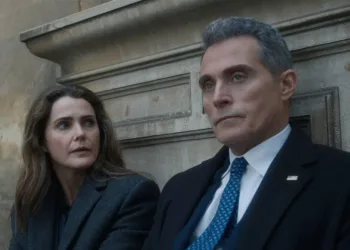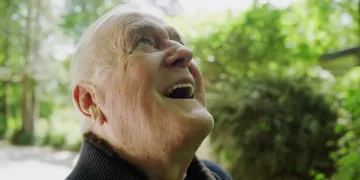
















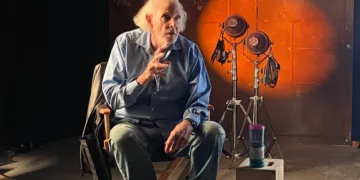













John Cleese Packs It In presents a documentary and travelogue that follows the 85-year-old comedian through a demanding European mini-tour. Cleese states the premise in blunt economic terms with the line, “I need the money.” That need, rooted in a $20 million divorce that appears in the credits with a dry, sardonic nod to his ex-wife, shapes the entire project.
The film immediately sets his work against the limits of an aging body, listing two replaced hips, a replaced knee, a pacemaker, deafness, vertigo and a painful bone spur on his toe beside a schedule of 23 shows in 16 cities across five countries. Director Andy Curd treats the tour as close-quarters observation of a comic legend, where the glamour of performance meets the vulnerability of an elderly performer. The film reflects on why an artist continues to work long after the body signals that the effort carries a heavy cost.
The Comic Mask and the Weary Man
Curd’s visual storytelling sets the towering, razor-witted misanthrope against the tired traveler who moves from car to hotel to stage. Cleese’s established persona functions as a kind of comic authority figure, yet the catalogue of ailments exposes a visibly fragile man. The physical strain shows in his irritation after facing a passive audience in Eindhoven, a moment that hints at a gap between his fame and the muted energy of a local crowd.
The camera lingers on unflattering angles that highlight the fatigue of constant packing and unpacking and the unceasing presence of the lens, which Cleese jokingly labels a “police state.” At the same time, the film pays careful attention to the genial figure behind the self-described “difficult” personality. Affectionate FaceTime calls with his wife, pride in his daughters and a childlike curiosity at a Buddhist temple or while fussing over lemurs form a counterpoint to the acerbic streak in his humour.
The same edge comes through in his teasing of Michael Palin and in a sharp joke about an ex-wife’s death. Across these scenes, the documentary pares back the public mask and tracks a performer who appears exhausted yet restlessly engaged with the world, a combination that ties the familiar image of the classic British comic to the more fragile presence of an elder statesman of comedy.
The Mundane and the Entourage
The travelogue passages focus on the ordinary labour that supports a comedy tour and create a pause from the more intense material. The small group around Cleese acts as a social cushion within what one voice calls the “gentle chaos” of the road. Promoter Berang Emamian Dezfoli keeps a calm profile, now spared the stage routine that once ended with yak’s milk poured over him.
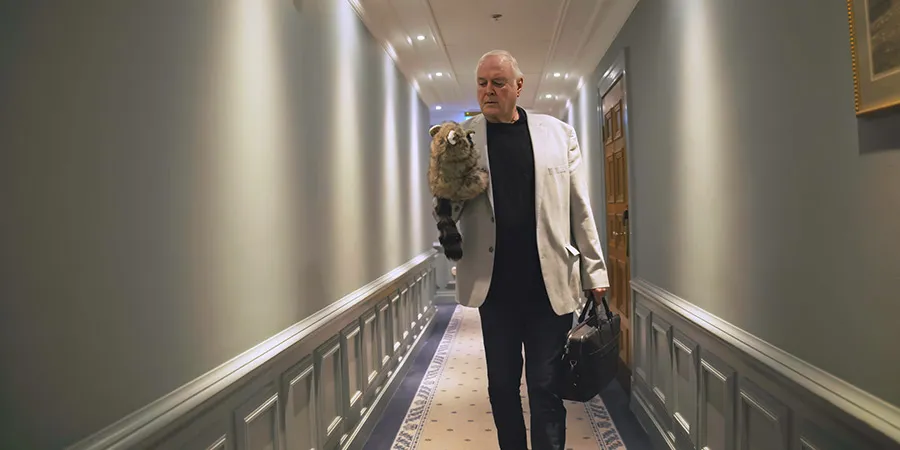
Production manager Spilling Johanssen appears as an all-purpose aide, a weary professional who checks dressing room temperatures and pushes a wheelchair when Cleese needs it. Their steady conduct provides a frame for the star’s shifts in mood. Curd’s role extends beyond that of detached observer, since he often assists Cleese while also filming private exchanges.
The documentary breaks up these backstage and hotel-room scenes with B-roll of the comedian strolling through European fish markets and cheese shops, a visual joke that gently nods to the Cleese family’s original surname, Cheese. Together with the almost comic photo display of his battered big toe, these images stress the everyday physical reality behind the work of a touring comic and give the film’s view of a globally recognised figure a grounding in very specific and local detail.
The Redemptive Power of Laughter
The film begins from a financial motivation and gradually turns into a reflection on art and survival. Cleese speaks with directness about his nervous breakdown and “suicidal thoughts” after the 2008 divorce, and this confession provides the emotional core of the documentary. His return to the stage appears as a way to reclaim his craft.
A key shift in his thinking about comedy’s worth arrives through a striking story from Sarajevo, where people found brief relief by watching Monty Python films in an underground car park during the conflict of the 1990s.
That account changes his idea of comedy from a “luxury” to something “essential for human life,” a shared resource that can lift viewers toward “a braver and more positive part of ourselves.” In this light, the structure of the film traces a redemptive line in which a performer who has given immense pleasure to audiences finally allows himself to accept some of that life-affirming force.
The documentary ends as an absorbing record of a long career and a portrait of an artistic spirit that refuses to give in, with a tenderness that quietly overtakes the armour of irony that helped define his fame.
John Cleese Packs It In is a feature-length documentary following the legendary comedian, John Cleese, on what may be his final European tour at the age of 85. The film offers a wry, behind-the-scenes portrait of Cleese as he travels through five countries, 16 cities, and performs 23 shows over six weeks. Released in UK cinemas on November 13, 2025, and in Australian cinemas on November 27, 2025, the film captures Cleese discussing his career, his health battles, and the financial imperative of the tour following a costly divorce.
Credits
Title: John Cleese Packs It In
Distributor: CinemaLive
Release date: November 13, 2025 (UK Theatrical)
Rating: 12A (UK) / M (Australia)
Running time: 80-90 minutes (TBC)
Director: Andy Curd
Cast: John Cleese, Jennifer Wade, Berang Emamian Dezfoli, Spilling Johanssen
The Review
John Cleese Packs It In
The documentary stands as a powerfully revealing portrait of an aging comic icon. It functions as a bathetic travelogue, yet it achieves genuine emotional weight by exploring Cleese's financial need and his profound personal trauma. The film’s greatest strength is its redemptive quality, charting the comedian’s shift in perspective on his art's necessity. It is an absorbing look at a figure reconciling his caustic public image with his surprising vulnerability.
PROS
- Direct, affecting discussion of the $20 million divorce and nervous breakdown.
- Exploration of comedy as an "essential" human function.
- Strips away the "impregnable" misanthrope mask to show the weary, amiable man.
- The supporting team provides humorous, stoic grounding for the celebrity chaos.
CONS
- Oddly little footage of the actual performances.
- Director Andy Curd's use of difficult or "unflattering" camera angles.
- Reliance on B-roll in markets and an extensive focus on the battered toe photo montage.
- The persistence of sour, ungenerous jokes about former colleagues.