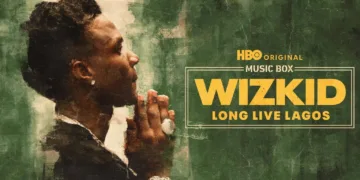



























When does a concert become an event, the kind of night that feels like a public marker, a date that reshapes the calendar around it? Karam Gill’s documentary, Wizkid: Long Live Lagos, pursues that question by following the lead-up to Nigerian artist Ayodeji Ibrahim Balogun’s record-breaking show at Tottenham Hotspur Stadium.
Wizkid arrives in the film already established as a dominant force in the Afrobeats genre, with a monumental global presence. Gill builds the documentary around the sold-out London show, a gathering of over 40,000 people, using it as the film’s structural spine and its symbolic climax. Seeing an African artist command a venue of this size in the United Kingdom carries weight, especially with the country’s colonial past hovering nearby.
The film sets its sights on a story that treats the music as the entry point to something larger: a life, a career, and the cultural and social meaning his achievements hold for Nigeria and the African continent. I kept thinking about the way certain sounds live in the world for years, then the world finally tunes in and speaks as if it has uncovered a brand-new frequency.
The Burden of the Ambassadorial Crown
The documentary dedicates significant time to mapping Wizkid’s ascent, moving from his early days in the Surulere neighborhood of Lagos to the height of international stardom. The film identifies his 2016 collaboration with Drake on “One Dance” as a key turning point, the song that launched his career into the mainstream and cemented his global visibility. That biographical grounding gives weight to what follows, so the stadium show reads as a culmination with a clear history behind it.
Wizkid’s interview presence leans toward humility and restraint. He speaks with quiet conviction and a deep gratitude for his success, and that composure steadies the film’s larger claims. He acknowledges that his position represents something larger than personal achievement, and he talks about carrying a cultural torch. Gill treats that torch as the documentary’s central idea. Wizkid is presented as a goodwill ambassador for Nigeria and for Africa. The film connects his breakthrough success to opening avenues for other artists from the continent and challenging outdated global perceptions.
The film also addresses the colonial legacy that frames the story. A concert in London becomes part of a historical conversation, with the location carrying meaning beyond booking and logistics. Femi Kuti, son of the pioneering Fela Kuti, offers historical and cultural commentary that underscores the importance of this moment for African cultural self-determination.
Also Read






The documentary critiques the term “Afrobeats,” arguing that a single geographically limiting label can diminish the complex, diverse musical traditions that originate from Africa. That critique places Wizkid’s success inside an ongoing dialogue about identity and sovereignty, where global recognition connects to cultural recovery and representation. Gill positions him as a beacon for his countrymen and the wider African diaspora, with the concert serving as a visible signal of what that beacon means in practice.
Structure, Style, and the Fan’s Perspective
Gill chooses a highly accessible narrative approach, anchoring the film with a chronological countdown to the major stadium show. It is a familiar device, and it makes the documentary immediately digestible for a wide audience. Joshua Whitaker’s fast, precise editing keeps the 83-minute film moving with a brisk pace, often adopting the rhythmic energy and visual language of a high-end music video.

The craft feels tuned to performance culture, with timing and momentum doing a lot of storytelling work. I grew up paying attention to editing rhythms in concert films, the way a cut can land like a drum hit, and Whitaker’s pacing has that same instinct for pulse.
Cinematographer Craig Deleon’s lens captures the spectacle and the intimacy of the story in the same visual vocabulary. The film shifts between the overwhelming scale of rehearsals and the final performance and quieter reflective moments. We see Wizkid’s recollections of childhood, and we see tense family news about his mother’s health. Those quieter beats give the documentary room to breathe, keeping private life close to the surface even as the event machine accelerates.
For me, the documentary’s sharpest choice is the inclusion of the young Nigerian fan Matthew Temitope Solomon, who also grew up in Surulere. This subplot grounds the entire massive spectacle in personal reality. Solomon’s attempt to travel to London to attend the concert becomes a tangible emotional barometer for Wizkid’s impact.
The film uses his perspective to show how one person’s music can cross geographic distance and inspire a generation. His storyline translates expert commentary and academic framing into an individual need you can recognize: the desire to be present for a moment that feels like it belongs to you.
The documentary also offers insight from Wizkid’s manager and partner, Jada Pollock. Her perspective carries personal closeness and professional clarity, and it sheds light on the demands of organizing an event of this magnitude while managing an ascent to superstardom.
This behind-the-scenes material adds dimension to the portrait, pairing the public image with the work required to sustain it. The countdown segment sometimes hints at dramatic obstacles that never expand into a full-blown crisis with a neat resolution. The tension stays rooted in emotional pressure, and the film keeps its attention on what the night means to the artist and to the people gathering around him.
The Contagious Rhythm of Success
The documentary celebrates the music itself, giving room to Wizkid’s highly addictive style and the way it combines traditional Afrobeats rhythms with pop sensibility and reggae influences. Wizkid credits foundational artists and figures such as Nigerian jùjú singer King Sunny Adé, the peaceful spirit of Bob Marley, and the revolutionary sound of Fela Kuti. His voice comes through as distinct and soothing, and the film presents his sound as infectious, linked to a style that frequently sets global trends. The music becomes a driving force inside the documentary, shaping its energy and its sense of scale.
The defining performance moment arrives when Wizkid steps onto the London stage. Gill directs these segments with palpable kinetic energy, allowing songs enough time to land while highlighting the electric connection between artist and crowd. Whitaker’s editing stays sharp, cutting between the performance and faces in the audience, capturing unrestrained joy without breaking the flow of the set. The sight of the massive, diverse crowd, Black, white, and people from countless other backgrounds, singing every word and screaming his name feels deeply moving.
The film closes on that image of shared release and recognition. The stadium scene becomes a symbol for the success of contemporary African popular music, presented as firmly claimed and impossible to ignore on the world stage. The victory plays out in front of a global audience, and the documentary treats Wizkid’s stage energy as artistic power tied to cultural awakening. Music, moment, and performer meet in a way that leaves the experience lingering after the screen goes dark.
The documentary film Wizkid: Long Live Lagos premiered as an HBO Original documentary as part of its acclaimed Music Box series. The film, which chronicles the Nigerian music icon Ayodeji Ibrahim Balogun’s journey to international stardom and his historic concert at Tottenham Hotspur Stadium, was released on December 11, 2025. It is available to stream in the United States on HBO Max (Max) and premiered in the UK on Sky on December 14, 2025. The film has a running time of approximately 83 to 85 minutes.
Full Credits
Title: Wizkid: Long Live Lagos
Distributor: HBO Documentary Films
Release date: December 11, 2025 (HBO/Max Premiere)
Running time: 83 minutes
Director: Karam Gill
Writers: N/A (Documentary)
Producers: Karam Gill, Daniel Malikyar
Executive Producers: Charles D. King, James Lopez, Andrew Primavera, Andie Tenoso, Bobby Singh, Blase Biello, Jody Gerson, Marc Cimino, Bill Simmons, Nancy Abraham, Lisa Heller, Tina Nguyen
Cast: Ayodeji Balogun (Wizkid), Femi-Anikulapo Kuti, Jada Pollock, Julie Adenuga, Seni Saraki, Sunday Are, Matthew Temitope Solomon, Karen Binns, Adosu Segan, Tops Bademosi
Director of Photography (Cinematographer): Lucas Klingner, Daniel Malikyar
Editors: Joshua Whitaker
Composer: Craig Deleon
The Review
Wizkid: Long Live Lagos
Wizkid: Long Live Lagos offers a powerful, culturally relevant portrait that transcends the typical music documentary format. By focusing on a monumental London concert, the film successfully weaves Wizkid’s personal journey from Surulere into the larger narrative of African cultural resurgence on the global stage. It is technically sharp and emotionally resonant, effectively balancing star power with vital socio-political context. The film is a must-watch statement on identity, influence, and the sheer joy of Afrobeats.
PROS
- Provides crucial socio-political depth, framing the music within the colonial legacy and African cultural identity.
- Effectively uses the countdown to the stadium show to drive the plot, making the narrative accessible and engaging.
- Sharp, kinetic editing (often music-video-like) and dynamic cinematography enhance the concert footage and pacing.
- The inclusion of the fan subplot (Matthew Temitope Solomon) successfully grounds the global spectacle in a tangible, human experience.
CONS
- The film critiques the term "Afrobeats" but offers limited exploration of alternative terminology.
- The preparation and production segment implies dramatic tension or obstacles that do not always fully materialize.
- Wizkid's quiet, composed demeanor means some personal stories feel slightly guarded, respecting his privacy.
- The film relies heavily on the significance of the London event, which could overshadow the complexities of his earlier career.