

























![Kingdom Hearts Collection [I-III] Review](https://gazettely.com/wp-content/uploads/2026/10/Kingdom-Hearts-Collection-I-III-1-360x180.webp "Kingdom Hearts Collection [I-III] Review: KHII Holds Steady as Newer Entries Fluctuate 37")




The Empire State Building cuts through the December night in vertical bands of red, white, and green, its glow promising a kind of holiday enchantment to anyone craning up from the street. That light becomes the film’s signature atmosphere, placing A Suite Holiday Romance in a New York City that looks polished enough to feel temporarily sealed off from ordinary life. The story settles inside the Grand Fairbanks Hotel, a fictional property that echoes the Beaux-Arts splendor of The Plaza. The hotel plays like a pocket universe, elegant and insulated, where the city’s noise fades into background hum.
Into that carefully staged calm steps Sabrina Post, played by Jessy Schram, arriving with the quiet skill set of a ghostwriter. Her work demands ventriloquism: she inhabits other people’s voices while keeping her own carefully contained. This assignment brings her to the hotel to chronicle the life of a prominent art dealer, and the job hands her a brief pass into a level of comfort far beyond her usual means.
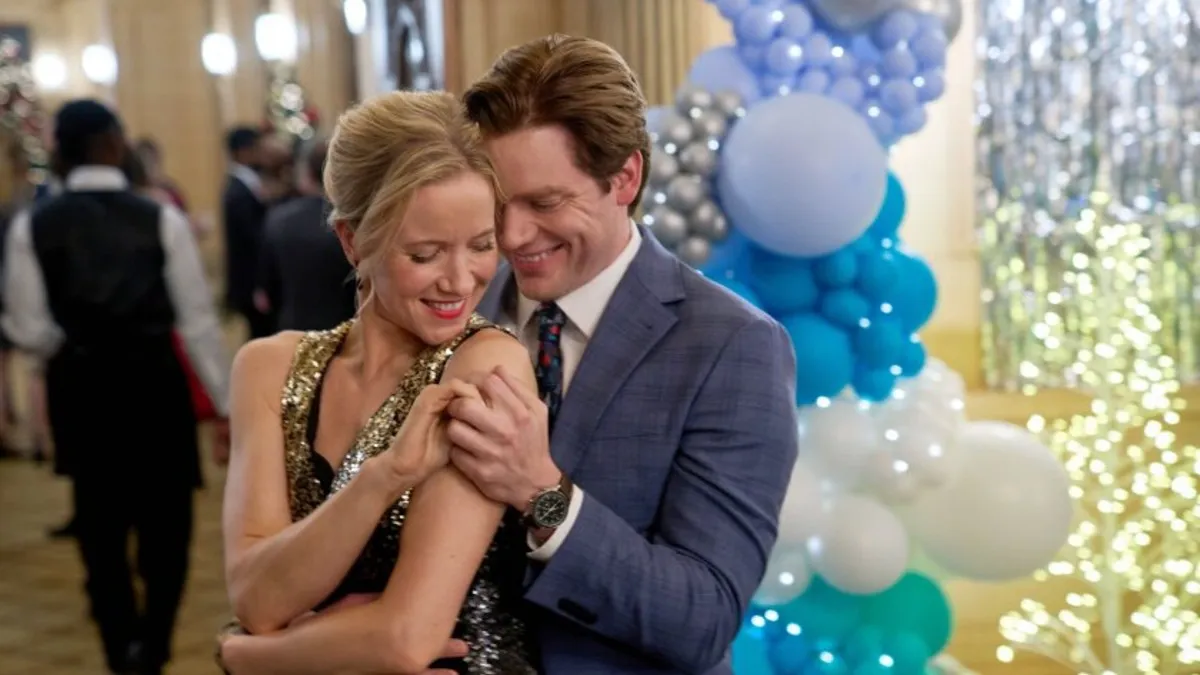
Sabrina approaches the Grand Fairbanks through childhood nostalgia. She grew up with the “Cordelia” books, a fictional series about a precocious girl living in the hotel, and that literary imprint reshapes what she sees. The Fairbanks becomes a storybook environment in her mind, one that feels primed for entrances, reveals, and romantic timing. That mindset carries her straight into Ian Turner, played by Dominic Sherwood. Their first meeting, staged in the hotel bar, moves with the smooth certainty the genre values, leaning on the charged mood of the room to do much of the talking.
The Royal Misunderstanding
The central conflict forms through quick assumptions that harden into an extended deception. Sabrina mistakes Ian for Lord Spencer Braxton, a British Royal visiting the city. The reality runs on paperwork and proximity. Ian works as the personal assistant and handler for the actual Lord Braxton, paid to manage access and control the chaos that follows in a famous person’s wake. Lord Braxton himself behaves like a romantic whirlwind, spending his time chasing a gift shop employee while Ian scrambles to contain the collateral damage.
That division of labor shapes every interaction. Ian keeps vanishing to rein in his employer, forced into half-explanations and hurried exits. Sabrina reads his disappearances as aristocratic eccentricity, the sort of behavior that signals privilege as much as personality. Her best friend feeds the fantasy, treating Ian’s secrecy as definitive proof of royal status and encouraging Sabrina to read mystery as romance.
Ian’s position tightens the trap. Correcting Sabrina would mean exposing Lord Braxton, and protecting that privacy sits inside Ian’s job description. Silence leaves room for imagination, and the film uses that gap to examine projection at the start of a romance. Sabrina falls for the version of Ian her mind assembles, then meets a person whose actual presence still carries warmth. Their time together rests on easy conversation and quiet moments that stand apart from titles and social standing, scenes that treat connection as something built through attention and rhythm.
The lie generates tension because it is fragile, always one question away from collapse. It also creates a contained space where feelings can grow without the immediate weight of ordinary explanations. Schram and Sherwood sell that dynamic with enough spark to hold interest, even while the misunderstanding stretches plausibility and asks patience from the audience.
Echoes of 1960s Glamour
Al Sapienza appears as Grayson Westcott, the art dealer whose memoir Sabrina is writing, and his presence shifts the film’s emotional temperature. Grayson brings melancholy into a story dressed for the holidays, offering a counterweight to the bright immediacy of the main romance. He once worked as a butler at the Grand Fairbanks during the 1960s, and he speaks of that era with fondness touched by ache, as if the memories still carry a sting.
Through Sabrina’s sessions with him, the film opens a passage into his past. His history includes a connection to the author Hazel Holley and an unrequited love for a woman named Charlotte. These scenes arrive through smooth, stage-like transitions, with the camera sliding from a contemporary suite into the golden hues of mid-century New York. The movement blurs memory and present tense, making the hotel feel like a place where time folds back on itself.
Grayson’s story carries real weight because it refuses to sit in the background as mere decoration. He becomes a mentor figure to Sabrina, turning his own history into a cautionary tale. He talks about missed chances and the quiet tragedy of letting love slip by, framing regret as something that accumulates through small delays and unspoken truths. His narrative acts as the film’s thematic spine, pressing Sabrina toward honesty and vulnerability in her own life.
That parallel matters because it links two decades through the same walls. Grayson’s regret sits beside Sabrina’s hesitation, giving the film continuity and a sense of repetition. The Grand Fairbanks starts to feel like an archive of longing, holding onto old emotions and replaying familiar patterns across different eras.
Visual Warmth and Final Impressions
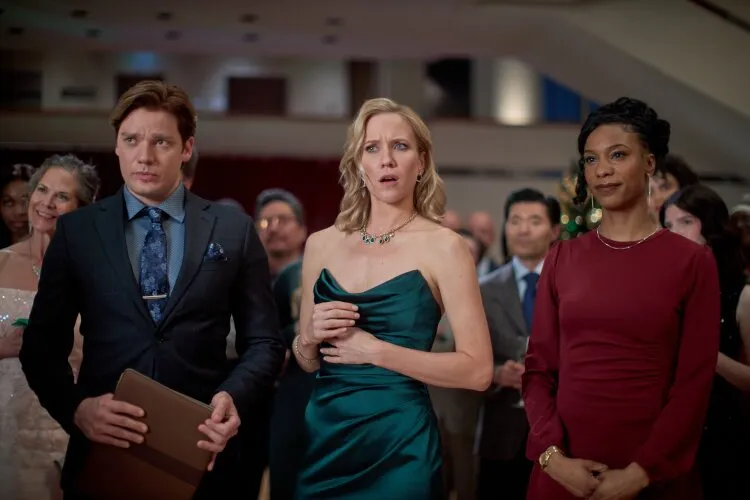
The production design leans into holiday décor with careful, specific detail, using the hotel’s interiors as a constant source of warmth. Sabrina’s strapless green gown stands out against those glowing spaces, a deliberate image of festive elegance that matches the film’s taste for polished romance. The visuals support a resolution built around removing pretense, pushing characters toward clearer truth.
That turn arrives when the deception collapses and forces Ian and Sabrina to face who they are once fantasy loses its scaffolding. The script ties intimacy to ordinariness, suggesting that real connection requires the nerve to stand plainly in front of another person without costume or title.
The film also keeps returning to a message about seizing the moment, arguing against waiting for perfect circumstances or ideal personas. Schram and Sherwood sustain a convincing dynamic through the lighter beats, keeping the romance grounded even as the story asks for big leaps. The closing mood balances sweetness with the lingering sadness of Grayson’s arc, and the film lands on a reflection about time itself: the past stays fixed, and the present remains a choice.
A Suite Holiday Romance is a television movie that premiered as part of the Hallmark Channel’s annual “Countdown to Christmas” programming event. It was first broadcast on Saturday, December 13, 2025. The movie centers on writer Sabrina Post, who stays at the iconic Grand Fairbanks Hotel in New York City while ghostwriting a memoir. There, she meets the handsome British visitor Ian Turner. A misunderstanding leads Sabrina to believe Ian is a member of the British aristocracy, when he is actually the personal secretary of a Lord. The film explores their developing romance amidst the holiday setting and the web of mistaken identity. You can watch the movie on the Hallmark Channel and stream it the following day on Hallmark+.
Full Credits
Title: A Suite Holiday Romance
Distributor: Hallmark Channel
Release Date: December 13, 2025
Rating: TV-G
Running Time: Approximately 84 minutes (Standard for Hallmark movies)
Director: Jeff Beesley
Writers: Nina Weinman
Producers and Executive Producers: Ian Dimerman (Producer), Jeff Beesley, Jessica Runck
Cast: Jessy Schram, Dominic Sherwood, Al Sapienza, Adam Hurtig, Stephanie Sy, Lauren Cochrane, Chase Winnicky
Director of Photography (Cinematographer): Paul Suderman
Editors: Chad Tremblay
Composer: Tyler Westen
The Review
A Suite Holiday Romance
The film is a successful example of its genre, elevated by strong lead chemistry and a surprisingly affecting subplot. It transforms familiar tropes of mistaken identity and holiday fantasy into a thoughtful reflection on authenticity and regret, thanks to the intergenerational story thread. The visual presentation of New York at Christmas is rich and persuasive. This movie offers warmth and satisfying emotional resolution.
PROS
- Jessy Schram and Dominic Sherwood share a natural, engaging dynamic.
- The 1960s flashbacks and Grayson Westcott's story add unexpected emotional depth.
- The Grand Fairbanks Hotel and New York City at Christmas create a compelling visual backdrop.
- The seamless transitions between the present and past timelines are well-executed.
CONS
- The mistaken identity setup follows a familiar arc within the genre.
- The central misunderstanding is stretched slightly too thin to sustain the entire runtime.
- The final confrontation and reconciliation adhere closely to genre expectations.







