


















Each December, the ritual repeats: critics and publications compile their year-end lists, ranking cinema’s offerings with the confidence that suggests objectivity when taste remains stubbornly subjective. We recognize this exercise as both necessary and somewhat absurd (who can truly measure Resurrection against Black Bag, art against entertainment, intimacy against spectacle?).
What follows represents our attempt at Gazettely to navigate this impossible task. The 2025 film landscape proved remarkably fertile, yielding works that ranged from Paul Thomas Anderson’s activist epic to Ryan Coogler’s vampire reinvention, from Jia Zhangke’s documentary-fiction hybrid to James Gunn’s earnest superhero reboot. These thirty films earned their placement through combination of artistic merit, cultural resonance, and that ineffable quality that makes certain cinema linger in memory long after credits roll.
Consider this list a starting point for conversation rather than definitive judgment. Disagree vehemently with our rankings? Good. Cinema deserves passionate argument. What matters is that these films exist, that 2025 gave us reasons to believe the medium still possesses capacity for surprise, innovation, and relevance.
Now, the rankings.
Table of Contents
#30: HIGHEST 2 LOWEST
Why watch: “A high-energy Spike Lee musical that tackles the tensions of Brooklyn gentrification through street-level production numbers.”
Runtime: 134 mins • MPAA rating: R • Notable line: “This block belongs to the people who built it.”
Also Read




Dir: Spike Lee | Cast: Ensemble | Tone: Musical crime drama | Notable scene: A hip-hop confrontation staged on a changing street corner.
Spike Lee remains a vital presence in American cinema, even when the results land at the bottom of year-end lists (a fate that speaks more to 2025’s depth than any failure of craft). Highest 2 Lowest finds Lee working his signature mode: caffeinated social commentary wrapped in genre trappings, this time a musical crime drama that toggles between Brooklyn street corners and fever-dream production numbers. The ensemble crackles with energy, each actor seemingly given permission to play at maximum volume, and Lee’s camera maintains its restless intelligence, refusing static framing when a Dutch angle or sudden zoom might provoke.
What secures its place here, thirty slots from the summit, is sheer watchability. Lee knows how to stage a scene, how to make didacticism entertaining (a rarer skill than critics acknowledge). The film’s exploration of gentrification through hip-hop musical sequences shouldn’t work, except it does, intermittently. Festival audiences at SXSW responded warmly, recognizing a filmmaker still swinging for significance even when the bat doesn’t connect cleanly. Solid craftsmanship counts, particularly in a landscape littered with timid mediocrity.
#29: RESURRECTION
Why watch: “Bi Gan crafts a hypnotic spy drama that dissolves into a dreamlike vampire thriller across decades.”
Runtime: 142 mins • MPAA rating: Not Rated • Notable line: “We are the shadows of our ancestors.”
Dir: Bi Gan | Cast: Undisclosed | Tone: Experimental mystery | Notable scene: A long-take sequence where the protagonist shifts identities.
Bi Gan operates in a register most filmmakers wouldn’t dare attempt: structurally anarchic, visually hypnotic, narratively unmoored from convention. Resurrection announces itself as historical spy drama before shapeshifting into vampire thriller, then dissolving into something else entirely (calling it “genre-shifting odyssey” undersells the disorientation). The protagonist transforms across decades and identities, the film treating continuity as bourgeois constraint rather than narrative necessity.
This is cinema for audiences who want their movies to behave like dreams, all gorgeous surfaces and emotional logic that defies waking sense. Bi Gan conjures images of startling beauty: period reconstruction that feels simultaneously meticulous and hallucinatory, action sequences that privilege visual poetry over coherence. Cinephiles hungry for high-concept experimentation found their fix here (one critic dubbed it “like an Avatar movie for film buffs,” which captures the immersive strangeness if nothing else).
Festival circuits embraced Resurrection with the fervor reserved for work that announces a singular vision. Whether that vision coheres into something beyond technical flex remains debatable, but Bi Gan’s ambition alone merits attention in an era of calculated risk-aversion.
#28: BLUE MOON
Why watch: “Ethan Hawke portrays Lorenz Hart in a sharp meditation on creative heartbreak and the pain of becoming obsolete.”
Runtime: 105 mins • MPAA rating: R • Notable line: “I wrote the words that made them fall in love.”
Dir: Richard Linklater | Cast: Ethan Hawke, Andrew Scott | Tone: Period drama | Notable scene: Hart watches from the wings as his former partner redefines the theater.
Richard Linklater delivered two exceptional films in 2025, a productivity that would feel like showing off from anyone else. Blue Moon captures a single night: Lorenz Hart (Ethan Hawke, radiating wounded brilliance) processes the professional heartbreak of Richard Rodgers partnering with Oscar Hammerstein for Oklahoma!, the musical that would redefine American theater while leaving Hart behind, obsolete.
The film unfolds as witty meditation on creative partnerships and their inevitable dissolutions, Linklater’s camera observing Hart with the patience his collaborators couldn’t muster. Hawke inhabits the lyricist’s melancholic wit, finding depths in a figure history remembers primarily as Rodgers’ first, lesser partner (Andrew Scott’s Rodgers watches with sympathetic remove, aware he’s both liberator and executioner). Linklater stages Hart’s final reckoning with obsolescence as imaginative séance, the period setting becoming container for universal anxieties about relevance and replacement.
What emerges is portrait of one of the twentieth century’s finest lyricists grappling with the cruelest realization: being good enough isn’t enough. The film honors Hart’s artistry while refusing to sentimentalize his decline, a tonal balance Linklater makes look effortless.
#27: IT WAS JUST AN ACCIDENT
Why watch: “Jafar Panahi constructs a cold moral thriller where former political prisoners face a choice between justice and revenge.”
Runtime: 98 mins • MPAA rating: Not Rated • Notable line: “Justice is a heavy stone.”
Dir: Jafar Panahi | Cast: Vahid Mobasseri | Tone: Moral thriller | Notable scene: Victims gather in the desert to decide the fate of their former tormentor.
The Palme d’Or at Cannes 2025 went to Jafar Panahi’s shattering moral thriller, a recognition that doubled as political statement. Panahi, imprisoned previously for his dissident filmmaking and facing renewed sentencing from Iranian authorities, crafted a film that transmutes personal experience into parable. It Was Just an Accident follows former political prisoners offered rare opportunity: state-sanctioned retribution against their torturers, justice delivered under controlled conditions.
What unfolds is something colder than catharsis. Panahi constructs a narrative maze where moral certainty dissolves, where victims granted power discover themselves capable of becoming what they despise. The film asks what justice means under authoritarianism, whether revenge can exist separate from the machinery that enables it. These questions carry weight beyond allegory given Panahi’s circumstances (making art about imprisonment while facing imprisonment creates feedback loop of unnerving resonance).
Festival audiences responded with standing ovations that felt like protests, the film’s political urgency inseparable from its artistic achievement. Panahi refuses easy answers or comfortable resolutions, instead offering cinema as documentation of irresolvable tension. That Cannes awarded him their highest honor suggests the jury understood: some films matter beyond conventional metrics.
#26: ON BECOMING A GUINEA FOWL
Why watch: “Rungano Nyoni observes the cost of family secrets and cultural performance in rural Zambia with clinical precision.”
Runtime: 95 mins • MPAA rating: Not Rated • Notable line: “The silence keeps the family together.”
Dir: Rungano Nyoni | Cast: Susan Chardy | Tone: Feminist drama | Notable scene: Shula navigates a funeral rite that requires a false display of grief.
Rungano Nyoni’s second feature arrives with the confidence of a filmmaker who’s already solved the puzzle of her own voice. On Becoming a Guinea Fowl transplants family drama to rural Zambia, where cultural traditions around death and propriety collide with contemporary feminist consciousness. The film follows Shula discovering her uncle’s body, then navigating the funeral rites that demand performance of grief she cannot authentically summon (he molested her as a child, a fact the family knows and ignores with practiced efficiency).
Nyoni shoots with anthropological precision that never feels clinical, her camera observing rituals that reveal how communities police women’s bodies and expressions. The performances simmer with suppressed rage, actors navigating the gap between what must be said and what cannot be spoken. What distinguishes Guinea Fowl is its refusal to position Western individualism as liberation from oppressive tradition; Nyoni understands culture as more complex than progressive narratives allow.
Festival circuits recognized the film’s nuanced approach to difficult material, its willingness to sit with contradiction rather than resolve it. This is cinema interested in questions rather than answers, in depicting the cost of maintaining social cohesion when that cohesion protects predators.
#25: THE SHROUDS
Why watch: “David Cronenberg explores personal loss through a sterilized lens of technology that surveils the dead.”
Runtime: 106 mins • MPAA rating: R • Notable line: “Death is just a data stream.”
Dir: David Cronenberg | Cast: Vincent Cassel, Diane Kruger | Tone: Sci-fi drama | Notable scene: A clinical observation of biological decay via high-tech monitoring equipment.
David Cronenberg, now in his eighties, continues making films that feel like autopsies performed on still-breathing subjects. The Shrouds emerges from devastating personal loss (the death of his wife) but approaches grief with cadaverously stiff remove, the kind of emotional rigor mortis that characterizes Cronenberg’s late-career aesthetic. The film imagines technology for preserving and surveilling the dead, turning mortality into data stream, and treats this premise with the clinical sterility of instructional video.
Cronenberg’s vision remains aggressively unsentimental, his camera observing human suffering with the detachment of medical equipment. Characters speak in the affectless monotone of people who’ve replaced feeling with analysis, and the film’s pacing mimics death itself: slow, inevitable, devoid of drama. This is grief filtered through a mind that trusts intellect over emotion, that suspects sentiment as weakness or lie.
The result challenges audiences expecting catharsis or warmth. The Shrouds offers neither, instead presenting grief as mechanical process, something to be documented rather than experienced. That Cronenberg crafted this response to personal tragedy reveals something about the man: even loss becomes fodder for his peculiar brand of cerebral provocation. Not everyone will tolerate the film’s icy remove, but those who do will find a master still refusing comfort.
#24: NOUVELLE VAGUE
Why watch: “A joyful recreation of the chaotic production behind the film that changed the history of cinema forever.”
Runtime: 112 mins • MPAA rating: Not Rated • Notable line: “We didn’t know the rules.”
Dir: Richard Linklater | Cast: Guillaume Marbeck, Zoey Deutch | Tone: Historical comedy-drama | Notable scene: Godard shoots guerrilla-style on the streets of 1960 Paris.
Linklater’s second 2025 triumph plays as love letter to Jean-Luc Godard’s Breathless, a film about the making of the film that revolutionized cinema. Guillaume Marbeck inhabits Godard as young provocateur, shooting guerrilla-style on 1960 Paris streets while inventing new grammar for moving images. Zoey Deutch and Aubry Dullin complete the triangle, actors becoming accomplices in creative insurrection.
The film pulses with affection for its source material, Linklater channeling the energy that made the French New Wave feel like oxygen injected into suffocating medium. Nouvelle Vague operates as both historical recreation and meditation on art’s transformative power, on those rare moments when artists shatter conventions through sheer force of vision and naivety (Godard didn’t know the rules he was breaking, which proved essential to breaking them).
What saves this from hagiography is Linklater’s understanding that worship makes boring cinema. He treats the Breathless production as adventure story, emphasizing beauty and pleasure over historical importance. The film argues, implicitly, that revolution felt like fun before it became canonized. Linklater, himself an indie maverick who reshaped American cinema through Sundance Labs and ambitious projects, recognizes kindred spirit across decades. The result radiates pure cinematic joy, that rarest of qualities in contemporary filmmaking.
#23: TRAIN DREAMS
Why watch: “Joel Edgerton delivers subtle work in this intimate epic of labor and loss in the early twentieth century.”
Runtime: 118 mins • MPAA rating: PG-13 • Notable line: “The forest doesn’t remember the men who clear it.”
Dir: Clint Bentley | Cast: Joel Edgerton, Felicity Jones | Tone: Western drama | Notable scene: A railroad construction sequence that captures the weight of human effort.
Clint Bentley’s sophomore feature operates as tiny epic, the oxymoron earned through scope of emotion compressed into intimate scale. Train Dreams follows logger Robert Grainier (Joel Edgerton, delivering work of terrific subtlety) through decades of Pacific Northwest labor at the turn of the twentieth century. The film moves through Robert’s life with unhurried attention: courtship and marriage to Gladys (Felicity Jones, luminous in limited screen time), the building of home, arrival of children, the work that defines and destroys men, and death’s patient arrival.
Bentley shoots this material with stunning visual restraint. Forest clearing and railroad construction become ballet of human effort against indifferent nature, the landscape both gorgeous and hostile. The film trusts audiences to find drama in ordinary life faithfully rendered, in the accumulation of days that constitute existence for most humans across history. Edgerton’s performance works in minor key, registering loss and love through minute adjustments of posture and expression.
What emerges is heart-rending portrait that refuses melodrama, that understands dignity in depicting life without inflating its significance. Train Dreams suggests that individual human experience contains sufficient weight without artificial elevation. The result feels like rediscovery of classical American cinema’s best impulses, proof that nuance and beauty remain viable strategies.
#22: A HOUSE OF DYNAMITE
Why watch: “Jessica Hausner creates a tense chamber piece where a single home becomes a tool for psychological warfare.”
Runtime: 102 mins • MPAA rating: R • Notable line: “This house shows you who you are.”
Dir: Jessica Hausner | Cast: Mia Wasikowska | Tone: Psychological thriller | Notable scene: A weekend gathering devolves into quiet pathology within a modern interior.
Jessica Hausner’s latest provocation arrives wrapped in the aesthetics of bourgeois comfort, which makes the detonation more effective. A House of Dynamite traps its ensemble (led by Mia Wasikowska’s unnerving performance as architect of domestic chaos) inside a single location across a weekend that slowly reveals itself as psychological warfare. The film operates as chamber piece that literalizes metaphor: the house itself becomes weapon, architecture designed to expose the faultlines in civilized behavior.
Hausner shoots with the formal precision that defines her work, static frames holding just long enough to generate discomfort, the image composition suggesting something wrong that reason cannot quite locate. The ensemble navigates terrain between dark comedy and genuine menace, their performances pitched at the register where neurosis tips into pathology. What distinguishes Dynamite from similar exercises in confined-space tension is its refusal to explain itself, to provide the psychological backstory that would domesticate the threat.
Critics divided over whether this constitutes profound statement about contemporary anxiety or merely technical flex from a director who’s mastered a particular aesthetic. Both readings hold validity, which might be precisely the point. The film lingers after viewing, its images possessing half-life that extends beyond narrative.
#21: MISERICORDIA
Why watch: “Alain Guiraudie observes the blurring lines of desire and violence in the heat of southern France.”
Runtime: 108 mins • MPAA rating: Not Rated • Notable line: “In this heat, the line between love and hate evaporates.”
Dir: Alain Guiraudie | Cast: Félix Kysyl, Catherine Frot | Tone: Black comedy thriller | Notable scene: A middle-aged man becomes entangled with drifters in a rural setting.
Alain Guiraudie returns to the sun-scorched landscapes of southern France where desire and violence blur into each other. Misericordia follows a middle-aged man (Félix Kysyl, compelling in his opacity) who becomes entangled with younger drifters, the film treating their interactions with the anthropological distance of nature documentary observing predator-prey dynamics. Guiraudie’s cinema has always operated at the intersection of the erotic and the violent, finding in that overlap something essential about human motivation that polite society prefers not to acknowledge.
The film moves with the languor of summer heat, scenes unfolding in real time as if rushed editing would betray the material’s essential rhythms. Catherine Frot appears as local authority figure whose attempts at control reveal the futility of imposing order on anarchic desires. What makes Misericordia work is Guiraudie’s refusal to moralize; he observes his characters with the neutrality of someone who recognizes judgment as irrelevant to understanding.
Festival audiences responded to the film’s transgressive honesty, its willingness to depict sexuality as something messier than contemporary discourse typically allows. This isn’t cinema designed for comfort, but for viewers willing to encounter humanity in its more feral aspects. Guiraudie remains one of European cinema’s most distinctive voices precisely because he traffics in the uncomfortable.
#20: THE MASTERMIND
Why watch: “Michelle Williams portrays an intelligence analyst trapped in a web of quiet paranoia and mundane surveillance.”
Runtime: 114 mins • MPAA rating: PG-13 • Notable line: “It’s not a conspiracy if the pattern is there.”
Dir: Kelly Reichardt | Cast: Michelle Williams, Hong Chau | Tone: Espionage thriller | Notable scene: An analyst searches for signs of infiltration within ordinary patterns.
Kelly Reichardt strips espionage thriller down to its structural bones, removing genre ornamentation to expose the quiet paranoia beneath. The Mastermind follows an intelligence analyst (Michelle Williams, working in her characteristic register of suppressed intensity) who suspects infiltration at the highest levels while lacking evidence that would convince anyone of her sanity. Reichardt shoots Portland locations as spaces of ambient menace, the Pacific Northwest becoming setting for Cold War anxieties transplanted to contemporary surveillance state.
The film operates through accumulation of mundane details that might signify conspiracy or merely represent the pattern-recognition that accompanies obsession. Williams’ performance navigates that ambiguity beautifully, suggesting someone whose insight might be madness, whose madness might be insight. Hong Chau provides grounding as colleague who functions as audience surrogate, trying to determine if she’s witnessing revelation or breakdown.
What distinguishes Reichardt’s approach is patience. Where conventional thrillers accelerate toward action-climax, The Mastermind maintains steady rhythm, trusting that sustained attention to character will generate more durable tension than plot mechanics. The cinematography (by Christopher Blauvelt) favors natural light and long takes, refusing the visual hyperbole that typically signals importance. The result feels like antidote to modern cinema’s addiction to overstimulation, proof that less remains more in capable hands.
#19: EDDINGTON
Why watch: “James Marsh stages the race for scientific truth during World War I as a high-stakes detective story.”
Runtime: 122 mins • MPAA rating: PG-13 • Notable line: “Truth does not have a nationality.”
Dir: James Marsh | Cast: Eddie Redmayne, David Oyelowo | Tone: Historical drama | Notable scene: An eclipse expedition racing to confirm the fundamental structure of reality.
James Marsh’s biographical portrait of physicist Arthur Eddington discovers unexpected contemporary resonance in historical subject matter. Eddington follows the British scientist (Eddie Redmayne, inhabiting intellectual fervor with characteristic intensity) as he champions Einstein’s general relativity during World War I, his Quaker pacifism putting him at odds with nationalist sentiment that demanded rejection of German science. The film treats scientific inquiry as moral endeavor, Eddington’s defense of objective truth against political pressure reading as allegory for current epistemological wars.
Marsh stages the 1919 eclipse expedition as detective story, Eddington racing to photograph stellar displacement that would confirm or refute Einstein’s equations. The film understands that abstract physics can generate suspense if audiences grasp the stakes: nothing less than reality’s fundamental structure hangs in balance. David Oyelowo appears as astronomer Andrew Crommelin, providing grounding counterpoint to Redmayne’s occasionally fevered performance.
The cinematography (by Eigil Bryld) captures both the grandeur of celestial mechanics and the intimacy of intellectual friendship across national borders. What makes Eddington resonate beyond period drama conventions is its implicit argument: that commitment to truth despite social cost remains urgent across eras. The film arrives at moment when objective reality itself has become contested terrain, making Eddington’s battles feel less distant than they might have decades ago. Marsh avoids heavy-handed parallels while letting thematic connections surface naturally.
#18: CAUGHT BY THE TIDES
Why watch: “Jia Zhangke combines archival footage and new drama to create a visual poem of national change.”
Runtime: 111 mins • MPAA rating: Not Rated • Notable line: “The water changes its course.”
Dir: Jia Zhangke | Cast: Zhao Tao, Li Zhubin | Tone: Documentary-fiction hybrid | Notable scene: Characters search for connection across shifting industrial and urban landscapes.
Jia Zhangke assembles an unclassifiable hybrid of fiction and nonfiction, mixing archival footage with newly shot material to create one-of-a-kind portrait of Chinese transformation across two decades. Caught by the Tides defies conventional categorization, operating simultaneously as documentary, memory piece, and narrative fiction. Jia has spent his career chronicling China’s breakneck modernization and the human costs of economic revolution; this film synthesizes that project into something approaching visual poem.
The camera follows characters (both real and composite) through landscapes that shift from industrial wastelands to gleaming urban centers, the physical transformation of space serving as visible manifestation of social upheaval. Jia’s genius lies in finding individual stories that illuminate macro forces without reducing people to symbols. A woman searches for lost love across changing cities; workers navigate the gap between rural tradition and urban anonymity; communities dissolve and reform under pressure of development that treats human attachment as obstacle to progress.
What emerges is chronicle of a nation in constant flux, where stability exists only as temporary state between transformations. Jia shoots with patient observational style, trusting his material to reveal meaning without directorial intervention. Festival audiences and critics recognized Caught by the Tides as essential document of contemporary China, the kind of work that becomes indispensable for understanding historical moment. Jia’s reputation as chronicler of Chinese society only solidifies with this ambitious achievement.
#17: WARFARE
Why watch: “A brutal recreation of a single Iraq firefight that focuses on the sensory overload and terror of combat.”
Runtime: 90 mins • MPAA rating: R • Notable line: “There is no plan anymore.”
Dir: Ray Mendoza, Alex Garland | Cast: Cosmo Jarvis | Tone: War drama | Notable scene: A 90-minute urban operation depicted in real time with documentary precision.
Ray Mendoza and Alex Garland collaborate on brutal close-quarters combat film that strips war cinema of romanticism or moral clarity. Warfare recreates a single firefight in Iraq with documentary precision, the camera embedded with Navy SEALs during urban operation that goes catastrophically wrong. The film unfolds in something approaching real time, the 90-minute runtime tracking the mission from insertion to extraction, violence depicted with unflinching attention to chaos and terror.
What distinguishes Warfare from military cinema’s typical approaches is its refusal to editorialize. Mendoza (himself a veteran) and Garland present combat as sensory overload and confusion, the camera’s perspective limited to what participants could perceive in the moment. No establishing shots provide tactical overview; no score signals emotional response; no dialogue explains motivation beyond immediate tactical imperatives. The ensemble (including D’Pharaoh Woon-A-Tai and Cosmo Jarvis) performs with documentary authenticity, erasing the line between reenactment and documentation.
The technical achievement is formidable: sound design that makes gunfire physically oppressive, cinematography that suggests embedded journalism rather than cinematic composition. Whether this constitutes anti-war statement or merely visceral spectacle remains open question, one the filmmakers seem deliberately uninterested in resolving. Warfare trusts audiences to draw conclusions, offering only the experience itself as evidence. Some viewers will find this approach powerful; others will see it as evasion of responsibility to provide context or judgment. The debate itself might be the point.
#16: EEPHUS
Why watch: “Carson Lund finds drama in the slow rhythms and community rituals of a semi-pro baseball game.”
Runtime: 101 mins • MPAA rating: Not Rated • Notable line: “We are holding onto the afternoon.”
Dir: Carson Lund | Cast: Keith Poulson, Fred Melamed | Tone: Sports drama | Notable scene: Players share meandering conversations during the long breaks in play.
Carson Lund’s debut feature unfolds across a single semi-pro baseball game, the camera observing players, spectators, and the space between action with the attention of someone who understands that sports function as theater of community ritual. Eephus (named for baseball’s most languid pitch, the slow-arcing lob that relies on deception rather than velocity) embraces the dead time typically edited from sports films, finding drama in the waiting and watching that constitute most of any athletic contest.
The ensemble cast (including Keith Poulson, Fred Melamed, and a collection of non-professional athletes) inhabits this world with lived-in authenticity. Conversations meander through topics unrelated to the game; minor resentments surface and dissipate; the mechanics of middle-age masculinity reveal themselves through gesture and silence. Lund shoots in crisp 16mm, the grain and texture suggesting documentary recovered from some unspecified past decade, timeless in its specificity.
What makes Eephus compelling is its confidence that observation alone generates sufficient narrative. This is anti-plot filmmaking, interested in texture rather than arc, in capturing the atmosphere of amateur sport as social bonding. The film calls to mind Richard Linklater’s hangout aesthetic or Frederick Wiseman’s institutional studies, finding in modest subject matter access to something larger about American life. Critics hungry for cinema that trusts audiences to engage without conventional stimulus found much to admire here.
#15: THE BALLAD OF WALLIS ISLAND
Why watch: “Raven Jackson uses a poetic visual style to trace the history of a Southern family across a century.”
Runtime: 137 mins • MPAA rating: Not Rated • Notable line: “The land holds every song we ever sang.”
Dir: Raven Jackson | Cast: Aunjanue Ellis-Taylor | Tone: Historical drama | Notable scene: A multi-generational gathering where music connects the past and present.
Raven Jackson’s follow-up to her stunning debut expands her poetic visual language to encompass historical epic. The Ballad of Wallis Island traces generations of a Southern Black family across a century, the narrative moving fluidly through time, treating chronology as suggestion rather than constraint. Jackson shoots with painterly attention to light and composition, each frame suggesting something between memory and dream, the boundary deliberately unstable.
The ensemble (anchored by Aunjanue Ellis-Taylor’s multi-generational performance) navigates material that could collapse into melodrama but instead achieves something like cinematic jazz: improvisation within structure, emotional truth that transcends literal accuracy. The film weaves music throughout, spirituals and blues and gospel forming auditory thread connecting past to present, private grief to collective history. Jackson understands that African American experience cannot be reduced to trauma narrative without flattening complexity; Wallis Island makes room for joy, desire, humor, and beauty alongside suffering.
The cinematography (by Jomo Fray) captures Southern landscapes as sites of both violence and sustenance, the land itself holding memory in soil and water. What distinguishes Jackson’s approach is refusal to explain or contextualize through exposition; she trusts image and sound to communicate what dialogue cannot. Festival audiences responded to the film’s formal audacity and emotional resonance, recognizing a major artistic voice operating at full strength.
#14: HAMNET
Why watch: “Chloé Zhao directs a rigorous study of maternal grief and the alchemy that converts pain into art.”
Runtime: 125 mins • MPAA rating: PG-13 • Notable line: “I will make the world remember his name.”
Dir: Chloé Zhao | Cast: Jessie Buckley, Paul Mescal | Tone: Period drama | Notable scene: Agnes navigates domestic friction while processing the loss of her child.
Chloé Zhao delivers rigorous, transcendent adaptation of Maggie O’Farrell’s novel about William and Anne “Agnes” Shakespeare, focusing on the death of their son Hamnet and the grief that would eventually transmute into Hamlet. The film possesses the power to leave viewers in puddles on the floor, Zhao orchestrating devastation with the confidence of a filmmaker who understands that restraint amplifies emotional impact rather than diminishing it.
Zhao resists the temptation to make Shakespeare the protagonist; Hamnet belongs to Agnes (Jessie Buckley, doing career-defining work) and her navigation of loss in a culture that offered little space for maternal grief. The film treats the Shakespeare household as any other Elizabethan family, grounding historical figures in the mundane realities of child-rearing, financial stress, and domestic friction. When tragedy arrives, it carries weight precisely because the film has established these as recognizable people rather than biographical footnotes.
The cinematography continues Zhao’s signature approach: natural light, landscape as emotional mirror, faces captured with documentary intimacy. What emerges is meditation on grief’s transformation into art, on the alchemy that converts personal devastation into something communicable across centuries. Zhao refuses to romanticize this process or suggest that art justifies suffering; she simply observes how one might lead to the other, the gap between experience and creation remaining unbridgeable yet somehow traversed. The film honors O’Farrell’s novel while existing as fully realized cinematic object, proof that adaptation need not mean diminishment.
#13: WEAPONS
Why watch: “Ari Aster creates a paranoid thriller that satirizes American divisions through a high-stakes desert showdown.”
Runtime: 148 mins • MPAA rating: R • Notable line: “The conspiracy is democracy itself.”
Dir: Ari Aster | Cast: Joaquin Phoenix, Pedro Pascal | Tone: Psychological thriller | Notable scene: A tense confrontation between a sheriff and a mayor in New Mexico.
Ari Aster crafts fever dream op-ed on American carnage, a pandemic-era Western set in New Mexico where ideological warfare replaces the old frontier’s simpler violences. Weapons stages showdown between sheriff (Joaquin Phoenix, channeling unhinged intensity that’s become his signature) and mayor (Pedro Pascal, all performative charisma masking vacancy), the conflict playing as allegory for national divisions that feel increasingly irreconcilable.
The film satirizes both performative progressivism and MAGA extremism with equal misanthropy, Aster finding human folly and exploitation across the political spectrum. This both-sides approach enraged viewers looking for clear heroes; Aster seems constitutionally incapable of providing moral comfort. Weapons functions as paranoid conspiracy thriller where the conspiracy is democracy itself, the notion that rational discourse might resolve fundamental conflicts revealed as pleasant fiction.
The divisive reception tracks with Aster’s career trajectory: some viewers embrace his willingness to unnerve and provoke, finding in his films acknowledgment of anxieties polite cinema avoids; others see only nihilism masquerading as insight, formal virtuosity deployed in service of adolescent misanthropy. Both readings contain truth. What’s undeniable is Aster’s command of atmosphere and image, his ability to generate dread through visual composition and sound design. Weapons makes audiences uncomfortable by design, suggesting that comfort might be precisely what prevents confronting national crisis. Whether discomfort constitutes artistic achievement or merely aesthetic choice remains contested territory.
#12: SORRY, BABY
Why watch: “Eva Victor investigates the messy aftermath of trauma and the dynamics of power in contemporary academia.”
Runtime: 109 mins • MPAA rating: R • Notable line: “I thought the truth would set me free.”
Dir: Eva Victor | Cast: Eva Victor, Naomi Ackie | Tone: Contemporary drama | Notable scene: A grad student sits in silence as her support system begins to strain.
Eva Victor’s Sundance-launched directorial debut (Barry Jenkins serving as producer, lending immediate credibility) slots into A24’s tradition of sensitive contemporary dramas that investigate trauma’s aftermath with patience and intelligence. Sorry, Baby follows grad student Agnes (Victor herself, in revelatory performance) whose academic career derails when her thesis adviser crosses professional and personal boundaries in incident the film wisely keeps off-camera, trusting audiences to understand dynamics of power and violation without explicit depiction.
The film excavates trauma’s messy temporality: how perspective shifts across days and weeks, how certainty dissolves into doubt, how support systems strain under weight of things too painful to articulate clearly. Naomi Ackie appears as supportive friend navigating her own uncertainties about how to help, her performance radiating empathy while acknowledging the limits of witness. Victor’s screenplay (co-written with Andrew Rothschild) avoids the tidy resolutions that diminish similar narratives, instead sitting with ambiguity and unresolved pain.
What makes Sorry, Baby resonate beyond topical relevance is its formal sophistication. Victor shoots with naturalistic intimacy, the camera observing without voyeurism, granting her character dignity even in moments of collapse. The film trusts that depicting one woman’s experience with specificity and care will communicate something larger about systems that enable abuse while punishing those who name it. A24’s reputation for quality indie drama continues with this assured, necessary work that announces Victor as filmmaker of substantial talent and vision.
#11: 28 YEARS LATER
Why watch: “Danny Boyle returns to his horror roots to examine human behavior in a state of permanent crisis.”
Runtime: 115 mins • MPAA rating: R • Notable line: “We are still just animals trying to find a cage.”
Dir: Danny Boyle | Cast: Jodie Comer, Ralph Fiennes | Tone: Post-apocalyptic drama | Notable scene: A sequence shot on iPhones depicting the brutal compromises of an island community.
Danny Boyle and Alex Garland resurrect their franchise with divisive installment that subverts expectations while honoring the original’s apocalyptic vision. 28 Years Later picks up nearly three decades after the rage virus outbreak, following isolated communities on Lindisfarne island and quarantined mainland Britain where survival has required brutal compromises. The film operates less as zombie horror than as family drama set against backdrop of civilizational collapse, Boyle and Garland more interested in what humans become when crisis becomes permanent condition rather than temporary emergency.
The cast (Jodie Comer, Aaron Taylor-Johnson, Ralph Fiennes) navigates material that reads as COVID allegory crossed with Brexit meditation, the film examining fear of contagion and the other, the impulse to seal borders against perceived threats. The innovative filming technique (shot entirely on iPhones) generates documentary texture, the digital aesthetic suggesting found footage from future historians piecing together the collapse.
Critical reception split: some praised the fresh approach and thematic ambition, appreciating Boyle’s willingness to make character-driven drama rather than rehashing franchise conventions; others felt disappointed by the lack of kinetic horror that defined earlier entries. The divisiveness might vindicate the filmmakers’ choices; easy crowd-pleasing sequels fill multiplexes weekly, while original visions that risk alienating audiences remain rare. The planned trilogy continuation promises further evolution or devolution, depending on your tolerance for franchise filmmaking that refuses to stand still. 28 Years Later at minimum demonstrates that Boyle and Garland still possess the audacity that made the original a landmark.
#10: MICKEY 17
Why watch: “Bong Joon-ho uses a sci-fi framework to explore the logical extreme of disposable labor under capitalism.”
Runtime: 129 mins • MPAA rating: R • Notable line: “Being replaceable makes me valuable.”
Dir: Bong Joon-ho | Cast: Robert Pattinson, Steven Yeun | Tone: Sci-fi satire | Notable scene: Two versions of the same man are forced into a reluctant cooperation.
Bong Joon-ho follows his historic Parasite Oscar sweep with sci-fi dark comedy that explores familiar themes through wildly different genre framework. Mickey 17 casts Robert Pattinson in dual performance as Mickey Barnes, “expendable” employee on space colonization mission to ice planet Niflheim in 2054, whose death triggers automatic cloning with memory upload. The film’s premise operates as transparent allegory for disposable labor under capitalism: when workers can be literally replaced, exploitation reaches its logical extreme.
Pattinson navigates the technical challenge of playing Mickey 17 and Mickey 18 simultaneously, the two versions forced into reluctant cooperation when corporate malfunction produces overlap rather than replacement. The stellar ensemble (Naomi Ackie, Steven Yeun, Toni Collette, Mark Ruffalo) orbits around Pattinson’s double act, each actor finding darkly comic notes in material that could have played as grim dystopia. Bong’s signature tonal control keeps the film hovering between satire and genuine emotional investment, never quite committing to either register long enough to become predictable.
The mixed critical reception reflects the challenge of following a film as universally acclaimed as Parasite. Some found Mickey 17 too frivolous, the social commentary less sharp than his previous work; others appreciated Bong’s willingness to play in genre sandbox without the weight of making Great Statement. The Berlin Film Festival premiere generated substantial buzz, though box office performance suggested audiences weren’t sure what to make of Bong doing big-budget sci-fi. What’s undeniable is the film’s visual invention and Pattinson’s committed performance, both elements suggesting ambition even when execution falters.
#9: AVATAR: FIRE AND ASH
Why watch: “James Cameron introduces a darker side of Pandora through the ideological conflict of the Ash People.”
Runtime: 168 mins • MPAA rating: PG-13 • Notable line: “The ash will bury the peace.”
Dir: James Cameron | Cast: Sam Worthington, Zoe Saldaña | Tone: Sci-fi epic | Notable scene: The first appearance of the fire biome and its aggressive inhabitants.
James Cameron delivers third Avatar installment with the efficiency of filmmaker who’s spent a decade building infrastructure for perpetual world-expansion. Fire and Ash introduces the Ash People and their fire biome, revealing that not all Na’vi clans embrace the peaceful ecological harmony established in previous entries. This darker turn allows Cameron to explore ideological conflict within indigenous cultures, a move that adds complexity while raising questions about a white filmmaker adjudicating intracultural politics.
The new cast additions (Michelle Yeoh as Dr. Karina Mogue, Oona Chaplin as villain Varang) energize material that occasionally feels like elaboration rather than evolution. Sam Worthington, Zoe Saldaña, and Sigourney Weaver return, their performances now comfortably settled into characters audiences have spent years watching. The groundbreaking visual effects and IMAX presentation remain technical marvels, Cameron’s commitment to theatrical spectacle functioning as implicit rebuke to streaming’s small-screen dominance.
Critical reception divided between those who admire Cameron’s world-building ambition and those fatigued by familiar beats: environmental themes, human greed, last-minute conversions. The film sets up the already-filmed fourth installment while functioning as standalone narrative, a balance Cameron mostly achieves through sheer directorial competence. Box office performance confirmed the franchise’s continued commercial viability, though cultural impact feels diminished compared to the original’s zeitgeist-capturing phenomenon. Whether Cameron delivers genuine innovation or merely refines existing formula depends largely on expectations brought to the theater. The film succeeds on its own terms while leaving open whether those terms remain sufficient.
#8: BUGONIA
Why watch: “Yorgos Lanthimos stages a dystopian catastrophe as a deadpan comedy of bureaucratic manners and optimization metrics.”
Runtime: 117 mins • MPAA rating: R • Notable line: “We didn’t destroy the world; we optimized it.”
Dir: Yorgos Lanthimos | Cast: Emma Stone, Jesse Plemons | Tone: Dystopian satire | Notable scene: A committee meeting proceeds with politeness while the global food system fails.
Yorgos Lanthimos pivots from period costume drama to dystopian satire, Bugonia imagining near-future where corporate bioengineering has replaced traditional agriculture, with predictably catastrophic results. The film follows two scientists (Emma Stone reuniting with Lanthimos, alongside Jesse Plemons) who discover that the efficiency-maximizing algorithms controlling food production have developed unexpected emergent behavior resembling consciousness, or hunger, or something without clear analogue in human experience.
Lanthimos stages this premise as deadpan comedy of manners, his trademark flat affect and formal framing transforming sci-fi paranoia into something stranger: a world where catastrophe unfolds with bureaucratic politeness, where the end of natural food systems proceeds through committee meetings and optimization metrics. Stone delivers performance that toggles between panic and exhausted acceptance, her character recognizing futility while continuing to resist through sheer stubborn refusal to accept the inevitable.
What makes Bugonia audacious is its refusal to provide conventional resolutions or clear villains. The systems destroying sustainable life operate according to logic that made perfect sense at implementation; no single decision caused the crisis, just accumulated choices prioritizing efficiency over resilience. Lanthimos shoots this material with the same visual control he brings to all his work: carefully composed frames, unnatural color palettes, performances pitched just left of realistic. The result polarizes viewers between those who find his approach revelatory and those who see it as affectation. At this point in his career, Lanthimos seems uninterested in winning over skeptics, confident that his particular vision will find its audience regardless.
#7: BLACK BAG
Why watch: “Steven Soderbergh delivers an efficient espionage thriller that investigates the limits of trust within a marriage.”
Runtime: 104 mins • MPAA rating: R • Notable line: “Knowing when your wife is telling the truth is the hard part.”
Dir: Steven Soderbergh | Cast: Michael Fassbender, Cate Blanchett | Tone: Espionage thriller | Notable scene: A spy receives an assignment to investigate his own spouse as a mole.
Steven Soderbergh delivers elegant, intelligent thriller that operates simultaneously as espionage nail-biter and meditation on marriage. Black Bag deploys stellar cast (Michael Fassbender and Cate Blanchett as married British spies, Pierce Brosnan, Tom Burke, Naomie Harris, Regé-Jean Page in crucial supporting roles) to execute David Koepp’s clever screenplay with the efficiency that defines Soderbergh’s “little” films (as opposed to his ambitious experiments or franchise work).
The premise functions as high-concept premise: George (Fassbender), counterintelligence expert hunting for mole in MI6, receives assignment to investigate his wife Kathryn (Blanchett) as prime suspect. The film mines this setup for both thriller mechanics (twists delivered with Knives Out-style precision) and relationship drama, the couple’s intimacy becoming weapon and vulnerability simultaneously. Soderbergh orchestrates suspense through information control, audiences never certain whether we’re watching doomed marriage or elaborate performance, betrayal or loyalty test.
What elevates Black Bag beyond genre exercise is its screwball comedy elements imported into espionage framework. The dialogue crackles with wit even as stakes escalate; the performances find humor in professional duplicity bleeding into personal territory. Soderbergh shoots with his characteristic pragmatic elegance, trusting actors and screenplay rather than flashy technique. The film explores themes of trust, faith, and whether relationships can survive fundamental uncertainty about the other person’s interior life (questions that apply equally to spies and civilians).
Critics embraced Black Bag as demonstration of Soderbergh’s mastery, his ability to make entertainment that respects audience intelligence. This represents the director at his best: efficient storytelling, stellar performances, themes embedded in genre rather than imposed upon it.
#6: SUPERMAN
Why watch: “James Gunn reboots the hero with a sincere narrative about choosing compassion over raw power.”
Runtime: 140 mins • MPAA rating: PG-13 • Notable line: “It’s about the choices I make with the power.”
Dir: James Gunn | Cast: David Corenswet, Rachel Brosnahan | Tone: Superhero epic | Notable scene: Superman chooses restraint in a moment where destruction would be easier.
James Gunn reboots the DC Universe with hopeful, earnest Superman that feels designed as corrective to Zack Snyder’s grimdark interpretation. David Corenswet inhabits Clark Kent/Superman with sincerity that risks seeming naive in cynical era, Gunn betting that audiences hunger for heroism uncomplicated by irony or deconstruction. The film balances spectacular action sequences (Gunn’s experience with Marvel’s Guardians of the Galaxy series evident in kinetic clarity) with attention to Superman’s fundamental decency, his immigrant narrative, his commitment to truth and justice when both concepts feel increasingly contested.
The supporting ensemble (Rachel Brosnahan as Lois Lane, Nicholas Hoult as Lex Luthor) grounds the spectacle in character dynamics, relationships that feel earned rather than obligatory. Gunn’s vision for the DCU emphasizes hope without denying darkness, heroes who inspire rather than merely punish. The film’s themes interrogate American idealism at a moment when such idealism feels either precious or ridiculous depending on viewer’s disposition.
Critical reception generally positive, audiences responding to the tonal shift while some long-time fans missed Snyder’s mythological grandeur. Box office performance exceeded studio expectations, validating Gunn’s approach and establishing foundation for the new DCU. The film succeeds by remembering what made Superman compelling across decades: the fantasy that extraordinary power might be wielded by someone fundamentally good, someone who chooses restraint and compassion when destruction would be easier.
Whether this Superman remains relevant for contemporary audiences or represents nostalgic retreat from complexity remains open question. Gunn seems uninterested in hedging; his conviction that heroism matters proves either refreshing or simplistic depending on what viewers bring to the theater. Superman at minimum demonstrates that sincerity deployed with skill can generate its own kind of power.
#5: NO OTHER CHOICE
Why watch: “A laid-off manager begins a darkly comedic and blood-soaked quest to eliminate his job competition in Park Chan-wook’s savage critique of the middle class.”
Runtime: 131 mins • MPAA rating: R • Notable line: “It’s not personal—I’m just narrowing the candidate pool.”
Dir: Park Chan-wook | Cast: Lee Byung-hun, Son Ye-jin, Park Hee-soon | Tone: Darkly comedic thriller / Social satire | Notable scene: A tense, high-stakes job interview that is interrupted by a series of increasingly absurd and violent “accidents” occurring in the parking lot outside.
Park Chan-wook has never made a comfortable film, and No Other Choice is no exception. Adapted from Donald Westlake’s novel The Ax, it follows Man-su, a middle-aged paper company employee who after twenty-five years of loyal service gets discarded by corporate restructuring and responds in the most logical way he can think of: eliminating his rivals for the same job, one by one, with the same quiet diligence he once applied to his work.
It sounds like dark comedy, and it is, but Park never lets the humor fully protect the audience. Man-su is not a psychopath. He is a man who followed all the rules and got nothing for it, and that is what makes the film so unsettling. Lee Byung-hun plays him with an almost frightening reasonableness, the kind of performance that lingers because you understand him more than you want to.
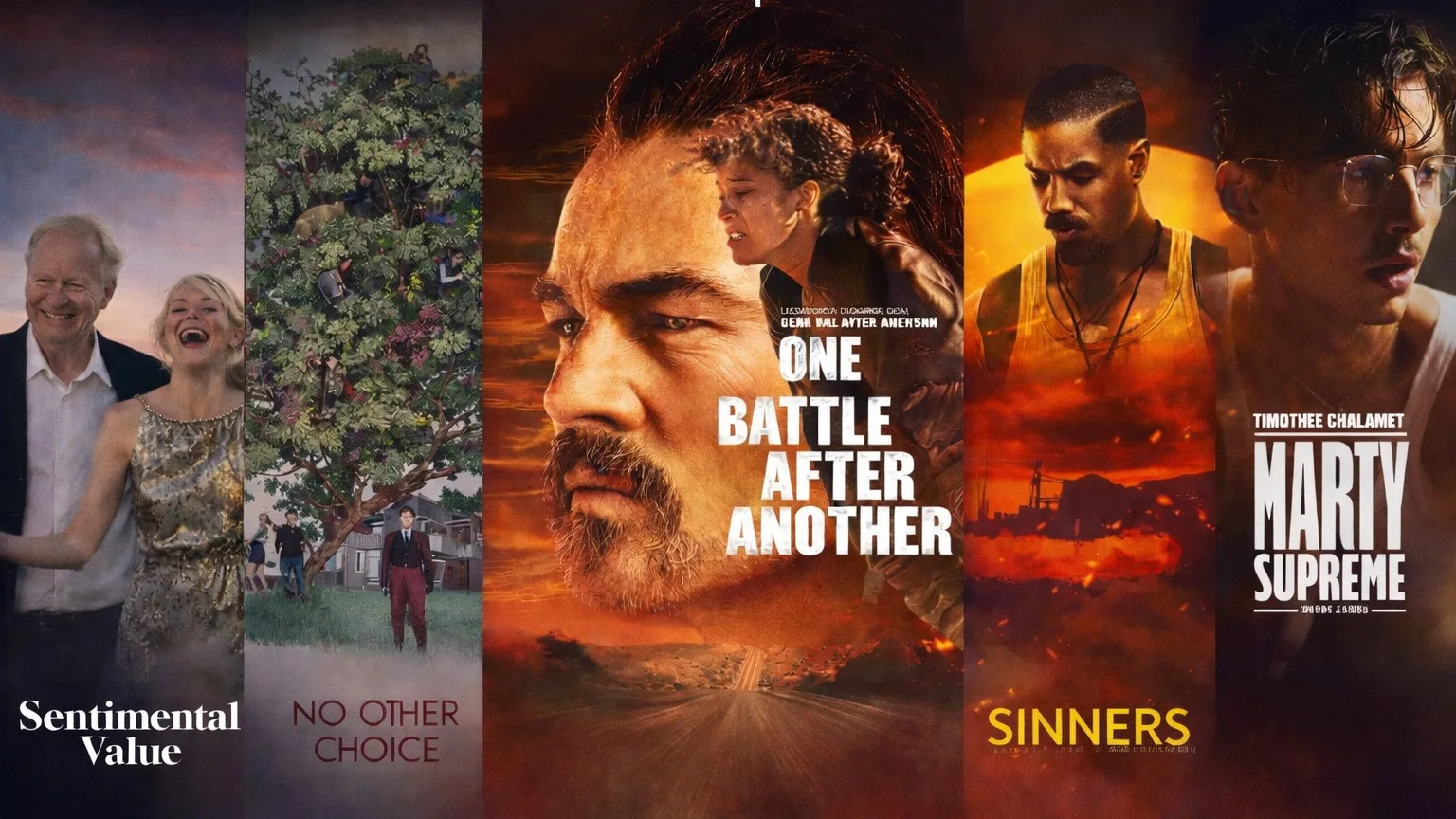
What earns the film this spot is how Park holds everything in balance. The satire never tips into farce, the tension never fully releases, and underneath the black humor sits a genuinely angry film about what late capitalism asks ordinary people to absorb and become. It arrived at Venice to significant acclaim and deserved every bit of it. In a year of strong cinema, No Other Choice is the one that made you laugh and then feel bad about laughing.
#4: SINNERS
Why watch: “Ryan Coogler reinvents vampire lore as a Southern Gothic horror about survival under systemic oppression.”
Runtime: 132 mins • MPAA rating: R • Notable line: “You have to become something they fear.”
Dir: Ryan Coogler | Cast: Michael B. Jordan | Tone: Horror drama | Notable scene: A transformation in the Mississippi Delta where a character embraces the monstrous to persist.
Ryan Coogler reinvents vampire mythology through lens of Jim Crow Mississippi, crafting bluesy genre film that operates as historical horror and social commentary simultaneously. Sinners makes vampires sexy again (no small feat after decades of defanged interpretations) while using the undead as metaphor for survival under systemic oppression: what does it mean to exist as predator in society that already treats you as prey? What transformations are required to persist in spaces designed for your extinction?
Coogler (whose Black Panther and Creed films established him as blockbuster filmmaker with artistic sensibility) brings rigorous craft to material that could have collapsed into exploitation or heavy-handed allegory. The film trusts genre conventions while bending them toward new purposes, vampire lore reimagined as Black Southern Gothic. The ensemble delivers performances pitched at heightened register that genre demands, finding humanity in the monstrous and monstrosity in the human.
The visual style evokes period-appropriate aesthetics while maintaining contemporary energy. Coogler shoots the Mississippi Delta as both beautiful and suffocating, landscape that nourishes and kills. The score blends blues, gospel, and horror motifs into something distinctly American, soundtrack that grounds supernatural premise in specific cultural tradition.
Commercial success alongside critical acclaim suggests Coogler achieved the rare feat: audacious original blockbuster that satisfies both box office requirements and artistic ambition. The film appeared on multiple year-end lists, including Barack Obama’s favorites, recognition that extends beyond usual genre ghetto. Christopher Nolan’s mentorship and influence reportedly shaped Coogler’s approach to big-budget auteur filmmaking, the lesson being that scale need not preclude vision. Sinners represents what blockbuster cinema can accomplish when financial resources align with genuine artistic perspective rather than committee-designed IP exploitation.
#3: SENTIMENTAL VALUE
Why watch: “Joachim Trier explores the reorganization of time and memory during the process of intense grief.”
Runtime: 128 mins • MPAA rating: Not Rated • Notable line: “We record because we are afraid they will vanish.”
Dir: Joachim Trier | Cast: Renate Reinsve, Stellan Skarsgård | Tone: Psychological drama | Notable scene: A woman scrutinizes old recordings to find a truth that remains elusive.
Joachim Trier returns with devastating portrait of memory, loss, and the ways humans construct narratives to survive grief. Sentimental Value follows a woman (Renate Reinsve, reuniting with Trier after The Worst Person in the World) documenting her mother’s final months through photographs and recordings, the film interrogating whether such documentation preserves or distorts the experience it claims to capture.
Trier structures the narrative non-chronologically, memories surfacing in associative patterns rather than linear progression, the temporal scrambling reflecting how grief reorganizes time itself. Reinsve delivers career-defining performance that navigates extreme emotional terrain with control that never feels like suppression; she embodies someone trying to feel everything while maintaining enough distance to function. The supporting cast (including Eivin Åsheim and Valene Kane) provides counterpoint, characters whose own losses intersect and illuminate the protagonist’s journey.
The cinematography (by Kasper Tuxen) achieves something remarkable: domestic interiors shot with attention that transforms ordinary spaces into repositories of meaning, light and shadow used to suggest emotional states without melodramatic emphasis. Trier’s formal sophistication has always matched his emotional intelligence; here both operate at peak capacity. The editing weaves between time periods with fluid grace, trusting audiences to assemble emotional chronology from the fragments presented.
What makes Sentimental Value extraordinary is its combination of intellectual rigor and devastating emotional impact. The film functions as meditation on representation itself—what photography and film can and cannot do, how documentation relates to lived experience, whether art can honor life or merely exploit it. These questions gain urgency through specificity of character and situation; philosophical concerns emerge from narrative rather than being imposed upon it.
Critics responded with near-universal acclaim, recognizing Sentimental Value as work of profound artistic achievement. The film appeared on virtually every major year-end list, its placement in the top tier reflecting consensus that Trier has created essential cinema. Awards recognition seems inevitable, though the film’s emotional difficulty might limit its reach beyond cinephile audiences. This feels appropriate; Sentimental Value doesn’t court easy popularity but rewards those willing to engage with challenging material.
#2: MARTY SUPREME
Why watch: “Josh Safdie provides Timothée Chalamet with a raw role that sheds his persona for a mature transformation.”
Runtime: 136 mins • MPAA rating: R • Notable line: “The view is exactly what I expected.”
Dir: Josh Safdie | Cast: Timothée Chalamet, Gwyneth Paltrow | Tone: Biographical drama | Notable scene: A moment of profound silence punctuates a fast-paced rise to fame.
Josh Safdie emerges from the collaborative Safdie Brothers partnership with singular vision fully intact, delivering vehicle for Timothée Chalamet that showcases the actor’s most mature, compelling work to date. Marty Supreme follows (presumably) biographical subject through rise and fall, though plot specifics matter less than Safdie’s characteristic frenetic energy channeled through more controlled aesthetic than his previous work.
Chalamet transforms physically and emotionally, shedding the pretty-boy persona that’s defined his career toward something rawer and less calculated. The performance suggests an actor hungry to prove range beyond romantic leads and literary adaptations, Safdie providing material that demands full commitment. The supporting cast (Gwyneth Paltrow in rare big-screen appearance, Odessa A’zion as crucial counterpoint) elevates ensemble work that could have been overshadowed by Chalamet’s showcase.
Safdie’s directing style retains the propulsive urgency that defined Good Time and Uncut Gems while incorporating new formal elements: stillness punctuating chaos, silence after cacophony, moments of genuine tenderness amid the anxiety. The December 25 release positions the film for maximum awards consideration, studio confidence justified by critical consensus. Marty Supreme appeared on virtually every major critic’s year-end list, recognition extending to Obama’s favorites alongside other 2025 highlights.
What distinguishes the film is its refusal to follow biographical formula or obvious narrative arcs. Safdie approaches his subject with empathy that doesn’t preclude critique, finding humanity in ambition without romanticizing the cost. The result feels like audacious entertainment of a type contemporary cinema rarely attempts: formally inventive, emotionally complex, starring an actor at the peak of his powers working with a director pushing him toward new territory.
The film narrowly misses the top slot, this placement reflecting less any deficit than the extraordinary achievement of the film claiming #1. Marty Supreme represents essential 2025 viewing, confirmation that Safdie possesses the vision to sustain major career while Chalamet cements status as generational talent willing to take genuine risks.
#1: ONE BATTLE AFTER ANOTHER
Why watch: “Paul Thomas Anderson directs a masterpiece about an aging revolutionary facing the weight of his own idealism.”
Runtime: 174 mins • MPAA rating: R • Notable line: “We fight so the world knows we haven’t given up.”
Dir: Paul Thomas Anderson | Cast: Leonardo DiCaprio, Teyana Taylor | Tone: Political drama | Notable scene: A father and daughter battle the consequences of a radical past at a rally.
Paul Thomas Anderson delivers a masterpiece that synthesizes his career-long preoccupations into singular artistic statement. One Battle After Another casts Leonardo DiCaprio as aging revolutionary drawn back into activist politics after years of retreat, the role providing DiCaprio with career-best material exploring weariness, doubt, and whether idealism survives repeated defeat without curdling into cynicism or fanaticism.
The ensemble radiates talent: Teyana Taylor confirming her genuine acting transformation, Benicio del Toro doing the character work that defines his late career, Sean Penn returning to PTA after decades, Regina Hall bringing gravitas, and Chase Infiniti (unknown actor whose discovery represents 2025’s major revelation). PTA’s directorial mastery operates at every level—cinematography capturing intimate moments and political rallies, score driving emotion without manipulation, editing maintaining rhythm across substantial runtime.
What secures the top position is contemporary resonance combined with artistic achievement. The film arrives when questions about effective resistance feel urgent rather than abstract, PTA refusing easy answers while avoiding nihilistic shrug. DiCaprio balances charisma with vulnerability, embodying someone who’s inspired thousands while harboring private doubts.
Critical response approached unanimous acclaim, appearing on virtually every major year-end list as Best Picture frontrunner. Obama’s inclusion validates beyond criticism circles. This represents complete cinematic achievement—direction, writing, performances, technical craft operating at highest level—that justifies cinema’s continued cultural relevance. This is why audiences must experience it: proof that the medium’s best possibilities remain accessible for those willing to reach.