
























![Kingdom Hearts Collection [I-III] Review](https://gazettely.com/wp-content/uploads/2026/10/Kingdom-Hearts-Collection-I-III-1-360x180.webp "Kingdom Hearts Collection [I-III] Review: KHII Holds Steady as Newer Entries Fluctuate 37")



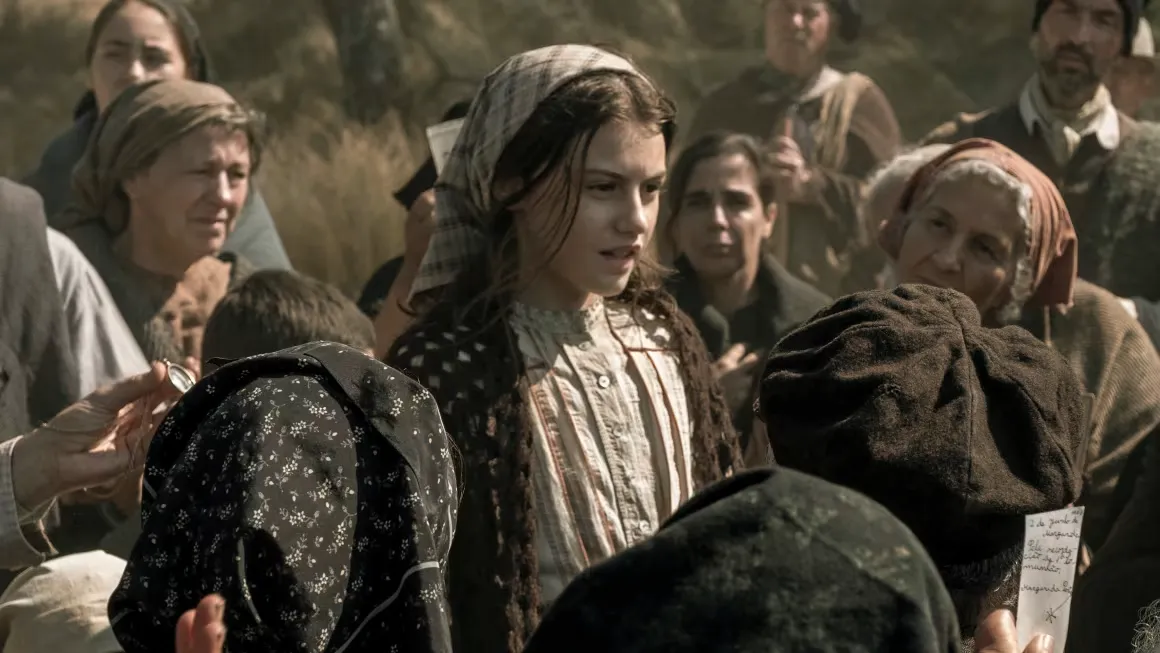

In 1917 Portugal, the parish of Fatima sits in a scorched, limestone-strewn countryside, a place running on old rhythms while modern slaughter hums close by. The Great War chews through young men in the trenches of France, and this village keeps going anyway, pulling life from stubborn soil, counting days by church bells and the roll call of the missing.
Ten-year-old Lucia dos Santos tends sheep with her younger cousins, Francisco and Jacinta Marto, living inside the small scale of labor, family, and quiet grazing. Then the air breaks open. The children describe a physical presence, “brighter than the sun,” standing atop a small evergreen tree. Light pours out in hard shafts, like something slicing the afternoon into strips, and the figure arrives with a message that carries its own kind of violence.
The demand is blunt: commit to the rosary, accept personal suffering, end the global conflict. It lands with a strange weight on children whose daily fears should stay confined to their flock. The moment smells of incense and something metallic, as if prayer has to compete with blood. Lucia’s brother Manuel has vanished into the war’s meat-grinder, and her mother, Maria Rosa, lives in a constant state of frayed nerves.
The film frames its premise as disruption, an unwanted arrival of the divine in a community already near collapse. Peace is promised, yet the message sparks a local battle of beliefs, loyalties, and suspicions. A miracle, in other words, behaves like a lit match in a hayloft.
The Architect of Doubt and the Vows of Silence
The story also shifts to 1989, settling inside the high walls of a Carmelite convent in Coimbra. Sister Lucia is now elderly, the lone survivor of the trio, seated across from Professor Nichols, an author built from the sturdy materials of skepticism. The framing device sets up a “cloisters-clash,” with the empirical mind pressing its face to the glass of the mystical. Nichols approaches faith without the easy sneer of a cartoon cynic.
He reads the 1917 events through mass psychology, maybe collective hallucination, and treats Lucia’s account like a case file that might confess if questioned long enough. His method is persistence: probe, circle back, look for the “tell” that might expose a childhood invention. Lucia meets him as an equal. Her wit runs dry and observant, and she seems faintly amused by how cramped his world becomes once it insists on the visible.
Their exchanges become the film’s intellectual marrow, a place where theology and logic share a table without flipping it. Nichols keeps returning to a simple insistence: an event that resists explanation does not earn an automatic passport to transcendence. He wants mechanics. He wants the “how” and “why” that can live inside a textbook. Lucia answers with an idea that is both plain and unsettling.
Faith begins at the edge of comprehension, right where understanding runs out of road. This 1989 strand comments on memory and conviction with a quiet sharpness, letting the film hold historical record in one hand and lived sacred experience in the other. The two figures embody a permanent human split, a respectful standoff where core principles stay intact, even as conversation keeps trying to soften them.
The Crucible of Family and the State
Back in 1917, Lucia’s path is shaped by pressures that keep tightening, and Stephanie Gil plays her with a haunted, steely focus. The sharpest pain comes from home. Maria Rosa becomes the central force of Lucia’s ordeal, and the conflict takes on the shape of “maternal-martyrdom” (the suffering born from a parent’s protective fear).
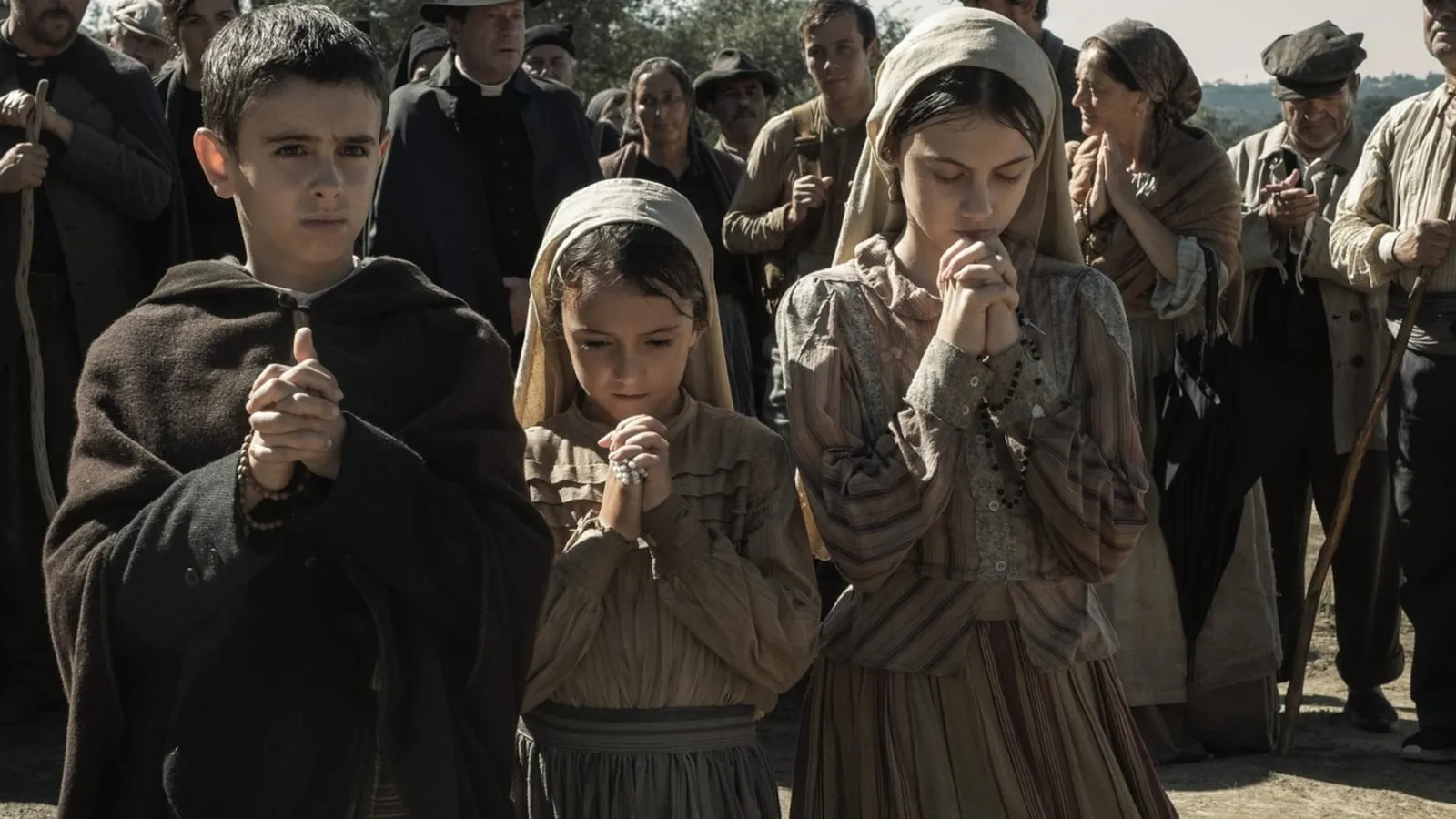
Maria Rosa is deeply pious, deeply traditional, and terrified her daughter has fallen into monstrous spiritual pride. She cannot grasp why the Mother of God would speak to her “difficult” child, bypassing the kind of holy figure the mind wants to appoint for such a moment: a priest, a saint, someone pre-approved. Her harshness grows from grief over her missing son, and the household turns brittle. Every sentence from Lucia lands like a fresh provocation aimed at a God who has already gone silent.
Outside the house, power wears a civic face. The mayor, Arturo, carries the anxieties of a secular republic, watching thousands of pilgrims arrive and seeing a threat to public order, a slide toward superstition. He lives in a private tension too, pulled between duty to the state and the quiet, brewing faith of his own wife. The Catholic hierarchy mirrors this caution, guarding itself, treating the children as risk and potential embarrassment.
Father Ferreira, the local priest, stands in a tight corridor between loyalty to his flock and orders from above to shut down what they call “hysteria.” Through interrogations, through intimidation, the children hold a strange calm. Even the threat of being boiled in oil meets a composure that suggests they have already looked at something more frightening than any local politician. The film gives these adults human motivations, tying them to the raw pain of a community that wants one basic thing: its children to stop disappearing into the war’s open mouth.
Landscapes of Light and the Visuals of the Void
Marco Pontecorvo brings a cinematographer’s instincts to the look of the film, refusing the glossy, artificial sheen that clings to so much modern religious cinema. He treats the Portuguese landscape with tactile reverence, almost grainy, as if the camera itself can feel heat and dust. The film’s visual grammar leans into “natural-theophany,” with hints of the divine arriving through physical movement: the silver-green shimmer of olive leaves, saltgrass pressed down by feet no one can see.
The apparition appears with startling simplicity, a barefoot woman in a white veil, free of the distracting CGI glow that turns cinematic miracles into science fiction. That plainness matters. It lets the sun stay hot, the soil stay gritty, and the supernatural feel like an eruption from the same ground everyone has been working all day.
That commitment to naturalism makes the film’s brief plunge into CGI-heavy hell feel jarring. When the children receive a vision of the underworld, the aesthetic shifts into literal fire and wailing souls, the familiar iconography of punishment rendered with digital force. The sequence plays like it wandered in from another movie, one that lacks the layered subtlety the rest of the production has been building. The vision does function as a severe reminder of what drives the children. Yet the film’s real weight sits elsewhere, in the quieter fields.
A child in a wind-swept patch of land, speaking to empty air with absolute certainty, carries a deeper chill than any digital fireball. By leaning into the miracle’s earthiness, the film argues for mystery as something local and immediate: a single beam of light striking ancient stone, a child’s face changing under the pressure of an unseen truth.
Released during the summer of 2020, Fatima is a poignant biographical drama that depicts the reported 1917 Marian apparitions in Portugal. The story follows three young shepherds whose spiritual testimonies inspire thousands of pilgrims while drawing the ire of both secular and religious authorities amidst the backdrop of World War I. As of today, December 25, 2025, the film remains available for audiences to stream or purchase on major digital platforms such as Amazon Prime Video, Apple TV, and Google Play.
Full Credits
Title: Fatima
Distributor: Picturehouse
Release date: August 28, 2020
Rating: PG-13
Running time: 1 hour 53 minutes
Director: Marco Pontecorvo
Writers: Marco Pontecorvo, Valerio D’Annunzio, Barbara Nicolosi
Producers and Executive Producers: Stefano Buono, Rose Ganguzza, Natasha Howes, Maribel Lopera Sierra, Richard I. Lyles, Marco Pontecorvo, James T. Volk, Holly Carney, David Fischer, Matthew J. Malek, Marco Valerio Pugini, Frida Torresblanco
Cast: Stephanie Gil, Lúcia Moniz, Joaquim de Almeida, Goran Visnjic, Sônia Braga, Harvey Keitel, Alejandra Howard, Jorge Lamelas, Joana Ribeiro, Alba Baptista
Director of Photography (Cinematographer): Vincenzo Carpineta
Editors: Alessio Doglione
Composer: Paolo Buonvino
The Review
Fatima
Fatima succeeds as a thoughtful "epistemological-drama" that prioritizes human conviction over spectacle. By grounding a famous miracle in the tactile, dusty reality of 1917 and the intellectual friction of a 1989 cloister, the film avoids the shallow pitfalls of modern religious cinema. It treats doubt with as much respect as belief, creating a space for genuine contemplation. While a heavy-handed sequence depicting the underworld creates a brief stylistic fracture, the performances and naturalistic cinematography provide a resonant, dignified exploration of what happens when the infinite touches the ordinary.
PROS
- Stephanie Gil’s grounded and convincing lead performance.
- Tactile, naturalistic cinematography that avoids "glossy" tropes.
- Respectful, intelligent framing device featuring Harvey Keitel.
- Complex characterizations of the secular and religious skeptics.
CONS
- The CGI-heavy hell sequence feels stylistically inconsistent.
- Some dialogue feels repetitive or overly didactic.
- The pacing occasionally slows to a crawl during village scenes.
- The literal depiction of the apparition may lack enough ambiguity.







