
























![Kingdom Hearts Collection [I-III] Review](https://gazettely.com/wp-content/uploads/2026/10/Kingdom-Hearts-Collection-I-III-1-360x180.webp "Kingdom Hearts Collection [I-III] Review: KHII Holds Steady as Newer Entries Fluctuate 37")




A hurricane filmed from the wrong side of good sense can look like judgment. Miko Lim’s Stormbound understands that image better than it understands restraint, which gives this documentary its strange split personality: half breathtaking elemental cinema, half motivational profile scored as if the clouds had hired a publicist.
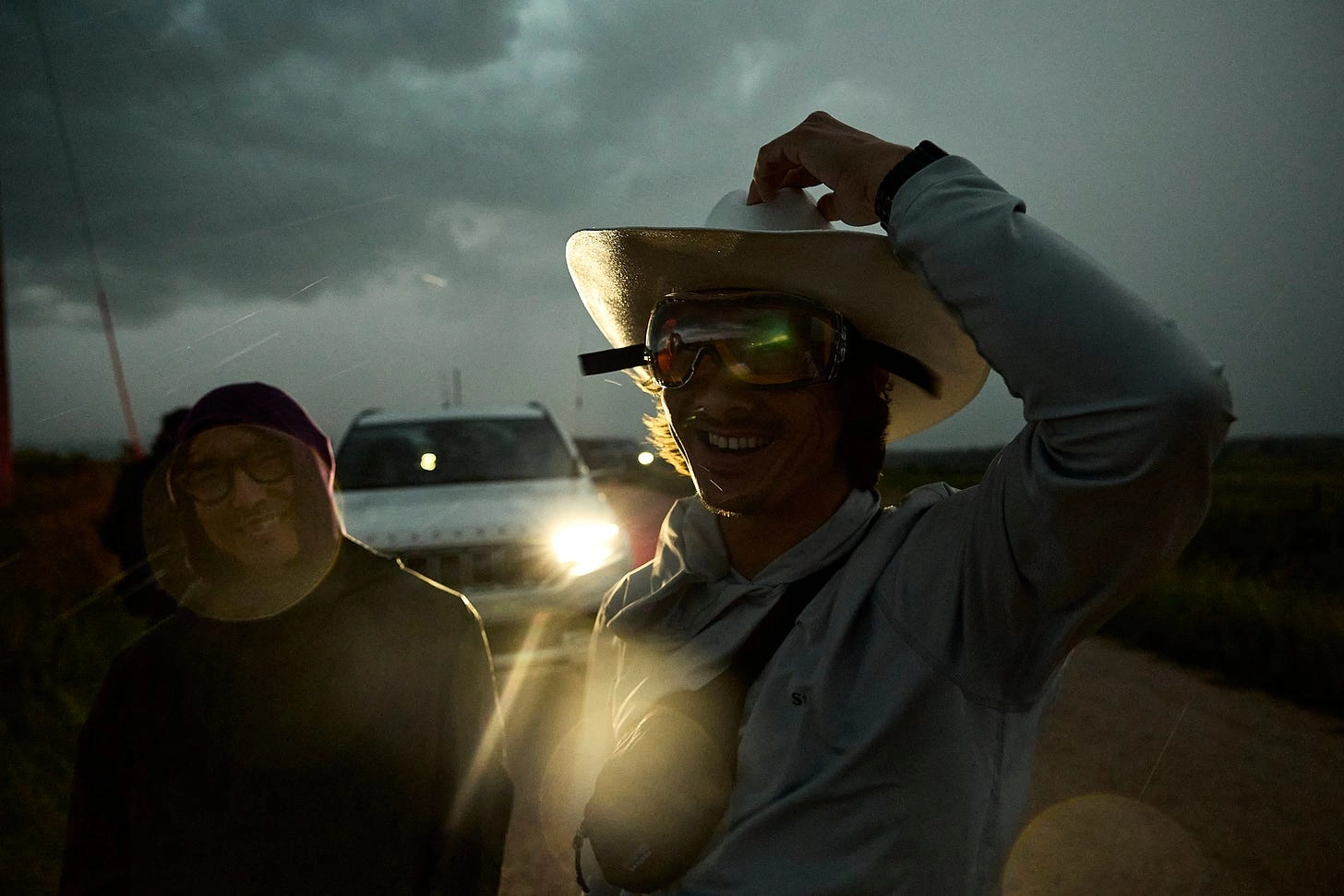
Lim follows Jeff and Sara Gammons, storm chasers who drive toward hurricanes, tornadoes, and supercells with cameras pointed at the sky and survival placed somewhere in the glove compartment. Jeff has recorded and studied major American storms for decades, including Hurricane Katrina, where his footage from Biloxi’s Mississippi Coliseum becomes both environmental document and personal confession.
In January 2023, he is told he needs a second kidney transplant. The film then places his body and the weather into a shared frame, sometimes with piercing force, sometimes with the delicacy of a siren test.
A Body Under Weather
Jeff’s biography gives Lim dramatic material that would make fiction seem shy. He was born with cancer on his spine, endured paralysis, kidney disease, open-heart surgery, a mechanical valve, and a first transplant that bought him fourteen years before the second became necessary. One childhood detail lands with brutal clarity: doctors broke the bones in his legs and placed him in braces to correct a congenital issue. The image of correction through fracture says plenty about Jeff’s relationship with pain.
That relationship becomes clearest in the Katrina material. He films inside and outside the Mississippi Coliseum while in stage 5 kidney failure, giving himself dialysis in a storage closet. The frame here carries moral pressure. One man records a public catastrophe while managing a private one, and the documentary barely needs to underline the symmetry. The storm is outside the building. The storm is inside the body. Yes, we get it. The power lies in watching him continue to point the camera.
Sara gives the film its emotional counterweight. She is not merely the worried spouse waiting beside a phone. She chases storms with Jeff, films with him, and considers donor testing when his kidney failure becomes urgent. Her interviews are often tearful, but her presence is strongest in the field, where the marriage becomes a working unit under pressure. When the pair drives toward a blackening sky, the romance is not verbal. It is logistical. Who watches the road? Who watches the radar? Who accepts fear as part of the equipment?
The Architecture of the Storm
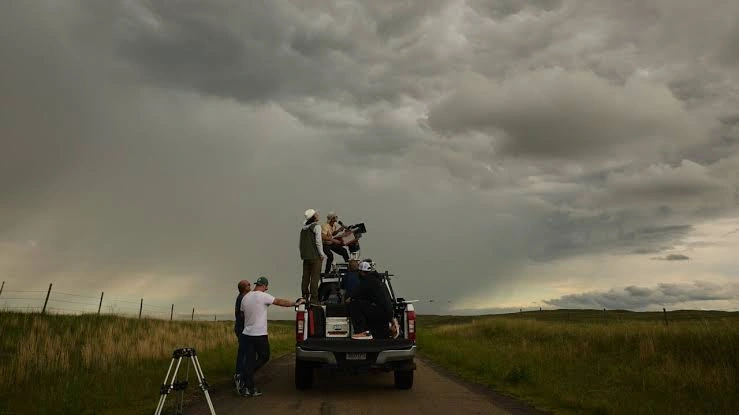
The images are the reason Stormbound exists. The opening note that no visual effects were used matters because several shots seem engineered by an angry god with excellent coverage. Supercells gather over Nebraska like bruised cathedrals. Tornadoes touch down in Oklahoma with that obscene grace weather has when it forgets humans are small. Lightning cracks across the frame with clean, surgical violence.
Cinematographer Rich Hama and the storm footage captured by Jeff and Sara give the IMAX format a subject worthy of scale. The wide images do not merely make storms larger. They make the viewer feel how scale changes ethics. A man standing near an SUV while hurricane winds lift his body off the ground is a thrilling shot, yes, but it is also an accusation against our appetite for thrill. The camera holds enough for awe to curdle into worry.
The drone work can be extraordinary. When the camera rides close to swirling dust inside a tornado or pulls back to show a storm system organizing itself across the horizon, the documentary finds a visual grammar for helplessness. Satellite footage gives the storms their strategic shape, while ground-level images give them teeth. Lim is at his best when he allows these perspectives to argue with each other: the god’s-eye view, then the human trapped under it.
The sound design has moments of real intelligence. Wind does not sound like a single force here. It rasps, pounds, hisses, and attacks the microphone in layers. Thunder arrives less like punctuation than warning. Chad Cannon’s score can lift these passages into grandeur, especially when the music lets a low pulse sit beneath the storm rather than climbing over it. Too often, it climbs.
The Metaphor Machine
The film’s weakness is not that it connects Jeff’s illness to the storms he chases. That connection is unavoidable, and in the right shot it is devastating. The weakness is the insistence with which Lim keeps restating it. A slow fade that places storm imagery over an operating theatre feels like an editor translating a thought the audience already speaks fluently. The image does not deepen the idea. It laminates it.
Some of the voiceover has the same polished sheen. Lines about weather serving as an escape from darker addictions sound rehearsed into shape, drained of the awkwardness that often makes documentary speech feel alive. That may be unfair to the subjects, but the film’s construction invites the suspicion. The score swells, the edit tightens, the sentence lands. Too clean. Life rarely hits its marks so neatly.
This matters because Jeff and Sara are most affecting when the film stops arranging them into symbols. Sara considering kidney donation carries real weight because the choice is bodily, intimate, and practical. Jeff holding on to his SUV in punishing wind carries force because it makes no speech about mortality. It simply shows a man whose body has betrayed him choosing a danger he can face head-on. The storm does not need to be a metaphor every minute. Sometimes it is weather. Sometimes weather is enough.
Awe, Risk, and Control
There is a moral ambiguity running through Stormbound that Lim notices without fully interrogating. Storm chasing turns danger into image, and the film benefits from that conversion. We get the beauty, the terror, the impossible footage. People in the path of these storms get wreckage. The documentary does acknowledge destructive power, yet its visual pleasure keeps pulling it toward seduction. This is not a flaw by itself. It is the subject.
That tension gives the best footage a noir edge, strange as that sounds for a daylight documentary about meteorology. Jeff is drawn toward forces that could erase him, not because he misunderstands danger, but because danger offers a kind of clarity his medical life denies him. Hospitals are lit spaces of waiting, measurement, and bad news. Storms are violent, legible, immediate. In one, he is a patient. In the other, he is the man holding the camera.
Lim’s film works whenever it trusts that distinction. The final-act storm footage has an elemental beauty that makes the documentary’s excess feel almost forgivable. Almost. The clouds know how to perform without direction. Stormbound keeps trying to cue them anyway.
The immersive American IMAX documentary Stormbound celebrated its world premiere at the SXSW Film Festival on March 14, 2026, where it won the Special Jury Award for Best Feature Documentary. Produced alongside Adam McKay, the visually jaw-dropping film captures thirty years of raw environmental footage as it tracks veteran storm chaser and photographer Jeff Gammons through the world’s most powerful hurricanes and tornadoes. As Gammons confronts a near-fatal kidney disease recurrence and faces the reality of a body failing him, the narrative explores the steep personal and mental toll of a life spent chasing uncontrollable natural elemental forces, offering an intimate love story between him and his dedicated wife, Sara, as they race against the clock ahead of his medical procedures. Audiences can catch this high-stakes cinematic experience as it screens across elite international festival showcases, including CPH:DOX, with a wider IMAX format rollout managed through public sales contact channels.
Where to Watch Stormbound (2026) Online
Full Credits
Title: Stormbound
Distributor: IMAX, CAA (Sales Agent)
Release date: March 14, 2026 (SXSW Film Festival)
Running time: 95 minutes
Director: Miko Lim
Writers: Documentary film (unscripted/no credited writers)
Producers and Executive Producers: Miko Lim, Adam McKay, Todd Schulman, Trevor Jones, John Turner, Stephanie Mercado, Randy Kiyan, David Clair, Ethan Harari
Cast: Jeff Gammons, Sara Gammons
Director of Photography (Cinematographer): Richard Hama
Editors: Miko Lim, Leslie Jones, Nick Pezzillo
Composer: Colin Stetson
The Review
Stormbound
Stormbound earns its awe through real images of impossible weather, then dulls that awe by explaining its own metaphor too loudly. Jeff and Sara Gammons give the film an emotional charge that needs little decoration, especially in the Katrina archive and the final storm passages. Lim’s camera sees scale, danger, and mortality with force. The score and voiceover keep pushing where silence would cut deeper. A visually mighty documentary with an overdeveloped thesis.
PROS
- Astonishing storm footage
- Strong IMAX scale
- Jeff and Sara’s lived risk
- Powerful Katrina archive
- Immersive wind sound
CONS
- Heavy-handed illness metaphor
- Overbearing score
- Polished voiceover lines
- Operating-room storm fade
- Too much emotional instruction







