












![Kingdom Hearts Collection [I-III] Review](https://gazettely.com/wp-content/uploads/2026/10/Kingdom-Hearts-Collection-I-III-1-360x180.webp "Kingdom Hearts Collection [I-III] Review: KHII Holds Steady as Newer Entries Fluctuate 40")


A child catches a loose shoelace while gripping a heavy pumpkin, then pitches forward and tumbles down a staircase. The fall lands with the blunt finality of an everyday accident, yet The Twin treats it like a curse stamped into the floorboards. Nicholas watches his son die, locked inside a moment he cannot revise. After the funeral and a stay in a psychiatric facility, he and his wife, Charlie, withdraw to a secluded estate that once belonged to his grandmother. The house is framed as a place meant to mend damage. The film turns it into a place where damage takes shape.
Nicholas soon meets a figure that carries his own outline. The Fetch arrives as a mirror that breathes. It functions as a traditional omen of impending doom, drawn from ancient folklore, and it also behaves like a private symptom given legs.
The story keeps its gaze on what trauma does over time, the slow abrasion of the mind as grief reshapes routine, memory, and perception. It poses the Fetch as an external predator and as the product of a psyche fractured by loss. The Twin refuses quick certainty, treating grief as something with mass, something that leans on the body until the world itself looks warped.
The Mirror and the Healer
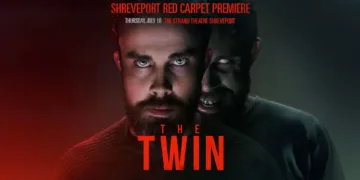
Logan Donovan plays the duality of his role with strained physical intensity. His Nicholas reads as a man carved out by guilt, moving through rooms like someone carrying an invisible burden in his joints. Donovan’s work as the Fetch stays equally controlled, built from minute changes in posture that register as a wrongness the viewer feels before fully naming. The double stands close, silent, watchful, and the stillness gains an edge. It becomes a presence that shadows Nicholas’s search for peace and makes that search feel exposed.
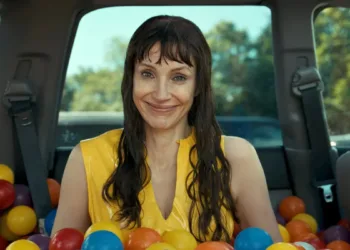
Aleksa Palladino plays Charlie at the margins of the film’s attention, and the choice matters. The story stresses her isolation as she manages the house while Nicholas slides into paranoia. Her mourning fades behind the loudness of his collapse, a grim portrait of how shared tragedy can split a partnership into separate rooms. She remains present, working, waiting, absorbing, while the marriage strains under an imbalance the film never smooths over.
Robert Longstreet brings needed warmth as Dr. Beaumont. The psychiatrist approaches Nicholas with human closeness and patient steadiness, rooted in his own history of loss, and that history becomes a bridge rather than a credential. Their relationship serves as the story’s emotional anchor, and Longstreet makes Beaumont feel accessible without sanding down the seriousness of the work. The bond keeps the horror tethered to lived pain, shifting attention toward the terror of vulnerability itself.
Shadows in the Ancestral Home
The grandmother’s house functions like a character, built from narrow hallways and shadowed corners that press inward. Its architecture manufactures claustrophobia, and the cinematography treats that pressure as a tool. The spaces are used to mislead the eye: lighting places the Fetch in plain sight, often near the edge of the frame, where recognition arrives a beat late. Unease grows from that quiet manipulation. The camera alternates between wide shots that stress isolation and tight shots that cling to Nicholas’s face as panic registers in real time.

Folk horror textures give the film its personality, and the music carries emotional weight alongside the imagery. In quieter passages of despair, the score settles into a heavy, resonant sound that echoes the characters’ sorrow. During suspense sequences, the sound turns jagged and sharp, cutting into the air like a warning.
The Fetch’s design avoids excessive makeup, leaning on the horror of familiarity: a human face rendered cold, emptied of softness. Jump scares appear sparingly, used to pierce the dense atmosphere of dread rather than to replace it.
The Dreamscape of Recovery
The line separating mental instability from supernatural reality stays thin. The monster operates as a surrogate for Nicholas’s self-destructive impulses, a shadow given a form he cannot ignore. Dr. Beaumont turns to hypnosis as a weapon against that shadow, and the sessions play as grueling confrontations. Nicholas is forced to face the part of himself that wants surrender, the impulse toward death dressed up as relief.
The final confrontation moves into a surreal dreamscape, and the film uses vivid symbolism to stage a war for Nicholas’s soul. The climax becomes a literal struggle to protect his marriage from the ghost of his son, with grief presented as something that can invade intimacy and hollow it out.
The resolution offers no clean cure. Recovery is framed as ongoing work, with pain remaining present rather than erased. Victory takes the shape of agency reclaimed from the Fetch, a decision to choose life while the void continues to call. The film closes on a stark proposition: tragedy becomes permanent scenery, and success looks like walking through it without letting it swallow the road ahead.
Directed by J.C. Doler, The Twin (also known as The Fetch) is an American psychological horror-thriller that explore themes of grief, trauma, and folklore. It premiered in limited theaters and on digital platforms on July 1, 2025, and later became available for streaming exclusively on Shudder starting August 29, 2025. The story follows a grieving father, Nicholas, who moves into his childhood home following the tragic death of his son, only to be haunted by a spectral doppelgänger known in Irish lore as a Fetch. You can currently watch the film on Shudder, AMC+, or purchase it through various VOD services like Apple TV and Amazon Video.
Full Credits
Title: The Twin
Distributor: Vertical, Shudder, VRC
Release date: July 1, 2025 (United States)
Running time: 103 minutes
Director: J.C. Doler
Writers: J.C. Doler, Paul Petersen, Taylor Bracewell, Chris Alan Evans
Producers and Executive Producers: Alexander Jeffery, Logan Donovan, J.C. Doler, Paul Petersen, Brittany Fallow, Chris Alan Evans, Lindsey Pellette
Cast: Logan Donovan, Aleksa Palladino, Robert Longstreet, Shannon Cochran, Pam Dougherty, Isabella Banks, Quinney Bucky, Tripp Toupal
Director of Photography (Cinematographer): Joel Froome
Editors: J.C. Doler
Composer: Zviad Mgebry
The Review
The Twin
The Twin provides a somber look at how a father survives the unthinkable. It succeeds by grounding its scares in the real pain of a family in crisis. Logan Donovan’s performance gives the story a necessary weight. The film avoids being a simple ghost story by focusing on the mental strain of guilt. It uses folklore to externalize internal pain. This approach results in a horror film that feels grounded and serious. It remains a solid entry in the subgenre of trauma-driven horror.
PROS
- Strong acting from Logan Donovan and Robert Longstreet.
- Effective use of atmospheric lighting and set design.
- Serious treatment of heavy emotional themes.
- Skillful use of Irish folklore to enhance the horror.
CONS
- Limited character development for Charlie.
- Predictable plot beats in the second half.
- Slow pacing that might lose some viewers.