























Greek Mothers Never Die lands in the supernatural comedy lane with an approach that plays intimate feeling and stage-ready exaggeration in the same breath. Rachel Suissa writes, directs, and stars, and she steers away from studio rom-com gloss in favor of an indie tone that values emotional grain. Ella lives inside a Greek-American pocket of Florida where her mother, Despina, takes up most of the available oxygen.
The plot kicks into gear with a hard turn: Despina dies during a blowup over Ella’s future. The script then rejects the clean relief that a premise like this can offer. Despina comes back as a spectral chaperone, still opinionated, still intrusive, and death treats her like a mild inconvenience.
That new reality complicates Ella’s attempt to restart a romance with Nick, a doctor tied to her earliest heartbreak. By placing this story in a town with bilingual street signs, Suissa builds a setting where past and present stay in constant conversation. The film keeps returning to a simple idea: cultural and family expectations can linger with the persistence of a haunting.
The Weight of a Matriarchal Ghost
The character work depends on the high-friction chemistry between Suissa and Abby Miner, and the film knows it. Suissa plays Despina as pure force of will, someone who treats the laws of nature like optional guidelines. Her shift from living parent to lingering spirit barely softens her command of the room.
She leans on physical comedy, drifting into the edges of scenes so she can judge Ella’s decisions with a stare, then seal the verdict with a sharp remark. The performance gives Despina the shape of a person, driven by intense motivations that land in the wrong place, instead of letting her flatten into a one-note gag.
Miner acts as Ella’s grounding point, taking on the “straight man” role opposite the chaos. She captures the fatigue that comes from living as the main project in a parent’s life, and she carries a restless charge that makes Ella’s need for autonomy feel immediate. Simon Rérolle enters as Nick and changes the temperature of the scenes. His calm, low-key presence plays against the mother-daughter frenzy, which turns him into a pressure point for Ella’s decisions.
Also Read






He pushes her toward a choice between the comfort of her mother’s shadow and the risk of starting again on her own terms. The supporting players widen the community, with Nick’s friend Tod standing out as part of that orbit. The film still keeps its attention on the trio, using the side characters to underline a town where everyone stays involved in everyone else’s business, the kind of place where a ghost can feel like a socially acceptable plus-one.
Ochre Tints and Auditory Echoes
The film leans on place and texture to create a hazy, dream-tinged atmosphere that distracts from its modest budget. Cinematographer Angélica Perez-Castro shoots with sun-washed brightness, framing Florida suburbia so it reads like a cousin to the Greek coast.
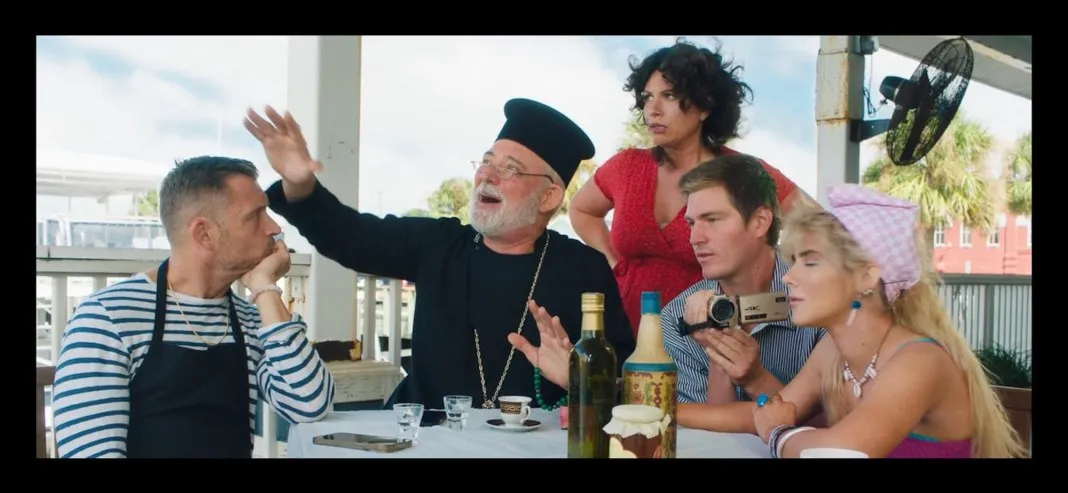
The point comes through clearly: heritage shapes the characters more than geography ever will. The palette does a lot of work, favoring Mediterranean warmth with deep teals, baked ochres, and amber light that push the imagery toward saturated, near-surreal territory. Despina’s appearances arrive with cooler, dimmer lighting, and that shift gives the audience a clean visual signal as Ella’s reality keeps changing.
Production design reinforces the same idea through lived-in detail. Blue-and-white ceramics and specific floral patterns bring a sense of history without polishing it into something sterile. Sound design carries equal weight in selling the supernatural angle. The film avoids jump scares and uses smaller cues instead: the soft rustle of fabric, the creak of a chair, the suggestion that a presence has entered the room before anyone turns their head.
That choice protects the light, playful tone. Abraham Gomez Rosales’s score moves through pop-rock grooves that sometimes break into full musical numbers. The change can arrive abruptly, yet it matches the story’s heightened rules, and the music supplies forward motion that helps the film move between comedy beats and heavier emotion without stalling.
The Evolution of Grief and Genre
Structurally, the screenplay aims high. It chooses a genre mix instead of settling into a safe template, and the film’s shape shifts as it goes. It starts in familiar romantic-comedy territory, then grows into fantasy drama that sits with grief and its long aftereffects.
That progression tracks Ella’s inner state, where life can feel erratic and outside her control. The script treats parental love as a complicated inheritance, something that demands sorting before adulthood can fully begin. It also asks the audience to hold parents in full dimension, complete with fears and private dreams that do not fit neatly into the role they play for their children.
The film threads the immigrant experience through a family clinging to its roots while trying to set new ones in Florida. The dialogue is strongest during the mother-daughter exchanges that rely on cultural shorthand, mixing humor with pointed observations about duty. A major story turn arrives with a revelation about Ella’s health, and it forces the audience to reconsider what the haunting has meant up to that point.
The twist frames the ghosts we see as reflections of internal struggle or physical condition, and that idea gives the narrative extra weight beyond the familiar meddling-ghost setup. The pacing wobbles under the number of ideas in play, yet the film keeps a sincere grip on its subject: the ways the dead stay present in the living. Despina may be gone, yet the story treats her influence on Ella’s identity as something that remains fixed in place.
Greek Mothers Never Die arrived on VOD platforms on May 9, 2025, after gaining recognition at several international film festivals through late 2024 and early 2025. This production explores the complex relationship between a mother and daughter through a supernatural lens. It reached a global audience through digital storefronts and streaming services. You can currently watch the film on Amazon Prime Video or Apple TV. It is also available for free with advertisements on platforms such as Fandango at Home, Hoopla, and Plex.
Full Credits
Title: Greek Mothers Never Die
Distributor: Gravitas Ventures, R.A.D. Pictures
Release date: May 9, 2025
Rating: PG-13
Running time: 120 minutes
Director: Rachel Suissa
Writers: Rachel Suissa
Producers and Executive Producers: Eleonore Dailly, Eloïse Descleves, Edouard De Lachomette, Rachel Suissa
Cast: Abby Miner, Rachel Suissa, Simon Rérolle, Carter Sirianni, Wade Hunt Williams, Kelby Roberson, Asia Suissa-Fuller
Director of Photography (Cinematographer): Angelica Perez-Castro
Editors: Yosa Whitney, Rachel Suissa
Composer: Abraham Gomez Rosales
The Review
Greek Mothers Never Die
Greek Mothers Never Die is a sincere, albeit messy, exploration of the enduring weight of family. While the film occasionally struggles under the weight of its own genre-blending ambitions, the central performances from Rachel Suissa and Abby Miner provide a grounded emotional center. It effectively captures the friction of the immigrant experience and the complicated process of reconciling with a parent's flaws. It is a whimsical, heartfelt piece that prioritizes character texture over polished structure.
PROS
- Strong, high-energy chemistry between the lead actresses.
- Vibrant, Mediterranean-inspired color palette and cinematography.
- Sincere exploration of grief and the mother-daughter bond.
- Inventive use of supernatural elements for comedic effect.
CONS
- Uneven pacing as the story shifts between multiple genres.
- Sitcom-safe humor that sometimes relies too heavily on tropes.
- Visible budget constraints in certain interior scenes and transitions.
- The late-stage musical numbers may feel jarring to some viewers.