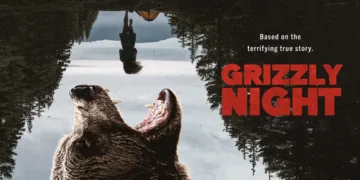









In August 1967, Montana’s Glacier National Park sits under smoke plumes and the low-grade panic of fire season. Burke Doeren’s film adapts Jack Olsen’s non-fiction account of a night when the statistically impossible turned literal. Within a single evening, two fatal grizzly attacks occurred nine miles apart.
That odd geography becomes the story’s spine, and the movie treats it with a sobriety that refuses carnival-barker monster-movie business. What you get is a survival thriller built on recorded history, then tightened into something grimly efficient.
We step into this world through rookie park ranger Joan Devereaux. It is her first day at the station, which lands like a small act of narrative cruelty given what is about to break loose. The film splits its attention between the Granite Park Chalet and Trout Lake.
It tracks multiple camping groups, including Julie Helgeson and Michelle Koons, as they move through a wilderness that no longer behaves in a predictable way. The 87-minute runtime keeps the experience compact. It cuts the padded spectacle that bloats plenty of contemporary disaster epics. The pacing has a clipped, procedural plainness. The film honors the dead by keeping the timeline intact and resisting decorative invention.
Sonic Dread and Visual Restraint
Director Burke Doeren works in a visual mode I’d tag as “period-authentic stillness.” Cinematographers Brian Mitchell and Ian Start push back against the glossy sheen of contemporary digital imagery. They favor a 1967 grammar (stable compositions, movement that feels chosen rather than restless).
Daylight frames the sunlit majesty of freshwater lakes and snow-capped peaks, postcard beauty with a slightly indifferent stare. Night is where the film speaks most clearly, in woods rendered with naturalistic darkness that swallows detail and turns space into a problem you can’t solve with your eyes.
Also Read




It helps that the Dolby 5.1 mix does much of the horror work. Ambient detail takes priority over visual gore. You hear the hush around burned-out campfires. You hear the weight of a quarter-ton animal shifting above a fabric sleeping bag. Those cues land with a stomach-drop force precisely because the image stays disciplined.
Dan Reckard’s folk-tinged score, carried by harmonica and dobro, fills gaps without wrestling the soundscape away from snapping branches and hard breathing. The editing manufactures fear through perspective, placing us beneath the bear or inside the panicked POV of a fleeing hiker. This sound-forward design turns the theater into a sensory trap, and it argues for a blunt idea: danger arrives first as a noise you cannot place.
The Human Calculus of Crisis
The ensemble cast supplies ballast to a situation that could tip into melodrama. Lauren Call plays Joan Devereaux with conviction that feels aligned with the historical record, and the film lets her competence emerge under pressure rather than handing it to her as a heroic badge. She deals with the casual sexism of the 1960s park system and still ends up pressed into leadership she never requested.

Oded Fehr brings medical urgency as Dr. John Lindberg. His calm competence steadies the audience (and, by extension, the characters), which is a sneaky form of mercy in a film this tense. At Trout Lake, the teen material involving Paul, Michele, and Roy adds tragic innocence, a reminder that the night’s arithmetic includes people who have not learned how quickly nature can revise the rules.
Special effects makeup artist Abigail Steel earns attention for restraint. Her “blood balloons,” used to depict Julie’s injuries, are gruesome while staying anatomically purposeful. The effect underlines the physical reality of a collapsed lung without reducing the victim to set dressing. The film treats these individuals with genuine dignity, and it shows in small choices: the presence of Father Connelly, for one, who facilitates an ecumenical moment of peace for a dying victim that feels earned rather than performative.
At the chalet, strangers band together while communication collapses. The film studies collective action under stress, less as inspirational poster text and more as a practical human reflex. People do what they can for someone who may not make it. That is the film’s moral math, and it lands hardest in the moments where help arrives late and decency still matters.
The Price of Anthropocentric Hubris
The tragedy of 1967 grows from a profound ethical failure. For years, park management allowed improper trash disposal and intentional bear feeding to attract tourists. The film looks at that “garbage-to-grizzly” pipeline with an analytical gaze, carrying a modern awareness of wildlife stewardship while staying anchored in the period. The characters at the Granite Park Chalet are forced to face a plain fact: human behavior drew danger into human space.
The attacks’ aftermath sparks a radical shift in national park policies. The film shows the grim necessity of rangers hunting the bears in a desperate attempt to restore safety. It plays as an ugly civic ritual. Humans set the conditions for violence, and the animals pay the final bill. That contradiction sits in the film like a stone you keep turning over, hoping it will feel different in your hand.
The movie also captures collective grief in a way that speaks to current environmental anxieties without lecturing. It expands beyond the specific events of August 12 to examine the line between civilization and the wild, and how quickly that line collapses when people treat predators as entertainment. The film functions as a cautionary tale about the arrogance baked into the belief that the untamed can be managed into harmlessness. It preserves the memory of a night that permanently changed how a nation looks at its wilderness.
Grizzly Night premiered in early 2026 as a sobering dramatization of the 1967 “Night of the Grizzlies” tragedy. Released in the United States on January 30, 2026, the film is currently available for viewing on digital and Video On Demand (VOD) platforms such as Vudu and Apple TV. In the United Kingdom and Ireland, the movie was released on February 2, 2026, through Lightbulb Film Distribution. The story remains a poignant reminder of a historical turning point in wildlife management, captured with a focus on human resilience and environmental responsibility.
Where to Watch Grizzly Night 2026 Online





Full Credits
Title: Grizzly Night
Distributor: Saban Films, Lightbulb Film Distribution, Well Go USA
Release Date: January 30, 2026
Rating: R
Running Time: 87 minutes
Director: Burke Doeren
Writers: Katrina Mathewson, Tanner Bean, Bo Bean
Producers and Executive Producers: Lauren Call, Burke Doeren, Kellie Doeren, Tyson Call
Cast: Brec Bassinger, Jack Griffo, Charles Esten, Oded Fehr, Joel Johnstone, Josh Zuckerman, Matt Lintz, Ali Skovbye, Lauren Call
Director of Photography (Cinematographer): Brian Mitchell, Ian Start
Editors: Michael DeJohn, G. Mitchell Johnson
Composer: Dan Reckard
The Review
Grizzly Night
Burke Doeren’s debut is a somber, intellectually honest examination of the friction between human negligence and wild reality. By prioritizing sonic dread and historical texture over digital gore, the film elevates a tragic footnote into a haunting meditation on environmental hubris. While the human drama occasionally feels secondary to the atmosphere, the film succeeds as a respectful, atmospheric reconstruction of a national crossroads. It is a lean, effective thriller that finds its power in what it chooses to withhold.
PROS
- Exceptional, immersive sound design and 5.1 mix
- Respectful treatment of real-life victims
- Strong, grounded performances by Lauren Call and Oded Fehr
- Effective use of practical makeup and visual restraint
CONS
- Occasional "streaming era" visual flatness in daytime scenes
- Shallow character development for some supporting roles
- Tonal uncertainty between historical drama and survival thriller
- Underdeveloped exploration of the protagonist's interior life