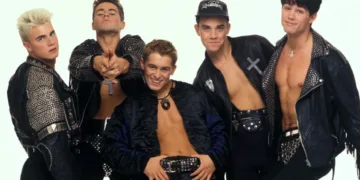





















The Manchester pop machine gets the prestige shine in Netflix’s three-part documentary. Directed by David Soutar, the series covers thirty-five years of Take That. The clock starts in 1990 and stays glued to the arc: five young men moving from the drizzly streets of Northern England to the peak of global superstardom.
Their rise plays out from early pockets of localized hysteria through to their present role as chart elder statesmen. The documentary treats that 1990 formation as the flashpoint for a cultural phenomenon that helped set the tone for British pop music.
Gary Barlow, Mark Owen, and Howard Donald carry most of the narration, speaking as adults who once lived under a microscope. The series frames their path as survival, persistence, and adaptation, charting a move from a manufactured quintet to a self-sustaining trio.
The presentation aims big, matching the scale of the stadiums they fill today. It wants to function as a factual record of how they became a permanent fixture in millions of lives. Pop history, plated like a fancy cheese course and served with a straight face.
A Scrapbook in High Definition
Soutar builds the narrative with an enormous volume of archive footage, and much of it plays with the charge of discovery. Grainy recordings in school halls slide into the high-definition gloss of modern arena tours, and the jump in texture does a lot of storytelling on its own. Time passes in the pixels.
The style leans into a scrapbook mood, with old photographs and news clippings streaking across the screen to mimic the frantic energy of 1990s fan culture. The effect drops you into a world of teen magazines and physical singles, back when obsession had paper cuts.
The interview approach is a clear creative choice. Gary, Mark, and Howard contribute new audio commentary while staying off camera, keeping the spotlight on the images that built the myth. The method preserves the nostalgic spell for longer, and the series commits to it.
Robbie Williams and Jason Orange appear through vintage clips, with their perspectives limited to what the archives can provide because they did not record new sessions for this project. That absence shapes the tone into something reflective, acknowledging who is missing while still honoring the group memory. Even the production values track the band’s own evolution, moving from early low-budget grit to later polished perfection.
From Gay Clubs to Global Grief
The origin story begins with manager Nigel Martin-Smith assembling the group in Manchester, and the early stretch looks decidedly unglamorous. They play school assemblies and local venues before landing in gay clubs, a practical search for an audience that welcomed the act.

The footage catches them in chainmail codpieces, working choreography that feels like it belongs to a different universe than the stadium shows waiting down the road. The music video for “Do What U Like” stands as proof of the group’s early willingness to do anything for a hit, complete with mops, jelly, and bared buttocks. Dignity takes a rain check.
Tension simmers inside the quintet from the start. Gary Barlow is presented as the primary songwriter and musical leader, a dynamic that leaves the others feeling sidelined. Robbie Williams comes through as someone who felt like a backup dancer in a project built to serve Gary’s ambitions.
The band hits its peak with major songs like “Back for Good” and “Pray,” and the documentary treats that success as real fuel for the pressure cooker. The friction grows into something unworkable. Williams leaves in 1995, swapping pop discipline for vodka and hotel-room antics, and the group officially splits a year later.
The aftermath stretches into a difficult decade. Gary’s solo career falters. Robbie becomes a massive solo star. The press keeps their rivalry in rotation for years, and the documentary lingers on the emotional cost of young men trying to locate an identity once the lights go out. The distance between Gary’s struggle and Robbie’s success supplies the most intimate drama in the early chapters, because fame is loud and the hangover is louder.
The Circle of Pop Life
A 2005 television documentary becomes the spark for a reunion as a four-piece, and the comeback lands as a major success. The series presents it as evidence that the bond with the public never really snapped. The emotional peak arrives in the 2010 Progress era, when Robbie returns to record and tour with the full lineup. The reconciliation plays as something earned, shaped by years of very public fighting and a long trail of bruised pride.
Now in their fifties, Gary, Mark, and Howard reflect with a steadier kind of honesty. They talk about the mental health toll of early fame and the mistakes they made as young men, and the final hour spends its time with healing and perspective. Regrets are framed through the voice of parents and veterans, people who have seen the machine from the inside and still have the scars.
The documentary steers away from specific controversies, leaving the tax issues and later tabloid scandals outside the frame. The story it chooses is endurance: friends who survived the pressures of a brutal industry, worked through the silence that once split them, and kept standing while many peers disappeared.
Can a boyband ever truly grow up if the fans still demand the songs of their youth?
The limited docuseries Take That premiered globally on January 27, 2026, and is available exclusively to stream on Netflix. Directed by David Soutar and produced by Fulwell 73, the three-part series offers a definitive, deeply personal look at the thirty-five-year journey of Britain’s most iconic boy band. It utilizes a vast trove of never-before-seen archive footage and intimate new off-camera interviews with current members Gary Barlow, Mark Owen, and Howard Donald to chronicle their meteoric rise from Manchester, their dramatic 1996 split, and their record-breaking reunion.
Where to Watch to Take That Online


Full Credits
Title: Take That
Distributor: Netflix
Release date: January 27, 2026
Rating: TV-MA
Running time: 153 minutes (3 episodes)
Director: David Soutar
Writers: David Soutar, Alex Emslie
Producers and Executive Producers: Gabe Turner, Alex Emslie, Leo Pearlman, Ben Turner, Ben Winston
Cast: Gary Barlow, Mark Owen, Howard Donald, Robbie Williams, Jason Orange, Nigel Martin-Smith
Director of Photography (Cinematographer): Various (Archive Footage)
Editors: Various (Archive Montage)
Composer: Take That
The Review
Take That
This documentary succeeds as a polished, reflective retrospective that prioritizes emotional resolution over investigative grit. While it sidesteps the band’s messier scandals, it offers a fascinating study of fame and the evolution of male friendship. The use of archive footage creates a vivid sense of history, even if the absence of new interviews from two key members leaves the narrative feeling slightly incomplete. It serves as a warm, expertly produced tribute to survival in the pop industry.
PROS
- Exceptional use of rare and unseen archive footage.
- Honest reflections on mental health and the pressures of youth.
- Strong, chronological pacing that keeps the narrative engaging.
CONS
- Avoids significant controversies like tax issues or personal scandals.
- Lack of new participation from Robbie Williams and Jason Orange.
- Relies heavily on the viewer already having an interest in the band.