



















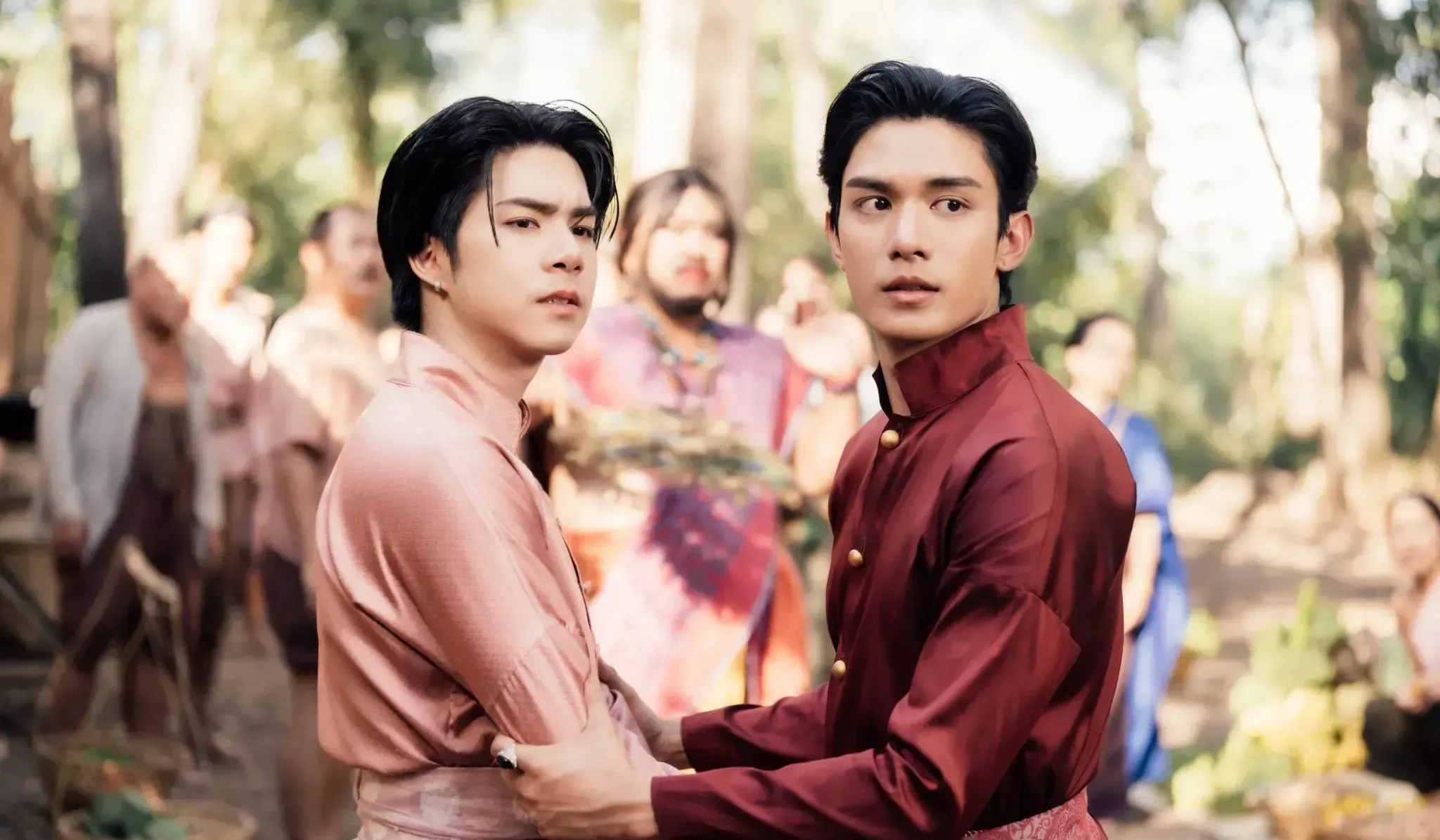

Nakhun lives like a walking satire of contemporary defeat. The world around him seems almost organized around his humiliation. Rain wrecks his birthday. Bird droppings ruin his clothes. A failed Thai history exam crushes what little academic faith he has left.
His bad luck shapes him into someone estranged from the very history he cannot pass on paper. A fortune teller gives him a protective amulet and warns him about a promise stretching across time. The passage into the past arrives beside a duck pond, where a shooting star strikes while Nakhun drinks to erase the sting of his present-day failures. He wakes four hundred years earlier in the Ayutthaya Kingdom during the reign of King Songtham.
His first response belongs entirely to the digital age. He assumes he has wandered onto an entertainment set. He mocks the servants for staying in character, praises the expensive realism of the costumes, and treats the missing cameras as proof of professional commitment.
The comedy works because it points at a familiar cultural habit: history has become something modern viewers consume through screens before they understand it as lived experience. The joke starts to curdle once the heat, danger, and social codes become real. Nakhun’s displacement is complete. He has to stop watching history and start surviving inside it.
The Social Cost of Disgrace
The stakes sharpen once Nakhun assumes the name of Master Klao. This identity comes burdened with public shame. Klao vanished days before Nakhun appeared. His father, Lord Preechapiban, died after being convicted of bribery and opium trafficking.
Through this family collapse, the show examines judicial corruption, inherited guilt, and the brutal social machinery that turns a legal charge into a generational stain. Nakhun feels the pain attached to that disgrace and chooses to investigate the truth behind the accusations. He suspects a conspiracy behind the punishment, and the mystery gives the time-travel device a social justice charge that fits the show’s wider concerns.
Also Read






His mission follows the theory offered by his modern professor, who suggested that time travel forms a loop. A task must be completed before return becomes possible. The amulet works as a physical warning signal, shaking whenever danger comes close.
The fortune teller appears in the past to repeat messages about restoration. These details give the story a clear direction while keeping its moral pressure in view. The episode closes with fear in the market, where a man sees Nakhun and reacts in horror. The moment suggests that the real Klao suffered at the hands of the same forces that destroyed his father.
Nakhun discovers that modern reasoning gives him little protection from 17th-century political danger. Reputation controls survival. Rank shapes whose suffering matters. The missing man’s story becomes a search for justice inside a rigid hierarchy. Nakhun uses his position to protect others while trying to clear the name of a dead man, and the series finds its strongest pulse in that collision between personal survival and social repair.
Physicality and Subtext
Net and JJ bring two distinct performance styles that keep the series grounded. Net plays Phop with restrained intensity. As a General who once protected Klao, he approaches Nakhun with care, suspicion, and unresolved grief. His eyes carry much of the performance.
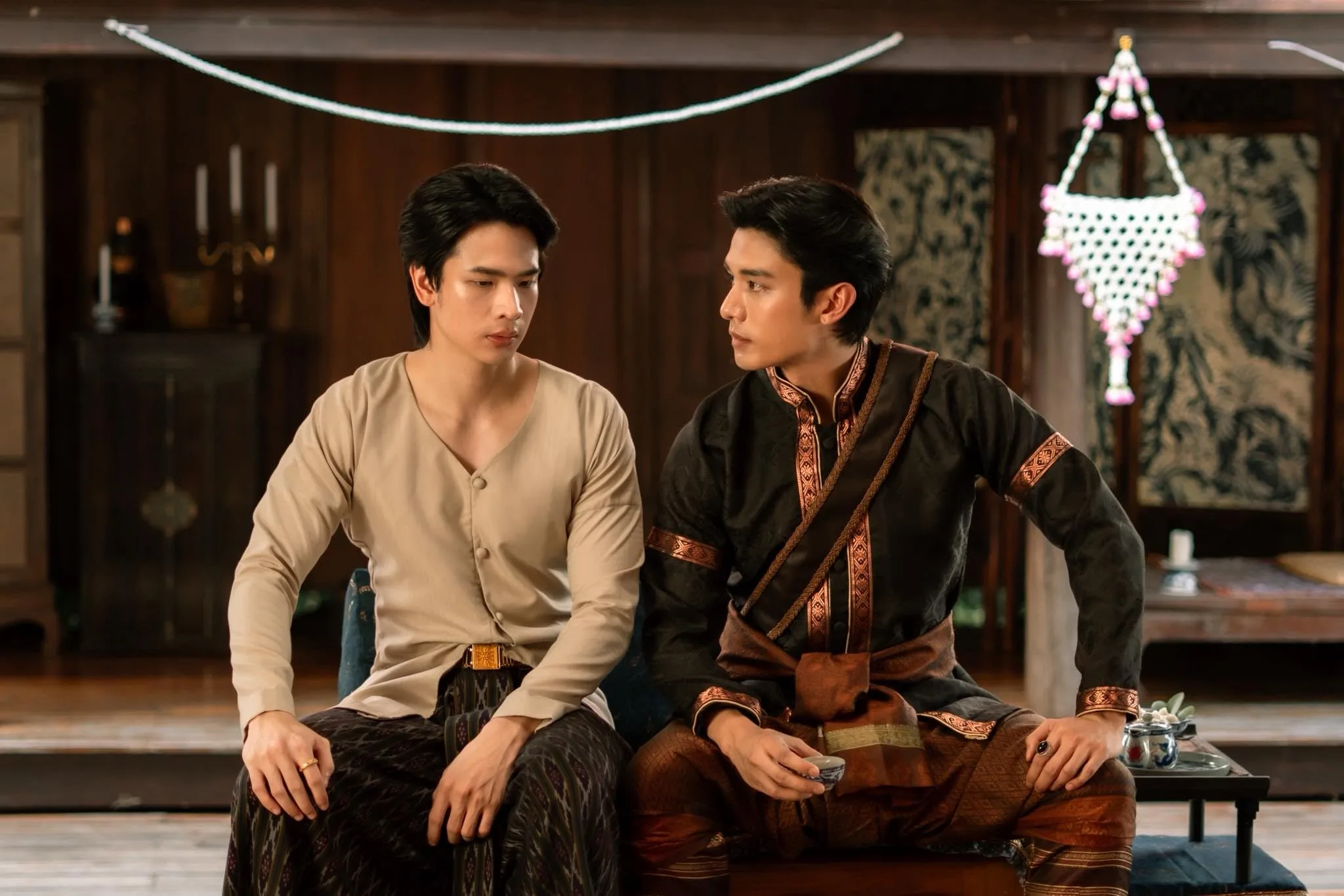
He searches for pieces of his childhood friend in a man who insists he is a stranger. JJ gives Nakhun the physical energy needed for the early comedy. He captures the awkward movements of a modern student trapped in a world built from rules he never learned. When memories of the past self return, JJ shifts into a more serious register, and the change feels earned.
The romantic tension grows through quiet gestures. Phop peels oranges for Nakhun, rare fruits imported from China. He helps clean a stain from the younger man’s face. These scenes resist spectacle and draw feeling from small acts of care. That restraint matters in a streaming era crowded with shows trying to announce emotion at full volume. Here, intimacy builds through service, silence, and watchfulness.
The appearance of modern friends as historical figures gives Nakhun emotional anchors. Thee becomes Jom, a local doctor. Pun becomes Khaew. Their presence gives him traces of safety inside an unfamiliar world. The performances sharpen the tragedy of a man who resembles someone beloved while carrying a different inner life.
The dynamic questions how identity is shaped: by face, memory, history, or the bonds others project onto us. JJ handles the grief of a son who never knew his parent with raw physical feeling. The chemistry between the leads remains steady, giving the show a strong emotional spine.
A Tangible Past
The production design avoids the polished emptiness that often weakens digital period dramas. The cinematography uses Thailand’s natural light to create a textured atmosphere. It catches the dust of the market, the green density of the woods, and the age worn into the temples.
Costumes clearly signal social status, and Nakhun’s inability to manage traditional garments becomes a recurring comic thread. He needs a servant to help him dress each day, a neat joke about the limits of modern independence once comfort and convenience disappear.
The series draws humor from his adjustment to the past. He complains about the absence of toothpaste and hot showers. He struggles to eat without forks. Language creates another obstacle. His modern slang confuses his ancestors, and the ancient Thai dialect and scholarly vocabulary leave him exposed. These details give the time-travel premise a cultural texture. Nakhun’s problem is temporal, social, linguistic, and bodily all at once.
The sound design strengthens that lived-in quality. Canal noise gives the world movement, while the manor carries a quieter tension. The shift from the rainy streets of Bangkok to the golden light of Ayutthaya marks a change in Nakhun’s inner life.
The technical choices serve the story by making the historical setting feel inhabited. The past becomes tactile, inconvenient, beautiful, and threatening. Through that texture, the show connects present and past through visual storytelling, grounding the fantasy in daily discomfort and emotional permanence.
Love Upon a Time premiered on March 27, 2026. This Thai series appears on Workpoint TV every Friday night. For those seeking the uncut version, iQIYI offers it through their streaming service. The narrative follows a student who experiences a shift from modern life to the Ayutthaya period. He faces challenges in a historical environment while uncovering connections to a mysterious past.
Full Credits
Title: Love Upon a Time
Distributor: Workpoint TV, iQIYI
Release date: March 27, 2026
Rating: 13+
Running time: 48–63 minutes
Director: Panuwat Inthawat
Writers: Piangpaitoon Satrawaha, Porndee Satrawaha
Producers and Executive Producers: Kittipat Jampa, Kornkanok Rangsimontakul
Cast: Siraphop Manithikhun, Radchapon Phornpinit, Thanutchon Chankaewarmorn, Pongsaton Sittipan, Piamchon Damrongsunthornchai, Nattapon Tangaon, Manussita Jarusasi, Marisar Hughes, Sadanont Durongkhaweroj, Sueangsuda Lawanprasert
Director of Photography (Cinematographer): Sarawut Chuparkpanich, Khanit Deepuang, Panpode Boonprasert, Nattapong Leartponrat
Editors: Sornpanath Patpho
Composer: FirstOne, JJ Radchapon, Pure Kanin, Jeaniich
The Review
Love Upon a Time
The show succeeds by grounding a wild premise in emotional truth. It balances physical humor with a serious look at historical injustice. JJ and Net provide a grounded center for the shifting tones. The production quality remains high. It offers a thoughtful look at how we view the past. It works as a romantic drama. It functions as a political mystery. Fans of the genre will find it satisfying. It sets a high standard for future productions. The writing stays sharp. The visuals look beautiful. It avoids common tropes.
PROS
- Strong chemistry between Net and JJ
- High production values and beautiful locations
- Effective balance between comedy and historical drama
- Captivating secondary character dynamics
CONS
- Initial dialogue feels heavy on exposition
- The logic of the time travel feels a bit loose





Thank you for this substantial review, it has been enjoyable to read.
I want to note, under the subtitle “Physicality and Subtext”, there is a mistake on the pic, not from the show. One of the actors is correct, but the other is not.
Good catch! That still was actually from the early pilot with the old cast. We’ve swapped it out for the official show photo. Thanks for helping us keep Gazettely accurate!