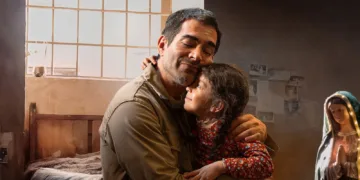































Hector’s life follows a pattern of hushed repetition. He exists along the margins of his community, selling fruit and caring for the residents of a dog kennel. His cognitive disability appears through a deep, disarming gentleness. Speech rarely comes easily to him.
His devotion to his daughter Alma gives the film its main emotional pulse. That fragile steadiness breaks when he searches for a pair of white sneakers for her race. A chance encounter turns into a fatal accident. Captain Aviles’s daughter dies. Hector is accused of a crime he did not commit.
The warmth of the family home gives way to the hard chill of a prison cell. That rupture reshapes the film, shifting its texture from tender domestic observation to grim survival drama. Hector becomes the prey of a system that reads his simplicity as danger. His arrest drives the remaining drama, tearing away his dignity and opening the film’s study of institutional injustice.
The Architecture of an Unaccountable State
The film places Hector’s tragedy inside an atmosphere thick with institutional control. Military police and immigration officers fill the streets, turning public space into a zone of surveillance. Captain Aviles presides over this brutality with a frightening absence of empathy.
His grief becomes permission for state-sanctioned revenge. Authority matters to him far more than truth. That sociopolitical pressure raises the stakes around Hector’s fate. The prison is a domain of rot and violence. Hector enters a population that first responds to his alleged crime with murderous intent. The guards provide no protection. They mirror their captain’s malice.
The warden occupies the middle of this corruption. Nearing retirement, he chooses silence over justice. His refusal to act gives cruelty room to grow. As a plot device, he embodies bureaucratic apathy. The movie critiques a system that feeds on vulnerable people.
Also Read






Institutional power becomes a weapon for private vendettas. The law serves the powerful. The streets of this fictionalized Mexico feel crushed under unearned authority. Officers move through markets with machine guns, figures of a state severed from its people. Hector becomes the purest outsider in that world.
Solidarity in the Shadows of Injustice
Omar Chaparro gives the production its emotional gravity. Through his physical presence, he communicates Hector’s confusion and steadfast love. His voice stays soft against the brutality of the cell block. That vulnerability gradually changes the inmates’ relationship to him.

El Tigre leads the prisoners and begins to doubt the state’s version of events. He recognizes truth in Hector’s eyes. A bond develops between these hardened men and the innocent father. They decide to shield him from the violence surrounding them. Beyond the prison walls, Natalia Reyes offers a needed counterweight as Ingrid.
Her naturalistic performance makes the teacher a grounded presence for Alma. She refuses to let the child surrender hope. These relationships create solidarity across the prison’s physical barriers. The inmates risk their safety to help Hector remain connected to his daughter.
Their cooperation reveals a shared humanity absent from the state. Empathy survives in the bleakest spaces. These men discover a reason to care beyond their own survival. They become the unlikely family Hector needs during confinement.
Visual Realism and the Limits of Melodrama
The film’s technical craft is strong. Ana Lorena Pérez Ríos uses a visual style built from gritty textures. The sets carry the weight of lived experience. Dusty streets and rusted prison bars lend the film a persuasive realism. That visual honesty clashes with the script’s structural weaknesses. Patricio Saiz leans on heavy coincidence to resolve narrative pressure. Far-fetched events arrive to pull at the audience’s emotions.
The plot moves at a pace that sometimes leaves logic behind. Faith-adjacent ideas shape the story. Angel references and religious imagery suggest a spiritual dimension to Hector’s suffering. These details give the viewer a lens of innocence. They strengthen the image of Hector as a holy fool trapped in a cynical world. The pacing stays brisk.
The director guides the film toward its dramatic peaks with confidence and keeps the story from stagnating. The screenplay lacks subtlety, yet the production values create a polished experience. The film builds a distinct mood even when the writing weakens. It carries high polish and emotional directness. The camera studies sweat and dirt with an intimacy that makes suffering feel immediate. The heat of the Mexican sun and the chill of concrete floors press into every frame.
A Father’s Miracle is a Mexican drama that premiered on Netflix on February 13, 2026. This poignant adaptation of the South Korean film Miracle in Cell No. 7 explores themes of wrongful imprisonment and the enduring bond between a father and his daughter. Set within a heightened sociopolitical landscape, the story follows a man with a cognitive disability who must navigate the brutality of the prison system. You can currently watch the film globally on the Netflix streaming platform.
Where to Watch A Father’s Miracle (2025) Online

Full Credits
Title: A Father’s Miracle
Distributor: Netflix
Release date: February 13, 2026
Rating: TV-14
Running time: 1 hour 41 minutes
Director: Ana Lorena Pérez Ríos
Writers: Patricio Saiz
Producers and Executive Producers: Alberto Muffelmann
Cast: Omar Chaparro, Mariana Calderón, Natalia Reyes, Biassini Segura, Sofía Álvarez, Jorge A. Jiménez, Gustavo Sánchez Parra, Juan Pablo de Santiago, Marco Treviño, Arturo Ríos
Director of Photography (Cinematographer): Paulo Pérez
Editors: Aaron Sanchez Rubio
Composer: Andrés Penella
The Review
A Father's Miracle
A Father’s Miracle finds its strength in the tactile realism of its setting and the sincerity of its performances. Omar Chaparro anchors the emotional weight of the piece with a performance of profound vulnerability. However, the narrative frequently succumbs to blatant manipulation. The screenplay relies on heavy coincidences that diminish the impact of its sociopolitical commentary. It functions effectively as a genre piece for those seeking emotional release. It lacks the structural integrity to sustain its more ambitious themes. It is a polished production that prioritizes sentiment over logic.
PROS
- Authentic art direction and gritty set design.
- Deeply felt lead performance by Omar Chaparro.
- Naturalistic supporting turn from Natalia Reyes.
- Efficient pacing.
CONS
- Emotionally manipulative narrative structure.
- Inconsistent character motivations within the prison hierarchy.
- Heavy reliance on unlikely coincidences.
- Simplified depiction of institutional corruption.