


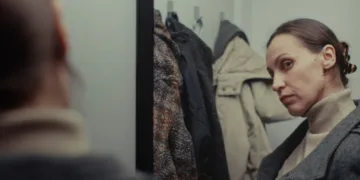
























Berlin at night takes shape as a soft blur of lights, glass, and fluorescent passageways. The city appears as a corridor of movement for Hassan, a fifty-five-year-old Palestinian taxi driver who has spent decades reading Berlin from behind the wheel. He occupies a quiet observational position, watching the streets and passengers move through the rearview mirror with the patience of someone trained by displacement.
In May 2022, that routine shifts when Amir, a young Israeli man, steps into the close quarters of Hassan’s cab. Their first exchange sharpens once each man recognizes the other’s origin. A shared link to Galilee complicates the encounter, turning geography into both wound and point of contact. The taxi becomes a moving chamber where national identity presses against immediate human presence.
Inside that narrow frame, the geopolitical divisions beyond the windows lose some of their force, replaced by the fragile pressure of two people seated close enough to hear each other breathe. Berlin recedes into background texture, while the car creates a temporary crossing between men who, in their homeland, may have remained distant figures shaped by inherited separation.
Internalized Histories and Generational Shifts
Ehab Salami gives Hassan a guarded stillness. His performance relies on micro-expressions, held pauses, and heavy silences that suggest trauma packed away and kept beneath speech. Outside the cab, Hassan’s private life carries its own form of exile. His relationship with his daughter, Nur, is tense, and her engagement to a German man leaves him culturally and emotionally unmoored.

That domestic conflict places Hassan within a familiar migrant dilemma: the parent tied to memory, the child moving toward another social code. Ido Tako’s Amir brings a different register of vulnerability. As a queer man seeking distance from the expectations of home, Amir finds relief in the anonymous flow of Berlin at night. His repeated choice to seek Hassan’s taxi changes the encounter from paid service into something close to kinship.
Their bond grows through heartbreak and shared outsider status, forming a father-son dynamic that remains tentative because history never fully exits the car. When Hassan gives Amir his personal phone number, the gesture carries the charge of recognition. The driver sees the passenger’s fragility and, through it, a reflection of his own arrival, separation, and long experience of living elsewhere.
The Formal Language of Enclosure
The 4:3 aspect ratio gives the film a compressed visual grammar, turning the taxi interior into a chamber of faces, glances, and withheld speech. The tight frame directs attention toward physical closeness, letting the viewer feel how little space exists between two people carrying large historical burdens.
Maayane Bouhnik’s shallow focus softens the outside world, leaving Berlin blurred beyond the windows and separating the men from the city that holds them. The taxi takes on the quality of a shelter, a modest sanctuary built from glass, upholstery, and passing neon. The editing keeps the dialogue alive by shifting between front and back seats, sustaining motion within scenes shaped largely by conversation.
Habib Hanna Shehadeh’s soundscape gives the episodic structure a lyrical pulse, with woodwind and piano melodies dividing the ten chapters. Language shapes the film with equal force. Arabic, Hebrew, German, and English create a multilingual field where identity is heard before it is explained.
Hassan and Amir rely on stilted English as their practical bridge, and that imperfect speech strips their exchanges down to direct emotional contact. The lighting places the cab’s shadowed interior against Berlin’s artificial neon glow, creating a filmic space where inner lives matter most.
Shared Secrets and the Weight of Exile
The 1948 Nakba defines Hassan’s sense of self. Its legacy of displacement led him from the West Bank to a life in Berlin, leaving him with a past that continues to press into the present. He carries a long-buried secret that sends him to meet someone from an earlier stage of his life, searching for resolution that has remained out of reach. By late 2023, the emotional weather inside the taxi changes.
War outside the frame enters through radio broadcasts, flickering into the cab and altering the temperature of each exchange. Hassan’s line, “I like you, and this is a problem,” gives their connection its sharpest expression. The sentence holds affection and danger in the same breath, naming the strain between personal feeling and collective identity.
In their final meeting, the two men reach enough trust to share private truths, even as global tension threatens to pull them away from that intimacy. The film closes with the road still open, suggesting that such encounters leave slow marks on people living with exile. History and politics remain intact. The men create a brief human space inside division and distance, fragile precisely because it has been earned.
This feature film premiered at the Berlin International Film Festival in February 2026 as part of the Perspectives section. As of May 2026, the production is primarily screening at major international festivals and through specialized arthouse venues. Viewers can expect a wider digital or theatrical release later this year through regional distributors such as Salaud Morisset.
Full Credits
Title: Where To?
Distributor: Salaud Morisset, Cinema 7, Rogovin Brothers
Release date: February 17, 2026
Running time: 95 minutes
Director: Assaf Machnes
Writers: Assaf Machnes
Producers and Executive Producers: Haim Mecklberg, Estee Yakov Mecklberg, Tomer Mecklberg, Oren Rogovin, Guy Shani, Luis Singer
Cast: Ehab Salami, Ido Tako, Milan Peschel, Rama Nasrallah, Raheeq Haj Yahia-Suleiman
Director of Photography (Cinematographer): Maayane Bouhnik
Editors: Or Lee Tal, Shauly Melamed
Composer: Habib Hanna Shehadeh
The Review
Where To?
Where To? succeeds as a quiet, observational chamber piece that prioritizes human intimacy over grand political statements. Through the lens of a shared taxi ride, Assaf Machnes captures the fragility of connection in a world divided by history. The performances by Ehab Salami and Ido Tako provide the emotional anchor needed to sustain the film's episodic structure. While some might find the narrative restraint frustrating, the film offers a sensitive exploration of exile and shared humanity.
PROS
- Strong, understated lead performances.
- Intimate visual style using the 4:3 aspect ratio.
- Evocative use of the Berlin setting at night.
- Nuanced treatment of historical trauma through personal stories.
CONS
- Episodic structure slows narrative momentum.
- Heavy reliance on implication might leave some viewers wanting more depth.
- Some scenes border on artificiality or simplification of complex issues.