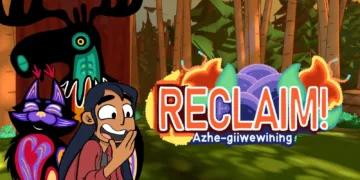






















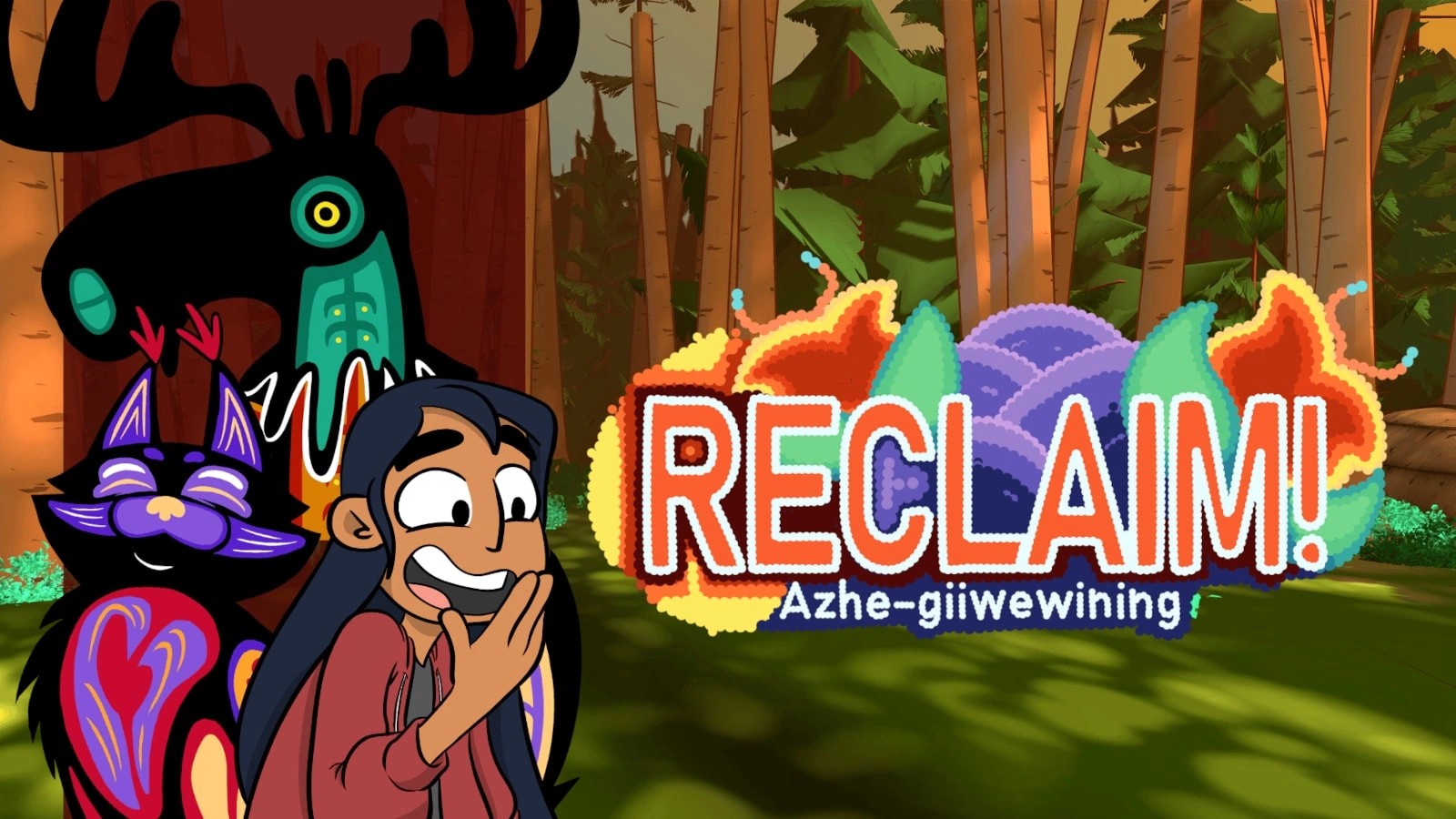

Grassroots Indigenous Multimedia’s Reclaim! Azhe-giiwewining presents a focused interactive work built around language, memory, and cultural return. It is a 2D adventure game performed entirely in Ojibwemowin, following Miskwaa, a young city resident who has drifted away from her cultural background. While visiting her grandmother, she enters the woods to gather berries, falls asleep, and wakes in a spiritual version of the forest filled with talking animals and ancient spirits.
Miskwaa soon meets Boozhii, a mischievous and helpful spirit who tells her that reaching Deer Island will lead her back to her grandmother. That goal gives the game a clean adventure structure, with each step tied to how Miskwaa speaks with the forest’s residents. The story frames exploration as an act of reconnection. Progress depends on listening, responding, and learning how this world works through ancestral knowledge and local lore.
Acoustic Cadence and Graphic Identity: Audio-Visual Presentation
The game builds much of its identity through voice, music, and illustration. Ojibwe elders, teachers, and immersion school graduates recorded the full script in Ojibwemowin, giving the dialogue a lived-in vocal rhythm. For players who do not speak the language, the performances still carry emotional information. Tone, pacing, and inflection communicate urgency, warmth, frustration, and playfulness before the subtitles finish their work.
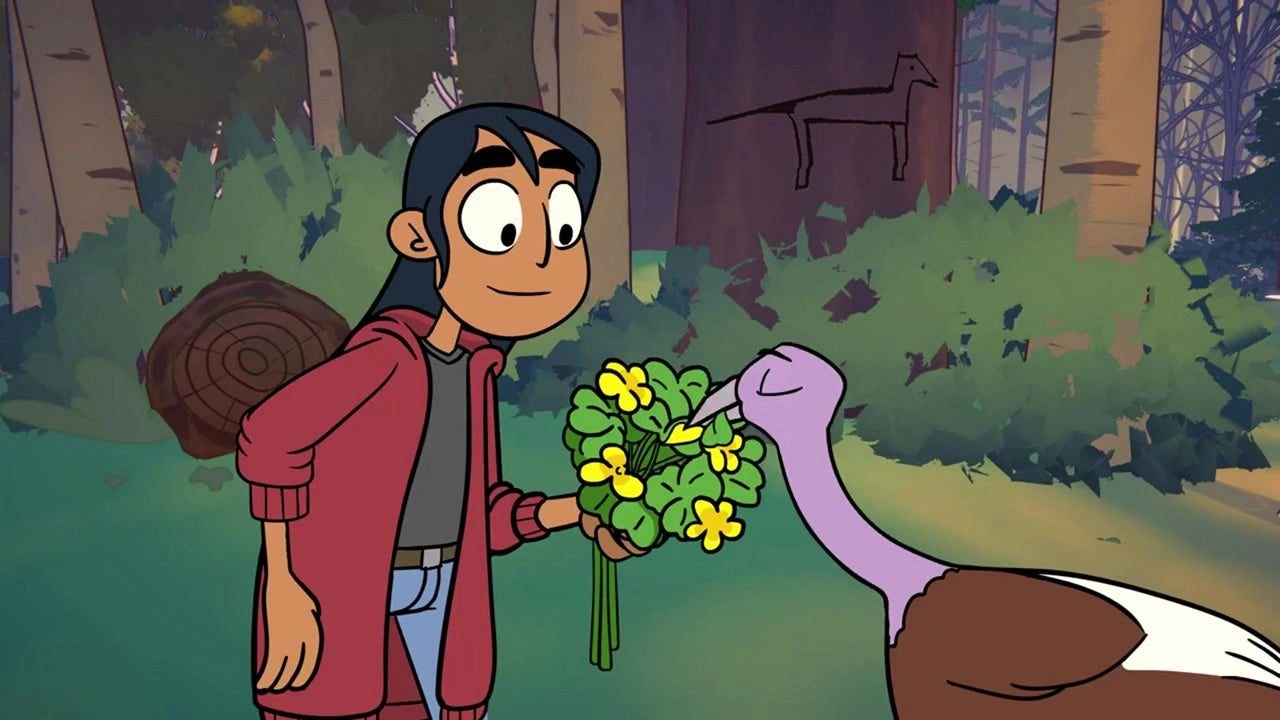
The visual style uses a graphic novel approach with a strong sense of atmosphere. Character designs shift in meaningful ways. The animals and forest residents often appear in contemporary forms during exploration, then take on bright, historically rooted Indigenous designs in dialogue portraits. That change gives each conversation a spiritual charge, making speech feel like a crossing point between ordinary space and older forms of presence.
Animation brings a lighter texture to the experience. Facial distortions and expressive reactions add comic timing, creating moments of surprise inside a story built on heritage and spiritual return. The humor benefits from animation leads whose background includes mainstream animated television such as Bob’s Burgers. Those small bursts of exaggeration help the cast feel lively, giving the game personality beyond its educational and cultural aims.
The soundscape reaches its best moments in specific areas. Lakeside music has a soft, calming quality, and underwater sections use meditative chanting that creates a relaxed state. The main forest hub has a jaunty, tavern-like melody recalling classic European fantasy adventures. That track clashes with the local setting and weakens the atmosphere whenever players return to the hub map. The audio remains one of the game’s defining strengths, grounding the story’s thematic weight in a distinctive acoustic space.
Contextual Literacy: Gameplay Mechanics and Language Integration
Mechanically, Reclaim! Azhe-giiwewining follows the familiar shape of 1990s point-and-click adventure games. Players move through a compact map of nine areas spread across fourteen screens. Basic mouse inputs handle movement, environmental examination, and item collection. The inventory system includes occasional object combinations, asking players to merge the right items to open paths or solve environmental problems.
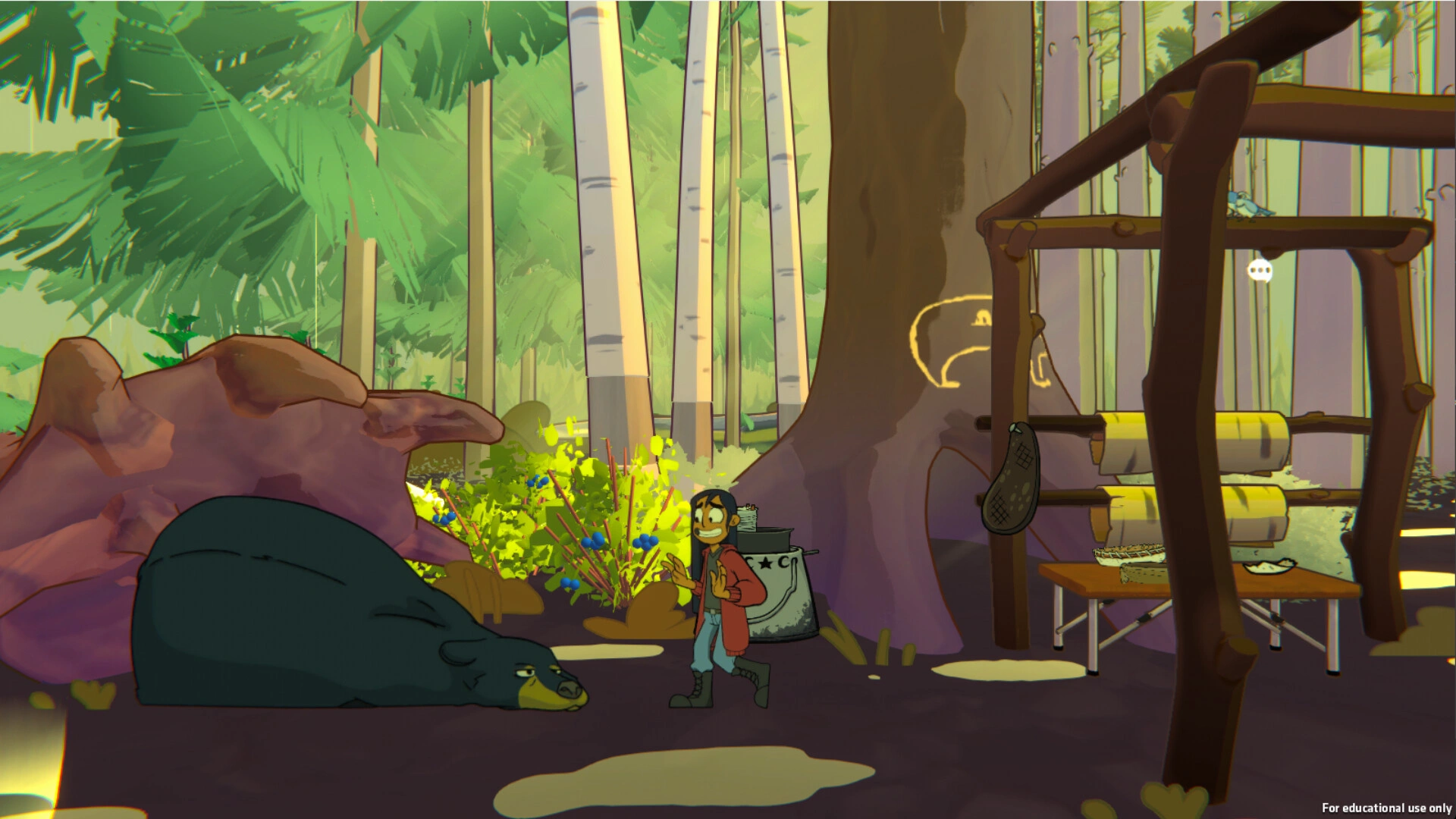
Dialogue choices drive the main sense of consequence. The game avoids a visible morality meter or branching alignment track. Its choices matter through practical social outcomes, which suits the story’s focus on communication. Players work through dialogue trees to mediate a dispute between a wolf and a bear, gaining a necessary progression item through careful interaction. Aiding Cool Aunt also depends on collecting canoe components, then transferring them through the correct conversation choices. The system makes speech part of the puzzle logic.
This design links language learning directly to play. The game rejects dry educational drills such as flashcards and repetitive quizzes. It uses contextual immersion, asking players to connect English subtitles, spoken Ojibwemowin, and environmental clues. Meaning grows through use. The player learns by paying attention to how words appear in social and spatial situations.
The game offers little hand-holding. There are no tutorial pop-ups or guiding waypoints. That choice can create early friction, yet it gives the language system a stronger mechanical role. Observation becomes the main tool for progress. Comprehension opens paths, solves problems, and helps Miskwaa rebuild her relationship with a world shaped by cultural memory.
Frictional Design: Technical Performance, Pacing, and Structural Quirks
The game’s strongest ideas often meet rough execution. The full experience lasts about two to three hours, and the opening can feel unclear for players unfamiliar with old-school adventure logic. Early play may involve aimless clicking while basic inventory functions remain obscure. The short runtime makes those first minutes feel heavier than they should.
Several interface bugs interrupt play. Items placed in the lower-right corner of the screen can block the cursor, stopping players from clicking transition arrows needed to move between scenes. More serious glitches appear near the lake, where event flags can fail to trigger. That problem can lock the game state and corrupt active save files, making backup saves a practical necessity for avoiding lost progress.
Some internal logic issues weaken immersion. Miskwaa can breathe and walk underwater with no difficulty, yet the story still insists that she needs a canoe to cross the water. The game also lacks an in-game dictionary, which makes learned vocabulary hard to track. For a design built around language acquisition through context, that missing reference tool leaves players without a useful way to review what they have absorbed.
Tonal shifts create another kind of friction. The cozy, spiritual atmosphere is sometimes broken by sudden contemporary internet slang and a crude, extended scene involving turkey diarrhea humor. These moments may land as playful interruptions for some players, yet they clash with the calmer mood that the audio, art, and language work so carefully to create.
Reclaim! Azhe-giiwewining works best when its systems and story move together. Its point-and-click structure gives Ojibwemowin a practical role in play, turning conversation into progression and listening into a form of agency. The technical flaws, unclear early guidance, and uneven tonal choices make the experience rough in places. Its strongest passages still show how an adventure game can use language, space, and choice to make cultural reconnection feel playable.
The Review
Reclaim! Azhe-giiwewining
Reclaim! Azhe-giiwewining succeeds as a cultural preservation project, using point-and-click mechanics to introduce the Ojibwemowin language. The authentic voice acting and expressive graphic novel art build a memorable atmosphere. Technical issues, including game-breaking bugs near the lake, counterintuitive underwater logic, and sudden crude humor, disrupt the experience. The short runtime lacks direction early on, yet the game provides value through its contextual immersion design. It balances educational merit with classic adventure gameplay.
PROS
- Full, expressive voice acting recorded entirely in Ojibwemowin.
- Contextual language learning replaces dry textbook quizzes.
- Stylized graphic novel art featuring expressive character animations.
- Satisfying classic point-and-click inventory and dialogue puzzles.
CONS
- Critical lakeside glitches that corrupt active save files.
- Short runtime lasting only two to three hours.
- User interface bugs where lower-right assets block the cursor.
- Jarring tonal shifts involving modern slang and crude humor.