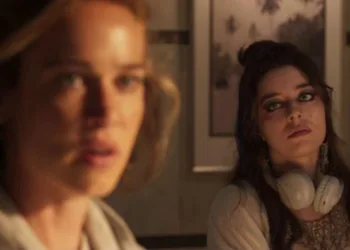


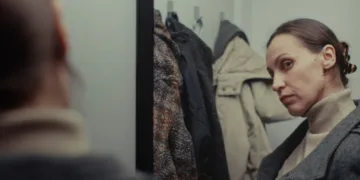







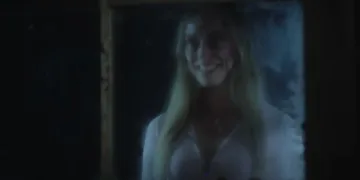












Marie Kreutzer’s domestic drama Gentle Monster studies the ruin that opens inside an artistic household after one police visit. French experimental musician Lucy Weiss (Léa Seydoux) leaves the city for a quiet Bavarian farmhouse with her Austrian husband Philip (Laurence Rupp) and their young son Johnny (Malo Blanchet).
The move to the countryside carries a therapeutic promise, meant to help Philip, a television documentarian, recover from severe emotional burnout. That fragile pastoral calm collapses when Munich police officers arrive with a search warrant. They arrest Philip for distributing child sexual abuse material online under the digital alias GentleMonster_87.
Kreutzer places the viewer beside Lucy at the exact point where domestic safety breaks apart. The criminal case stays near the edge of the frame. The film turns toward a wife forced to re-read the life she thought she understood. Its narrative design has the sharpness of a chamber piece, built around shock, suspicion, and the slow contamination of memory.
Kreutzer draws a severe divide between the warmth of family rooms and the sickening reality hidden inside them. Through this contemporary crisis, she studies how trust can vanish with frightening speed, especially in a culture where private selves can be stored, disguised, and circulated through screens.
The Geography of Estrangement and Vanishing Alibis
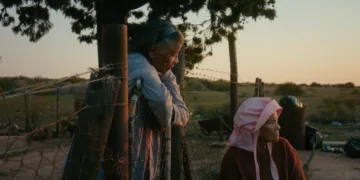
The Bavarian farmhouse becomes a map of Lucy’s exposure. Its spacious, unfinished rooms deepen her isolation. She has no local roots, no nearby circle of support, and limited ease in German. That linguistic and social distance leaves her stranded in a place that was meant to feel restorative.

I thought of a remote studio I once visited, where silence seemed generous for an hour, then began to press against the walls. Kreutzer makes that same quiet turn toxic. Lucy’s mother, Eloise (Catherine Deneuve), a sharp concert pianist, cuts through the pastoral fantasy with a brutal line about the two disasters awaiting a female artist: having children and moving to the countryside.
Inside that isolation, Philip’s alibis fall apart piece by piece. His explanations keep changing. He first says the illicit files were research for a future documentary project. Later, he admits to financial desperation, presenting the crime as a response to the emasculation he felt from his stalled career. Each revision forces Lucy to revisit her own memories with new terror.
Familial tenderness curdles into evidence. Philip filming Johnny on a new backyard trampoline, or recording tight, lingering 8mm close-ups of the boy’s face, shifts from ordinary parental pride into the image of something monstrous. Lucy carries that pressure into a family wedding, wearing calm like formal clothing as her private reality splinters.
Doubled Narratives and Structural Friction
Kreutzer sets Detective Elsa Kühn (Jella Haase) against Lucy as a hard, rigid foil. Elsa’s working-class pragmatism clashes with Lucy’s drifting artistic life. The film then builds a major parallel subplot around Elsa’s aging father, Herrmann (Sylvester Groth).
Herrmann suffers from dementia-driven disinhibition and physically harasses his live-in caretaker, Natalia (Patrycja Ziółkowska). The mirror is deliberate. Lucy and Elsa both answer the misconduct of men in their homes through minimization, financial compensation, and convenient excuses that keep the rot under their roofs from being fully faced.
That doubling creates heavy structural strain. During the final third, the secondary storyline interrupts the film’s focus. The editing fragments the rhythm, creating an uneven movement that drains pressure from Lucy’s crisis. The thematic pairing also raises difficult ideological questions.
By placing Elsa’s father and Philip on parallel narrative tracks, the script suggests a continuum between casual domestic misogyny and predatory dark web deviance. That idea lands with less precision than the film seems to intend. The comparison feels forced, and it risks clouding the specific horror of Philip’s actions as it reaches for a larger portrait of male entitlement.
Textures of Despair and Auditory Subversion
The film’s power comes from rigorous formal control, anchored by Léa Seydoux’s restrained performance. Seydoux avoids visible theatrical release. She communicates psychological devastation through micro-expressions, facial tension, and her command of French, English, and German.
Cinematographer Judith Kaufmann supports that interior acting with a claustrophobic visual scheme. Kaufmann uses long, handheld tracking shots that remain close to Seydoux’s face. The approach transforms the beautiful Austrian and Bavarian landscapes into a visual cage, turning open country into something inescapable.
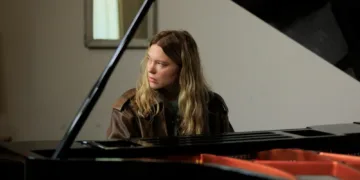
The sound design, arranged by the composer Camille, gives the film one of its sharpest artistic ideas. Lucy, as an experimental artist, performs avant-garde covers on piano, glass harp, and harmonium. She pares down classic pop songs written by men, including Charles & Eddie’s “Would I Lie to You?”, The Cure’s “Boys Don’t Cry”, and George Michael’s “Freedom”.
These interludes question male emotional honesty through familiar melodies made strange. I have always been drawn to acoustic covers for that reason; a song everyone knows can suddenly reveal a darker lyric hiding in plain hearing. Kreutzer links these sonic choices to precise visual motifs.
The backyard trampoline appears at the beginning and end, marking a bleak downward emotional path. The ending offers a cold refusal of tidy resolution, leaving the viewer with Lucy’s continuing, quiet isolation as the screen fades.
Gentle Monster is a European drama co-produced by Austria, Germany, and France. The film premiered at the Cannes Film Festival on May 15, 2026, where it competed for the prestigious Palme d’Or. As it just made its festival debut a couple of days ago, the project is not yet available on commercial streaming platforms or digital networks. The theatrical rollout is scheduled to begin in Germany via Alamode Film in late 2026, with Ad Vitam managing the theatrical release in France in 2027. Audiences will need to wait for these local cinema runs or subsequent digital video-on-demand announcements to watch the film.
Full Credits
Title: Gentle Monster
Distributor: Alamode Film, Ad Vitam
Release date: May 15, 2026
Running time: 114 minutes
Director: Marie Kreutzer
Writers: Marie Kreutzer
Producers and Executive Producers: Alexander Glehr, Johanna Scherz, Jonas Dornbach, Janine Jackowski, Jean-Christophe Reymond, Marie Kjellson
Cast: Léa Seydoux, Jella Haase, Laurence Rupp, Catherine Deneuve, Malo Blanchet, Sylvester Groth, Regina Fritsch, Sami Loris, Baran Sönmez, Raphael Nicholas, Patrycja Ziółkowska
Director of Photography (Cinematographer): Judith Kaufmann
Editors: Ulrike Kofler
Composer: Camille
The Review
Gentle Monster
Marie Kreutzer delivers a bruising, formally rigorous exploration of shattered trust that avoids sensationalism. The film shines when focusing on the psychological fallout through its claustrophobic camera work and brilliant sonic choices. Its impact softens during the final third, weakened by an uneven secondary plotline that forces an unearned moral comparison. Even with these pacing flaws, the central performance anchors the production with devastating precision. It stands as a challenging piece of independent cinema that demands attention.
PROS
- Léa Seydoux delivers an exceptional, deeply internal performance using minimal dialogue.
- The claustrophobic visual style transforms idyllic locations into an effective psychological cage.
- Subversive musical choices use deconstructed pop covers to cleverly critique male emotional honesty.
CONS
- The law enforcement subplot introduces significant pacing issues and structural fragmentation in the final third.
- The narrative creates a questionable moral equivalence between domestic misconduct and severe digital exploitation.
- A cold, unresolved final act may alienate viewers seeking traditional narrative resolution.