

























![Kingdom Hearts Collection [I-III] Review](https://gazettely.com/wp-content/uploads/2026/10/Kingdom-Hearts-Collection-I-III-1-360x180.webp "Kingdom Hearts Collection [I-III] Review: KHII Holds Steady as Newer Entries Fluctuate 37")




Lucy Schulman is a modest New York dramedy about a woman who mistakes attachment for direction, then has to live inside the quiet embarrassment of that mistake. Ellie Sachs writes, directs, and stars as Lucy, a late-twenties bookstore employee drifting through literary parties, writerly crushes, half-shaped ambitions, and the old gravitational pull of her childhood bedroom.
The film is built as a character study, not a plot machine. There are breakups, bad dates, missed obligations, and career uncertainty, yet none of it carries grand tragic weight. Sachs understands the scale of Lucy’s problems, which is part of the film’s charm.
The emotional key arrives in Lucy’s memory of two mallards in Central Park, a childhood image of companionship that slowly reveals itself as a map of her psyche. Lucy has learned to see life in pairs. Alone, she reads herself as incomplete. The movie asks what happens when solitude stops looking like punishment and starts looking like a room with decent lighting.
Lucy and the Art of Romantic Evasion
Lucy is witty, stylish, observant, and maddening in the precise way real people often are. She can identify the pattern, then walk directly back into it with fresh lipstick and a hopeful smile. After discovering that Nikhil has cheated on her, her first response is not fury. She asks what she did wrong. It is a devastating little reflex, the sort of self-erasure that says far too much in far too few words.

Sachs plays Lucy with a comic delicacy that keeps the character from hardening into a case study. Her face carries the fatigue of bad dates, the giddy electrical current of a new crush, and the private panic of someone who knows she is behind an invisible schedule.
Lucy works in an independent bookstore, surrounded by literature and ambition, yet she remains oddly adjacent to her own life. She dates writers instead of writing. She attends parties full of articulate people and still struggles to name what she wants.
That tension gives the film its cleanest existential line. Is identity chosen, or does it form around whoever happens to love us first, loudest, or most conveniently? Lucy behaves as if romance can solve the problem of selfhood. When James enters the frame, she becomes absorbed by him with almost noir-like fatalism, minus the cigarette smoke and homicide. Her friendships blur. Work becomes background noise. The world narrows to one man, which is romantic only until it becomes visibly ridiculous.
A Father, a Daughter, and the Warm Trap of Comfort
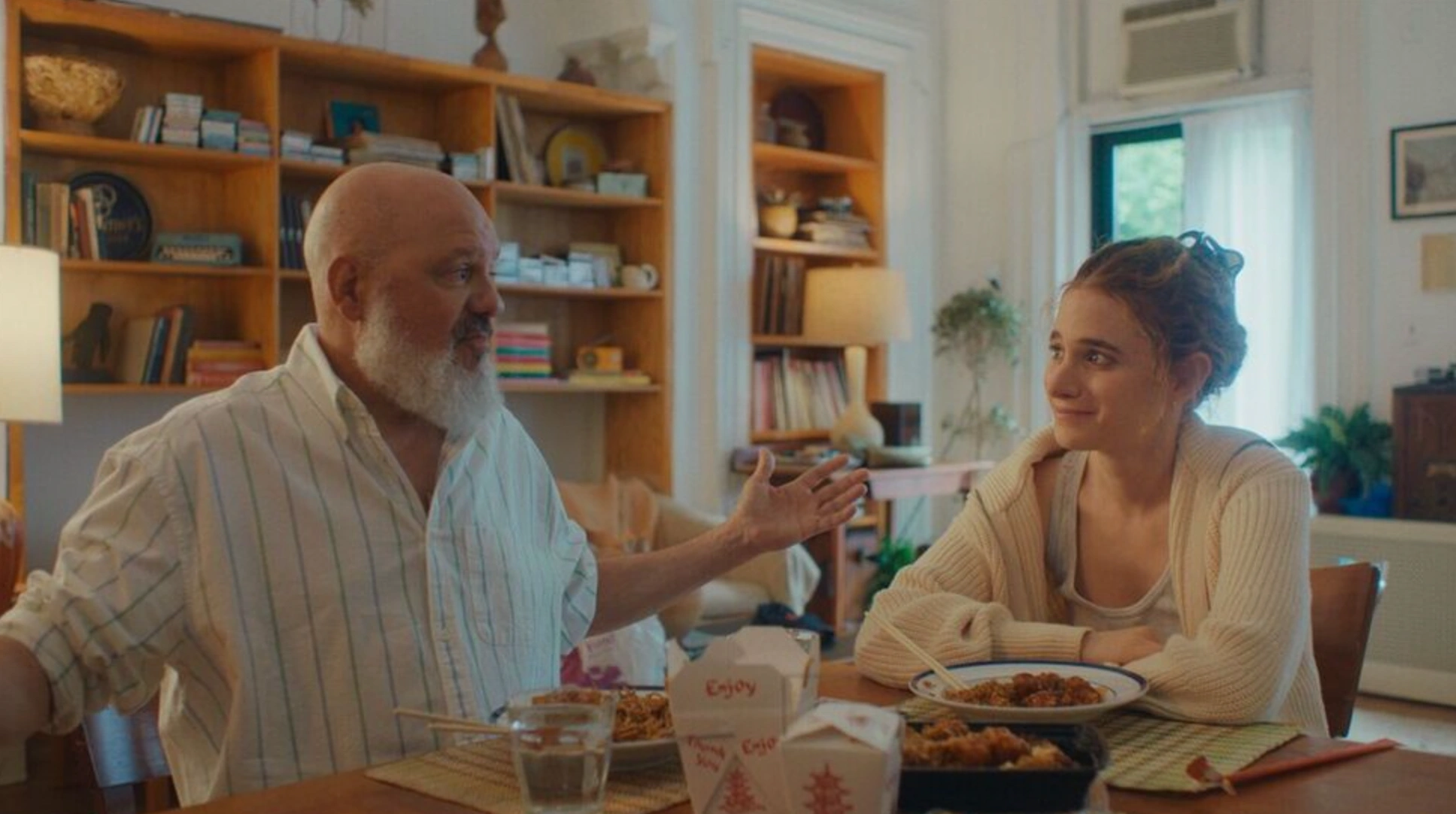
The richest material belongs to Lucy and her father, Peter, played by David Cross with disarming softness. Peter is a single father who raised Lucy alone, and their relationship has the texture of a private domestic language: food, jokes, old routines, emotional shorthand, and the gentle absurdity of two people who have spent years learning each other’s silences.
Cross gives Peter a comic rhythm that feels protective rather than performative. His one-liners are little sandbags against Lucy’s heartbreak. When she cries, he cries too, explaining it like a yawn, and the moment lands because it turns a gag into character architecture. This is where the film’s visual restraint works best. The domestic spaces feel warmly lit, framed with enough softness to suggest safety, yet the stillness carries a faint pressure. Home is shelter. Home is a cul-de-sac.
The flashbacks and mirrored dating anxieties deepen that idea. Peter asking Lucy how to text a woman from pilates echoes younger Lucy seeking similar advice after receiving a boy’s number. Their bond is lovely, and it is also faintly dangerous. Peter’s endless patience gives Lucy a landing pad every time she falls, which may be exactly why she keeps falling the same way. The film is at its sharpest when it lets that contradiction breathe. Love heals. Love can also preserve a wound in flattering light.
Romance in Tunnel Vision
James, played by Thomas Mann, enters through the familiar grammar of chance encounters and nocturnal wandering. Their night together carries traces of talky urban romance, with New York serving as both stage and accomplice. The camera seems to relax into their movement, letting streets, parties, and late-hour conversations create the illusion of destiny. It is a nice illusion. Perhaps too nice.
James is not written as a villain, which is one of the film’s better choices. He listens, he cares, and he does not arrive with a warning label taped to his forehead. Very considerate of him. His function is subtler: he becomes the next surface onto which Lucy projects escape.
The issue is that the chemistry between them feels thinner than the film needs. As Lucy’s attention contracts around James, the movie mirrors her tunnel vision. Peter fades. Her friends fade. Her job fades. The structure makes sense, yet the viewing experience loses some charge because the displaced relationships are livelier than the romance replacing them.
The missed bridal shower restores consequence with welcome force. Suddenly Lucy’s pattern has a cost outside her own feelings. The film’s comedy remains quiet and observational, built from awkward pauses, bookstore pretension, strained dates, and the tiny humiliations of adult life. Its lighting and framing avoid noir severity, yet its emotional geometry has a shadowed quality: a woman follows desire through the city and discovers that the real trap was her own need to be chosen. Sachs does not overstate the point. She lets Lucy stumble toward it, which feels right.
Lucy Schulman is an American independent romantic comedy-drama feature film that celebrated its world premiere at the Tribeca Festival on June 5, 2026, as part of the festival’s milestone 25th anniversary programming. Written, directed by, and starring Ellie Sachs in her feature-length directorial debut, the narrative chronicles a 29-year-old bookstore employee who moves back into her childhood bedroom with her eccentric single father following a devastating romantic breakup. As she navigates a series of terrible dates and attempts to reclaim her own professional ambitions, she discovers that her chronic habit of prioritizing her partners’ lives has left her completely disconnected from herself. Cinema enthusiasts can currently track the celebrated coming-of-age feature across the domestic independent film festival circuit prior to its eventual commercial theatrical and digital streaming platform rollouts.
Full Credits
Title: Lucy Schulman
Distributor: Tigresa
Release date: June 5, 2026
Running time: 94 minutes
Director: Ellie Sachs
Writers: Ellie Sachs
Producers and Executive Producers: Fernando Loureiro, Guilherme Coelho, Morwin Schmookler, Gabriel Amaral
Cast: Ellie Sachs, David Cross, Thomas Mann, Hasan Minhaj, Annabelle Attanasio, Chelsea Frei, Sandrine Holt, Eisa Davis, Olivia Luccardi, Joanna Arnow, Stephen Adly Guirgis, Will Janowitz, Dan Perlman, Devon Walker, Kareem Rahma, Tuffy Questell, Henry Hall
Director of Photography (Cinematographer): Barton Cortright
Editors: Kate Pedatella, Henry Hayes
Composer: Giosuè Greco
The Review
Lucy Schulman
Lucy Schulman is a gentle, funny, lightly melancholic dramedy that finds its best material in Lucy’s dependence on love and her tender bond with her father. The romance with James slows the film, and the ending feels slightly premature, yet Ellie Sachs brings enough warmth, wit, and emotional precision to make Lucy’s small crisis feel worth following.
PROS
- Strong Ellie Sachs performance
- Lovely father-daughter dynamic
- Sharp observational humor
- Warm New York atmosphere
- Honest portrait of romantic dependence
CONS
- James romance lacks spark
- Pacing dips in the middle
- Ending arrives too soon
- Familiar indie dramedy structure







