

























![Kingdom Hearts Collection [I-III] Review](https://gazettely.com/wp-content/uploads/2026/10/Kingdom-Hearts-Collection-I-III-1-360x180.webp "Kingdom Hearts Collection [I-III] Review: KHII Holds Steady as Newer Entries Fluctuate 37")



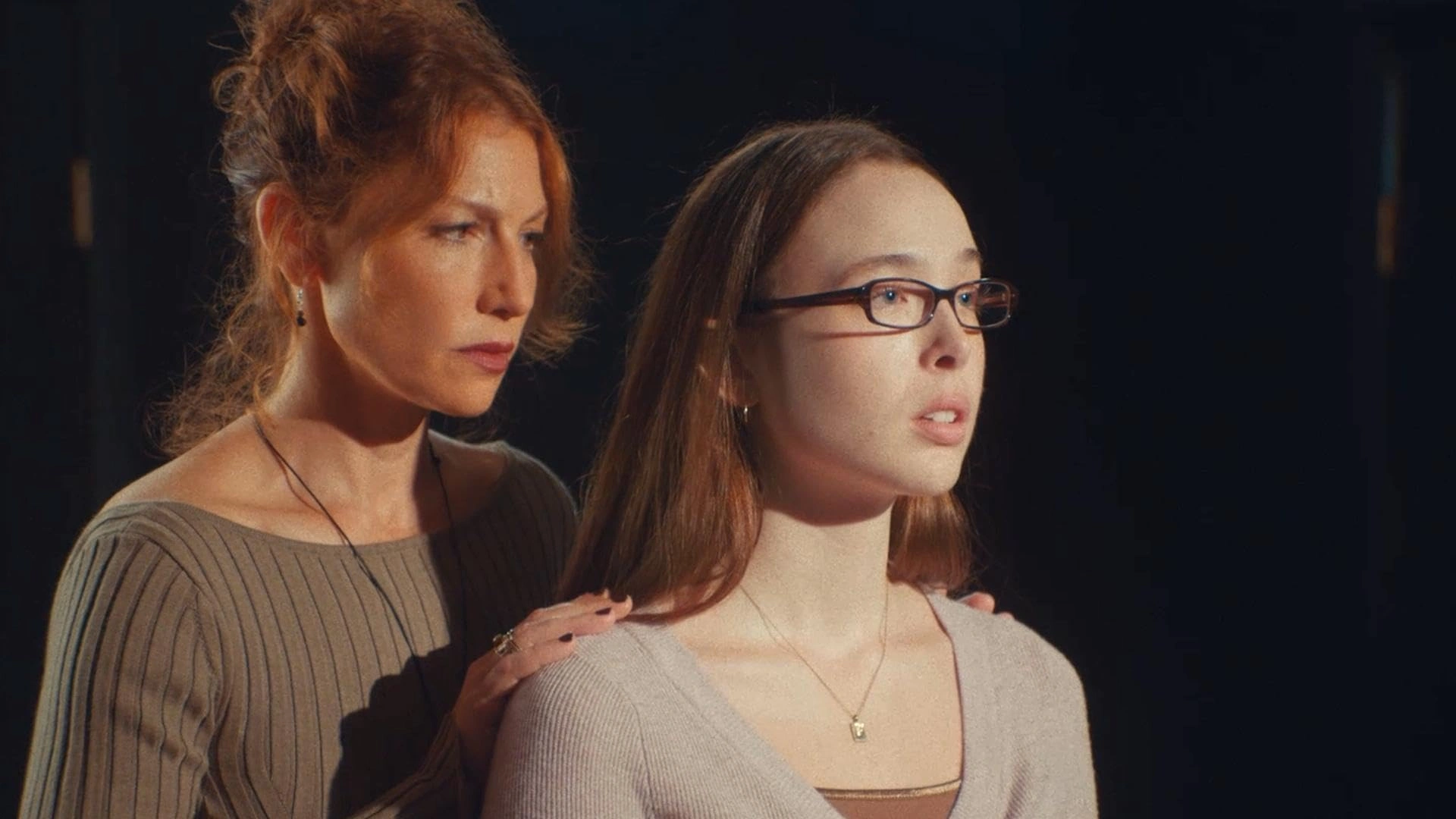

Sophia Takal’s Act One studies artistic hunger as a form of exposure. Hannah, a lonely 17-year-old aspiring actress, moves through her late-1990s suburb like a ghost still waiting to be cast in her own life. At school, she is overlooked. At home, she is managed, corrected, and quietly dismissed. Acting becomes the one place where her selfhood can expand, or at least escape its cramped room.
After losing out on a role in the school play, Hannah finds Act One Studios, where Melanie, a magnetic acting coach with a voice dipped in spiritual certainty, gives her the validation she has been starving for. The film turns this need into dread. Its central question is not whether Hannah can act, but what remains of a person who learns to survive by becoming someone else.
Takal frames the acting world as both sanctuary and trap. The studio offers language, ritual, touch, confession. It also offers control. What begins as discipline darkens into possession.
The Teacher, the Pupil, and the Shape of Need
Hannah is vulnerable, yet she is not empty. Ella Beatty plays her with a withdrawn physicality that suggests fear, intelligence, and a private violence of ambition. She wants approval, certainly, but she also wants proof that she is exceptional. That distinction matters. Melanie does not create Hannah’s hunger. She names it, praises it, then bends it toward her own designs.
Ari Graynor’s Melanie is the film’s most dangerous presence because she understands the theater of care. She speaks of truth, the body, emotional freedom, and artistic awakening, all while tightening her grip on Hannah’s life. Her vocabulary has the polish of pedagogy and the odor of a cult sermon. Every line about authenticity feels like a lock clicking shut.
The film is sharpest in the spaces where abuse disguises itself as artistic necessity. Melanie reframes humiliation as growth. She turns discomfort into evidence of commitment. She encourages Hannah to distrust the family that already makes her feel unseen, then offers herself as mentor, mother, priestess, and director.
Henry adds another layer of danger. His attention flatters Hannah because it makes her feel adult, desired, chosen. Yet that desire is part of Melanie’s machinery. Their intimacy becomes less romance than leverage, a stage direction whispered by someone standing just outside the frame.
The scene with Gracie, Melanie’s former protégé, lands like a message from a future Hannah has not yet learned to fear. One question, cold and almost casual, reveals the pattern. Hannah is not the first girl to mistake a cage for a spotlight.
A Slow Spiral Through Suburban Night
Takal directs Act One as a gradual loss of gravity. The film does not rush toward shock. It lets dread collect in pauses, in glances, in the charged silence after a teacher says something cruel and calls it instruction. Acting exercises become rituals of surrender. A rehearsal can feel like therapy, seduction, punishment, or all three at once.
The late-1990s setting gives the film a strange, half-remembered texture. Clunky websites, instant messages, and suburban anonymity create a world with fewer alarms and wider shadows. Hannah can drift away from school and home with frightening ease. The period detail serves the psychology rather than nostalgia.
Visually, the film often seems to hover. The camerawork gives certain scenes a floating, disembodied quality, as if Hannah is watching her own life from slightly outside her skin. Red fadeouts flare like warning lights, blunt and almost theatrical. The sparse, atonal score keeps the air chilled, giving even quiet moments a pulse of threat.
The genre shape is familiar, yet Takal’s interest lies in the instability beneath it. Is this a lesson, a scene, a fantasy, a memory, or a trap? The film’s strongest passages sit inside that uncertainty. Performance becomes an existential wound. If identity can be trained, stripped, and rebuilt, then the self may be less sacred than we pretend. It may be clay in the wrong hands.
Performers in the House of Mirrors
Beatty gives Hannah a persuasive fragility. Her best moments suggest a girl who wants rescue and recognition with equal force, then slowly loses the ability to tell them apart. As Hannah becomes absorbed by Melanie’s mythology, Beatty lets innocence curdle into something harder. The transformation is quiet before it becomes alarming.
Graynor gives the film its fever. Melanie has to be seductive enough for Hannah’s surrender to feel believable, and Graynor finds that exact voltage. Her calm voice, sudden cruelty, theatrical confidence, and teacherly poise create a woman who can charm a room while poisoning it. She never plays Melanie as a simple monster. That restraint makes her worse.
Elizabeth Reaser gives Hannah’s mother a brittle, distracted edge. She is not a villain, but her failure to see her daughter clearly leaves a space for Melanie to enter. Nate Mann’s Henry works as romantic bait and ethical threat, a figure whose softness makes his role in the manipulation even uglier.
The film’s setup is stronger than its final stretch. Once Act One leans into kidnapping and heightened thriller mechanics, some of its carefully grounded tension begins to strain. The melodrama fits Hannah’s psychic collapse, yet the execution feels rushed in places. Still, Takal’s final movement carries a grim poetic logic. Hannah may discover a kind of truth onstage. The cost is terrifying. She has learned to perform so completely that the person underneath begins to disappear.
Act One is an American independent psychological thriller film that celebrated its world premiere at the Tribeca Festival on June 10, 2026. Directed, written, and co-produced by Sophia Takal, the narrative tracks a lonely, aspiring teenage actress who enrolls in an elite dramatic acting company after being rejected by her school’s theater program. She is rapidly pulled into a dark web of control and manipulation by her magnetic instructor, which completely blurs the lines between artistic dedication and dangerous obsession. Film enthusiasts looking to watch the tense thriller can currently track its screenings across the international film festival circuit while its distribution rights are represented by Visit Films.
Full Credits
Title: Act One
Distributor: Visit Films
Release date: June 10, 2026
Running time: 104 minutes
Director: Sophia Takal
Writers: Sophia Takal
Producers and Executive Producers: Allison Rose Carter, Julie Christeas, Jon Read, Stephanie Roush, Sophia Takal, Julie Waters, Marilyn White, Evan Dyal, Allison Stockel, Jon Stockel, Lawrence Michael Levine
Cast: Ella Beatty, Ari Graynor, Nate Mann, Elizabeth Reaser, Sinclair Daniel, Robert Sean Leonard, Tavi Gevinson
Director of Photography (Cinematographer): Robert Leitzell
Editors: Zach Clark, Matthew L. Weiss
Composer: Jonathan Goldsmith
The Review
Act One
Act One is an unsettling, elegantly controlled thriller about ambition curdling into submission. Sophia Takal’s film is strongest in its slow psychological tightening, with Ella Beatty and Ari Graynor giving the story its wounded pulse and venomous charm. The final act leans too hard into familiar thriller machinery, yet its darker ideas linger: performance can reveal the self, or erase it.
PROS
- Strong lead performances from Ella Beatty and Ari Graynor
- Tense, atmospheric direction
- Sharp study of manipulation and artistic obsession
- Effective late-1990s setting
- Disturbing mentor-student dynamic
CONS
- Final act feels rushed
- Kidnapping turn strains belief
- Some melodrama weakens the grounded tension
- Supporting characters could use greater depth







