























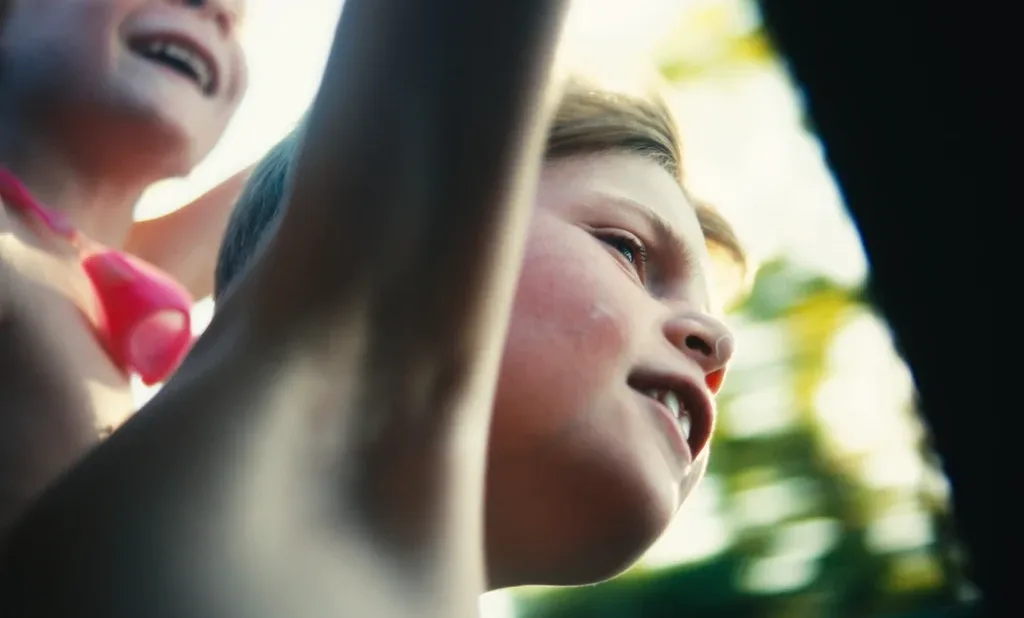

French-Irish director Alexander Murphy follows his 2025 debut Goodbye Sisters with Tin Castle, an observational documentary shaped as a grave, quiet study of cultural displacement. The film profiles the O’Reillys, a family of twelve Irish Travellers living from a battered mobile home parked illegally along a Tipperary highway, holding their ground against the slow spread of modern sameness. Murphy serves as his own cinematographer, and that choice matters. The camera behaves as a witness granted fragile permission. It studies a domestic ecosystem surviving on the geographic and economic edges of the state.
The main pressure comes from an unstable balance between inheritance and enforcement. The O’Reillys carry a communal identity rooted in centuries of nomadic heritage, while institutional forces keep pressing them toward settlement. Tin Castle becomes an archival record of a community facing administrative erasure, the kind that arrives with paperwork, polite language, and a very clean brochure.
By fixing his attention on a single domestic unit, Murphy turns a roadside plot into contested territory, where an old way of life meets bureaucratic standardization with exhausting regularity. The film plays as a slow observation of an ongoing historical retreat.
Matriarchy, Melancholy, and the Morning Rush
Domestic life inside the caravan is a daily feat of hyper-spatial efficiency. Murphy opens with ten children moving through shared breakfast, missing footwear, and the strict timetable of the local school bus. The rhythm recalls an agrarian, localized version of The Waltons, with survival organized through collective labor. Older children tend horses and hunting hounds with disciplined maturity, quietly puncturing the mainstream anxieties so often projected onto Traveller communities.
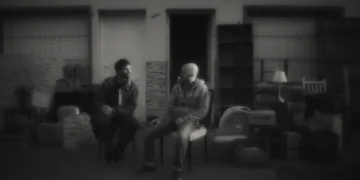
The family’s inner architecture depends on a severe psychological division of labor. Pa’ O’Reilly, the patriarch, appears as a withdrawn presence, caught in static frames while severe depression, anxiety, and physical decline press down on him. He carries the heavy, silent cost of cultural displacement. His devotion to traditional identity remains fierce, yet his body and face register a retreat into mute worry.
Lisa, his wife, supplies the structural scaffolding for the household. She is the pragmatic administrator, handling solicitors as Pa’s prison sentence approaches, stretching welfare payments, and searching for parts for a broken Honda generator. If the caravan is a tiny republic, Lisa is its finance ministry, crisis desk, and weather system. The joke is dry because the labor is anything else.
The generational shift arrives through Sean, the eldest son. His coming marriage creates an existential crossing point for the family. Sean respects his heritage, yet he understands that the modern economic landscape makes this exact mode of life nearly impossible. He carries a sharp generational fatigue, asking, in effect, how much freedom can survive once social isolation becomes the daily toll.
The Geometry of Confinement and Dusk
Murphy uses the caravan’s physical restrictions to create claustrophobic intimacy. The limited interior forces the lens close to its subjects, recording brief flickers of anxiety and affection across the parents’ faces. This proximity signals deep trust, since the camera moves through private space without puncturing its privacy. A single shot of Pa’ seated beside a portrait of the Pope says plenty about the Catholic undertow of Traveller identity, with no need for explanatory dialogue.
Outside, the film’s visual grammar opens into romantic lyricism. Murphy captures horse rides through evening damp and children counting passing traffic beneath wide Tipperary skies. He pairs this beauty with a raw view of country pursuits, including nocturnal rabbit hunts likely to unsettle comfortable urban viewers. The film’s ethics live in that tension. It lets beauty and discomfort occupy the same frame, like relatives forced to share a small room.
One backward-facing tracking shot, filmed from a vehicle speeding away from Pa’ while he follows in a horse-drawn trap, becomes the film’s clearest visual metaphor. A traditional world recedes under the pressure of technological acceleration. The image has the nasty elegance of history doing its work while pretending to be traffic.
The soundscape deepens the elegiac mood. The score, composed by Kevin O’Leary and Mathias Levy Valensi, layers classical pieces from Schubert and Glenn Gould with original string arrangements. The pulse of cello and violin mimics the cadence of trotting hooves. That percussive accompaniment gives the O’Reilly family’s daily activity the weight of a slow, unavoidable march toward closure.
The Bureaucracy of Displacement
The outside world enters through the steady presence of local authorities. Government representatives arrive with sleek brochures for modern housing estates, selling a sanitized stability that reads as bureaucratic assimilation. Acceptance would require the O’Reillys to give up their livestock and abandon their traditional lifestyle. The policy recalls the post-war European movement of communities out of traditional quarters and into planned suburban spaces, a swap of cultural autonomy for indoor plumbing.
Murphy treats the material hardship of this choice with clear eyes. When the generator fails, the family falls into cold darkness, relying on candlelight and traditional storytelling against the winter chill. State intervention remains a constant threat, and Pa’s eventual prison sentence gives that threat institutional weight. These conditions expose the friction of living outside the grid. The O’Reillys choose precarity because the alternative means complete cultural absorption.
Tin Castle stands as an essential archive of a community on the brink of structural displacement. It works as a dignified monument to a lifestyle that modern legislation is systematically making illegal. Murphy records a final, stubborn defense of a culture determined to avoid a quiet disappearance into the history books.
Tin Castle premiered in May 2026 at the Cannes Film Festival as part of the prestigious Critics’ Week lineup, where it earned a special mention for the L’Œil d’or documentary award. Following its successful festival debut, the international rights are managed by Films Boutique with Dulac Distribution handling its theatrical rollout. Viewers can currently catch this moving documentary on the global film festival circuit, with a wider streaming and theatrical release expected later this year.
Full Credits
Title: Tin Castle
Distributor: Dulac Distribution, Films Boutique
Release date: May 2026
Running time: 105 minutes
Director: Alexander Murphy
Writers: Alexander Murphy, Jean-Baptiste Plard
Producers and Executive Producers: Cosme Bongrain, David Collins, Eamon Hughes
Cast: Paddy O’Reilly, Lisa O’Reilly, Sean O’Reilly, Patrick O’Reilly, Chantelle O’Reilly, Tina O’Reilly, Maggie O’Reilly, Willy O’Reilly, Jimmy O’Reilly, Martin Anthony O’Reilly, Scarlett Rose O’Reilly, MacKenzie O’Reilly
Director of Photography (Cinematographer): Alexander Murphy
Editors: Nicolas Longinotti
Composer: Kevin O’Leary, Mathias Levy Valensi
The Review
Tin Castle
Tin Castle succeeds as a dignified, hauntingly intimate archive of a community facing structural erasure. Rather than relying on standard documentary tropes, Alexander Murphy uses a remarkably close lens and lyrical landscape photography to honor the O’Reilly family’s stubborn autonomy. The film balances the poetic freedom of the road with the bleak, unvarnished precarity of modern isolation. It stands as a vital, bittersweet requiem for an ancient way of life that is being quietly outpaced by bureaucratic assimilation.
PROS
- Masterful, intimate cinematography that captures deep emotional nuance within confined spaces.
- A striking, rhythmic musical score that beautifully mirrors the cadence of traditional Traveller life.
- Avoids patronizing or romanticizing the subjects, presenting a dignified portrait of familial solidarity.
CONS
- The focus remains heavily confined to the immediate surroundings, leaving some broader socio-political context opaque.
- Aside from the eldest son, many of the ten children function more as lifestyle symbols than fully developed individuals.