




























Being Towards Death, written and directed by Chen Sicheng, takes the grim grammar of terminal illness and gives it the nervous tempo of a hospital farce. The film follows Zhang Xiaobing, played by Jiang Long, a debt-strangled young man whose failed CareBot business, loan-shark trouble, and grief over the death of his aunt push him to the edge of a hospital roof. His survival leads him into Ward 10, where cancer patients live under the shadow of final diagnoses and gradually form the Fearless Squad.
The title gestures toward Heidegger, which is bold for a comedy that also enjoys pratfalls, shouting matches, and medical absurdity. Still, that tension is part of the film’s identity. Chen treats mortality less like a distant philosophical thundercloud and closer to bad fluorescent lighting: constant, unflattering, impossible to ignore. The film wants to laugh near death without laughing at death. Sometimes it manages the distinction. Sometimes it drops the scalpel.
Slapstick, Sentiment, and the Problem of Too Many Endings
The narrative starts at a sprint, nearly tripping over its own feet. Xiaobing’s rooftop crisis is staged with broad physical comedy, rapid cuts, and a frantic performance style that seems determined to announce the film’s emotional temperature with a siren. It is a risky opening because the subject asks for delicacy, while the execution initially favors noise. The result feels like a noir protagonist wandered into a medical sitcom after taking a wrong turn at existential despair.
Once the film settles into Ward 10, its rhythm improves. The patients give the story a shared pulse, each bringing a different defense against fear: bravado, denial, humor, fantasy, anger, appetite. Xiaobing’s assignment to observe them becomes a documentary project, guided by Jia Dao, a terminally ill director still chasing one final act of authorship. This device gives the film structure, letting characters speak to camera about regret, desire, and unfinished business.
It also creates a problem. Direct address can expose interior life, yet here it often replaces dramatic excavation. Rather than letting silence, gesture, and frame composition reveal private terror, the film sometimes lets characters explain their wounds in clean verbal packages. That is efficient. It is rarely mysterious.
The later road trip and studio excursion expand the film beyond hospital walls, turning the story toward cinema itself: who gets remembered, who gets filmed, who earns a final cut. The tonal aim is bittersweet, with the sweet part receiving better lighting and nicer music. The film also has a habit of ending, then ending again, then remembering one last emotional invoice it forgot to settle.
Also Read




The Fearless Squad and the Ethics of Care
Jiang Long’s Xiaobing is built as a man with no practical future, then placed among people whose futures have been medically shortened. The contrast is blunt, yet effective. He begins as a figure of panic, debt, and self-erasure. Around him, the ward patients become strange tutors in survival, though the writing does not always grant them the psychological shading they deserve.
Jia Dao gives the film its richest meta-cinematic thread. A director facing death, he clings to the camera as proof that time can be arranged, shaped, perhaps cheated a little. His wife, Zhen Yi, becomes the emotional anchor of that storyline. Their relationship is drawn through acts of care rather than speeches of possession. She supports his final creative urge while carrying the quieter burden of anticipated grief. There is moral difficulty there: love expressed through acceptance, pain carried without spectacle. It is the film’s most honest chamber piece.
Bowen, the wealthy young patient pressed by family expectation, brings another angle on mortality. His illness does not release him from inheritance, duty, or paternal control. Death, in his case, becomes another business matter. A bleak joke, really, and the film knows it.
Ma Mau and Liu Jianye supply combative energy, turning the ward into a stage of aging pride, old grudges, and comic friction. Meng Mei’s arrival reopens emotional debts that medical charts cannot record. Little Bing, the abandoned child with a talent for lies, is touching in concept yet artificial in placement. Her presence sharpens the film’s sentimental blade, then waves it a bit too close to the audience’s face.
The ensemble is lively, sometimes moving, sometimes pitched at theatrical volume. The performances work best in small gestures: a glance held too long, a body turning away from bad news, a joke landing half a second before fear returns.
Chiaroscuro in Fluorescent Light
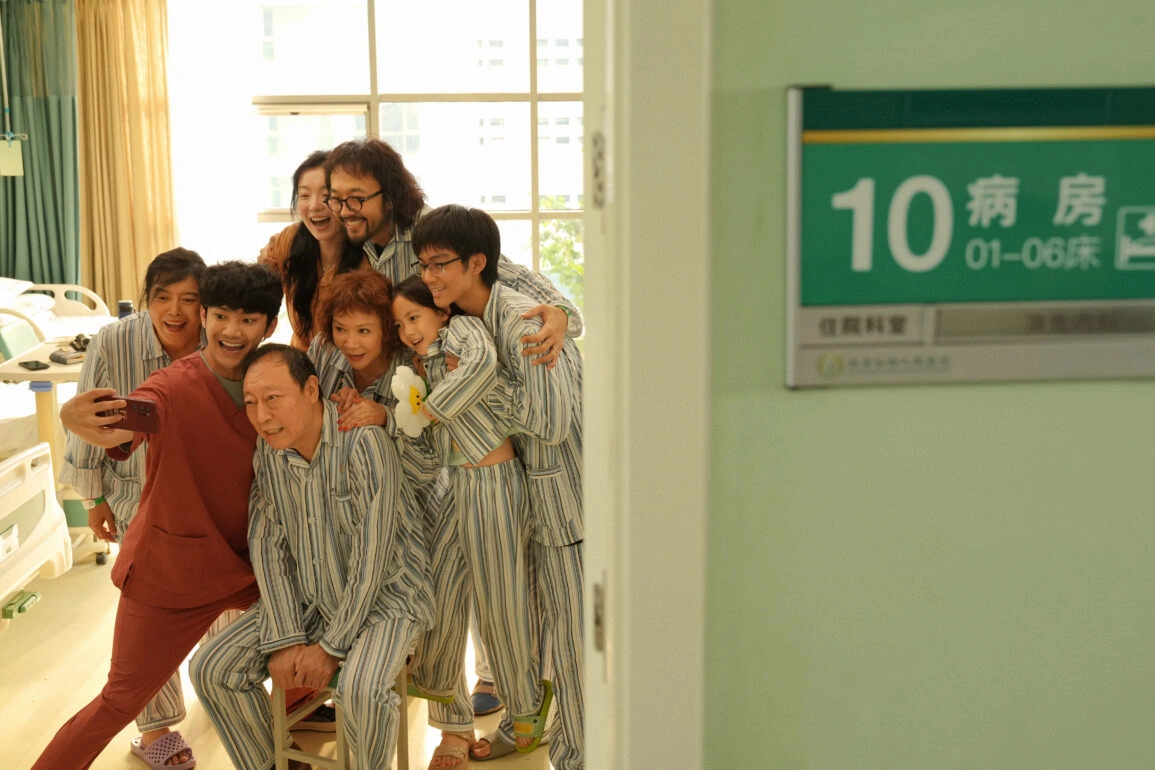
For a film set largely in a hospital ward, Being Towards Death finds a peculiar visual language. This is no classic noir alleyway of wet pavement and Venetian blinds, yet the hospital creates its own form of chiaroscuro. White walls, striped pajamas, harsh lamps, and cramped beds produce a moral brightness that can feel oppressive. Everyone is exposed. No one gets the comfort of shadow for long.
Chen’s camera often treats Ward 10 like a communal stage, arranging bodies in layered compositions that stress proximity. Patients argue, joke, eat, scheme, and mourn within the same visual field. The frame turns illness into social choreography. Death is private in theory, crowded in practice.
The score leans whimsical, sometimes too eager to underline comedy where silence might have cut deeper. Sound design plays into audience psychology through abrupt shifts: chatter gives way to confession, bustle folds into grief, laughter arrives with suspicious timing. The viewer is pulled between emotional release and tonal suspicion. Is this catharsis, or is the film nudging too hard? Both answers fit, inconveniently.
The film’s Chinese hospital setting adds social texture: working-class debt, wealthy lineage anxiety, medical hierarchy, and the uneasy fantasy that art can compensate for institutional coldness. The shared ward, mixing adults and a child, strains realism, serving dramatic convenience over medical plausibility. The self-referential film-industry satire carries sharper teeth, especially through Jia Dao’s desperate need to make meaning before his body fails.
Being Towards Death is sincere, messy, emotionally accessible, and occasionally tone-deaf. Its warmth is real. Its contrivances are also real. Like many patients in Ward 10, it keeps talking past the point where rest might have helped.
Being Towards Death is a Chinese comedy-drama film that made its debut at the Beijing International Film Festival on April 17, 2026, before expanding to wide theatrical release in China on May 1, 2026, and a limited North American theatrical release on May 15, 2026. Directed by Chen Sicheng, the story centers on Zhang Xiaobing, a desperate young man who tries to end his life due to crippling debts. After surviving his suicide attempt, he is hired by a hospital director to conduct psychological interviews in Ward 10—a terminal cancer unit unexpectedly filled with laughter, humor, and unfiltered vitality. Witnessing their relentless determination to enjoy their final days, Zhang finds his own perspective transformed as he collaborates with the patients to film a bittersweet documentary about their lives. Distributed internationally by CMC Pictures, the film is currently concluding its theatrical runs in selected global markets, with upcoming digital streaming platform options expected to be announced later this year.
Where to Watch Being Towards Death (2026) Online
Full Credits
Title: Being Towards Death
Distributor: CMC Pictures, Trinity CineAsia
Release date: April 17, 2026 (Beijing International Film Festival), May 1, 2026 (China), May 15, 2026 (United States limited release)
Running time: 120 minutes
Director: Chen Sicheng
Writers: Chen Sicheng, Tan Liying, Liu Shou, Shi Xiaoyu
Producers and Executive Producers: Sabrina Fan
Cast: Jiang Long, Qi Xi, Yang Chaoyue, Wang Zichuan, Zhang Chi, Cao Bingkun, Huang Yi, Ye Quanxi, Ni Dahong, Cai Ming
Director of Photography (Cinematographer): Florian Zinke
The Review
Being Towards Death
Being Towards Death is an uneven but emotionally earnest comedy-drama. It oscillates between chaotic slapstick and sincere reflections on mortality, enriched by a lively ensemble and moments of genuine warmth. The film’s meta-cinematic threads, theatrical ward compositions, and philosophical undertones make it a curious exploration of life at the edge. Its tonal swings, contrived setups, and occasional sentimental excess keep it from reaching full cohesion, yet the sincerity of its performances and small emotional triumphs make it a memorable if flawed experience.
PROS
- Strong ensemble performances with distinctive character arcs
- Thoughtful philosophical undercurrents and meta-cinematic elements
- Moments of genuine emotional resonance, particularly in relationships
- Creative visual composition and dynamic camera work
- Humorous approach to heavy subject matter
CONS
- Uneven tone, mixing slapstick and serious drama
- Contrived plot points and unrealistic hospital logistics
- Tonal overreach in multiple endings
- Some characters underdeveloped or reduced to types
- Occasional heavy-handed sentimentality