


























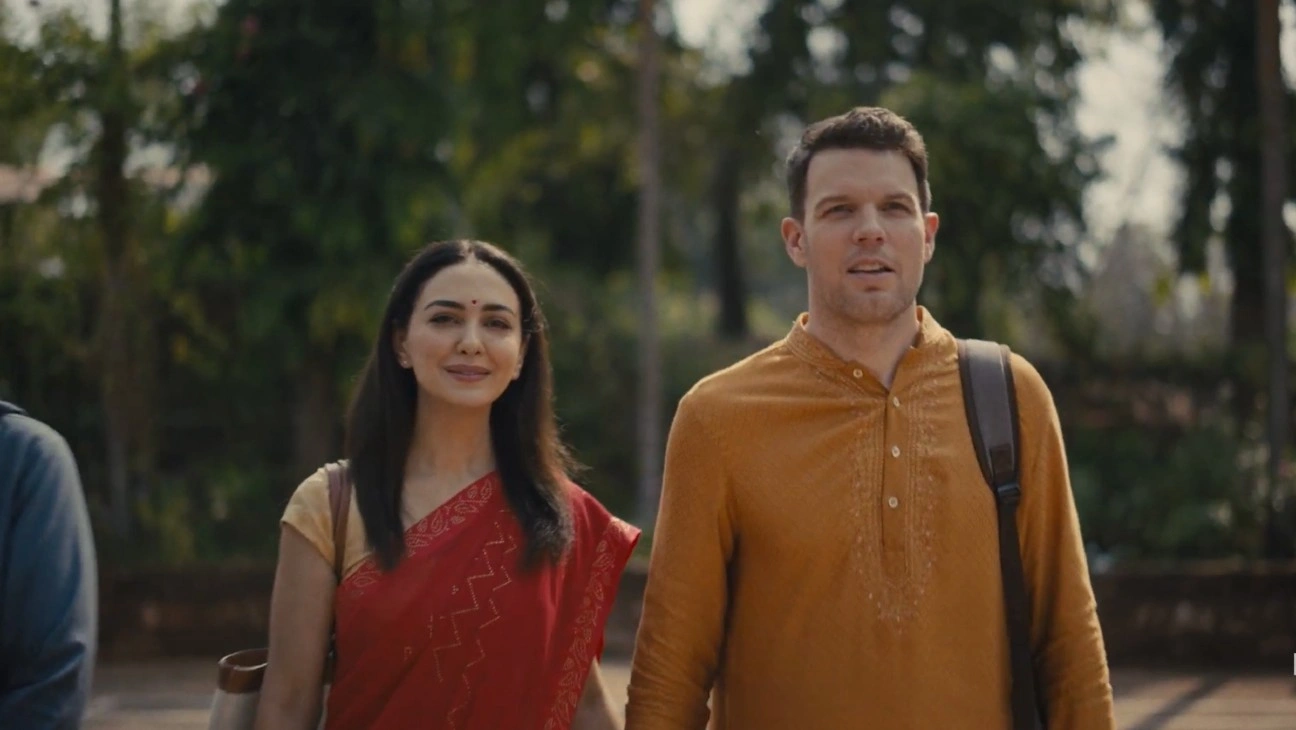

A Mosquito in the Ear is an intimate independent family drama directed by Nicola Rinciari and adapted from Andrea Ferraris’ graphic novel Una Zanzara nell’Orecchio. The film follows Andrew and Daniela, played by Jake Lacy and Nazanin Boniadi, an American couple who travel to India after a six-year adoption process to meet Sarvari, a four-year-old girl played by Ruhi Pal. What should be a moment of completion soon becomes something far less stable: the birth of a family before anyone involved has learned how to speak, listen, or trust.
The title carries a precise sting. For Sarvari, the English spoken around her sounds like a mosquito near the ear: constant, irritating, close, and impossible to understand. That metaphor gives the film its emotional grammar. This is a story about adoption viewed through confusion rather than instant affection, through fear rather than greeting-card warmth.
Rooted in a true story, the film draws power from small, bruising moments: a refused meal, a scream in a hotel room, a child’s body stiffening against comfort. Patient, grounded, and quietly painful, A Mosquito in the Ear studies cultural dislocation through the terror of a child losing the only world she knows.
The Pain of Being Taken From the Familiar
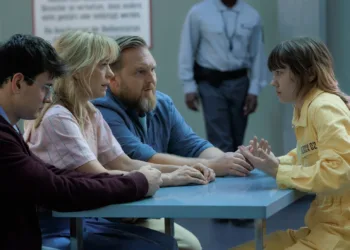
Andrew and Daniela first meet Sarvari at the orphanage, where she appears shy, watchful, and almost ceremonially polite. She helps serve food, observes these strangers, and seems to understand that something important is happening. Once she leaves the orphanage, that fragile calm collapses. She screams, refuses food, resists changing clothes, bites, runs, and pushes back against every attempt to fold her into a new family unit.
The film’s smartest choice is refusing to treat Sarvari’s behavior as mere mischief. Her distress reads as a survival language. She has been taken from the children she knows, the nuns who cared for her, the routines that gave shape to her days, and the sounds that made the world legible.
In Indian cinema, especially in the tradition of parallel cinema, childhood has often been used to expose adult systems that fail to see the individual child clearly. Rinciari’s film shares some of that attentiveness. Sarvari is never reduced to a symbol of rescue. She is a person in crisis.
Andrew and Daniela want to love her, yet the film quietly asks what love means without preparation. They arrive with good intentions, but little linguistic or cultural readiness. A passing man’s warning that Sarvari should not lose her culture cuts through the family drama with startling clarity.
International adoption can offer safety and opportunity, but it can also create a rupture in language, memory, and belonging. The film lets that tension sit in the room. Meanwhile, the couple’s marriage begins to strain under the speed of their new reality. Parenthood arrives in a rush of panic, guilt, tenderness, and helplessness.
A Family Built Through Misread Signals
Ruhi Pal gives the film its most difficult and affecting performance. As Sarvari, she communicates through resistance, silence, movement, and sudden emotional eruptions. The role could have become a collection of tantrums, but Pal makes each outburst feel specific.

A scream is fear. A refusal is grief. A retreat is calculation. Her character speaks Hindi while Andrew and Daniela do not understand her, so much of the film’s emotional storytelling rests on gesture, rhythm, and reaction. Pal carries that burden with startling control.
Nazanin Boniadi brings a tense warmth to Daniela. She seems to bond with Sarvari sooner, partly through patience and partly through her willingness to stay physically and emotionally present. Daniela is not written as an idealized mother. She is exhausted, anxious, and occasionally overwhelmed by the sense that she must manage Sarvari’s fear while absorbing Andrew’s panic. Boniadi plays her as a woman whose longing for motherhood now has to survive the reality of it.
Jake Lacy’s Andrew is messier, and that messiness matters. He is more visibly unsettled, more likely to step away when the pressure becomes unbearable. His walk during a stressful moment, his purchase of candy, and his later apology sketch a man embarrassed by his own limits. Andrew’s difficulty is sharpened by Sarvari’s unease around men, since her early life has been shaped by women at the orphanage. Lacy never turns him into a brute. He is simply a new father discovering, with no graceful buffer, how quickly fear can expose weakness.
Micky Singh’s Sister Aruna gives the film its needed steadiness. She acts as translator, mediator, and emotional anchor, yet the script wisely avoids making her a magical solution. Some divides can be interpreted. Others have to be endured.
Realism Without Melodrama
Rinciari directs with restraint, keeping the drama concentrated within the first days of adoption. The compressed time frame gives the film an almost claustrophobic pressure, as if every hotel room, car ride, and street corner is testing whether this new family can survive its first hours together. The on-location filming gives India texture without turning it into visual ornament. Crowds, streets, orphanage spaces, and domestic interiors all remind Andrew and Daniela that they are guests in a culture they have not yet learned to read.

The film’s use of art is especially thoughtful. Andrew and Daniela are artists, and Sarvari draws too. These images create one of the few spaces where communication can happen without translation. The motif could have been overstated, but Rinciari lets it work quietly, allowing marks on paper to carry emotions that spoken language cannot reach.
The final act, where Sarvari runs into the crowded streets, lands with real force because the film has prepared us for both sides of the terror. We understand why she runs, and we understand why Andrew and Daniela are shattered by it. Editing and pacing serve that dread without swelling it into artificial hysteria. The scene recalls a global tradition of child-centered dramas where physical movement becomes emotional argument, from Italian neorealism to Indian social realism.
A Mosquito in the Ear is humane, observant, and emotionally precise. It understands that love cannot erase fear on command. Trust, like language, has to be learned one difficult sound at a time.
A Mosquito in the Ear is an American-Indian independent drama film that was released in the United States by Persimmon on June 11, 2026, following its initial world premiere at the Santa Barbara International Film Festival earlier this year. Directed by Nicola Rinciari and adapted from the Italian graphic novel Una Zanzara nell’Orecchio by Andrea Ferraris, the narrative follows an eager American couple who travels to Goa, India, to bring home their newly adopted four-year-old daughter. Their idealized vision of parenthood shatters when the young girl completely refuses to leave the orphanage behind, turning their trip into a deeply emotional challenge that tests their relationship stability. Audiences seeking to watch this touching independent feature can find it screening at select local theater venues and independent film festivals nationwide.
Where to Watch A Mosquito in the Ear (2026) Online



Full Credits
Title: A Mosquito in the Ear
Distributor: Persimmon
Release date: June 11, 2026
Running time: 90 minutes
Director: Nicola Rinciari
Writers: Nicola Rinciari, Emily Dillard, Darren Dean, Samina Motlekar
Producers and Executive Producers: Emily Dillard, Darren Dean, Ali K. Rizvi, Frank Hall Green, Stephen Stanley, Jomon Thomas, Sunitha Ram, Laurens C Postma
Cast: Jake Lacy, Nazanin Boniadi, Ruhi Pal, Micky Singh
Director of Photography (Cinematographer): Kai Dickson
Editors: Devon Solwold
Composer: Franco Piersanti
The Review
A Mosquito in the Ear
A Mosquito in the Ear is a tender, tense, and culturally alert drama about adoption, language, and fear. Nicola Rinciari keeps the emotion grounded, while Ruhi Pal, Nazanin Boniadi, and Jake Lacy turn miscommunication into gripping human drama. Its restraint gives the story its sting.
PROS
- Excellent child performance from Ruhi Pal
- Sensitive treatment of adoption and cultural identity
- Strong chemistry between the adult leads
- Patient direction avoids melodrama
- Meaningful use of language barriers
CONS
- Deliberate pacing may feel slow for some viewers
- Narrow time frame limits secondary characters
- Some adoption themes could have used deeper expansion