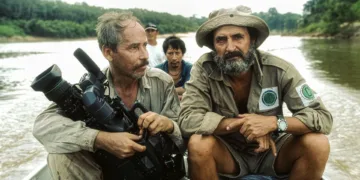













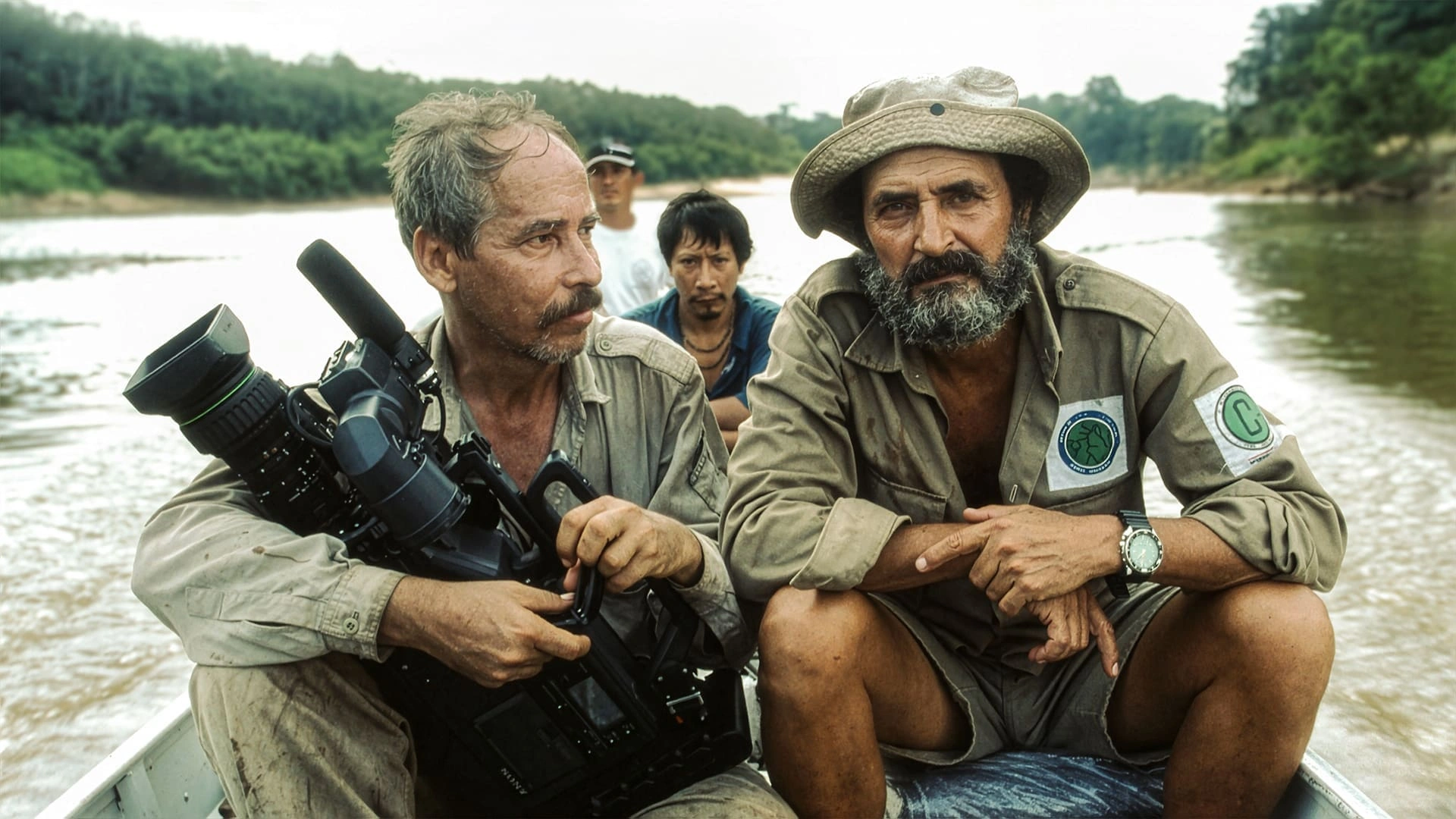

Amazomania begins with the old grammar of exploration: a white man tying his boots, speaking into a camera, preparing to enter Indigenous territory as if history has granted him an appointment. Swedish journalist Erling Söderström traveled into Brazil’s Javari Valley in 1996 with Brazilian official Sidney Possuelo, whose expedition sought peaceful contact with the Korubo, one of the last communities living in isolation in the Amazon. Söderström filmed the encounter, used part of the footage in an earlier documentary, built a reputation from it, then left much of the material unseen for decades.
Nathan Grossman’s film returns to that archive with a cold question under its skin: what did this contact mean to those who were contacted? The answer arrives slowly, through recovered footage, present-day interviews, and Söderström’s 2023 return to the Korubo. The film’s moral tension lies in its construction. It wants to expose the colonial gaze, and it can only do so by replaying it.
The Archive Refuses To Behave
The opening stretch is heavy with exposition, and the patience it demands is not always rewarded in rhythm. Söderström’s 1996 footage carries the stiffness of a heroic field report. He speaks of danger, failed attempts, and uncertainty, then slips into a revealing phrase about “humans” entering Indigenous territory.
The word lands like a dropped match. The Korubo are present in the mission’s imagination before they appear on screen, described through menace, clubs, skulls, and warnings passed among visitors who have already written the emotional script of the encounter.
That script curdles once the meeting happens. The cameras swarm. Expedition members put clothes on the Korubo. Photographs are taken with the greed of people convinced that access is a form of permission. Grossman does not need to underline the violence of the scene.
He lets the bodies do the indictment: the visitors leaning in, aiming lenses, performing kindness through possession. One of the film’s sharpest details is that some Korubo believed the camera was a gun. The comparison has been made before in writing about cinema and colonial power, yet here it becomes physical, immediate, almost absurdly literal.
Possuelo’s mission is framed as protection against settlers, fishermen, and killings on both sides. The stated purpose matters. So does the imagery surrounding it. A peaceful expedition can still carry the posture of conquest. Amazomania is strongest when it refuses to treat good intentions as moral shelter.
The Question From The Other Side
The film’s defining reversal comes through a simple question. Tsamavo, young and curious, approaches Söderström’s camera during the first contact and asks, “Who are you?” It is a devastating moment because it breaks the fantasy of one-way observation. The person turned into an image studies the maker of images. The presumed subject becomes the examiner.
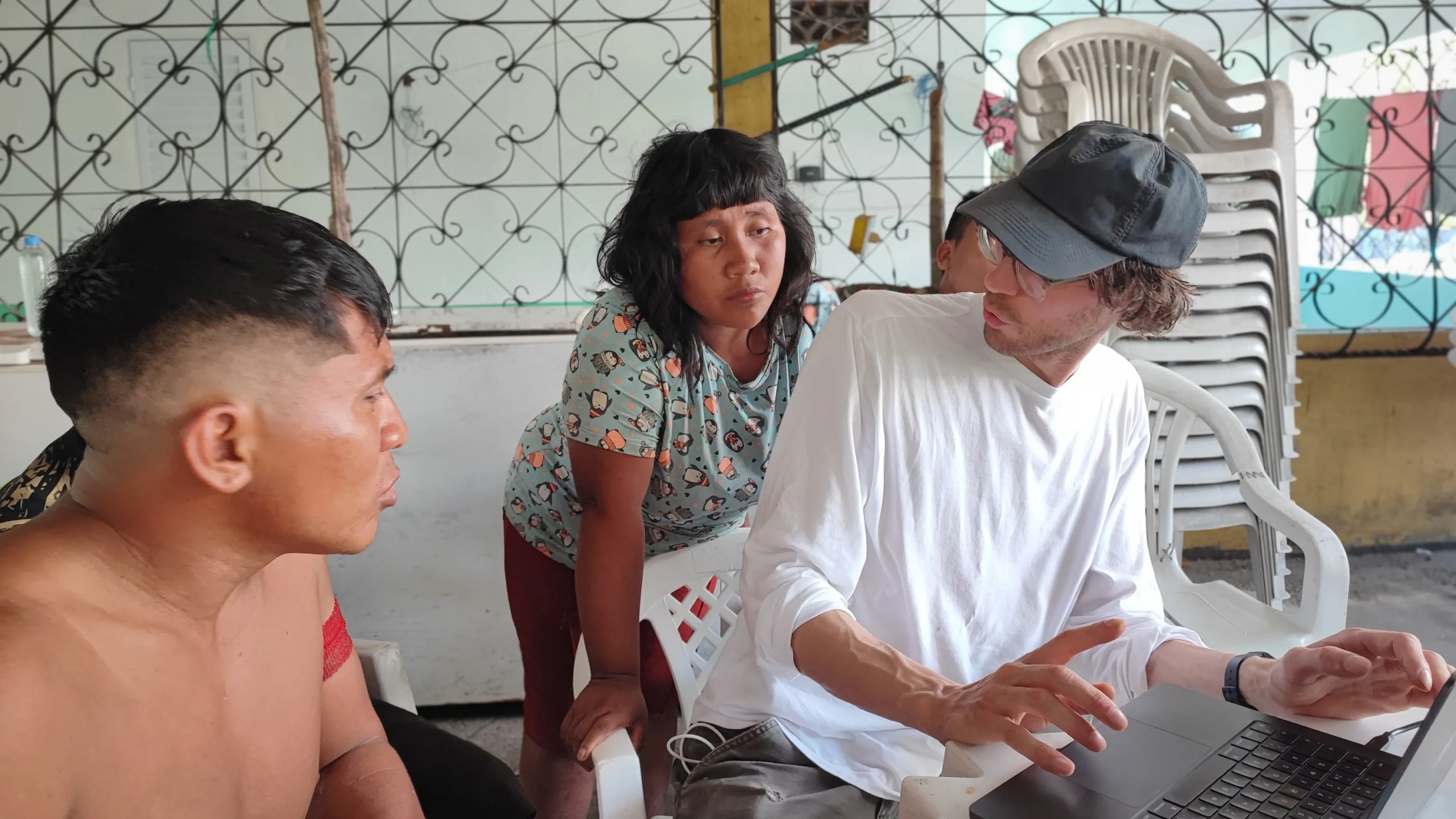
Grossman structures the film so that this reversal arrives twice: first inside the 1996 footage, then again in the 2023 return. The early material lets Söderström’s adventure narrative assemble itself: the childhood dream of far horizons, the thrill of contact, the romance of the Amazon imagined as an untouched Eden.
The later material punctures that romance. A Korubo translator watches the footage and reveals how little the visitors understood. The peaceful encounter was not proof of outsider control. It happened because the Korubo chose that response for that moment.
Söderström returns expecting recognition, maybe affection, certainly continuity. What he receives is a claim. The Korubo ask about image rights, money, ownership, and the profits attached to their faces. The demand changes the temperature of the film. His archive, once a trophy of access, becomes evidence in a dispute. His pride in having extensive coverage of isolated people begins to sound less like achievement than appetite.
The discomfort is precise. Söderström can present himself as friend, ally, chronicler, and witness, yet he struggles when asked why he came back so often and what his work returned to the people who made it valuable. The film does not need a villain. It has something harder to dismiss: a liberal self-image caught on tape.
Ownership In The Frame
Grossman arranges Amazomania in three movements: the original contact footage, Söderström’s earlier account of his Amazon work, and the 2023 confrontation. The structure is clean without being tidy. The film understands that chronology alone cannot repair a distorted image. It must let the image be challenged by those inside it.
Its formal choices are restrained, with occasional playful reversals of observer and observed. These touches matter because the film’s subject is not only an expedition. It is documentary power itself. Who points the lens? Who keeps the footage? Who turns another culture into professional capital? Who gets praised for access, and who is asked to be grateful for visibility?
The collaboration with Korubo participants gives the film necessary force, and their demand for restitution gives it political weight. Still, the project cannot wash itself clean. This remains a Swedish filmmaker revisiting a Swedish journalist’s reckoning through an archive produced by unequal contact. The film knows this, which is why its final argument feels properly unsettled. The Korubo are granted agency here, yet the frame remains partially inherited.
Amazomania’s secondary threads, especially ecological pressure in the Javari Valley from illegal logging, fishing conflict, and resource depletion, receive less attention than the battle over representation. That imbalance narrows the film’s scope, but it also sharpens its blade. Grossman’s documentary is about the cost of being seen by those who mistake seeing for understanding, and about what happens when the image looks back and sends an invoice.
The European documentary feature Amazomania celebrated its global world premiere at the CPH:DOX festival on March 18, 2026, where it secured the prestigious FIPRESCI Critics’ Award before going on to win the Best Film Award at DocsBarcelona. Directed by acclaimed Swedish filmmaker Nathan Grossman, the non-fiction narrative follows the re-examination of a historic 1996 expedition where a Swedish journalist made first contact with the isolated Korubo tribe deep within the Amazon jungle, contrasting the original footage with a modern journey where the community reclaims their own narrative and demands accountability. Audiences seeking to watch the award-winning feature can find it touring the international non-fiction festival circuit, with North American event screenings at showcases like DC/DOX and international distribution rights represented by Autlook Filmsales.
Full Credits
Title: Amazomania
Distributor: Autlook Filmsales, B-Reel Films, Siersted Films, Les films du Tambour de Soie
Release date: March 18, 2026
Running time: 93 minutes
Director: Nathan Grossman
Writers: Nathan Grossman
Producers and Executive Producers: Cecilia Nessen, Pelle Nilsson, Fredrik Heinig, Alexandre Cornu, Comunidade Korubo, Takvan Vakwë
Cast: Erling Söderström, Diego Lajst, Nathan Grossman
Director of Photography (Cinematographer): Nathan Grossman, Erling Söderström, Diego Lajst
Editors: Jordana Berg, Nathan Grossman
Composer: Josefine Skov
The Review
Amazomania
Amazomania turns archival adventure into a trial of the camera itself. Grossman’s film is strongest when the Korubo interrupt the old fantasy of discovery and ask for ownership, payment, and recognition. Its Swedish frame never fully disappears, but that failure becomes part of its ethical charge. This is a sharp, uneasy documentary about contact, extraction, and the expensive myth of innocent looking.
PROS
- Powerful archival reversal
- Korubo agency foregrounded
- Sharp critique of image ownership
- Uncomfortable, necessary 2023 return
CONS
- Slow opening stretch
- Ecological threats get limited space
- Swedish framing remains visible
- Some questions stay unresolved