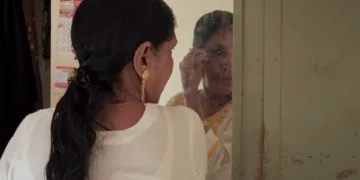








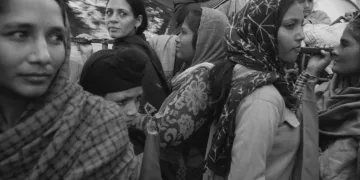




















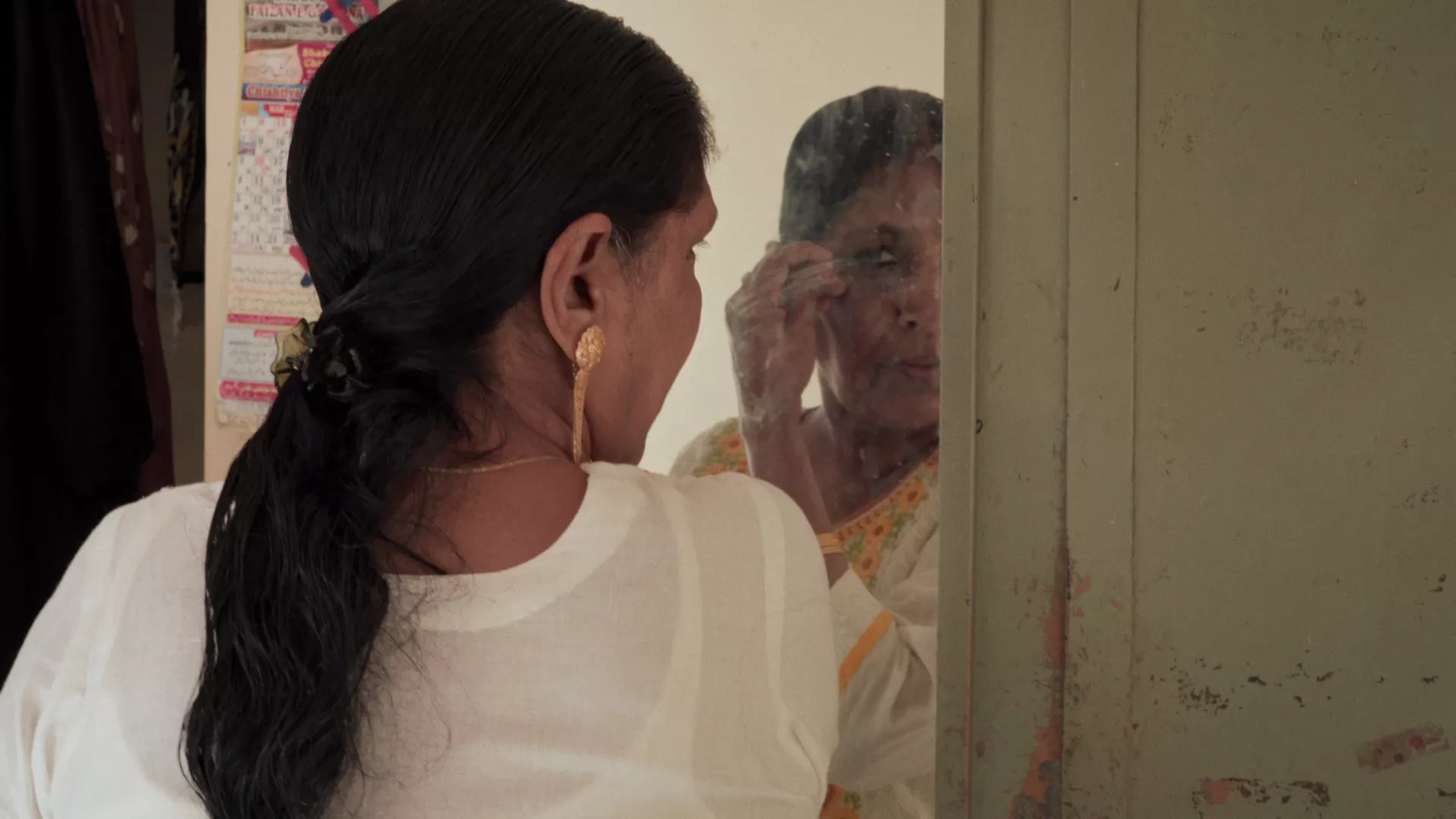

Behind a Bandra shopfront, a table and a few plastic garden chairs carry the weight of bruised marriages, religious authority, family shame, and women’s speech newly given public force. Sophie Schrago’s What Comes From Sitting In Silence? spends most of its time inside Mumbai’s first women-led Islamic court, where Judge Khatoon Zubeda Shaikh hears marital disputes with the patience of someone who understands that silence can be trained into a person.
The room has none of the grandeur associated with law. Parents hover behind their children. Husbands sit close enough to their wives for every denial to feel physical. The street remains nearby, pressing noise into the hearings. This modest setting gives the film its sharpest visual idea: justice here is not marble, robes, or distance. It is a crowded office where a woman must say, sometimes with visible difficulty, what has happened to her at home.
Schrago’s film is observational, often intensely so. It watches Khatoon and her team mediate cases involving humiliation, physical abuse, emotional distress, family interference, and the exhausting expectation that wives absorb domestic cruelty as routine. The film’s strength comes from access. Its weakness comes from how rarely it steps outside that access to explain the system holding these encounters in place.
The Judge Who Makes Silence Answerable
Khatoon is the film’s great subject, and Schrago knows it. She sits with a calm, twinkling authority, asking both sides to speak, then waiting long enough for the weaker voice in the room to gather itself. Her method is not theatrical. She does not turn men into villains for the camera.
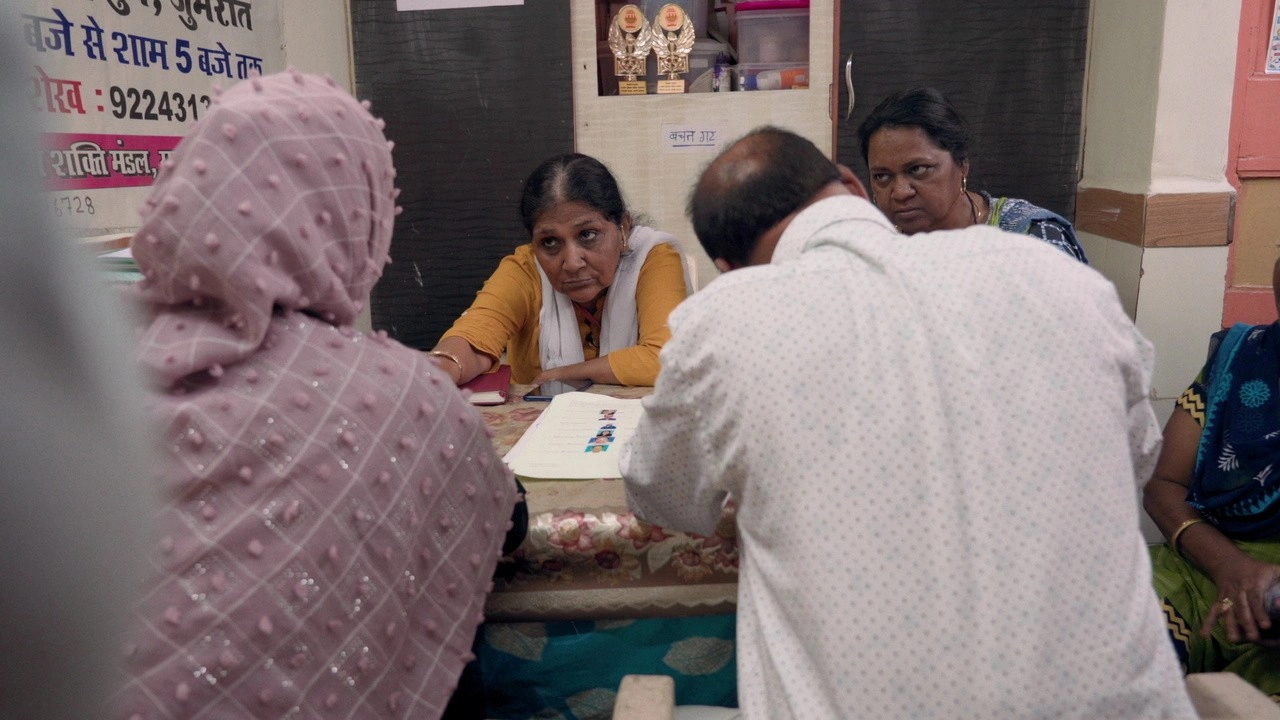
She lets them speak, which can be more revealing. When a husband tries to soften violence into “light” hitting, or when another assumes being served is his marital right, Khatoon refutes him with a steadiness that feels practiced through years of hearing the same logic in different shirts.
Also Read






The most piercing line belongs to a woman who asks, “Does my body belong to anyone but me?” In a different film, that sentence might be treated as a slogan. Here, it lands as exhaustion. It comes from a woman sitting in a cramped room, trying to turn private injury into something that can be recognized by an authority her husband respects.
That respect matters. The men may resist, deflect, or explain themselves badly, but they do sit before Khatoon. The film’s most radical image is often that simple arrangement: a female Muslim judge hearing women’s claims within a religious framework too often presumed, especially by outside observers, to be closed to female authority. Khatoon’s work unsettles that lazy reading. She does not reject Islamic law; she interprets it in a room where women are allowed to initiate speech.
Her insistence on reconciliation complicates the film. Khatoon often tries to preserve marriages, especially where children are involved. Some cases make that instinct painful to watch. A woman describes abuse, then the hearing bends toward repair. Without deeper explanation of divorce, custody, financial dependence, family pressure, and religious procedure in this setting, the viewer is left to read the gesture alone. It can look humane. It can also look like a softer route back into harm.
Observation and Its Blind Spots
Schrago shot the film herself, and the camera’s closeness has real value. The uneven framing and rough edges sometimes work in the film’s favor, giving the room an immediacy that a polished crew might have disturbed. Faces are caught mid-thought. Silence sits between questions. The ceiling fan becomes part of the soundscape, a low mechanical pulse above conversations that feel both ordinary and unbearable.
The film’s fly-on-the-wall approach also limits it. The hearings create a natural rhythm: complaint, denial, intervention, negotiation. After several cases, that rhythm begins to call for structure beyond observation. What power does this court possess? How do women find it? How did Khatoon earn such authority in a male-dominated religious-legal culture? How many similar courts exist, and what resistance do they face? The film has access to a rare institution but too often treats rarity as self-explanatory.
The absence is especially felt because Schrago clearly has the anthropological patience for this material. She understands behavior, space, and social performance. She watches the posture of husbands, the hesitations of wives, the way parents crowd the room with inherited expectations. Yet the film leaves too much cultural and legal architecture outside the frame. For international viewers, that creates confusion. For Indian viewers, it may create a different frustration: the sense that a necessary local complexity has been thinned into atmosphere.
Schrago’s own presence shifts the film in its later stretch. Speaking from behind the camera, she shares her own experience after something Khatoon says opens a door. The exchange is delicate, and Khatoon’s response gives the film one of its clearest articulations of speech as action. Only by speaking can change begin, she suggests. In that moment, the camera stops being a quiet observer and becomes part of the room’s moral traffic.
Filmi Songs and the Cost of Reconciliation
The most revealing breaks come when Khatoon sings classic romantic filmi songs between hearings. These moments could have seemed decorative, but they deepen the portrait. Indian cinema has long treated song as emotional argument, a place where desire, grief, memory, and social duty can say what dialogue cannot. Khatoon’s singing places her inside that tradition: a judge surrounded by broken trust still carrying the musical residue of love.
That tension gives the film its richest cultural texture. The court is built around injury, yet its presiding figure has not surrendered the language of romance. She works among women harmed by husbands and in-laws, but she still seems to believe that some marriages can be pulled back from cruelty into mutual recognition. The songs do not excuse that belief. They make it legible.
What Comes From Sitting In Silence? is strongest when it lets the room speak through small details: the plastic chairs, the poster tracking women-initiated cases, the men shifting under Khatoon’s questions, the women learning how to turn pain into testimony. It falters when the frame needs widening. A film about women taking religious law into their own hands should give us sharper tools to understand the cost, reach, and limits of that act. Speech is liberation here. It is also only the first door.
The international documentary feature What Comes from Sitting in Silence? celebrated its world premiere at the True/False Film Fest in March 2026 before building momentum across the global non-fiction circuit with notable spring screenings at Visions du Réel, Hot Docs, and the DOXA Documentary Film Festival. Directed by Sophie Schrago in her feature length debut, the intimate film embeds itself within the quiet, busy confines of Mumbai’s very first women-led Islamic Sharia court. The narrative follows the remarkably astute and humane Judge Khatoon Zubeda Shaikh as she and her resolute team provide safety, counsel, and a rare public platform for female plaintiffs to confront domestic violence, challenge deep-seated patriarchal structures, and redefine religious law to claim personal justice. Audiences looking to watch the film can currently catch it making the rounds at independent cinema showcases, with wider international streaming and broadcast distributions expected to follow.
Full Credits
Title: What Comes from Sitting in Silence?
Distributor: Hutong Productions, Seesaw Pictures
Release date: March 5, 2026 (True/False Film Fest)
Rating: Unclassified (18+)
Running time: 77 minutes
Director: Sophie Schrago
Writers: Sophie Schrago
Producers and Executive Producers: Pauline Tran Van Lieu, Lucie Rego, Heejung Oh, Sarah Kang
Cast: Khatoon Zubeda Shaikh
Director of Photography (Cinematographer): Sophie Schrago
Editors: Isidore Bethel
Composer: R.D. Burman
The Review
What Comes from Sitting in Silence?
What Comes From Sitting In Silence? captures a rare and vital courtroom with patience, intimacy, and a sharp ear for the courage required before speech can become evidence. Its strongest presence is Judge Khatoon, whose authority complicates easy assumptions about Muslim women, religious law, and domestic power. The film’s weakness is its narrow frame: the room is vivid, but the legal and social structures around it remain underlit. Still, its small details carry force.
PROS
- Judge Khatoon’s humane authority
- Rare access to private hearings
- Strong use of confined space
- Filmi songs as cultural texture
- Patient observational rhythm
CONS
- Limited legal background
- Khatoon’s backstory feels thin
- Reconciliation scenes need sharper framing
- Rough self-shot camerawork
- Repetition in mediation structure