






























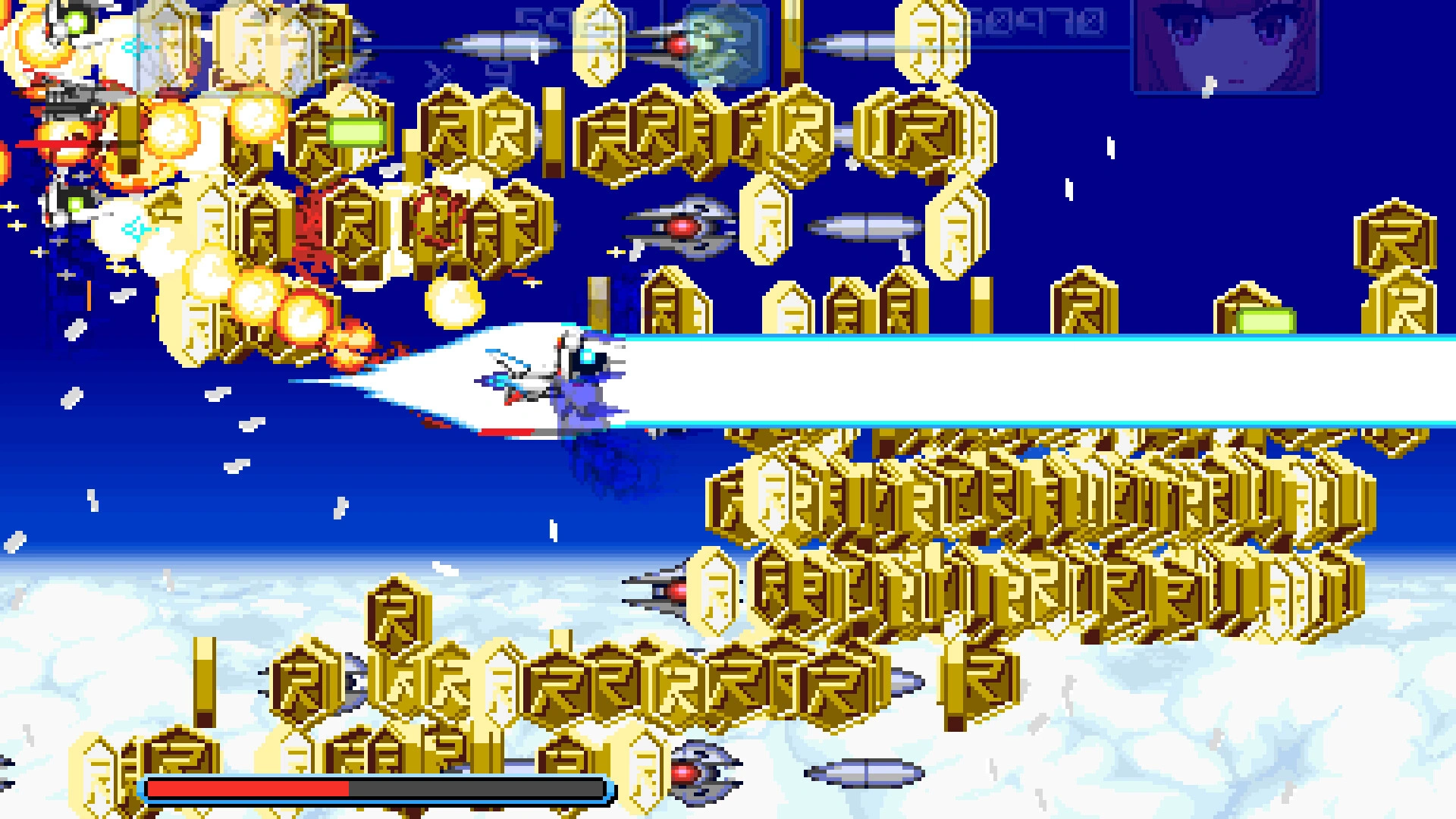
Hold the charge beam in Revolgear Zero for a few seconds and the whole screen turns into a payout machine. Enemy ships break apart, coins scatter everywhere, and the game gives you that old arcade rush where survival, greed, and reflex all occupy the same tiny strip of space. It is a simple pleasure, but Bikkuri Software understands the genre well enough to know that simple is not the same thing as thin.
This is a side-scrolling shoot ’em up built from familiar pieces: Gradius in its forward push, R-Type in its ship identity, and a little Raiden II in the pleasure of clearing a screen that looked impossible half a second earlier. It does not pretend to reinvent the shmup. The better question is how well it reconstructs the feeling of one, and on that front, Revolgear Zero is often confident, quick, and satisfying.
The setup barely matters. There are cosmic warriors, cryptic phrases, and a story that withholds most of its context until the credits, where multiple endings hint at a larger world. For a genre that has spent decades turning vague galactic peril into an excuse for laser fire, this is hardly fatal. Still, the missing narrative texture means the game has to live almost entirely through movement, weapons, and replay value.
A Shooter That Lets the Stage Fight Back
The basic loop is direct: move, shoot, dodge, collect, repeat. What gives Revolgear Zero its best shape is the way its stages interrupt that rhythm. Some areas push forward like standard horizontal shmup routes, with waves arriving from predictable lanes. Others force the player through branching paths, narrow corridors, vertical climbs, and damaging terrain that can be as dangerous as any enemy pattern.
That environmental pressure matters. In one stretch, the safer choice is not to fire wildly, but to find a pocket of space and wait for the stage to let you breathe. In another, enemies approach from both directions, turning a forward-facing loadout into a liability. The game is at its best when a level makes you reconsider the ship you brought into it.
The burst attack gives those moments a useful second layer. It hits hard and protects you from incoming fire, which makes it ideal for bullet-heavy sections or sudden enemy clusters. The energy gauge can refill after taking damage, which is a nasty bargain, or through a separate attack that leaves you exposed. That creates a small tactical argument during every busy screen: spend the burst to survive now, or save it for the larger threat you know the game is about to throw at you.
Damage feedback is the one piece of that loop that could be clearer. When bullets, coins, explosions, and enemy bodies crowd the screen, the exact moment where danger becomes disaster can feel muddy. A shmup can be chaotic without feeling unreadable. Revolgear Zero usually manages that balance, then occasionally lets the spectacle get in the way of information.
The Shop Is the Real Campaign
The smartest long-term hook is not the story, the endings, or even the stage list. It is the ship configuration system. Coins earned during runs can be spent in the shop on weapons and gear, and the game quietly pushes you to play better by making cleaner kills and stronger chains pay out more generously.

This is where Revolgear Zero earns its comparisons to its genre ancestors rather than merely borrowing their clothes. Gradius tied power to the anxiety of staying alive long enough to build your ship. R-Type gave each craft a distinct combat personality. Revolgear Zero turns that inheritance into a tinkering loop where the player keeps asking which loadout solves which problem.
A weapon that feels excessive in open space can become awkward in a tight passage. A focused shot that melts bosses may leave you exposed when enemies swarm from behind. A dual-direction setup can trivialize a stage that previously felt unfair. These are not massive build decisions by RPG standards, but inside a short arcade shooter, they give repeat runs a real sense of adjustment.
Co-op strengthens that design. With two players, weapon coverage becomes a shared plan rather than a personal preference. One ship can handle forward pressure while another watches the rear, and the screen’s coin-filled chaos takes on the noise of a proper arcade cabinet. Many modern shmups forget how much fun the genre can be with another player beside you. Revolgear Zero remembers.
Strong Feel, Thin Extras
On paper, the game has a healthy list of modes. Standard Mode unlocks individual stage play, Boss Rush, 30 missions, an alternate mode with faster boost energy recharge, co-op, and a secret mode. The problem is that several of these extras do not deepen the game’s best ideas.
Boss Rush works because the combat is already built around quick pressure and damage windows. It lets players test loadouts without the full run structure around them. Mission mode is weaker. Too many missions feel like side tasks rather than new ways to understand the weapons or stages, so they do little to extend the game beyond the pleasure of repeating what already works.
Presentation follows a similar pattern of sturdy genre affection rather than surprise. The anime character art gives the game a modern arcade wrapper, while the stages lean into retro machinery, organic threats, bright effects, and a soundtrack that keeps pushing the player forward. Early sky areas can look plain, but later levels bring stronger color and busier backgrounds. Performance during heavy action is impressive too, with no obvious slowdown when bullets and coins flood the screen.
The harder caveat is stability. Reported crashes after stage completion on Nintendo hardware are difficult to shrug off in a game built around repeat runs. Losing momentum after clearing a stage cuts directly against the arcade flow the rest of the design works so hard to protect.
Revolgear Zero belongs to the sturdy middle branch of the shmup family tree: not as punishing as the genre’s most famous bruisers, not as inventive as its modern outliers, but far better at pure game feel than many flashier arcade revivals. When the ship is tuned, the music is driving, and coins are filling every corner of the screen, it understands exactly which old pleasure it came to revive.
The Review
Revolgear Zero
Revolgear Zero knows its lineage and plays to it with confidence. Its best runs recall the quick-hit pleasure of Gradius and R-Type, then add enough coin-chasing, loadout testing, terrain pressure, and co-op chaos to give each replay a reason to exist. The weak mission mode, thin story, and reported crashes hold it below the genre’s sharper modern standouts, but the core shooting has punch, speed, and a strong arcade pulse.
PROS
- Satisfying arcade shooting
- Strong ship customization
- Fun co-op play
- Energetic soundtrack
- Varied stage hazards
CONS
- Shallow mission mode
- Thin story setup
- Reported crashes
- Uneven visual variety
- Limited content depth