




























Landing on an empty fire territory with no creature in hand explains Culdcept Begins faster than any tutorial box can. The board offers an opportunity, the deck refuses to cooperate, and one unlucky draw changes the value of your next several turns. This tension between planning and disorder drives a strategy game that combines property control, collectible cards, and dice movement without reducing any of them to decoration.
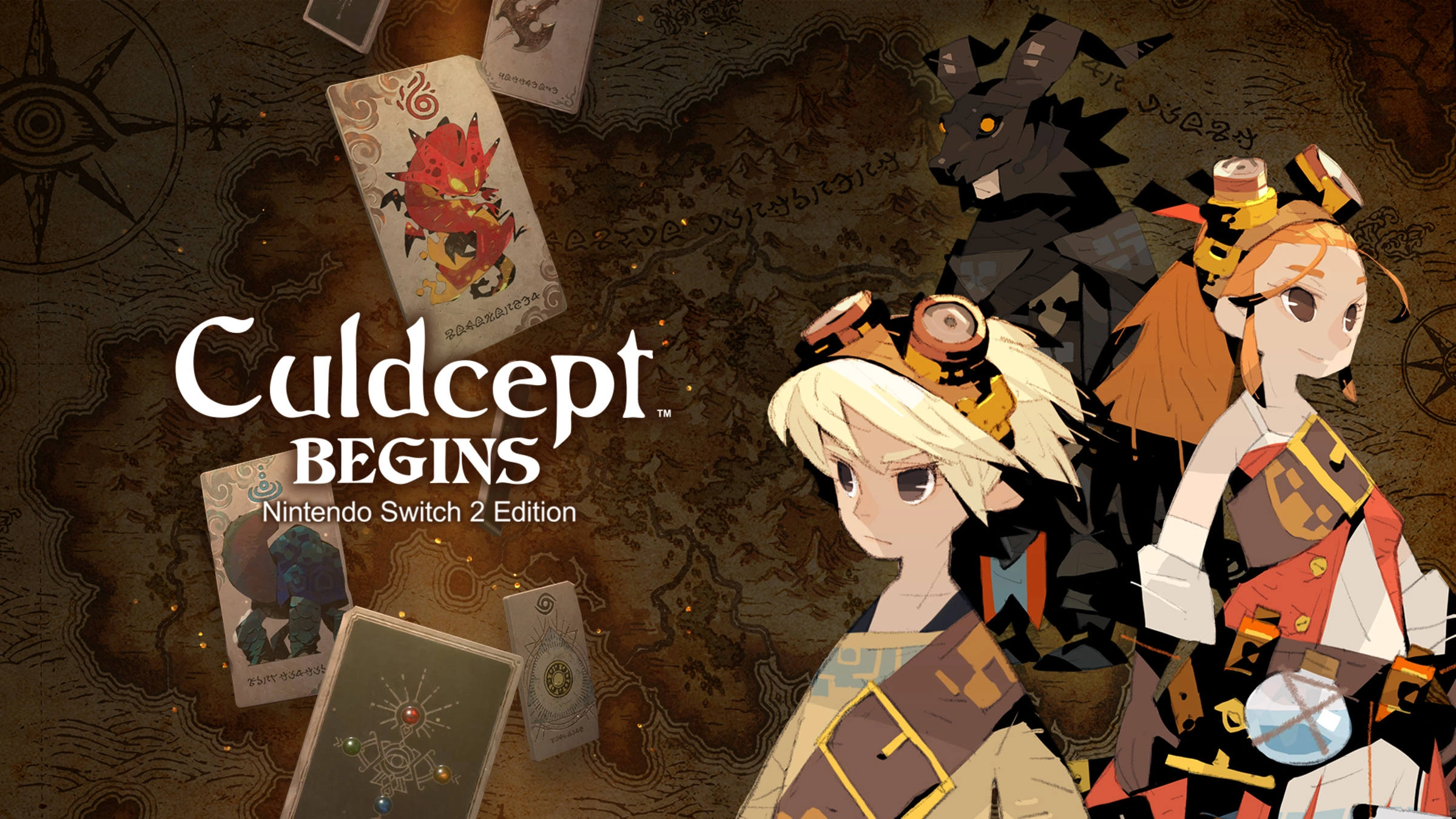
The series has used this foundation since its Sega Saturn debut, yet its density has kept it near the edges of mainstream strategy gaming. This soft reboot makes a deliberate attempt to change that. Rules arrive gradually through a campaign following Kamru, a gifted student who transfers to the Royal Cept Academy and learns to wield magical tablets called Culds. His training soon expands into a conflict involving four elemental regions, his missing father, and an evil sealed beneath the kingdom.
The plot follows a familiar path from academy prodigy to reluctant saviour. Its real function is mechanical instruction. Early matches teach movement and territory placement before introducing elemental chains, land development, branching boards, and deck construction. The campaign understands that Culdcept’s hardest opponent is often its own rulebook.
Every Square Has Teeth
Each match begins with a 40-card deck and a board divided into elemental territories. Players roll a die, move through forts, and return to the castle to complete laps. Passing these checkpoints generates magic, which acts as both currency and score. Reaching the required Total Magic threshold is not enough. Victory belongs to the player who reaches the castle afterward, leaving space for a final bad roll to ruin a commanding position.
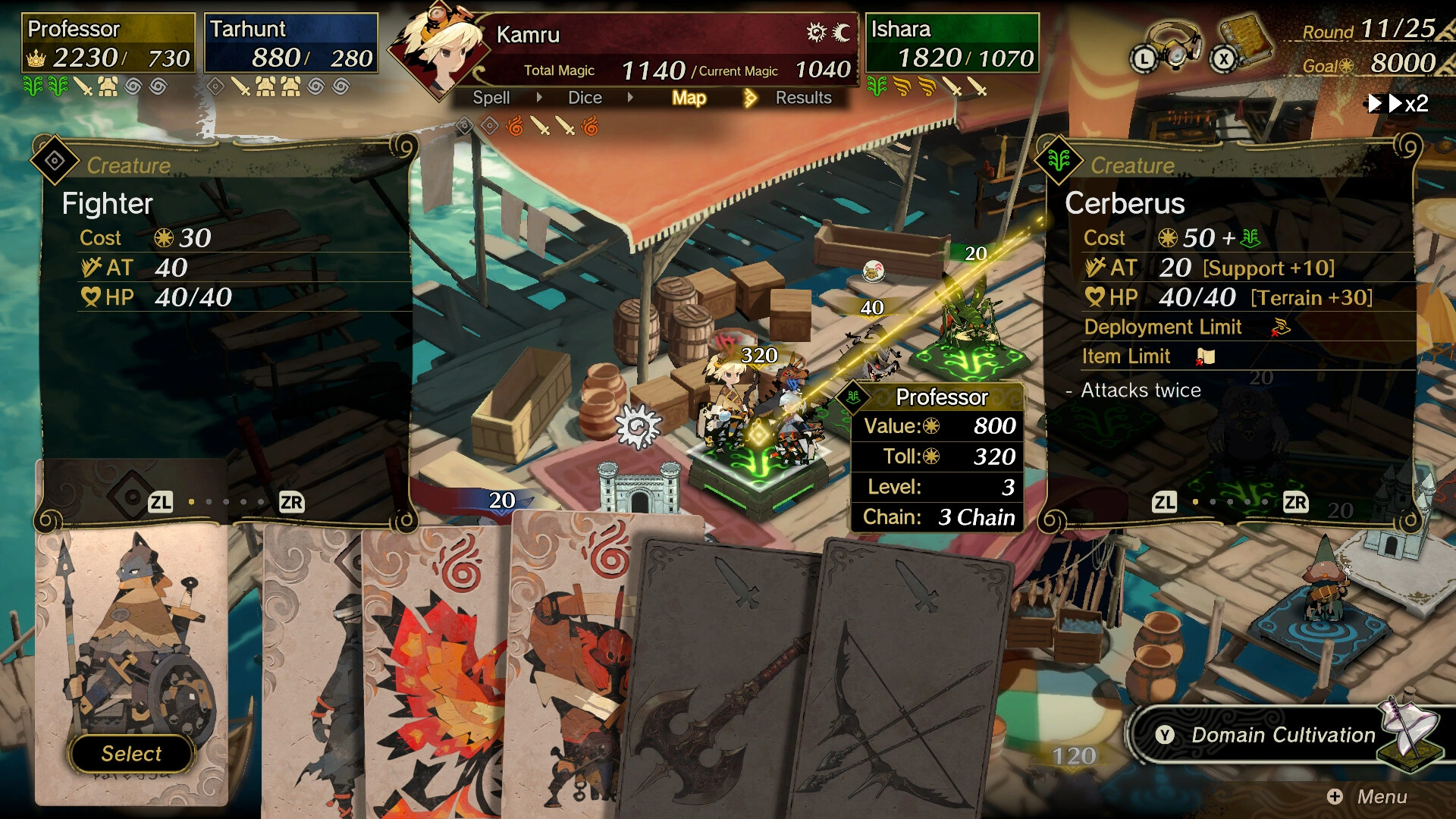
Empty territories can be claimed by placing a creature from the player’s hand. A creature matching the territory’s element gains defensive health, while multiple lands of the same element form chains that increase their value. Magic can then be invested into individual spaces, raising their tolls and strengthening the creature stationed there.
This turns property development into calculated exposure. A level-five territory can drain an opponent’s resources when they land on it, yet losing that space transfers its inflated value to the attacker. One successful invasion can create a swing worth thousands of magic, dragging a distant player into first place or destroying twenty minutes of careful expansion.
Combat keeps these transfers from becoming automatic. A player landing on enemy land may pay the toll or attack with a creature from their hand. Both sides can use item cards, adding armour, weapons, health, or special abilities. Terrain bonuses favour defenders, while effects such as first strike or elemental targeting can overturn the raw attack numbers.
The important decision often happens before combat begins. An invasion might remove an expensive toll from the route ahead, but using a strong creature and valuable item leaves fewer answers for the next threat. Every territory is both an asset and a resource sink, and the board remembers each reckless investment.
Building Around Bad Luck
Deck construction determines how often the game’s randomness becomes manageable. Creature cards claim land and initiate attacks. Item cards protect those investments or help steal enemy spaces. Spell cards manipulate movement, draw additional cards, drain magic, or interfere with opponents. The strict deck limit makes every inclusion compete for space.
A creature-heavy deck can spread across the board quickly, yet it may lack the equipment needed to hold those territories. Loading up on spells creates powerful turns until the player lands on open land with nothing available to summon. Premade decks provide workable foundations, while custom builds support specialised plans built around one element, rapid movement, aggressive invasions, or cheap creatures designed to occupy territory before stronger units replace them.
Match rewards feed this experimentation through individual card purchases and booster packs focused on creatures, items, or specific elements. With hundreds of cards available, improvement comes from understanding relationships rather than collecting cards with larger numbers. A modest creature that attacks first can be safer than an expensive powerhouse. A spell guaranteeing a particular roll can matter far more during the final lap than another combat item.
Dice still retain enough authority to make good planning feel fragile. A player can reach the scoring threshold, fail to roll high enough for the castle, and lose before receiving another turn. A poor opening hand can leave several territories uncontested. Two opponents may attack each other and accidentally hand the lead to someone who took no part in the fight.
These outcomes can feel punitive, especially when the interface contributes to the mistake. Creatures cover the elemental symbols beneath them, territory icons are small, and crowded boards make ownership difficult to read at a glance. Strategy games should punish bad interpretation of information, not the effort required to locate it.
The Story Teaches, the Matches Endure
Kamru’s campaign provides enough structure to keep the mechanical lessons moving. His rivalry with Tarhunt, the legacy of his celebrated father, and the threat surrounding the four regions supply reasons to travel between boards. Side missions offer sharper character material, including Tarhunt’s response to defeat and battles set during earlier conflicts. They also unlock cards, giving narrative detours a practical role in progression.
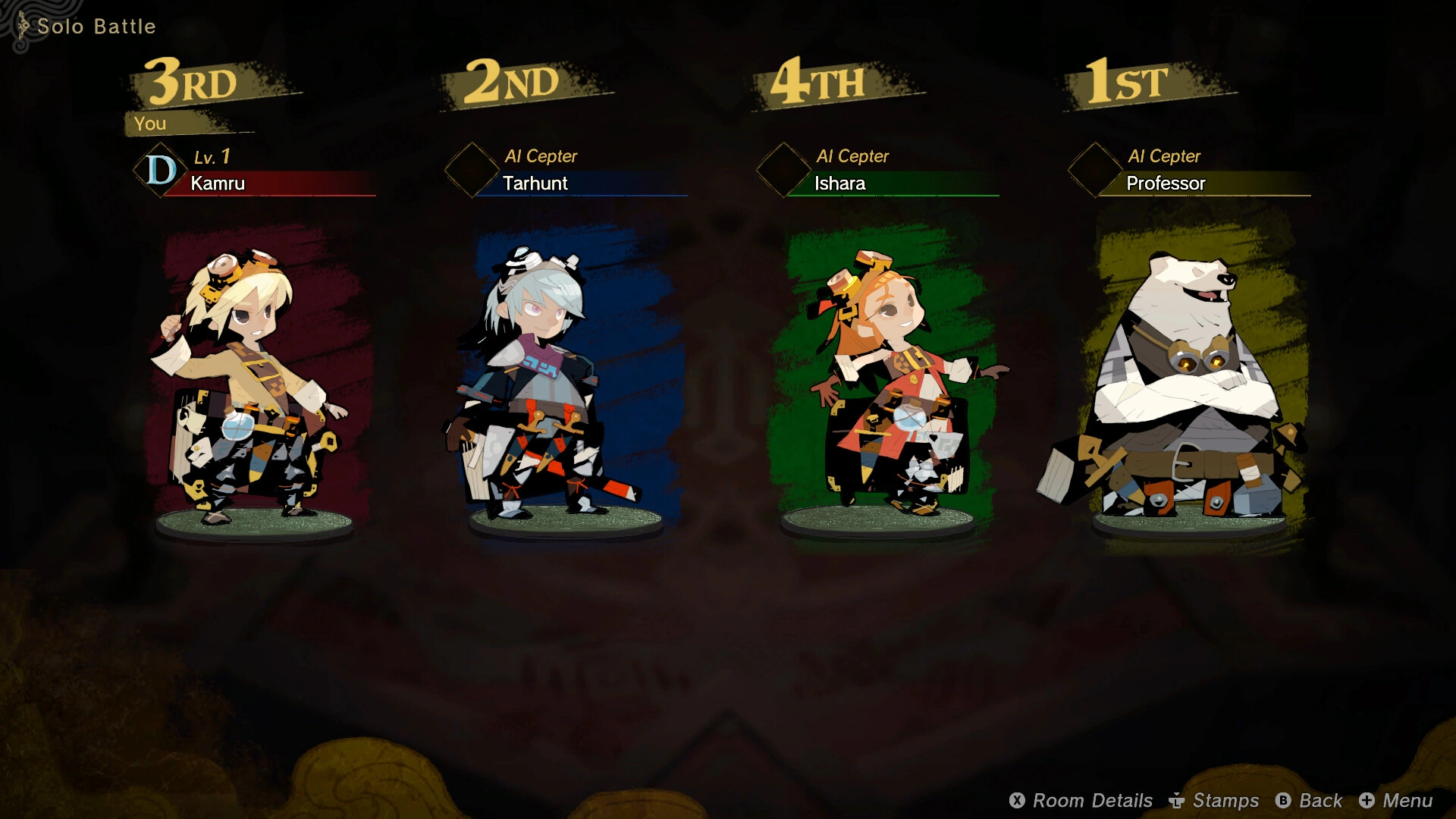
The presentation is divided between cohesion and economy. Character designs use a colourful, exaggerated style, while the cards resemble weathered stone tablets. Creature illustrations match their board representations closely, making a large collection feel visually consistent. Story scenes rely on static backgrounds, basic sprites, and limited animation, exposing the modest production behind the polished interface.
The campaign eventually gives way to custom and multiplayer matches, where the deckbuilding system finds its strongest purpose. Online play allows constructed decks to face human strategies, while GameShare lets multiple Switch owners join through one purchased copy. Traditional single-screen play is absent, so every participant still needs separate hardware.
A narrow loss naturally creates its own next objective. Replace the expensive defender that failed, add a movement spell to avoid the same route, then test the revision against the player who exposed the weakness.
The Review
Culdcept Begins
Culdcept Begins makes its strange board-game and card-battling hybrid remarkably readable. The 40-card limit forces meaningful trade-offs, elemental territories reward careful planning, and one captured high-level space can overturn an entire match. Dice rolls and awkward board icons occasionally sabotage good decisions, while the campaign rarely develops beyond its tutorial function. The system survives those weaknesses because every loss suggests a deck adjustment, a safer route, or a better answer for the next match.
PROS
- Deep, approachable deckbuilding
- Excellent territory combat
- Varied board layouts
- Strong comeback potential
- Convenient GameShare support
CONS
- Forgettable main story
- Cluttered board interface
- Punishing dice randomness
- No single-screen multiplayer