





















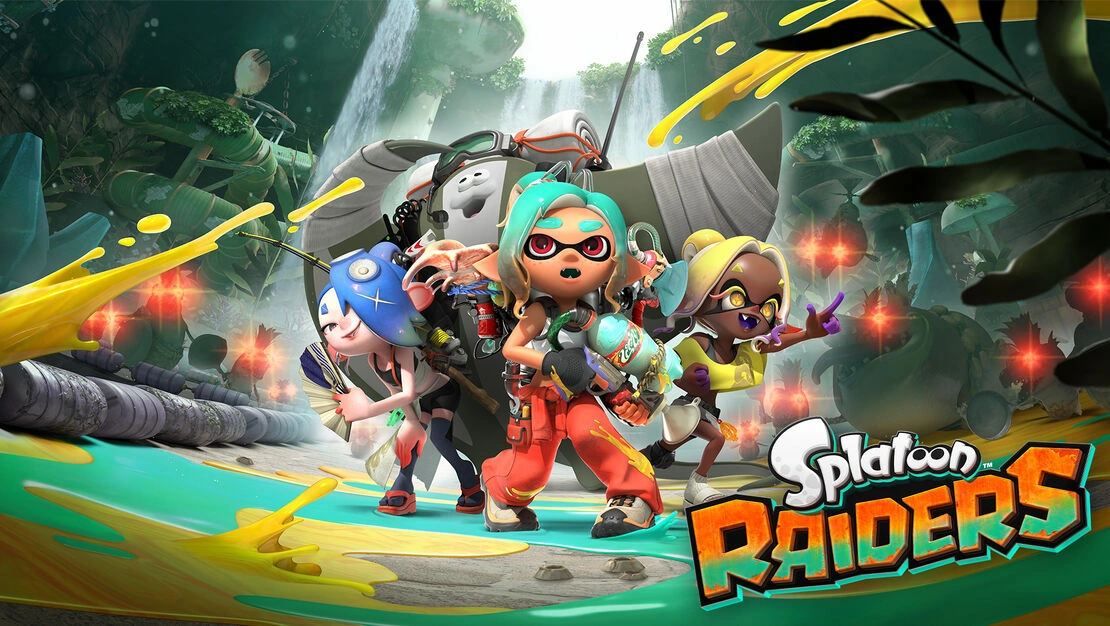

Splatoon has always carried a distinctly Japanese answer to the military shooter: replace mud with fluorescent ink, firearms with toys, and battlefield hierarchy with fashion, music, and movement. Splatoon Raiders sends that language through a structure associated with Western looter shooters, turning repeated missions, gear drops, rarity levels, and build optimisation into the spine of a solo-focused adventure.
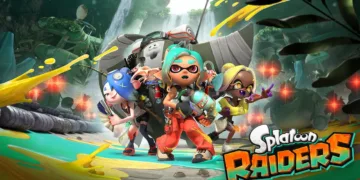
The fit is surprisingly natural. Deep Cut’s treasure hunt ends with Shiver, Frye, Big Man, and their pilot stranded across the Spirhalite Islands after a violent storm destroys their helicopter. The player controls the Mechanic, a resourceful outsider who assembles weapons and gadgets from whatever the ocean has discarded. Soap bottles become shooters. Beach buckets become Sloshers. Palm-tree debris becomes part of a Brella.
This scavenged aesthetic gives the progression system a cultural logic. Loot collection feels tied to survival and improvisation rather than pasted onto the series for numerical busywork.
Salmon Run Leaves the Arena
Most raids reshape the pressure of Salmon Run into self-contained missions. Linear stages send the Mechanic through groups of Salmonids before ending at buried treasure. Open island areas scatter crystals across beaches and vertical routes. Multi-floor dungeons demand enough Power Eggs within a time limit to activate Bot Buddy and drill deeper.
The strongest encounters preserve Salmon Run’s frantic priority management. Stingers attack from a distance, Scrappers force players to circle their armour, and Flyfish fill the air with missiles while other enemies coat escape routes in hostile ink. During timed battles, grabbing one final Power Egg can require swimming directly through a crowded arena, surfacing beside a defeated boss, then retreating before the remaining Salmonids close the route.
Movement remains the system’s sharpest idea. Painting a wall creates a path. Diving into ink turns cover into acceleration. Bot Buddy offers extra height, letting the Mechanic reach elevated weak points or leap away from a collapsing position. Deep Cut members provide covering fire and unleash large attacks once enough Power Eggs have been collected.
The island maps introduce water surfing, wind tunnels, and broad spaces that feel connected to the fiction. Previous campaigns often presented stages as abstract mechanical trials. Here, beaches, caves, improvised machinery, and ocean debris belong to the same stranded ecosystem.
Raiders loses some of that earlier experimental spirit when combat becomes the answer to every design question. Sampler Dungeons occasionally restrict the player to a single gadget, including an explosive forward jump used for rapid precision platforming, yet these compact diversions end before their concepts can develop. Several bosses also abandon the puzzle-like weak-point structure associated with earlier Splatoon campaigns and settle for prolonged damage output.
A Looter Shooter in Nintendo Clothing
The Mechanic’s loadout combines familiar Splatoon weapons with a dense set of modifiers. Splattershots, Rollers, Dualies, Brushes, Brellas, Sloshers, and Chargers appear across varying levels and rarities. Defeating Salmonids grants experience, while raids supply materials for weapon upgrades, gadgets, character statistics, and improvements to the makeshift base.
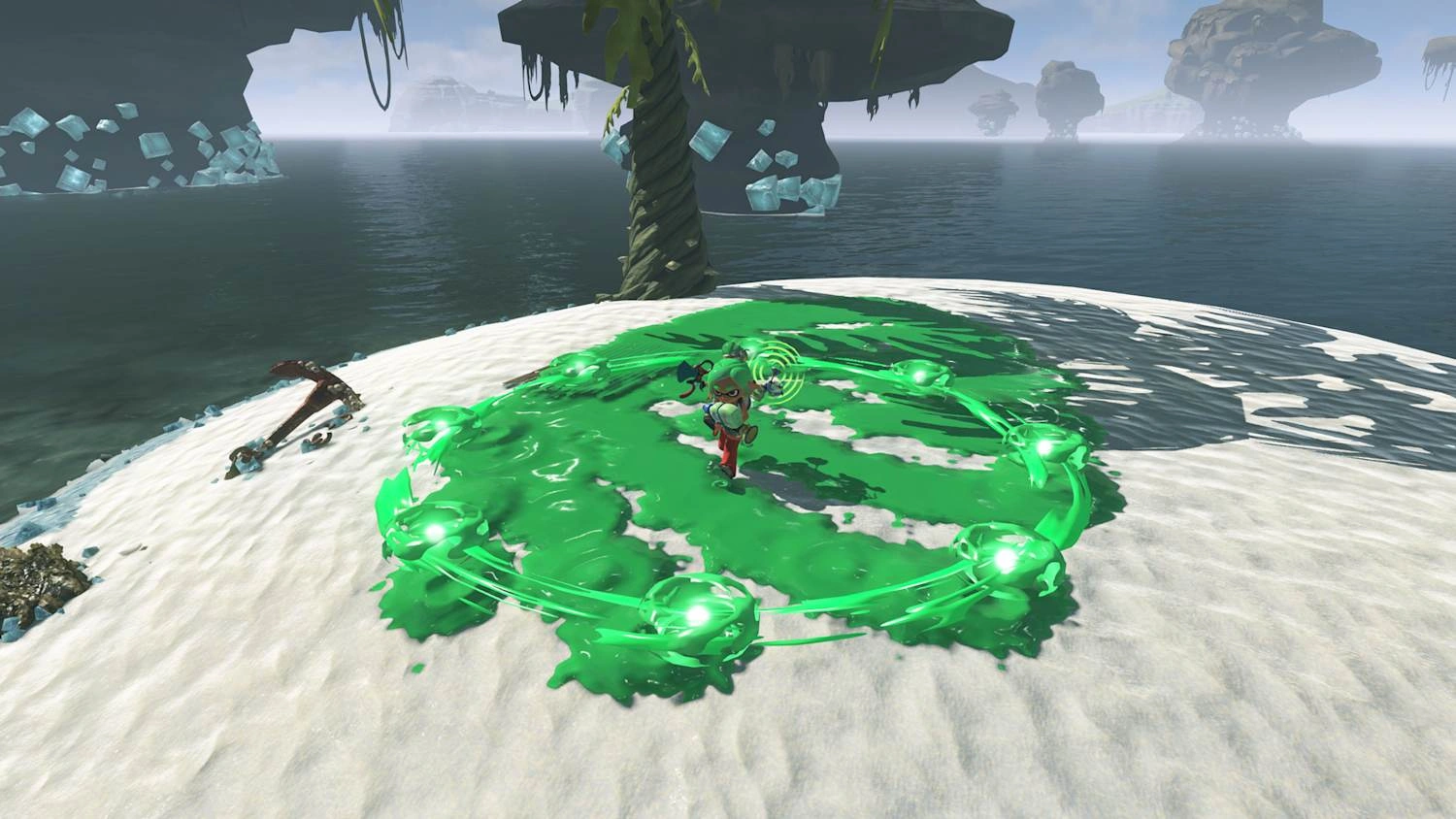
Three Ink Tanks support different approaches. The Power Tank offers direct attacks such as the Splatchet and orbiting Splatelites. The Speed Tank favours rapid entry and escape. The Tactical Tank deploys turrets, bombs, and tools for controlling crowded spaces.
Attachments can alter how those gadgets behave. A turret may deploy automatically after the player shoots an enemy or gain extra sprinklers to cover nearby ground. Blast Boot upgrades create explosions during take-off and landing. Relics improve health recovery, movement speed, damage under pressure, or Power Egg collection.
This reflects a common split between Japanese action design and Western progression design. The combat asks for immediate mechanical fluency, while the equipment layer encourages repeated optimisation. Raiders keeps the menus readable enough that experimentation rarely interrupts the action. Switching Tanks, changing a weapon, and fitting a relic can turn a failed dungeon into a manageable second attempt.
Failure also preserves collected gear and experience, making each loss productive. Harder Spicy variants and post-game dungeons give specialised builds somewhere to go. Co-op extends that loop through local play, online squads, and assistance for strangers, though the cooldown attached to “Call for Help” feels needlessly restrictive in a game already comfortable with repeated grinding.
Power growth does expose a weakness. New gadgets make the Mechanic louder and deadlier, yet many upgrades improve efficiency rather than changing the rhythm of aiming, firing, swimming, and repositioning. Returning to an early mission with a late-game build can feel strikingly similar to facing the final raids, only with fewer threats surviving the first barrage.
Pop Idols, Scrap Metal, and Salmonid Myth
Deep Cut receives greater narrative attention here than in Splatoon 3. Animated cutscenes allow Shiver’s confidence, Frye’s impulsiveness, and Big Man’s warmth to shape the expedition. Treasure descriptions provide smaller comic details, with the trio confidently misreading artefacts pulled from the islands. The Mechanic’s quiet detachment gives their enthusiasm room to become funny without turning them into caricatures.
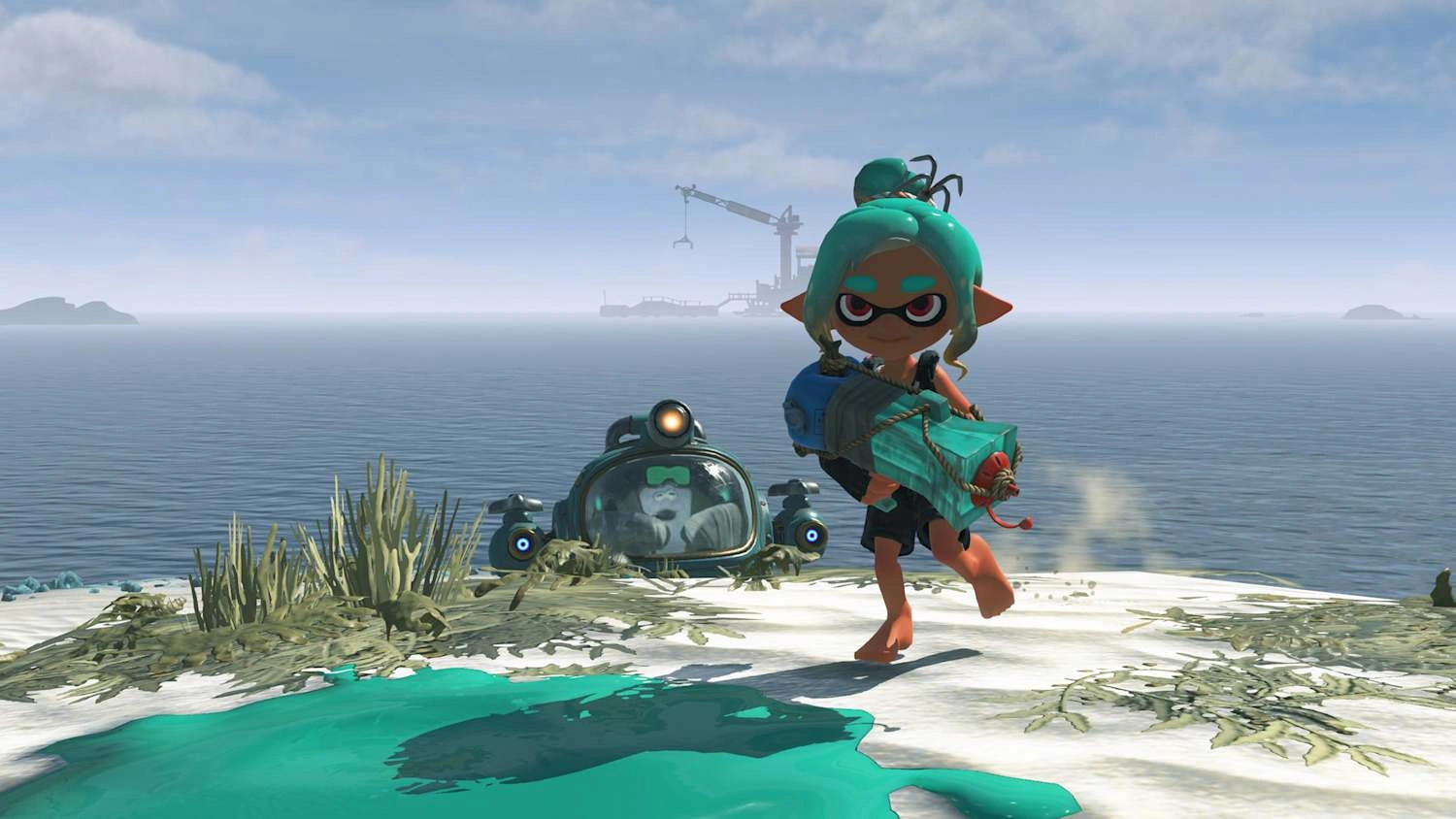
The Spirhalite Islands also expand the Salmonids beyond their former function as wave-based targets. Returning enemy designs sit beside new mutations and larger encounters, giving the species a stronger place within Splatoon’s strange ecological history. The campaign’s abrupt final stretch leaves parts of that mythology unresolved, cutting away just as the setting begins to suggest deeper connections.
Muted sand, rusted machinery, and floating rubbish provide a restrained background for ink that looks thicker and livelier than before. The soundtrack draws from Salmon Run’s tense, uneasy rhythms rather than the franchise’s brighter pop, creating a productive clash between childlike colour and environmental menace.
Technical roughness remains visible. Distant enemies lose animation fluidity, several gadgets appear without expressive throwing or movement animations, and mouse controls are absent from a Switch 2 exclusive built around precise aiming. Raiders may borrow the structure of a global looter shooter, but its best moments still come from Nintendo’s local design instincts: a painted wall, a sudden dive, and a route that exists because the player created it seconds earlier.
The Review
Splatoon Raiders
Splatoon Raiders translates Nintendo’s bright, distinctly Japanese shooter language into the progression structure of a Western looter shooter without losing Splatoon’s tactile pleasure. Ink movement, improvised weapons, flexible builds, and Deep Cut’s comic energy keep the raids lively, while the Spirhalite Islands give the campaign a welcome sense of place. Repeated combat objectives, simpler bosses, and uneven visual polish prevent the spin-off from matching Octo Expansion at its most inventive. Still, this is a confident expansion of what Splatoon can support beyond competitive play.
PROS
- Responsive ink-based combat
- Flexible weapon and gadget builds
- Strong Deep Cut characterisation
- Distinct scavenged art direction
- Rewarding co-op and post-game challenges
CONS
- Repetitive raid objectives
- Simplified boss design
- Abrupt narrative resolution
- Restrictive assistance cooldown
- Minor animation and performance issues