


















![Kingdom Hearts Collection [I-III] Review](https://gazettely.com/wp-content/uploads/2026/10/Kingdom-Hearts-Collection-I-III-1-360x180.webp "Kingdom Hearts Collection [I-III] Review: KHII Holds Steady as Newer Entries Fluctuate 33")







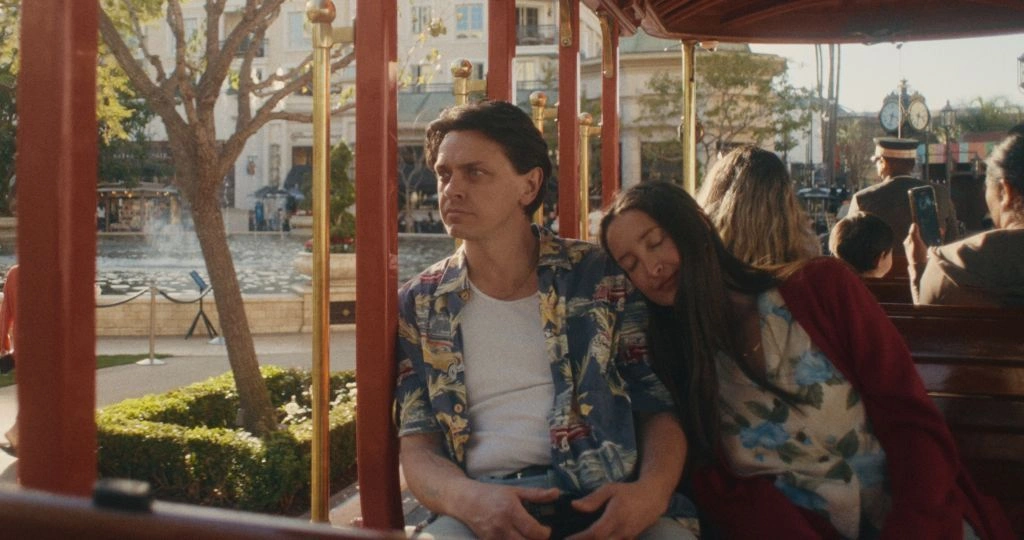

Planning saves Andie from uncertainty until the plan begins to feel like a sentence. She has scheduled the recognizable markers of adulthood with almost architectural precision: marriage, professional stability, a child at thirty-four. In one quietly revealing sequence, she presents that timeline to a friend as evidence of competence while her husband, Chris, describes the same arrangement as a life in which his own will has gradually disappeared.
Pavan Moondi’s Middle Life places this domestic exhaustion beside a violent accident. Driving through suburban Toronto at night, Andie finds a car overturned on the road. Inside are plumber Ryan and his father, Bernie. Her decision to stop and call for help saves them.
Months later, Andie and Ryan meet again by chance, carrying very different memories of that night. For her, it was an interruption. For him, it divided existence into before and after. Ryan wants to thank her. Andie wants, though she cannot yet admit it, to become briefly unrecognizable to herself.
She removes her wedding ring before meeting him for a drink. The gesture is small, almost embarrassed. She puts it back on during the ride home, and Leah Fay Goldstein lets the disappointment settle across Andie’s face without forcing it into confession. The ring has not changed. The hand wearing it has.
Borrowed Hours
Ryan calls their time together a “good hang,” a phrase that sounds casual enough to protect them from the implications of what they are doing. They drink, crash a house party, go bowling, get pedicures, visit a Pizza Hut buffet, bid at an art auction, and sit among the bright artificial enthusiasm of a television studio audience. None of these activities matters on its own. Their meaning comes from repetition. Each outing is another hour removed from the lives waiting elsewhere.
Moondi gives these passages a loose, airy rhythm. Ben Fox’s jazzy score drifts around conversations rather than directing them, while Jared Raab photographs Toronto with a mild, sunlit freshness. Bowling alleys and office bathrooms become places of release. Even the city seems temporarily relieved of responsibility.
Goldstein and Peter Dreimanis share the relaxed timing of people who already understand each other’s pauses. Their offscreen partnership never turns the performances into smug displays of chemistry. The ease between them carries a faint sadness, since Andie and Ryan can speak freely only inside an arrangement they refuse to name.
Ryan’s impulsiveness offers Andie something her marriage no longer provides: the sensation that a day has not already been decided. Yet he is not a messenger arriving from some purer form of existence. His cheerfulness is partly a disguise.
He lives with the memory of the crash and cares for Bernie, whose body survived while parts of his mind did not fully return. Ryan’s appetite for experience begins to look less like freedom than panic with excellent social skills. Their companionship is warm. It is also an evasion.
The Body Keeps Interrupting
Ryan’s recurring inability to urinate becomes the film’s strangest joke. The plumber who installs bidets cannot persuade his own body to perform its most ordinary function. Moondi plays the condition lightly, letting Ryan describe pain and medical confusion with the openness he brings to everything, yet the joke has a nervous pulse beneath it. His body appears to be holding what his personality keeps releasing.
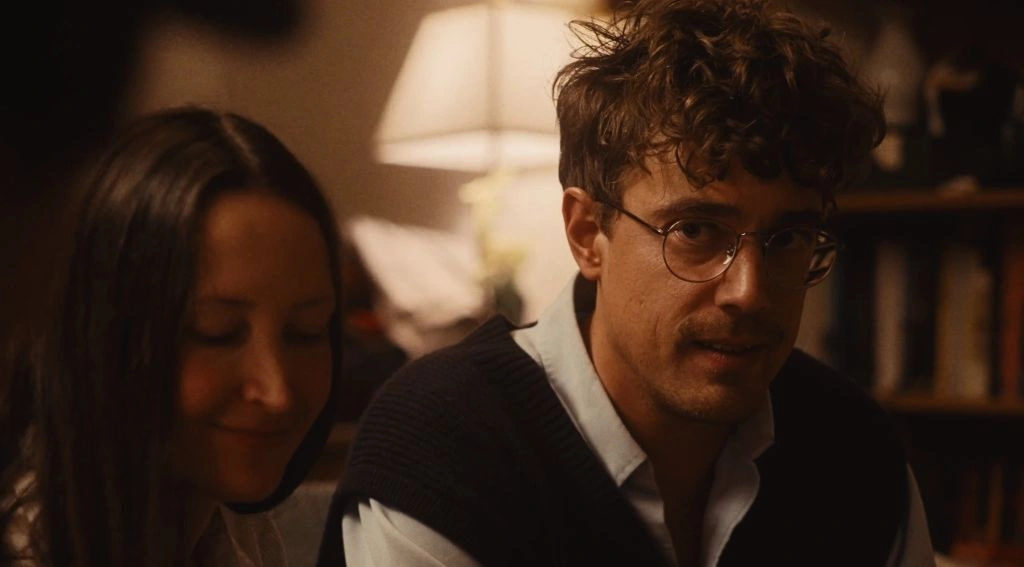
Dreimanis allows flashes of this tension to disturb Ryan’s genial surface. The smile remains, then arrives a second too late. A remark about Bernie loses its casual tone halfway through. The near-death experience that supposedly liberated him has left him frightened of stillness, since stillness might allow memory to catch up.
Andie’s strain is quieter. She is caring for a baby, attempting to restart a wedding-planning business, and living beside a husband who has begun to see her competence as domination. Goldstein expresses that fatigue through the way Andie brightens around Ryan. Her happiness has the force of deprivation. When a plumbing problem at her office gives her an excuse to call him, the relief is immediate and slightly humiliating.
The dinner shared by Andie, Chris, and Ryan exposes the arrangement without resolving it. Ryan’s presence brings the secret atmosphere of the hangouts into Andie’s home. Chris does not need proof of an affair. The attention between them is already visible. Emotional betrayal rarely enters a room carrying evidence. Sometimes it asks how dinner was.
Distance Without Escape
Chris eventually asks for a divorce, but the film refuses to treat him as an obstacle cleared from the path of romance. Luke Lalonde plays him as wounded, passive, and increasingly conscious of how little space he occupies inside his own marriage. His resentment has its own history. Andie’s withdrawal gives it a final shape.
A spontaneous trip to Los Angeles then tests the fantasy Andie and Ryan have constructed. Toronto allowed their outings to remain detachable from ordinary life. Travel removes that shelter. Ryan wants movement, sights, another story to tell. Andie’s instinct to plan returns once the risks stop feeling playful. Their difference is no longer charming. It becomes a question of how each person survives fear.
Moondi does not press far enough into Ryan’s guilt or Andie’s exhaustion. Bernie’s decline remains partly peripheral, and motherhood is often treated as pressure rather than a living relationship. The film sees the wounds clearly, then hesitates near their depth.
Still, its restraint protects the characters from becoming romantic functions. Andie and Ryan do not heal each other. They provide a room in which pain can briefly loosen its grip. Outside that room wait a child, a father, a damaged marriage, unpaid emotional debts, and the silent knowledge that joy can be genuine while its consequences are cruel. For a few hours, they feel alive together. Morning keeps arriving.
Middle Life is a romantic comedy film that premiered at the Calgary International Film Festival on September 20, 2025, before receiving independent theatrical rollouts in mid-2026. The film follows a perfectionist wedding planner and new mother who saves a blue-collar plumber from a roadside accident, sparking an unexpected connection that challenges them both. Viewers can watch the film through select independent theater screenings.
Full Credits
Title: Middle Life
Release date: September 20, 2025 (CIFF), July 29, 2026 (US)
Running time: 84 minutes
Director: Pavan Moondi
Writers: Pavan Moondi
Producers and Executive Producers: Peter Dreimanis, Leah Fay Goldstein, Pavan Moondi, Dean Perlmutter, Josh Warburton, Chetan Bhanot, Mark Homza, Philippe Leblanc, Michael Dotsikas, Abe Sanjakdar, Adrienne Sanjakdar, Clare Stein, Ryan Young
Cast: Leah Fay Goldstein, Peter Dreimanis, Luke Lalonde, Norah Sadava, Colin Burgess, Mike D. Smith
Director of Photography (Cinematographer): Jared Raab
Editors: Pavan Moondi
Composer: Ben Fox
The Review
Middle Life
Middle Life finds tenderness in the dangerous space between the life one has built and the life that still calls from somewhere outside it. Andie and Ryan’s outings carry the temporary warmth of borrowed time, made persuasive by Leah Fay Goldstein and Peter Dreimanis’s easy, vulnerable chemistry. Pavan Moondi leaves Ryan’s trauma and Andie’s domestic exhaustion thinner than they deserve, yet the film understands a painful truth: joy can rescue a person while quietly damaging everything waiting at home.
PROS
- Natural lead chemistry
- Warm conversational humor
- Specific, charming shared adventures
- Mature treatment of emotional infidelity
- Light, inviting direction
CONS
- Ryan’s trauma lacks depth
- Andie’s pressures need fuller examination
- Familiar romantic trajectory
- Practical consequences remain hazy