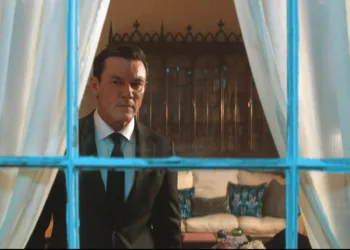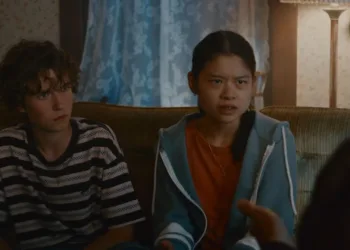



























Jason Delgado has been out of work long enough for providing for his family to have become a moral problem in his own head. Then the world apparently ends, and unemployment turns out to be excellent preparation. Louis Leterrier’s The Last House, written by Matthew Robinson, traps Jason (Wagner Moura), his wife Ann (Greta Lee), and their children Graham (Noah Alexander Sosnowski) and Ruth (Riley Chung) inside their Seattle home during a heavy November rainstorm.
Doors refuse to open. Windows cannot be broken. Damaged glass reforms. Phones and Wi-Fi are useless. Across the street, neighbors discover the same problem and begin communicating through handwritten signs pressed against windows. Leterrier reaches this predicament within roughly 20 minutes, denying the family the gradual suspicion most survival thrillers use as foreplay. One morning they have mortgage payments, Christmas plans, and sibling arguments. Shortly afterward, the house has become the known universe.
There are two movies inside this premise. One concerns strange rain, creatures beyond the windows, and the question of what has happened to the world. The other concerns four people discovering how quickly ordinary domestic life becomes archaeology. The second movie is much better.
Making a Prison Livable
The early survival sequences understand something the larger science-fiction plot occasionally forgets: civilization is mostly a collection of boring conveniences we notice only after they stop working. The Delgados count food. Jason begins engineering substitutes for whatever the house can no longer provide. Neighbors exchange information using signs. Family entertainment contracts to two DVDs, Annie and Air Force One, an accidental double feature so strange that the apocalypse almost seems worth enduring once.
There is warmth here, too. A Cure-backed dance sequence allows the family to treat confinement like an eccentric holiday rather than an indefinite sentence. Christmas arrives in reduced form. Ann keeps Graham and Ruth occupied while Jason throws himself into practical problems that give him a sense of usefulness his unemployment had stripped away.
Robinson lands one particularly sharp joke without treating it like one. Overdue mortgage papers are burned in the fireplace for kindling. Before the rain, those pieces of paper represented Jason’s inability to satisfy an economic system. After the rain, their finest contribution to civilization is that they catch fire.
Call this the film’s utility inversion: everything previously considered important becomes useless, while trivial objects acquire enormous value. DVDs matter. Paper burns. Household scraps become engineering materials. The family dog’s heart medication turns into a countdown clock.
This is where The Last House nearly becomes the thoughtful disaster film hiding inside its streaming-thriller body. Jason’s unemployment stops being background characterization and changes meaning under pressure. Ann’s instinct to maintain rituals becomes a form of psychological defense. Parenting itself shifts from preparing children for society to preparing them for the possibility that society no longer exists. Then the movie gets impatient with its own best idea.
Childhood Without an Outside World
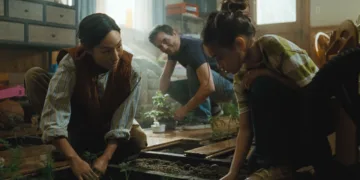
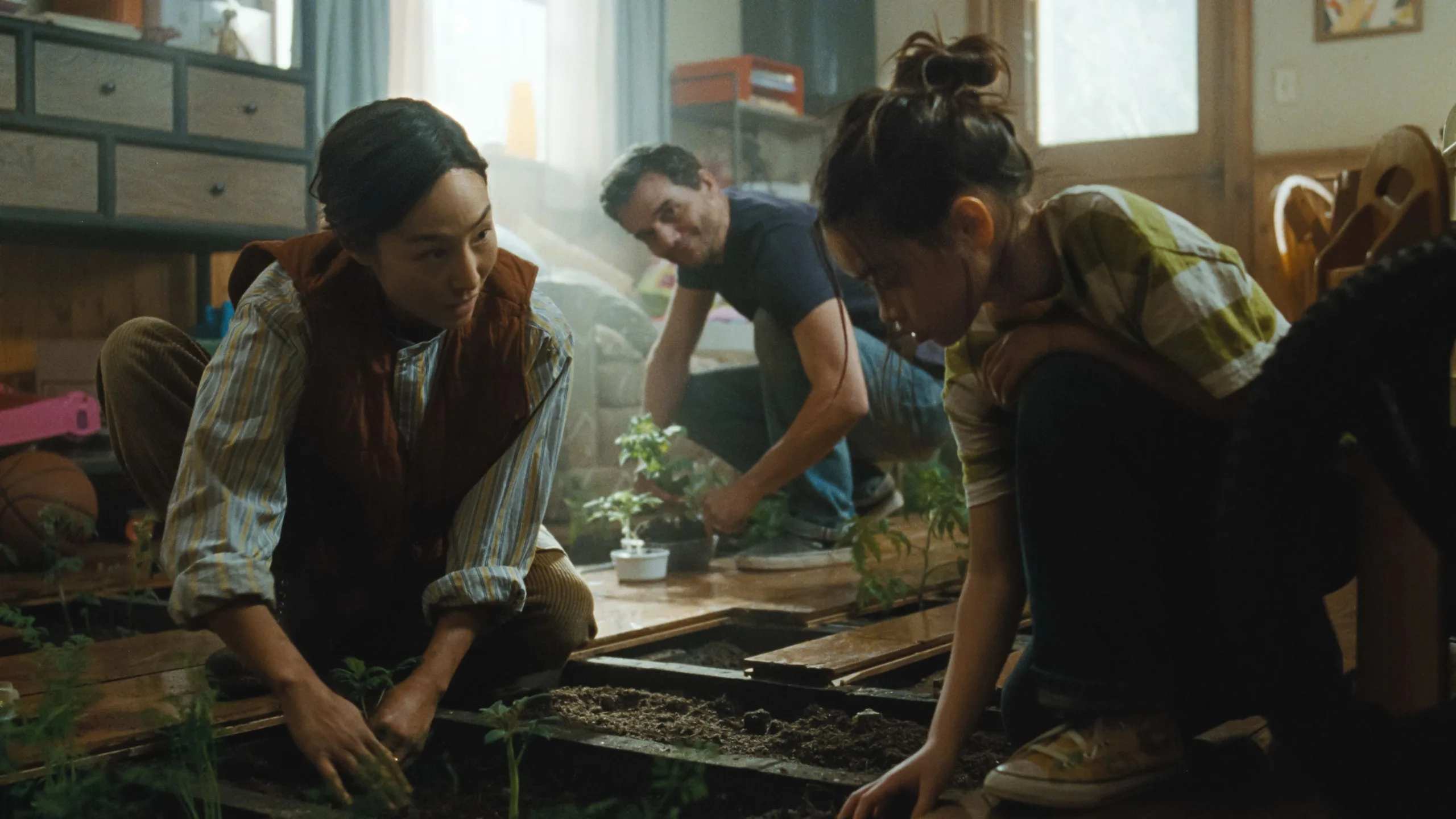
Days become weeks. Weeks become months. Time eventually jumps far enough for Gabriel Barbosa and Emma Ho to take over as the older Graham and Ruth. The house changes with them. Floorboards are removed so food can be grown indoors. Walls acquire marks recording elapsed time. Cracks spread through corners. Rooms designed around middle-class comfort are reorganized around calories, water, warmth, and survival. The children age inside spaces that were built for childhood but can no longer provide one.
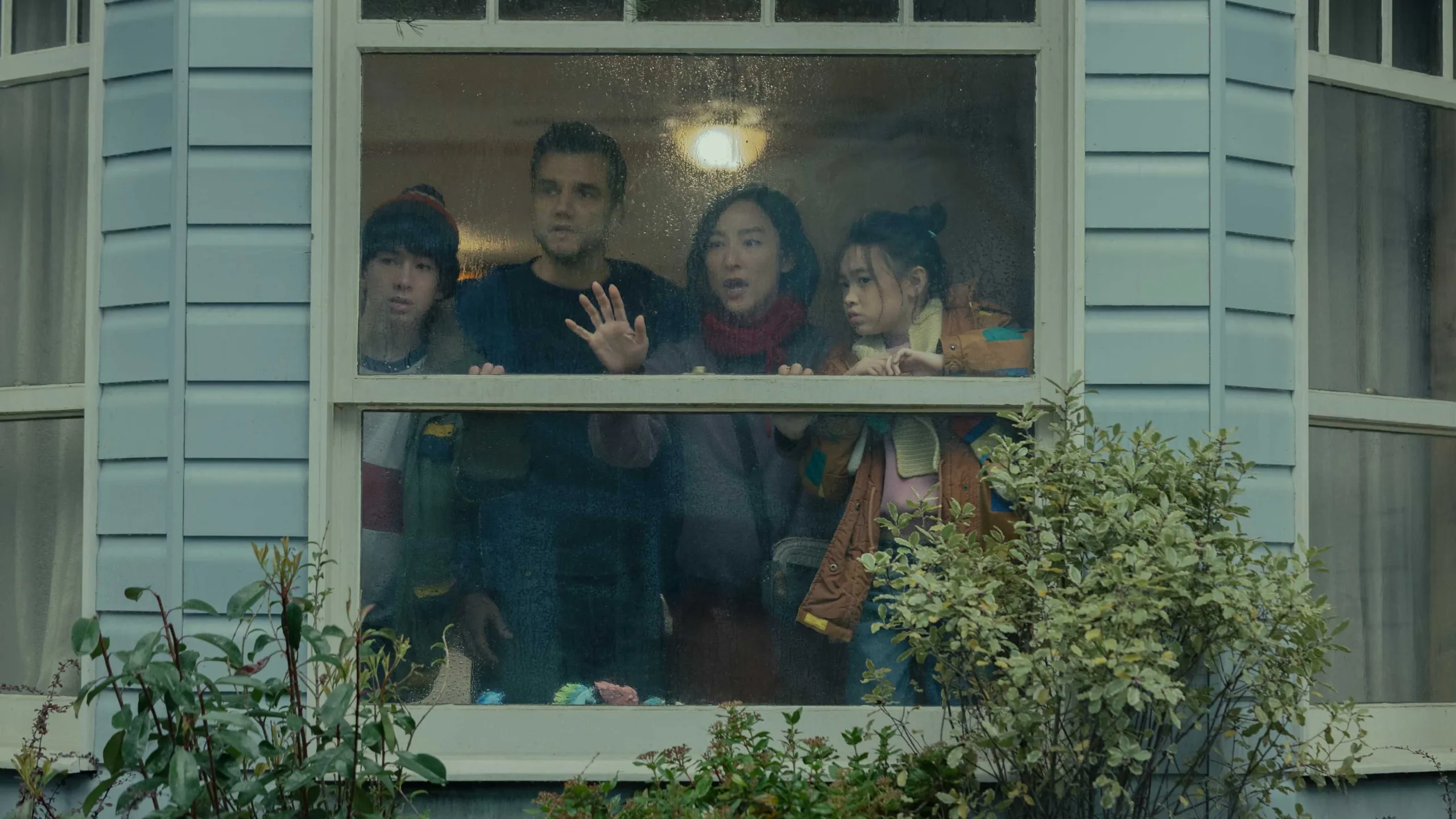
That should be psychologically terrifying. Imagine reaching adolescence without strangers, teachers, friendships, flirtations, public embarrassment, independence, or even the minor freedom of walking down a street alone. Graham and Ruth have each other, their parents, and whatever appears through a window. Social development has effectively been reduced to four people.
Robinson’s screenplay understands the premise intellectually and rarely gives it enough dramatic time. The children fight and change, yet the film skips through so many intermediate stages that their lost years register most strongly through casting and production design. We see that they have aged. We receive less evidence of what aging in this environment has constructed inside them.
Moura fares better because Jason has a clean psychological mechanism to play. Every improvised solution validates him. The man who could not provide in the old world becomes increasingly necessary in the new one, and Moura allows pride, fear, and control to begin occupying the same gestures. Survival has solved one of Jason’s insecurities by giving him a worse problem.
Lee works from the opposite direction. Ann tries to preserve emotional continuity, especially when the family still holds movie nights and celebrations. Her performance is strongest when positivity begins looking like labor. A reassuring expression held for a little too long suggests that Ann understands the children are watching her for instructions on how frightened they are permitted to be.
I initially thought the movie had developed a genuine argument about parental authority under catastrophe. I am less convinced once the later conflicts arrive. The performances supply accumulated history that the screenplay has skipped past. The actors remember years the film has barely shown.
The House Remembers Everything
Production designer Kevin Jenkins solves part of that problem by letting the building carry the missing history. The Delgado home begins as recognizably comfortable, cluttered enough to suggest actual habitation rather than showroom minimalism. Each survival adjustment then rewrites its purpose. Floors become agricultural space. Marks accumulate. Furniture moves. Surfaces deteriorate. Cracks spread as the saturated earth beneath the building shifts and the structure starts sinking.
A strange thing happens: the house develops a stronger character arc than Graham or Ruth. This sounds like an insult, and partly it is, but Jenkins’ work deserves the compliment contained inside it. Leterrier establishes the geography clearly enough that later alterations register instantly. We know what a room used to be, so its transformed function carries emotional information without dialogue. Domestic architecture becomes a timeline.
The exterior threat works through a similar principle whenever Leterrier keeps it indistinct. Shadowy figures moving beyond the windows are effective because the glass establishes a brutal relationship between knowledge and safety. The family can look. They cannot investigate. Seeing becomes useless.
The larger effects-driven material weakens that arrangement. Once the movie shows too much, uncertainty gives way to mechanics, and the mechanics invite questions the screenplay has trouble answering. Earlier, a glimpse of something moving through rain can occupy the imagination. Later spectacle has to compete with the simple terror of a creature standing somewhere outside Ruth’s window. For a director associated with Fast X, Leterrier is unexpectedly persuasive when nothing explodes. His least expensive-looking ideas are frequently his richest.
The Rain Problem
The rain itself is harder to accept. Water appears able to seal doors, prevent windows from breaking, block signals, and restore damaged barriers. Strange organisms or creatures move beyond the house during storms. The film keeps asking us to consider the precipitation as both environmental event and intelligent mechanism. Mystery can survive missing information. It struggles with missing rules.
The easiest version of this story required only a lethal environment outside. One drop kills you, fine. Monsters attack anyone leaving a house, also fine. Instead, the rain appears capable of enforcing architectural imprisonment with such specificity that every unexplained detail becomes another invitation to interrogate the premise. How does water know where a window ends? Why does a damaged barrier repair itself? What exactly prevents communication signals from passing through?
These questions matter because Robinson eventually supplies an explanation. Once explanation becomes part of the contract, vagueness stops feeling mysterious and starts feeling unfinished.
The COVID reading is unavoidable. Families remain indoors indefinitely. Neighbors communicate at distance. Supplies become uncertain. Parents create routines for children while nobody knows when normality might return. The resemblance is so direct that the film occasionally feels like a pandemic memory translated into speculative fiction after its emotional temperature has cooled.
Its environmental argument is less developed. An unidentified narrator speaks about people once living near one another while remaining emotionally isolated, and the later science-fiction material points toward ecological change, adaptation, and humanity’s relationship with natural systems. Yet the ideas never become as specific as the mortgage papers burning in Jason’s fireplace.
That may be the central irony of The Last House. It wants to contemplate humanity’s relationship with the planet, but it understands humanity best at the scale of a living room. Robinson can make two DVDs, a bottle of dog medication, and a damaged floor carry existential weight. Give him the fate of the natural world and the language turns strangely thin. The apocalypse outside the window keeps demanding attention. The family surviving beside it is where the movie actually has something to say.
The Last House premiered globally on Netflix on August 7, 2026. The science fiction thriller follows a family of four inexplicably sealed inside their home as they struggle to survive against dwindling resources and an ominous external threat.
Where to Watch The Last House (2026) Online


Full Credits
Title: The Last House
Distributor: Netflix
Release date: August 7, 2026
Rating: PG-13
Running time: 112 minutes
Director: Louis Leterrier
Writers: Matthew Robinson
Producers and Executive Producers: Kori Adelson, Peter Chernin, Louis Leterrier, Joe Neurauter, Jenno Topping, Oly Obst
Cast: Greta Lee, Wagner Moura, Riley Chung, Emma Ho, Noah Alexander Sosnowski, Gabriel Barbosa, Sam Lerner, Audrey Anderson
Director of Photography (Cinematographer): Pål Ulvik Rokseth
Editors: Adam Gough
Composer: Yair Elazar Glotman
The Review
The Last House
The Last House finds its most persuasive apocalypse in unpaid bills, dwindling dog medication, worn floorboards, and two DVDs played into oblivion. Louis Leterrier keeps reaching toward ecological grandeur when the smaller disaster is far richer: a family slowly forgetting what a normal home is supposed to do. Call it domestic apocalypse drift, where survival gradually replaces living without anyone noticing the exact moment of exchange. Wagner Moura and Greta Lee give that idea weight, while Kevin Jenkins’ transforming house expresses it better than Matthew Robinson’s thin environmental mythology ever manages.
PROS
- Excellent evolving production design
- Strong Moura and Lee performances
- Effective early survival details
- Unsettling glimpses beyond the windows
CONS
- Underwritten children
- Hurried psychological deterioration
- Shaky rain mythology
- Thin ecological ideas
- Weak mystery payoff