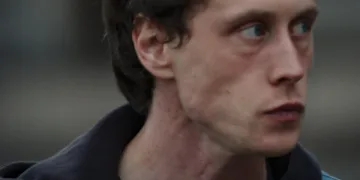























Suicide gives Mission its ticking clock, yet Paul Wright refuses the clean geometry of a countdown thriller. Dylan, played by George MacKay, gives himself one week to locate some reason to remain alive, then proceeds through that week as if testing how much disorder the world will tolerate before it answers him. The danger lies partly in his intentions and partly in the suspicion that he has stopped recognizing the difference between liberation and damage.
Wright reunites with MacKay after For Those in Peril, returning to isolation, psychic fracture, and young men unable to translate distress into ordinary language. Dylan works as a waiter in an upscale Scottish hotel, moving through shifts with the mechanical vacancy of someone already halfway absent. His voiceover makes the crisis explicit. He cannot connect to anyone or anything. He remembers dying for several minutes at seven years old and associates that childhood experience with a glimpse of existence he has never recovered.
The film treats memory less as evidence than as contaminated territory. Grainy home-video fragments show Dylan with his sister Claire, once his closest companion, without confirming that his remembered childhood contained the revelation he assigns to it. The ambiguity matters. Dylan has constructed an entire philosophy around a past the camera itself cannot verify.
The Performance Review
The hotel performance assessment is where Wright’s ideas become painfully concrete. CEO James, played by Emun Elliott, expects the familiar ritual of workplace compliance. Dylan attempts it. He sits there, visibly uncomfortable, trying to produce the approved language before honesty ruptures the exercise and he admits that the job feels soul-destroying.
MacKay makes the scene work through physical resistance. Dylan’s gaze wanders, his posture tightens, and each attempt to participate appears to cost him something. There is bleak comedy in watching corporate vocabulary collide with a man incapable of maintaining the fiction that any of this matters to him. The scene also refuses to make honesty automatically virtuous. Dylan tells the truth and still damages himself.
His attachment to co-worker Becky carries the same imbalance. Emma Naomi plays her kindness without suggesting the intimacy Dylan imagines. For him, their exchanges constitute a lifeline. For her, they are ordinary gestures between colleagues. Wright lets that asymmetry sit without turning Becky into either savior or villain.
Also Read





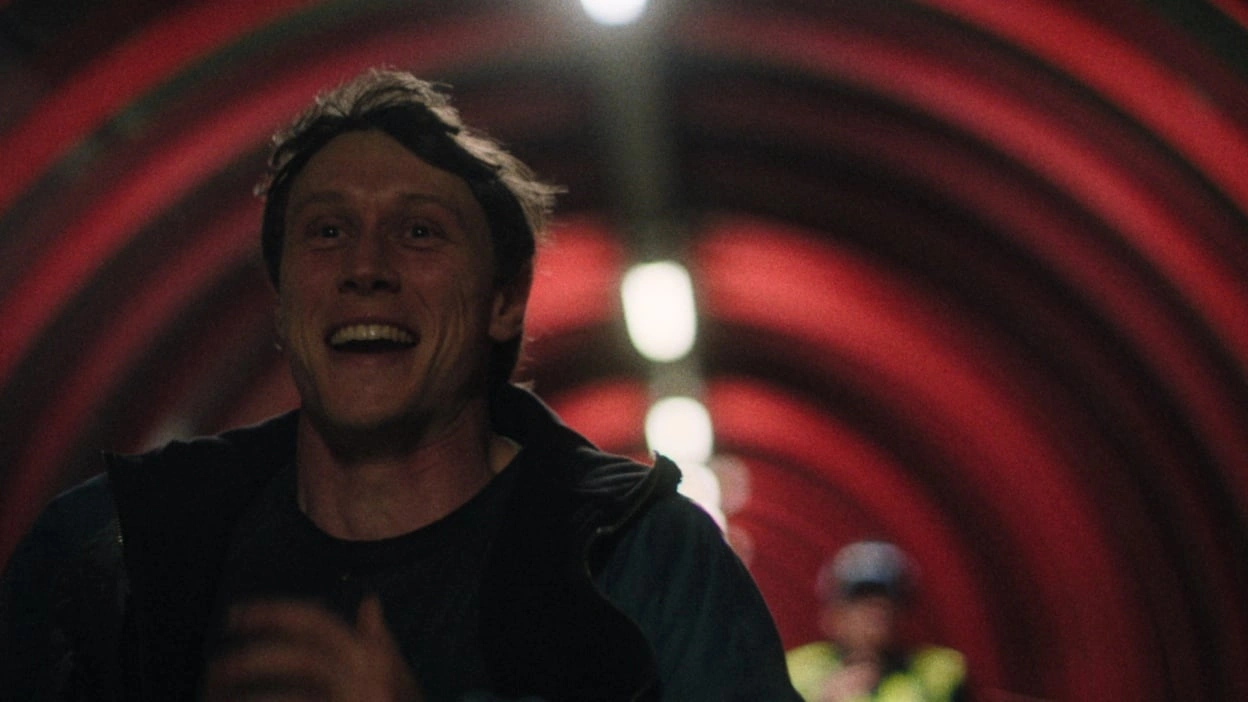
Once Dylan leaves work and begins following his private manifesto to embrace randomness, the moral geometry grows murkier. Karaoke and impulsive pleasure give way to stealing a monkey, BDSM sex, knives, confrontations with strangers, a bus standoff, and eventually a gun.
The man demanding a world where “the dreamers and the freaks and the good guys win” does so while frightening someone whose home he has entered in extreme makeup. Dylan wants to classify himself among the good guys. The person staring back at him has every reason to disagree.
Claire and the Unrecoverable Past
Rosy McEwen’s Claire gives the film its clearest counterweight because she refuses Dylan’s romanticization of childhood without dismissing his pain. Their old home videos show shared games, silliness, and creative freedom. Adult Claire remembers the same past, yet she has not converted it into an indictment of adulthood.
Her phone calls carry an exhaustion that Wright wisely leaves unexplained. When she asks if Dylan is okay, the question suggests repetition, history, and failed attempts at intervention. Nothing needs to be spelled out. McEwen’s measured responses make clear that Claire has spent years living with a brother whose suffering repeatedly enters her life without giving her the means to repair it.
Dylan cannot accept her accommodation with routine. He sees compromise as contamination, while Claire regards it as the basic price of continuing to exist among other people. Their conflict becomes ethically sharper because neither position is treated as entirely hollow. Dylan detects the deadening rituals around him with uncomfortable accuracy. He also uses that perception to excuse actions that terrify others.
Their quieter scenes expose what the film’s louder episodes sometimes obscure. MacKay stops convulsing against the world and simply faces the person whose memory he has turned into proof that happiness once existed. Claire cannot become the child he remembers. She cannot confirm the past strongly enough to make his present bearable.
Fracture as Form
Wright renders Dylan’s mental state through formal disruption rather than conventional exposition. Editors Michael Aaglund and Jennifer Mackie repeatedly cut away from present action into home movies, demolished buildings, crowds, protests, current-events imagery, and abstract fragments. These inserts arrive too quickly to function as ordinary symbolism. They behave like intrusive thought, entering before interpretation can catch up.
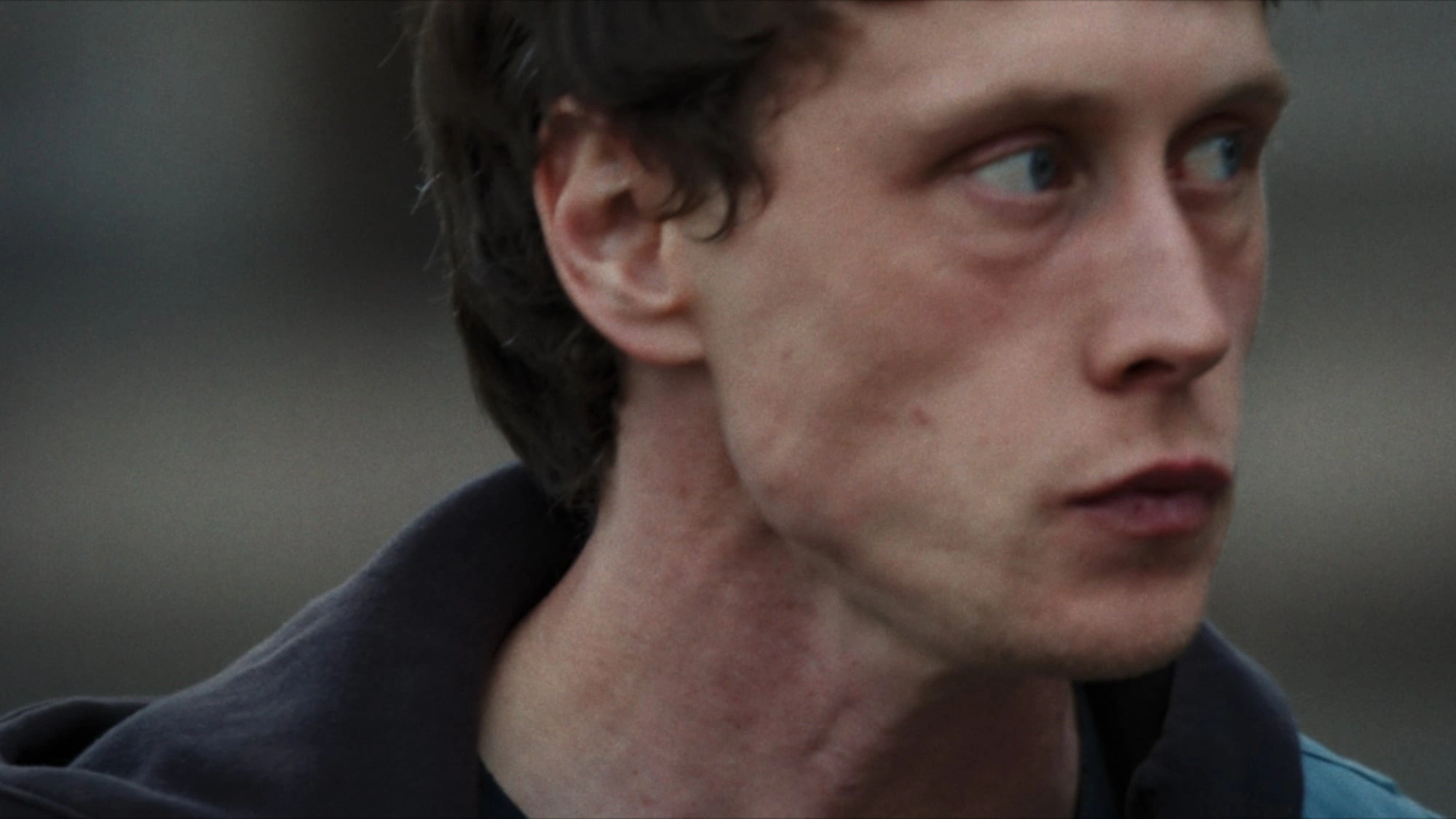
Nick Cooke’s handheld cinematography intensifies that pressure. Tight close-ups crowd MacKay’s face, while nervous movement denies Dylan the visual stability that the narrative withholds emotionally. When he moves through the hotel or erupts during later confrontations, the camera seems less interested in surveying space than in remaining trapped within his agitation.
Sound is equally hostile. Phone vibrations and drilling invade Dylan’s apartment, while Dario Swade’s layered design turns environmental noise into psychological friction. Roly Porter’s score and tracks from The Fall, Big Business, The Cramps, and Throbbing Gristle give the film an industrial pulse that suits Dylan’s transition from mechanical numbness to physical volatility.
The method can become self-defeating. Fireworks in the street, theatrical makeup, the sudden discovery of a pistol, and the accumulation of violent encounters keep demanding escalation. Each new shock risks making the previous one feel smaller. Some confrontations carry so little visible consequence that uncertainty about reality starts resembling narrative convenience.
MacKay survives that instability through specificity. Early on, he flicks lights, stares blankly, and moves through work as if every gesture has been programmed. Later, his body twists, lunges, and collapses into manic expression. The change is terrifying because the same man who once appeared almost motionless now seems unable to contain himself within a frame.
Mission premiered at the Edinburgh International Film Festival on August 15, 2026. The film follows a young man named Dylan who, after quitting his job, gives himself one week to discover a compelling reason to live.
Full Credits
Title: Mission
Distributor: BBC
Release date: August 15, 2026 (Edinburgh International Film Festival)
Running time: 86 minutes
Director: Paul Wright
Writers: Paul Wright
Producers and Executive Producers: Not Available
Cast: George MacKay, Rosy McEwen, Emma Naomi
The Review
Mission
Mission turns psychic collapse into an assault of fractured images, abrasive sound, and bodies trapped too close to the lens. Wright’s formal aggression can be startling, especially when Nick Cooke’s handheld camera and the layered soundscape make Dylan’s environment feel actively hostile. Yet the constant escalation, from knives and a pistol to theatrical makeup and violent encounters, sometimes blunts the danger it wants us to feel. George MacKay gives the chaos a human pulse, while the quieter scenes with Claire expose wounds that montage cannot reach.
PROS
- MacKay’s fiercely physical performance
- Claustrophobic handheld cinematography
- Aggressive, expressive sound design
- Strong Dylan and Claire scenes
CONS
- Excessive escalation weakens tension
- Some incidents strain credibility
- Symbolic imagery can become opaque
- Formal intensity occasionally overwhelms character