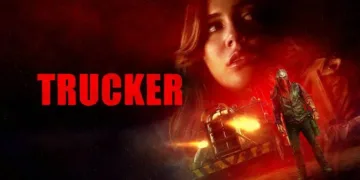



























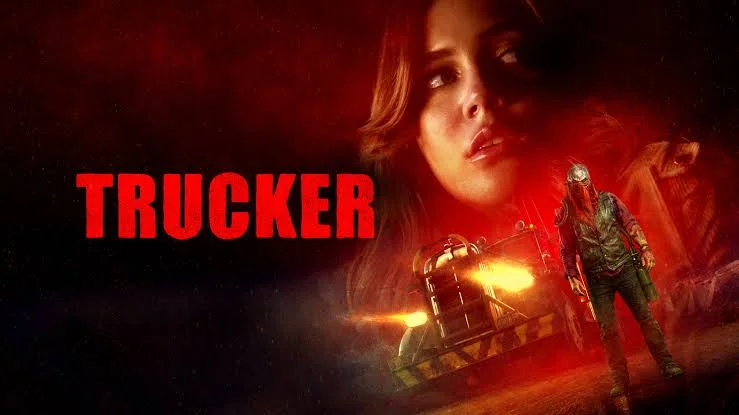

Leaving a family to burn on the roadside is already enough to make a revenge story uncomfortable. Humiliating the surviving father afterward pushes Trucker into uglier territory, and that ugliness gives Errol Sack’s film its best idea.
Set in 1985 and written by Steven Shaffer, the film begins with Scotty, Greg, Vanessa, Dan, Cindy, and Reina driving recklessly enough to cause a catastrophic collision. Long-haul driver Chris survives, but his wife and two children do not. The group flees rather than face what they have done, while the badly injured Chris is recovered by the eccentric Old Man Levy and taken to a sprawling junkyard.
One year later, Vanessa can no longer live comfortably with the secret. Her decision to return to the crash site drags several friends back toward Chris, who now hides his burns behind a mask and has converted grief into a methodical killing spree.
The lineage is easy to recognize. The buried crime recalls I Know What You Did Last Summer, the roadway menace carries traces of Duel and Joy Ride, and the production has the tactile scruffiness of something once discovered by accident in a video store. Trucker rarely hides those influences. Its affection for them is practically smeared across the windshield.
Victims With Blood on Their Hands
The most interesting feeling Trucker creates is uncertainty about who deserves your sympathy. Chris has lost everything because a group of reckless strangers treated his family’s deaths as an inconvenience to escape. When he finally begins hunting them, the familiar slasher relationship between predator and prey has already been disturbed. These young people are terrified, but several are also facing the consequences of something horrific they knowingly concealed.
Vanessa gives that conflict its clearest human shape. Katherine Gibson plays her as the person least capable of pretending the past has disappeared. Her insistence on returning to the accident site creates the story’s second movement, while the others would prefer to preserve their silence. That guilt makes her easier to invest in than characters primarily defined by arrogance or panic.
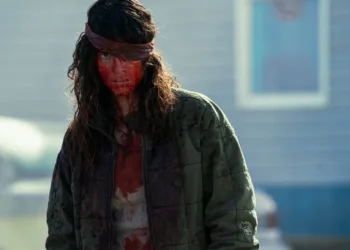
Chris becomes less interesting once the mask goes on. Milo Hayden has a sympathetic foundation to work from, yet the killer rarely speaks and expresses little beyond physical menace. His covered face, burned appearance, heavy gait, and imposing silhouette make him look convincing stalking through rusted vehicles, but the grief established earlier becomes harder to feel once the murders begin.
The film further muddies its revenge logic when Chris targets people whose responsibility for his family’s deaths is far less direct. That could have transformed him from wounded father into a frightening example of grief consuming moral judgment. The screenplay rarely stays with the idea long enough. A disturbing ethical question appears, then another body hits the ground.
Rust, Masks, and Missing Logic
The junkyard understands this movie better than many of its characters do. Stacks of damaged vehicles, narrow passages between machinery, dark sheds, twisted metal, and abandoned trucks give Sack a naturally hostile playground. Someone can disappear behind a wrecked cab, emerge through another opening, or become trapped between industrial objects without the film needing elaborate set pieces. Chris also looks most convincing here. His road-warrior appearance feels born from the environment around him.
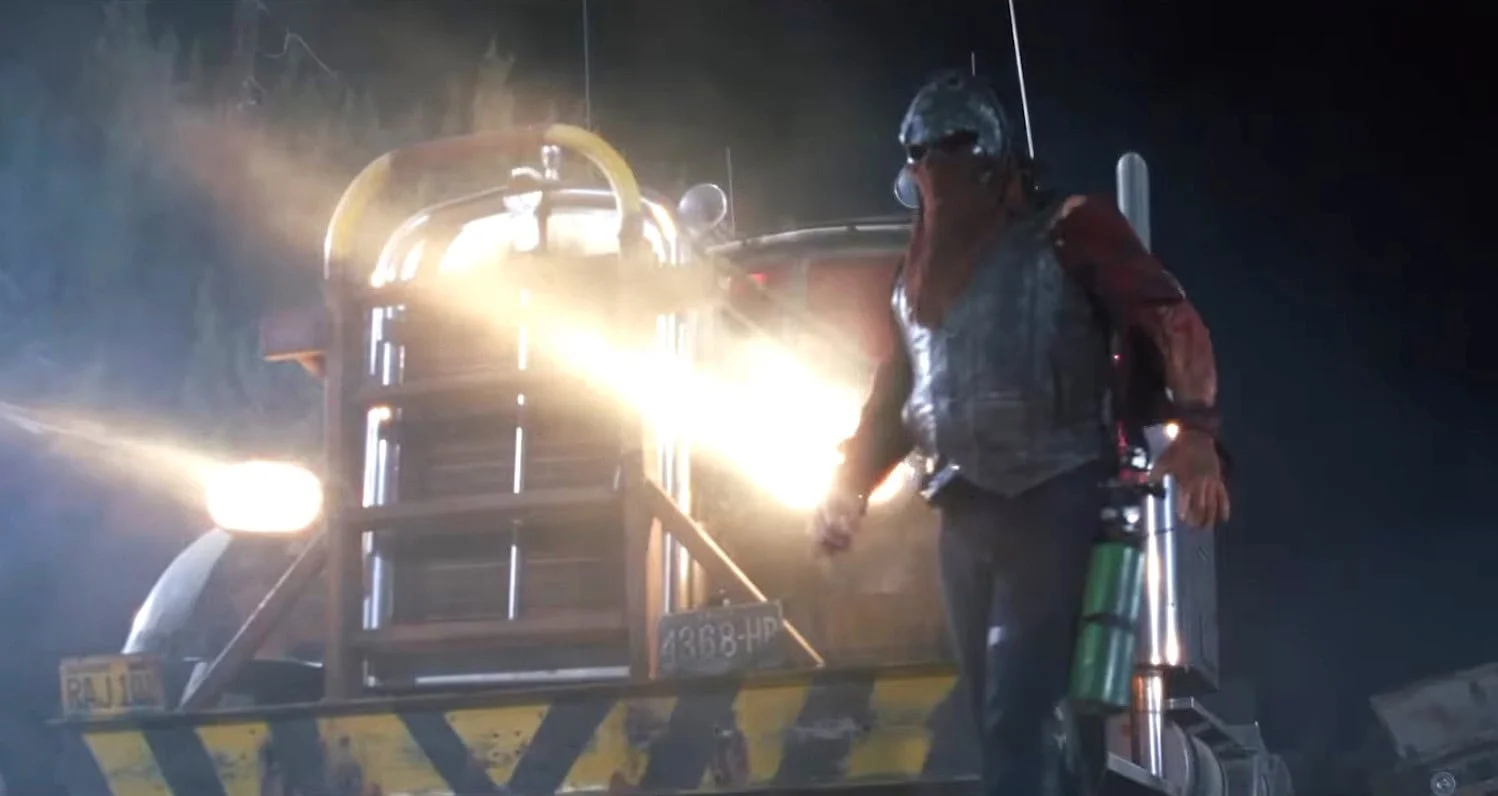
Some later confrontations have the messy physical energy that this material needs. Practical gore helps, particularly after the long setup, though several deaths occurring off-screen rob the hunt of momentum. The filmmaking regularly alternates between resourceful and visibly inexpensive. The junkyard provides texture for free; the crash sequence, green-screen driving, and digital fire expose how hard the production is stretching its budget.
The performances fluctuate in much the same way. Gibson gives Vanessa a believable current of guilt, while several early conversations among the group feel stiff enough to make relationships difficult to read. Screams sometimes carry less urgency than the danger requires, and attempted jokes land without much rhythm.
Then there is Old Man Levy. Chuck Cirino leans into the character’s bizarre energy, but the script never makes his purpose satisfying. He finds Chris, rehabilitates him in the junkyard, and seems connected to the transformation that follows, yet what he actually wants remains hazy. Chris later absorbs punishment with almost superhuman durability, another element the movie simply asks us to accept.
That looseness spreads into the revenge plot. Chris somehow knows enough about the people involved in a chaotic nighttime collision to hunt them individually. Slasher movies can survive strange logic. They have been doing it for decades. The trick is making the chase exciting enough that nobody stops to check the paperwork.
Too Long Before the Engine Turns Over
Trucker spends too much of its 85-minute runtime preparing for the movie promised by its own masked killer. The opening collision creates immediate guilt and tragedy, but the stretch separating that event from Chris becoming an active threat is sluggish. Vanessa’s return to the site, the search for their missing friend, and Levy’s strange involvement keep delaying the moment when the junkyard finally becomes a hunting ground.
Once Chris starts moving through the wreckage, the movie finds its pulse. Chases through cluttered industrial spaces, bursts of practical violence, the masked figure appearing around ruined vehicles, and the dusty soundtrack finally operate on the same frequency. For a while, it feels like a straight-to-video slasher that somehow slipped untouched out of the late 1980s or early 1990s.
That sensation carries much of the film’s appeal. The rough effects, uncomplicated revenge setup, eccentric old man, attractive young victims, grimy location, and killer seemingly designed for memorable box art all belong to a type of horror that rarely worried about refinement.
The frustrating part is that Trucker occasionally has something stranger hiding underneath that nostalgia. Chris begins as both victim and monster, Vanessa returns because guilt will not leave her alone, and the people running from the killer helped create him. Whenever the film lets those feelings breathe inside its rusted playground, this cheap revenge ride becomes surprisingly easy to enjoy.
Trucker arrived on digital VOD platforms on March 10, 2026, distributed worldwide by Breaking Glass Pictures. The action-horror feature follows a grieving long-haul driver who embarks on a brutal campaign of retribution against the reckless teenagers responsible for a fatal crash.
Where to Watch Trucker (2024) Online








Full Credits
Title: Trucker
Distributor: Breaking Glass Pictures
Release date: March 10, 2026
Rating: TV-MA
Running time: 1 hour 25 minutes
Director: Errol Sack
Writers: Steven Shaffer
Producers and Executive Producers: Alexia Cirino, Chuck Cirino, Dennis McCarthy, Steven Shaffer
Cast: Dan, Nicole Mattox, Dare Taylor, Chuck Cirino, Zach Cirino, Eli Cirino
The Review
Trucker
Trucker works best when its rusted junkyard, masked road warrior, and guilty young victims create the feeling of discovering some forgotten VHS slasher after midnight. Chris has enough tragedy behind the mask to make his revenge uncomfortable rather than purely mechanical, yet thin characterization and shaky logic keep that idea from cutting very deep. The movie takes too long to reach its strongest material, but once the hunt begins, its scrappy practical violence and grimy atmosphere carry a certain affectionately trashy pleasure.
PROS
- Excellent junkyard setting
- Memorable killer design
- Enjoyable VHS-era atmosphere
- Interesting revenge morality
- Scrappy practical gore
CONS
- Slow middle stretch
- Thin victim characterization
- Frequently shaky logic
- Uneven performances
- Underdeveloped killer mythology