


















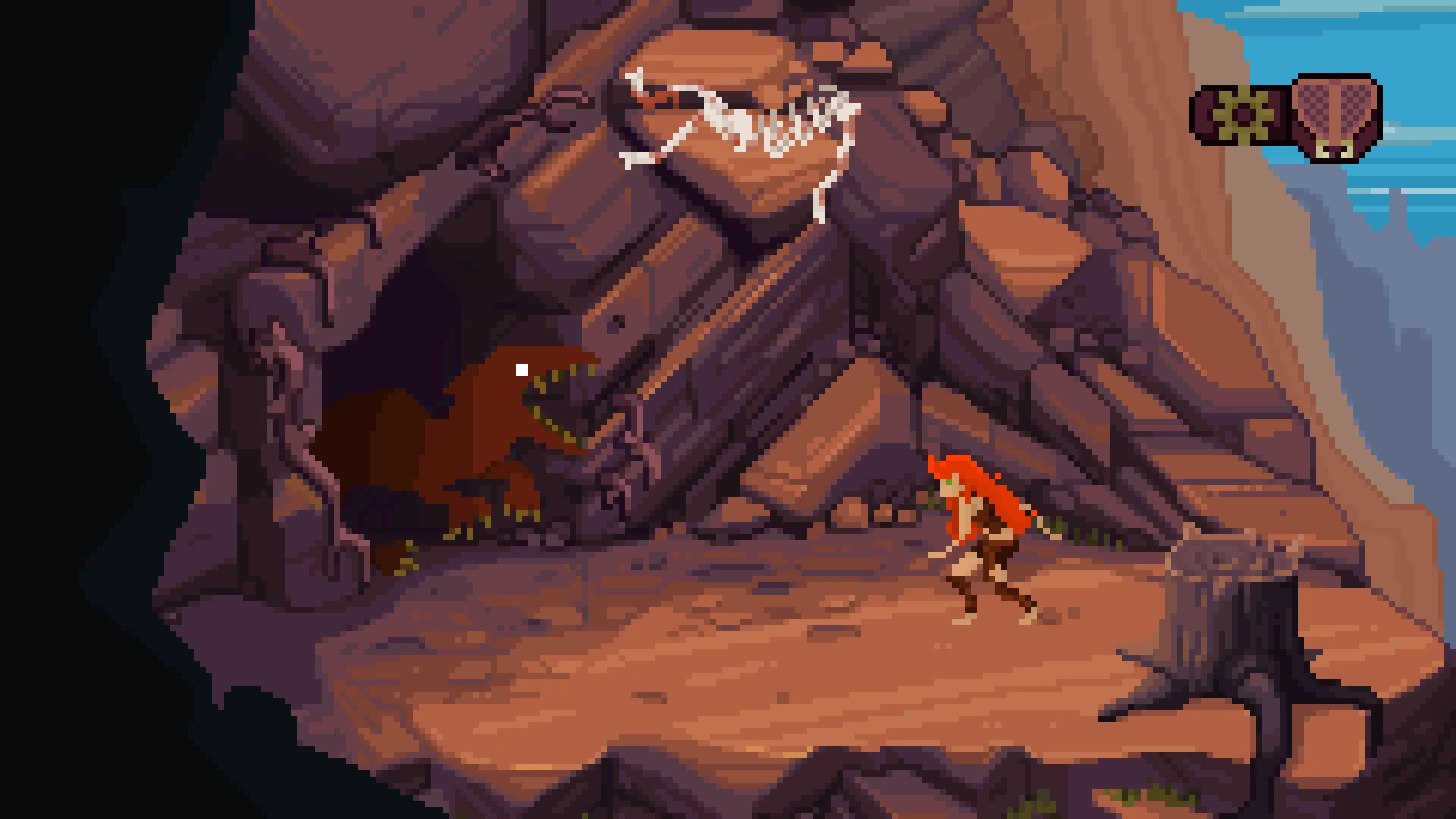

Fear arrives before language does. The young hunter at the center of Theropods learns that as a child, watching her mother die during a dinosaur attack, and Lost Token keeps returning to that memory whenever another enormous reptile blocks her path. Years later, she carries her mother’s spear, hunts for her village, and faces creatures that once reduced her to a terrified child. None of this requires a dialogue box.
That choice shapes nearly everything about Theropods. Characters grunt, gesture, point, recoil, and exchange glances rather than speak recognizable words. When a glowing object falls near the hunter’s village and a hostile tribe attacks soon afterward, the game expects players to understand panic from movement and context.
The object eventually leads her to a crashed spacecraft and its stranded pilot, pushing a Stone Age adventure into science fiction without stopping to explain the collision. For a point-and-click game, where dialogue traditionally carries huge portions of the experience, removing readable conversation is a risky decision. Here, silence becomes part of how you play.
Thinking Around the Dinosaurs
Anyone familiar with Monkey Island, Goblins, or the adventure games that filled PC screens during the 1990s will recognize the basic rhythm. You enter a small environment, inspect whatever looks useful, collect an item or two, then figure out the exact sequence of actions that lets you continue. The difference is how often Theropods turns those routines into survival scenes.
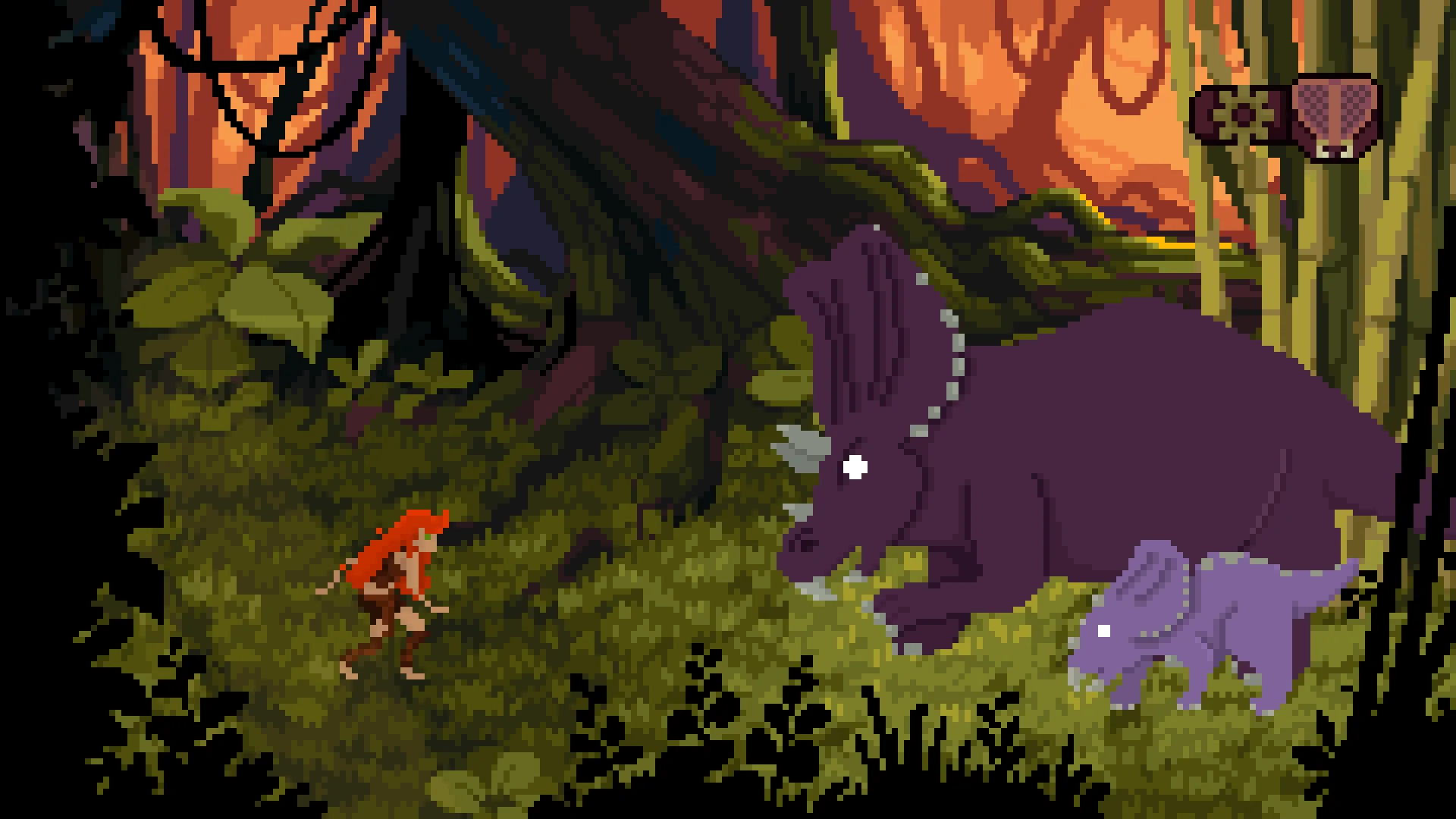
An early hunt requires setting a trap for a dinosaur and then determining how to lure the animal into it. Later sequences ask you to extinguish a fire surrounding the damaged spacecraft, rescue the hunter after she becomes stranded on a rock in a river, move enormous creatures away from a blocked path, and survive an underwater encounter with a predator. The game never hands you a sword and asks you to mash through these problems. Dinosaurs are obstacles to understand rather than health bars to empty.
Once the stranded pilot joins the hunter, Lost Token occasionally lets you switch between the two women. Their positions become pieces of the puzzle, recalling the multi-character design of Goblins, where progress often depended on understanding how one character could create an opportunity for another.
The restriction can become tiresome. Theropods frequently has one correct solution, and failing to spot one interactive object can leave you clicking across scenery rather than reasoning through a puzzle. The built-in hint function, which highlights usable elements, limits the damage, yet there are moments where the problem comes from unclear interaction indicators rather than a difficult idea.
The later stages also return repeatedly to the same setup: one protagonist is captured or trapped, leaving the other to engineer a rescue. Across a game that lasts roughly three to four hours, that recycling becomes visible surprisingly quickly.
Friendship Through Action
The lack of dialogue matters most once the hunter and pilot begin traveling together. There is no conversation where they explain their histories, declare trust, or describe what the other has come to mean to them. Their relationship grows through what the player watches them do.
One pulls the other out of danger. They help each other cross hostile terrain. They survive encounters with dinosaurs, escape the invading tribe, and gradually stop behaving like strangers forced into temporary cooperation. Facial expressions and physical reactions fill the spaces where another adventure game might place several screens of dialogue.
That makes small animations unusually important. A frustrated sound after an incorrect interaction communicates both character and mechanical feedback. A frightened expression before approaching a predator reconnects the adult hunter with the child who watched her mother die. Close-up shots during story sequences let fear, relief, and affection register without subtitles spelling out the intended emotion.
The science-fiction premise strengthens that relationship because each protagonist belongs to a world the other cannot understand through language. One carries primitive tools and inherited survival knowledge. The other arrives through advanced technology that looks almost supernatural against the jungle and stone villages. Their common vocabulary becomes action.
It also gives the game’s dinosaur encounters emotional progression. By the time the pair faces its largest threats, including a T-Rex, the hunter is confronting the image tied directly to her childhood trauma rather than encountering another impressive sprite placed at the end of a puzzle chain.
When Pixel Art Has to Speak
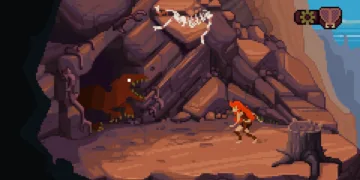
Lost Token’s hand-drawn pixel animation carries an enormous amount of responsibility. The characters need enough physical expression to replace spoken performances, and the environments need to reveal puzzle information without burying every usable object beneath visual noise.
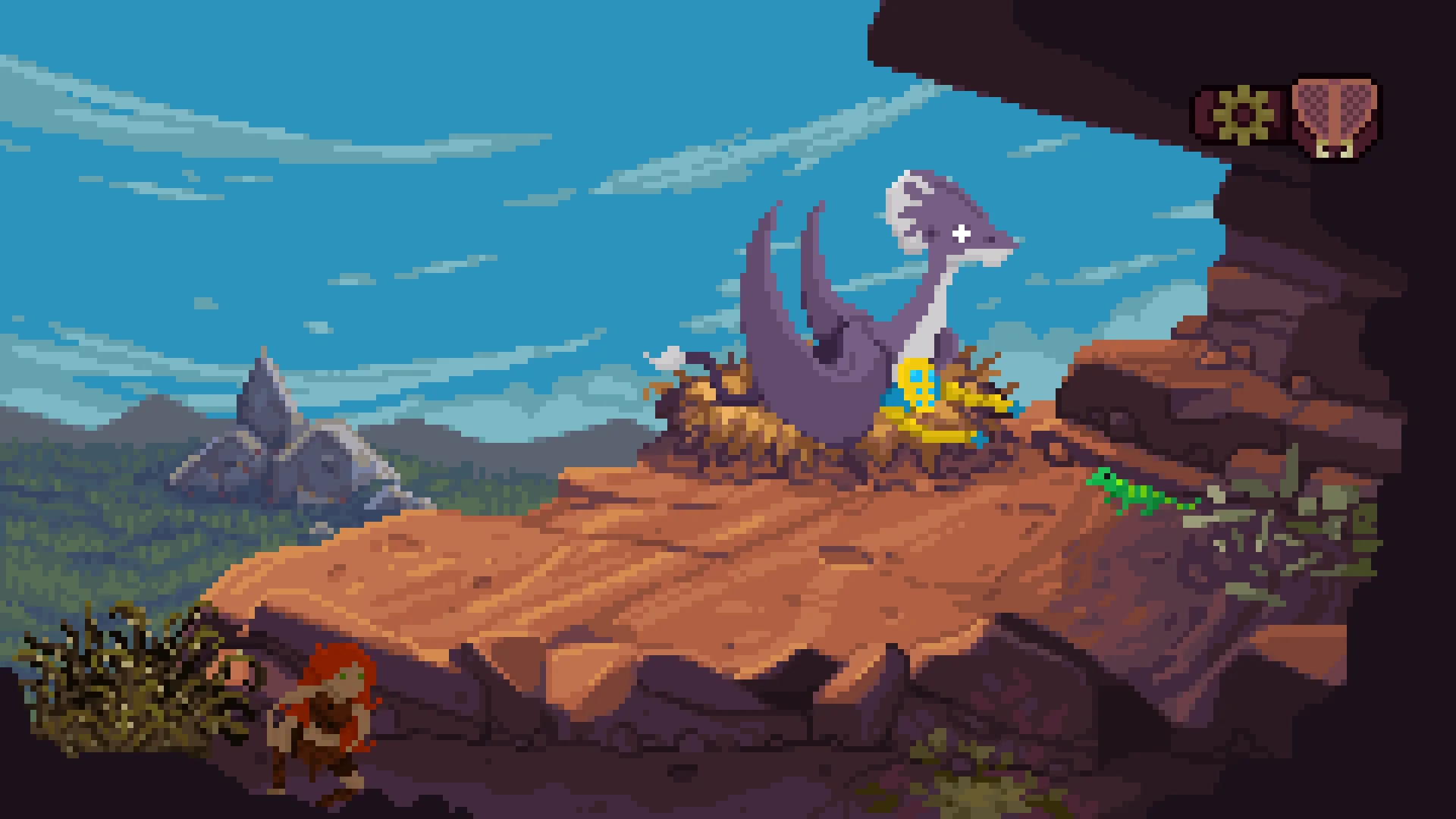
The best scenes handle both beautifully. From a cliff overlooking the village, grass moves gently through the wind while the hunter stands against a landscape that briefly feels peaceful. Jungles, caves, settlements, underwater areas, and dinosaur-filled paths then give the short campaign distinct visual identities.
Character movement deserves particular attention. The frame-by-frame animation recalls the physical clarity of games such as Prince of Persia and Another World, where posture could tell the player what a character was thinking before interface design became obsessed with markers and prompts. Theropods uses that same principle for emotion. Watching someone hesitate, shake her head, panic, or reach toward another person becomes readable information.
Sound carries the remaining weight. Individual grunts help distinguish characters. Creature noises announce danger. Small audio reactions can tell you that an attempted puzzle solution has failed. The soundtrack then combines tribal percussion with science-fiction synths and heavier rhythmic passages, letting its prehistoric setting and extraterrestrial intrusion occupy the same musical space.
That combination fits a game where a cavewoman and a stranded space traveler can stand beside each other without sharing a language, look toward the same dinosaur, and know exactly what the other means.
The Review
Theropods
Theropods turns the limitations of a classic point-and-click adventure into part of its emotional language. Watching the hunter and stranded pilot learn to communicate through gestures, rescues, and shared danger gives their friendship warmth without a single conventional conversation. Some later puzzles recycle the captured-companion setup, and unclear interaction points can turn observation into pixel hunting. Still, the hand-drawn animation, expressive sound work, prehistoric sci-fi collision, and compact three-to-four-hour structure make this small adventure unusually easy to care about.
PROS
- Expressive wordless storytelling
- Beautiful hand-drawn pixel animation
- Genuine central friendship
- Clever environmental puzzles
- Excellent sound and music
CONS
- Repetitive late-game rescue scenarios
- Occasionally unclear interaction points
- Strict single-solution puzzle design