

















The Paper Season 2 understands the strange rule of workplace comedy: the more desperately people try to look professional, the faster everything falls apart. The Toledo Truth Teller staff returns with awards on the wall, confidence in the air, and absolutely no ability to behave like a normal workplace. That combination gives the series a stronger identity than its first season, where every joke carried the invisible weight of being connected to The Office.
The comparison remains unavoidable. The mockumentary format, the workplace setting, and the presence of Oscar Martinez (Oscar Nuñez) create an obvious family resemblance. Yet Season 2 spends less time asking for permission to exist and more time building its own newsroom full of strange personalities, questionable decisions, and people who are one bad meeting away from disaster.
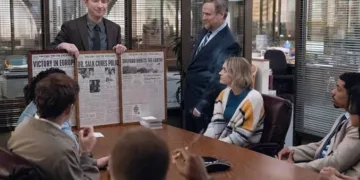
The season begins after the Toledo Truth Teller’s major sweep at the Ohio Journalism Awards. Editor-in-chief Ned Sampson (Domhnall Gleeson) has finally achieved a version of the success he wanted, though the victory comes with complications. His secret relationship with reporter Mare Pritti (Chelsea Frei) becomes the emotional engine of the season, forcing the newsroom’s professional chaos to collide with personal chaos.
That is where The Paper finds its funniest material. The show understands that office romance is rarely dramatic because of the romance itself. It is dramatic because coworkers have to watch two people pretend they are not obviously dating while everyone knows they are obviously dating. The secret is always the least secret thing in the building.
A Sequel That Stops Apologizing for Its Existence
The first season of The Paper had a difficult assignment. It needed to introduce a new workplace, establish new characters, and convince viewers that another mockumentary could exist after one of television’s defining sitcoms. Season 2 feels like the moment where the series finally puts that comparison in the background.
The biggest change is the newsroom itself. A group of reporters chasing stories creates different comedic rhythms than employees selling office supplies. These characters are not simply trying to survive another workday. They are trying to prove their work matters while constantly making choices that create bigger problems.
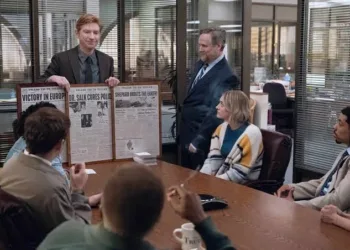
The show gets a lot of mileage from that contradiction. The Truth Teller wants to represent serious journalism, yet the people responsible for that mission are frequently distracted by their own egos, relationships, and bizarre ideas. A newspaper office should be a place of investigation and responsibility. Instead, it often becomes a laboratory where bad decisions are tested in real time.
The ensemble also benefits from the extra confidence. Characters who felt like supporting pieces in Season 1 receive clearer personalities and stronger comedic opportunities. The workplace feels less like a collection of actors waiting for their big moment and more like a functioning ecosystem where every strange employee has a role in creating the next disaster. That is the trick great sitcoms understand. The funniest characters are rarely funny because they tell jokes. They are funny because they have absolutely no idea how funny their own behavior is.
Ned and Mare Turn Workplace Romance Into a Mess
The decision to move Ned and Mare from unresolved tension into an actual relationship gives Season 2 a different structure. Instead of spending episodes asking if they will finally admit their feelings, the show explores what happens after the romantic breakthrough. The answer is: everything becomes more complicated.
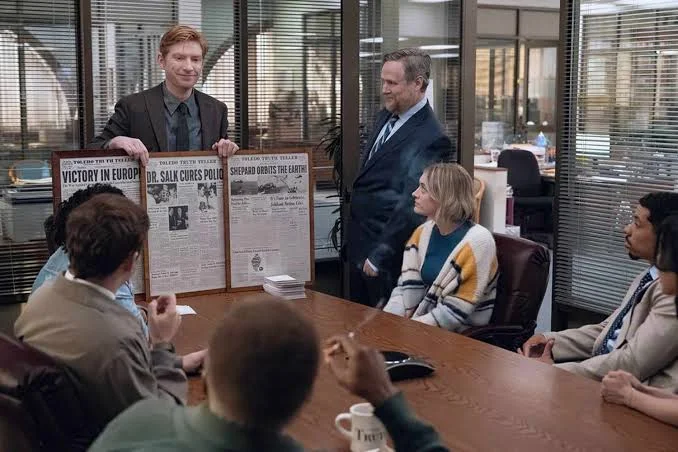
Ned and Mare genuinely work as a couple because their relationship is built around a shared passion for journalism. They are not simply attracted to each other. They understand why the other person cares about the newspaper. Their connection gives the show an emotional foundation that balances the louder comedy around them.
The season repeatedly places their relationship into ridiculous situations. Ned becomes jealous when Mare proves herself better than him at a gun range while they are trying to impress a local police contact. Their debate-style podcast turns into a strange mixture of professional disagreement and flirtation. A romantic weekend gets interrupted when the newsroom proves incapable of handling an important election story without them.
Gleeson continues to be one of the show’s strongest weapons because Ned exists in a very specific comedic space. He is not Michael Scott. He is competent enough to understand what is happening around him, which somehow makes his mistakes even funnier.
Watching him attempt to maintain control while everything slips away gives the character a different energy. Frei brings balance to the relationship by making Mare feel grounded. She is a talented reporter first and a romantic partner second, which keeps the story from becoming a simple workplace love story.
The problem arrives when the season gives romance too much space. Almost everyone starts having some kind of romantic storyline. Esmeralda Grand (Sabrina Impacciatore) and Ken (Tim Key) develop their strange pseudo-relationship.
Oscar attempts to pursue someone from a nursing home. Detrick, Adelola, Nicole, and Troy all deal with their own romantic complications. Individually, these stories work. Together, they sometimes make the newsroom feel like it has transformed into a workplace dating show where someone forgot to remove the newspaper equipment.
When The Paper Gets Weird, It Gets Great
Season 2 expands the comedy beyond the awkward realism associated with The Office. The show still understands uncomfortable humor, but it is increasingly willing to chase bigger and stranger ideas. The strongest examples come when the absurdity grows naturally from character choices.
Ned faking a rat bite and nearly allowing a fake nurse to inject him with an enormous syringe works because it feels like the exact kind of terrible plan he would create while believing he is being heroic. A secret office task force recreating a crime scene with condiments sounds like a sketch, yet it works because the characters approach the nonsense with complete seriousness.
The funniest running joke involving newspaper figure William Randolph Hearst’s mistress shows another strength of the series. The comedy comes from the characters taking their work seriously while revealing how strange the world of journalism can become.
The bigger swings do not always land. Esmeralda going undercover as a teenage boy to investigate her son’s school pushes the character into cartoon territory. The joke is clear, but the emotional logic becomes harder to follow.
Still, Esmeralda remains one of the season’s best performers. Impacciatore commits fully to every ridiculous choice while finding small moments of sincerity underneath the chaos. She understands that the character works because there is a real person buried under the performance. Sometimes the funniest thing a character can do is admit they are performing.
The Future of the Truth Teller
The strongest idea running through The Paper remains its interest in journalism during an era where local newspapers are struggling. Ned’s mission to restore the Toledo Truth Teller gives the sitcom a purpose beyond office jokes. The characters are chasing stories because they believe those stories matter.
Season 2 continues exploring that conflict through corporate interference and newsroom politics. CEO Marv (Allan Havey) represents the pressure placed on journalism when business priorities begin influencing editorial decisions. The newspaper’s success does not automatically protect it from outside control.
The season also strengthens the supporting cast with new additions. Lisa Gilroy’s HR representative brings the perfect sitcom contradiction: she is technically capable while creating complete chaos every time she enters a room. Jon Lovitz’s veteran newsroom character adds another memorable personality, especially because his priorities are often focused on sandwiches rather than journalism. Travis (Eric Rahill) and Adelola (Gbemisola Ikumelo) also benefit from increased attention. The season allows them to move beyond quick jokes and become fuller members of the newsroom.
Not every character receives the same treatment. Nicole’s storyline becomes less satisfying as the season progresses, and some returning characters disappear into the background. The show has built a large workplace, and sometimes it feels like there are too many desks to visit. That is a good problem for a sitcom to have. It means the world feels alive. It also means someone occasionally gets left behind in the break room.
The Paper Season 2 does not completely escape the shadow of The Office, and it probably never will. The connection is part of its identity. What matters is that the series now has its own stories to tell, its own workplace disasters to create, and its own strange little newsroom full of people who should probably never be trusted with a deadline. The newspaper may be struggling. The comedy is doing just fine.
The Paper Season 2 premiered on Peacock on September 9, 2026. The mockumentary comedy series follows the same documentary crew from The Office as they turn their lenses toward a struggling historic Midwestern newspaper trying to rebuild itself.
Where to Watch The Paper Season 2 Online









Full Credits
Title: The Paper Season 2
Distributor: Peacock
Release date: September 9, 2026
Rating: TV-14
Running time: 30 minutes
Director: Greg Daniels, Michael Koman
Writers: Greg Daniels, Michael Koman
Producers and Executive Producers: Greg Daniels, Michael Koman, Howard Klein
Cast: Domhnall Gleeson, Sabrina Impacciatore, Melvin Gregg, Gbemisola Ikumelo, Tim Key, Eric Rahill, Ramona Young, Ally Maki
Director of Photography (Cinematographer): Matt Klamer
Editors: David Rogers, Claire Scanlon
Composer: Jay Ferguson
The Review
The Paper Season 2
The Paper Season 2 understands that a sitcom needs room to misbehave. Its bigger comedic swings, stronger ensemble chemistry, and Ned and Mare’s evolving relationship create plenty of memorable newsroom disasters. Some storylines stretch the format too far, and the romance-heavy structure occasionally crowds out the journalism angle, but the show’s funniest moments prove the series has found its own rhythm. It still has a few pages left to fill, though the headline looks promising.
PROS
- Stronger ensemble chemistry
- Bigger comedic set pieces
- Ned and Mare’s dynamic
- Expanded newsroom world
CONS
- Overloaded romance plots
- Uneven comedy swings
- Familiar Office echoes
- Underused characters