























The modern media ecosystem did not arrive with a single invention or a sudden collapse of standards. It was assembled through thousands of small editorial decisions, commercial calculations, and moments when attention became the most valuable currency. Ink examines one of those turning points through the rise of Larry Lamb, the editor who transformed The Sun newspaper from a struggling publication into a cultural force under the ownership of Rupert Murdoch.
Danny Boyle approaches this history with the energy of the very media machine the film examines. Adapted by James Graham from his stage play, Ink turns Fleet Street’s transformation in the late 1960s and 1970s into a fast-moving drama about ambition, class resentment, and the uncomfortable relationship between audiences and the stories they consume. The film understands the appeal of disruption. It also understands that disruption often leaves someone cleaning up the damage.
Jack O’Connell’s Larry Lamb becomes the perfect vessel for that contradiction. He is charming, determined, funny, and deeply aware of the barriers that kept him away from power. He is also a man who discovers that giving people what they want can become an excuse for giving them what harms them.
The Making of a Media Empire
The film’s strongest idea is that The Sun was not created through pure cynicism. It was created through frustration. Lamb enters Murdoch’s world as a journalist who believes traditional newspapers have abandoned ordinary readers. The established Fleet Street institutions are presented as rigid spaces controlled by people who underestimate working-class audiences.
O’Connell captures this frustration through small gestures rather than simple anger. Lamb carries himself like someone who has spent years waiting for recognition and has finally decided to stop asking for permission. When Murdoch offers him control of The Sun, the opportunity represents personal revenge against the system that ignored him.
Guy Pearce’s Murdoch operates differently. He is colder, more controlled, and constantly calculating the next move. Pearce avoids turning him into a cartoon businessman. This Murdoch understands that success requires risk, but he also recognizes the danger when Lamb’s ideas begin moving faster than his own expectations.
Their relationship gives the film its central tension. Murdoch supplies the money and the vision of expansion. Lamb supplies the editorial instincts that turn a forgotten newspaper into a national obsession. The partnership works because both men believe they are correcting a broken system. The problem arrives when their solution begins creating a different kind of problem.
Boyle frames the creation of The Sun almost like a workplace rebellion. The recruitment scenes move with the rhythm of a caper, as Lamb gathers journalists who are tired of traditional newsroom rules. The film finds humor in the process of convincing experienced writers to join a newspaper many of them initially dismiss as beneath them. Money, ambition, and the promise of creative freedom prove difficult to resist.
The Pleasure and Danger of Sensation
Ink understands the uncomfortable truth behind sensational media: it works because people respond to it. The film does not present readers as passive victims. Lamb’s philosophy depends on recognizing desires that already exist, then building an entire publication around them.
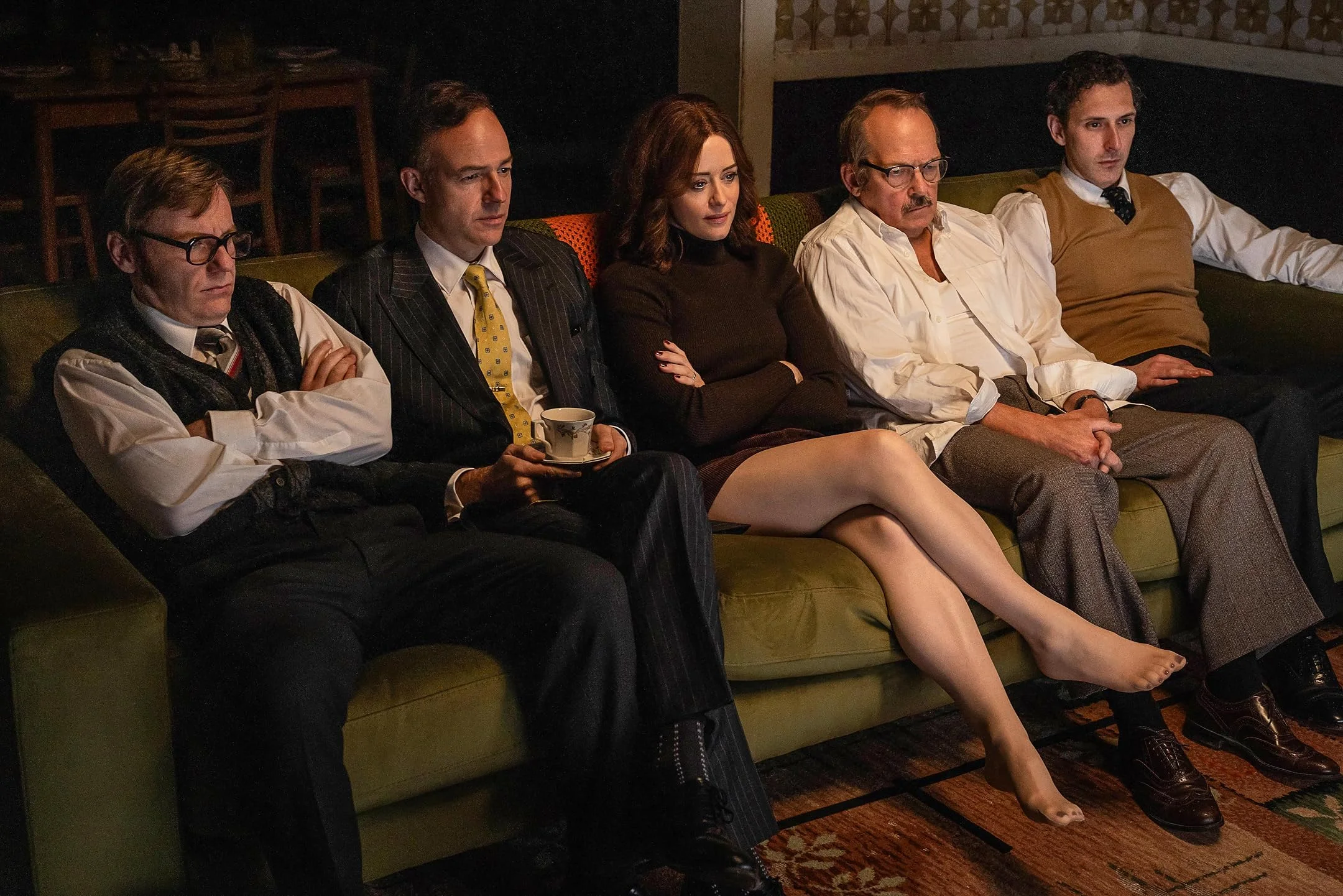
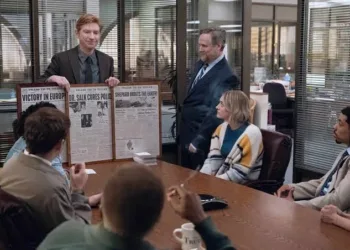
The famous newsroom discussion about what The Sun should cover becomes one of the film’s clearest moments. Staff members identify sex, celebrity, sport, crime, and personal stories as subjects capable of attracting attention. The scene is funny because the characters are discovering a formula. It becomes disturbing because that formula eventually defines the newspaper’s identity.
The introduction of provocative content, including Page 3, marks a shift in the publication’s approach. Lamb sees these decisions as innovation. Others see them as a surrender to the easiest forms of attention. The film refuses to make the transition simple. The new Sun offers a louder voice to audiences ignored by traditional newspapers, while that same voice increasingly depends on reducing people into images and headlines.
This contradiction gives Ink its most interesting cultural question. Who controls a media culture built around public appetite? The editors who create the material? The owners who finance it? Or the audience that rewards it?
The film understands that these questions remain unresolved because modern media operates through the same tension. Every platform claims to reflect public interest while competing to capture public attention. Ink finds the origins of that conflict in a newspaper office filled with cigarette smoke, printing presses, and ambitious people convinced they are changing history.
Danny Boyle’s Newspaper Symphony
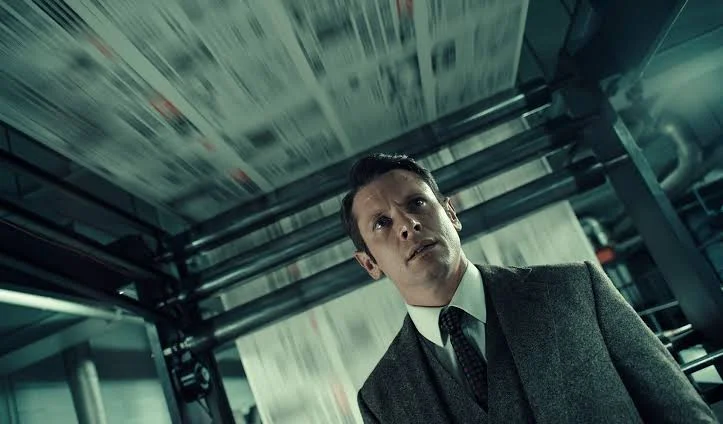
Boyle’s direction turns a dialogue-heavy newsroom story into a visual assault. The camera rarely settles during the film’s early sections. Dutch angles, quick cuts, shifting perspectives, and aggressive movement create the feeling of a publication being assembled at impossible speed.
The style fits the subject. A newspaper built around urgency requires a filmmaking approach built around urgency. The irony is that Boyle’s own methods occasionally mirror the sensationalism being criticized. The film seduces viewers with the same energy it later questions.
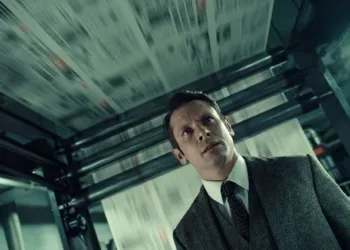
Alwin H. Küchler’s cinematography gives Fleet Street a physical identity. The offices, restaurants, and printing facilities feel like different worlds within the same industry. Wealthy executives sit in polished spaces while journalists and workers operate among machinery, noise, and exhaustion.
Daniel Pemberton’s score and the film’s contemporary musical choices push the period setting away from traditional historical drama. Boyle is less interested in recreating the past with museum-like accuracy than capturing the emotional speed of a moment when old media structures were collapsing.
That choice makes Ink feel connected to the present. The newspaper office becomes an early version of today’s digital attention economy, where every headline competes for immediate reaction.
The Cost of Chasing Attention
The film’s moral turning point arrives through the kidnapping of Muriel McKay, the wife of Murdoch executive Alick McKay. The tragedy exposes the consequences of treating every event as material for circulation.
Lamb argues that aggressive reporting can help uncover information and maintain public interest in the case. Those around him see something else: a human tragedy being transformed into a product. The conflict between Lamb and Murdoch reveals the fragile boundary between journalism and exploitation.
Jonathan Hyde brings emotional weight to Alick McKay’s grief, grounding a storyline surrounded by larger arguments about media power. The personal cost of the newspaper’s methods becomes impossible to ignore.
The film’s final movement connects Lamb’s editorial choices to modern media problems, from click-driven headlines to the endless competition for attention online. This connection is clear, but Ink occasionally states its argument too directly. The earlier sections are strongest when they allow viewers to experience the attraction of the media machine before examining its consequences.
A Complicated Legacy
Claire Foy’s Jules Davies provides an important perspective inside Lamb’s world. She represents the possibilities and limitations facing women in a male-dominated newsroom. Her character supports some of Lamb’s changes because they create opportunities unavailable elsewhere, yet she recognizes the cost of a culture built around provocation.
Foy gives Jules intelligence and independence, though the script sometimes uses her as a guide for the audience rather than allowing her to exist with the same complexity as Lamb and Murdoch.
Ink remains most effective when it refuses easy answers. Larry Lamb is neither a simple hero who challenged outdated institutions nor a villain who single-handedly destroyed journalism. He is a person who found a weakness in an old system and built a new one around that weakness.
The film’s greatest achievement is recognizing that cultural change rarely arrives wearing a clear label. Sometimes it arrives as progress. Sometimes it arrives as entertainment. Sometimes it arrives as a newspaper headline that everyone reads before asking who paid the price.
Ink premiered at the 83rd Venice International Film Festival on September 2, 2026, ahead of its scheduled release on Netflix and in theaters. The biographical drama details the events of 1969 as media mogul Rupert Murdoch acquires The Sun and partners with editor Larry Lamb to transform the publication into Britain’s most influential tabloid.
Where to Watch Ink (2026) Online
Full Credits
Title: Ink
Distributor: StudioCanal, Netflix
Release date: September 2, 2026 (Venice Film Festival)
Rating: Not Rated
Running time: 1 hour 56 minutes
Director: Danny Boyle
Writers: James Graham
Producers and Executive Producers: Danny Boyle, Michael Ellenberg, Tessa Ross, Tracey Seaward
Cast: Jack O’Connell, Guy Pearce, Claire Foy, Brian Gleeson, Blake Harrison, Patrick Kennedy, Angus Imrie, Bertie Carvel
Director of Photography (Cinematographer): Alwin H. Küchler
Editors: Fin Oates
Composer: Daniel Pemberton
The Review
Ink
Ink understands that media revolutions are rarely born from a single villain. Danny Boyle’s energetic portrait of Larry Lamb and Rupert Murdoch captures the seductive thrill of disruption while examining the compromises hidden inside that excitement. Jack O’Connell and Guy Pearce bring complexity to figures who shaped modern media culture, though the film sometimes explains its argument when its own contradictions already speak loudly. A sharp, restless drama about the cost of chasing attention.
PROS
- Jack O’Connell’s magnetic performance
- Boyle’s kinetic direction
- Complex media critique
- Strong newsroom atmosphere
CONS
- Heavy-handed final message
- Jules feels underdeveloped
- Uneven moral exploration