























Chronovisor understands that mystery is created as much by what remains hidden as by what is revealed. Kevin Walker and Jack Auen’s debut feature builds its tension around a machine that supposedly allows humanity to witness history itself, yet the film’s real unease comes from the spaces around that knowledge: the empty libraries, the darkened rooms, the silent moments when a person realizes they have gone too far.
Béatrice Courte (Anne-Laure Sellier), a philosophy professor in New York, discovers the story of Pellegrino Ernetti, a Benedictine priest who claimed to have created a device capable of observing the past. Her investigation begins like an academic pursuit, with books, articles, and archival material spread across library tables. The deeper she goes, the more the research begins to resemble a descent into a conspiracy thriller.
The film’s most striking decision is making written material its primary visual language. Passages from books and documents appear across the screen through translated overlays, turning research into a form of cinematic excavation. Words become evidence. A sentence highlighted on a page carries the weight of a confession. A forgotten article feels like a hidden doorway.
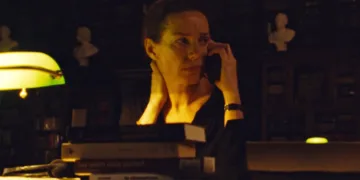
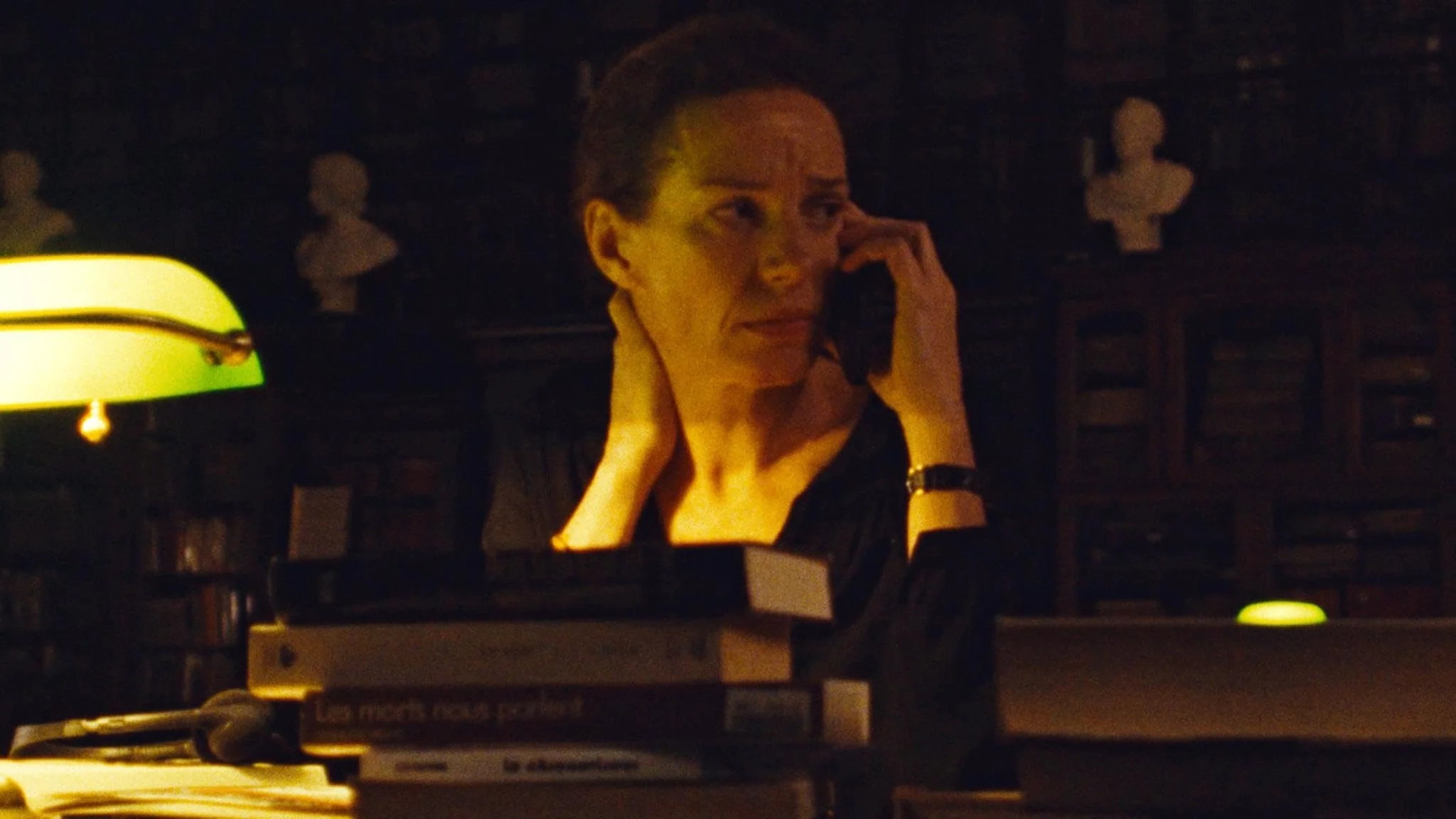
This could have become an exercise in intellectual distance, yet Walker and Auen understand that obsession has its own suspense. The camera repeatedly returns to Béatrice alone among shelves and desks, surrounded by darkness and illuminated only by pools of warm light. The composition places her inside the architecture of knowledge, but also inside a trap.
The film’s visual language draws heavily from noir traditions, where shadows are never decoration. They are moral territory. Béatrice is often framed as someone searching for truth, but the lighting suggests another possibility: she is slowly disappearing into the mystery she wants to solve.
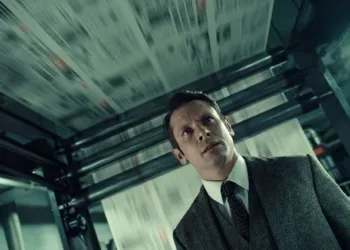
Cinematographer Leo Zhang’s 16mm photography gives every location a physical history. The grain on the image mirrors the texture of the old books Béatrice examines, creating a connection between the material world and the information contained inside it. Even ordinary spaces, such as libraries and research rooms, carry a sense of secrecy. The film makes paper feel ancient and fragile, almost like an artifact recovered from another civilization.
The strongest sequences come when Chronovisor allows its form to create suspense. A slow movement across a page can carry the same anticipation as a detective opening a locked door. A phone call becomes a transmission from another world because the film understands that information itself can be frightening. The audience is not waiting for an action sequence. We are waiting for the next fragment of evidence.
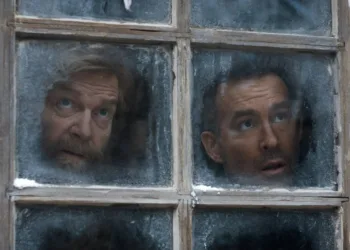
The eventual appearance of the Chronovisor shifts the film into stranger territory. The device’s images are distorted and abstract, lacking the polished effects expected from conventional science fiction. This choice works because the machine feels less like futuristic technology and more like a damaged memory trying to force itself into existence. The visuals suggest a haunted signal rather than a clean window into history.
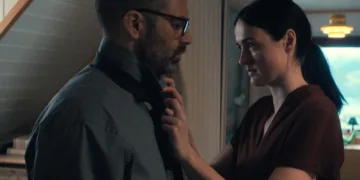
Sellier’s performance keeps Béatrice grounded throughout the increasingly strange investigation. She avoids turning the character into a simple conspiracy hunter. Instead, her physical changes tell the story. The excitement of discovery gradually gives way to exhaustion and fixation. Her posture, her silence, and the way she absorbs each new piece of information reveal someone being reshaped by the search.
The film occasionally tests patience with its repetition. There are many moments of reading, translating, and following another clue. The method is deliberate, but the rhythm can become heavy. A mystery built around research has to make obsession feel infectious, and there are sections where the process becomes more interesting than the person experiencing it.
Still, Chronovisor remains most powerful when it questions the morality of looking. The film presents knowledge as something that can illuminate and consume at the same time. The machine promises access to every moment humanity has lost, yet the closer Béatrice gets to that possibility, the less certain the path becomes.
The final images refuse the comfort of a simple answer. They leave behind the feeling of a door opened into a room that should perhaps have remained locked. Chronovisor finds its horror in curiosity itself, in the human urge to turn every shadow into evidence. The camera keeps searching because the characters cannot stop.
Chronovisor made its world premiere at the International Film Festival Rotterdam on January 30, 2026, before expanding to specialized theatrical runs via Grasshopper Film. The techno-horror mystery follows a French academic in New York City who becomes dangerously obsessed with tracking down records of a rumored 1950s machine built to project history onto a television screen.
Where to Watch Chronovisor (2026) Online
Full Credits
Title: Chronovisor
Distributor: Cosmic Salon Films, Grasshopper Film
Release date: January 30, 2026 (International Film Festival Rotterdam)
Running time: 1 hour 39 minutes
Director: Kevin Walker, Jack Auen
Writers: Kevin Walker, Jack Auen
Producers and Executive Producers: Jason Zuriff
Cast: Anne-Laure Sellier, Nicholas Tebben, Nicole Dombrowski Risser
Director of Photography (Cinematographer): Leo Zhang
Editors: Danielius Kokanauskis
Composer: Gustav Holst
The Review
Chronovisor
Chronovisor turns archival research into a psychological maze, using 16mm shadows, glowing text, and restrained performances to transform a simple investigation into a study of obsession. Walker and Auen understand that the unseen can be more frightening than the revealed, and the film’s strongest moments come from its control of atmosphere. The final act loses some restraint, yet the mystery remains haunting because the real danger was never the machine. It was the desire to look too closely.
PROS
- Hypnotic 16mm photography
- Inventive text-based storytelling
- Strong atmosphere and sound design
- Sellier’s restrained performance
CONS
- Slow repetition in the middle
- Final act becomes less subtle
- Limited character exploration beyond the investigation