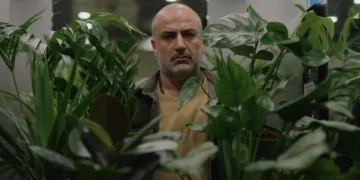


















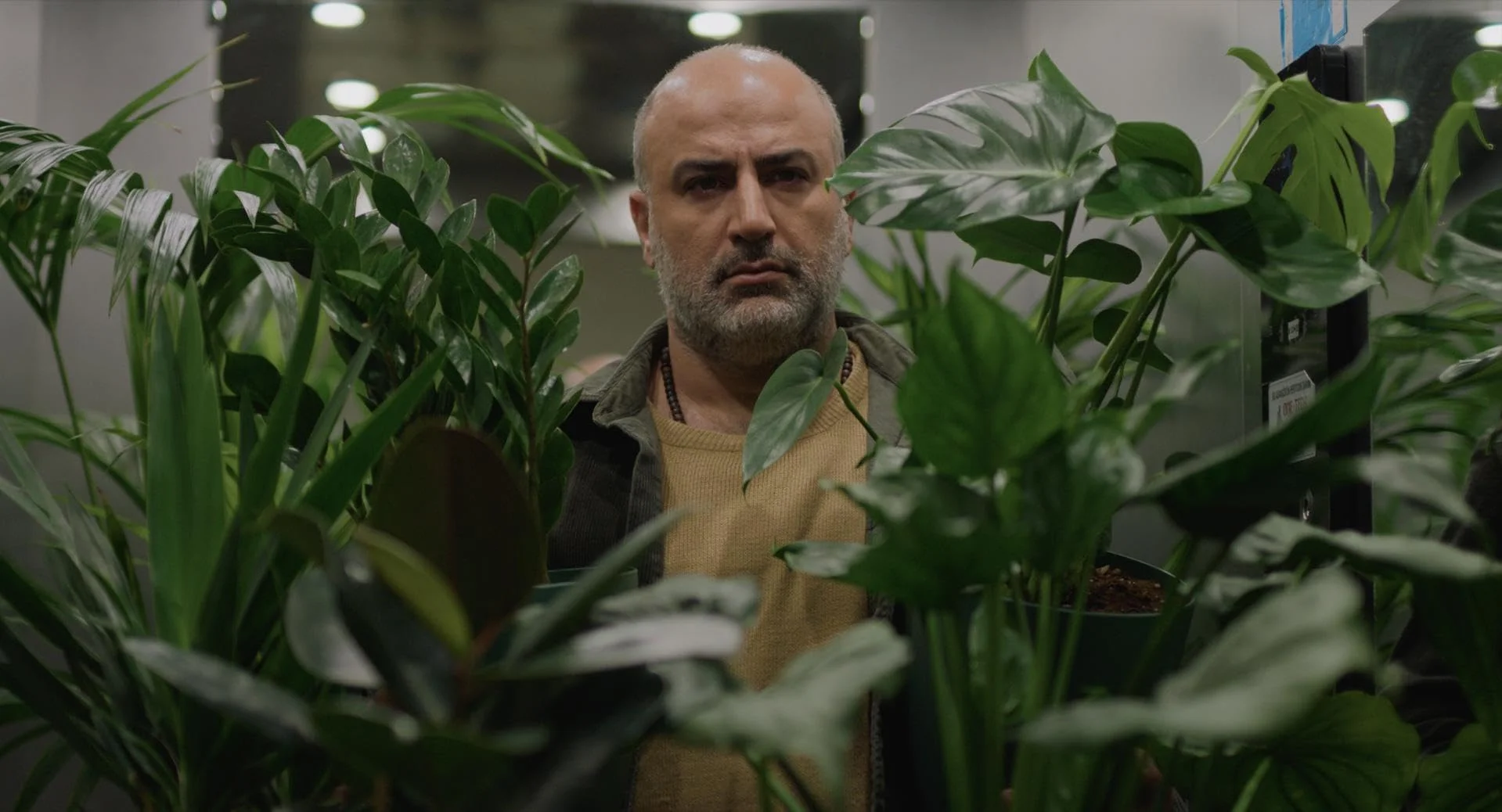

Arash has decided to die, and the terrible calm of that decision gives A Bit Of Light its shape. There is no panic in the way he tells his younger brother Maziar. He discusses keys, paperwork, his cat, the plants that will need new homes. Misagh Zareh plays these preparations with the grave efficiency of a doctor completing discharge notes for himself. Death has already been turned into administration. Ali Asgari’s film spends the following day asking how long that illusion of order can survive contact with other people.
Arash’s despair has a history, though Asgari and co-writer Shadmehr Rastin resist compressing it into a neat diagnosis. His medical licence has been revoked and his clinic sealed after he treated protesters injured by the authorities. He is no revolutionary figure in the usual cinematic sense. He is a doctor who kept behaving like one after compassion became politically dangerous.
That distinction matters because his punishment has destroyed the practical structure through which he understood his place in the world. When a young woman begs him for help obtaining medication for her father, he initially refuses. He cannot practise. She persists. Eventually, he helps anyway. The cruel irony is almost unbearable. The instinct that has helped ruin his life remains alive inside him.
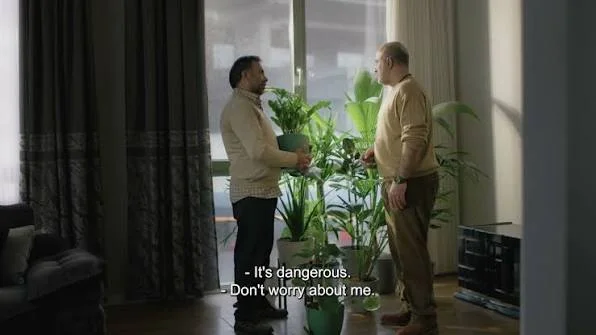
Asgari keeps returning to that contradiction without turning it into an inspirational mechanism. Arash worries about injured protesters hiding at home because seeking treatment might expose them to further punishment. If he disappears, their predicament does not disappear with him. Yet the film never treats this responsibility as proof that he owes the world his continued existence.
It understands something darker: being needed can give life meaning, and being endlessly needed can exhaust the person doing the giving. The political pressure surrounding Arash becomes inseparable from his fatigue because every decent action seems to produce another demand, another danger, another reminder that survival in this environment carries its own moral cost.
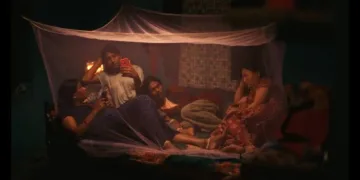
His siblings respond to the news according to the strange private languages families build over decades. Maziar bargains with him through panic, even suggesting sex and other distractions as emergency medicine for existential despair.
Mahsa, a yoga teacher, reaches for a spiritual vocabulary and tells him that joy and suffering are not enemies. Massi, carrying more distance in her relationship with him, meets the situation with a harder practicality. None of them finds the correct sentence because no such sentence exists. Their awkwardness becomes one of the film’s most persuasive forms of tenderness.
There is humor here, though it arrives wearing funeral clothes. Arash’s unwanted plants become a recurring practical nuisance while their owner is attempting to arrange his death. Maziar’s desperate solutions are funny because they are hopelessly inadequate, then painful for exactly the same reason. The film understands that families often meet catastrophe with habits that refuse to become solemn on command. Somebody still has to move the plants. Somebody still has an opinion about dinner.
Asgari directs these encounters with an austerity that occasionally risks becoming inert. Long conversations unfold without visual insistence, and the camera frequently watches Arash from a restrained distance. At its strongest, that distance reflects the peculiar state Zareh gives him: present in every room, yet already behaving as if he has begun to withdraw from it.
Silence is allowed to remain silence. The film rarely reaches for music to instruct the audience through those pauses, leaving the scrape of ordinary spaces, voices and household machinery to carry the discomfort.
Sound becomes especially expressive in small places. Early on, the hiss of the espresso machine accompanies Arash’s vacant concentration and makes the apartment feel briefly sealed around him. Later, inside Mahsa’s yoga studio, her instructions echo through the room as bodies lie motionless on mats.
Arash watches them with an expression that seems to contain grief, anger and something harder to name. The reflective glass around him subtly distorts the otherwise plain realism. For a film so committed to emotional restraint, the sequence feels almost dreamlike, as if Arash has briefly stepped into a space where his numbness has acquired an acoustic form.
The measured pacing does not always earn every extra beat. Some exchanges linger after their emotional information has settled, and the film’s familiar movement from despair toward renewed attachment can occasionally be felt underneath its subtler intentions. Stillness can deepen a moment; it can also leave the viewer waiting for a scene to admit that it has finished. Asgari usually knows the difference, though not invariably.
Zareh makes that patience easier to extend. His performance is built from containment: low speech, economical gestures, a face trained to keep distress from becoming spectacle. This makes the fractures matter. His reaction upon returning to his sealed, damaged clinic briefly exposes the grief beneath all that professional control. His reluctance gives way when former patients need him. At Mahsa’s studio, the distant look begins to soften into attention. None of these moments announces a transformation. They accumulate like light finding cracks in a closed room.
Then the siblings reach their mother, intending to tell her what Arash has decided, but domestic ritual interferes. She prepares his favorite food. The family cooks. Instructions about the meal pass between people carrying knowledge that she does not yet possess. She insists on feeding him watermelon. Arash, who has spent the day explaining his death with clinical precision, eventually places his head in her lap. The gesture contains no philosophy. That is why it hurts.
The film does not grant his mother a miraculous power to cure him. His clinic remains closed. The wounded still hide. The threat surrounding ordinary Iranian life has not receded. Even Arash’s silence about his plan cannot safely be read as a permanent decision to live. Something simpler has changed: the future he had reduced to a closed door has become uncertain again. For this man, that uncertainty is a small mercy, barely enough to alter the next hour. His mother is still beside him, cutting food and refusing to let him leave the table hungry.
A Bit of Light had its world premiere in competition at the 83rd Venice International Film Festival in September 2026. The drama follows an Iranian doctor who, after being arrested and having his medical practice shut down, resolves to end his life, only for one final day spent with his family to disrupt his final plans.
Where to Watch A Bit of Light (2026) Online
Full Credits
Title: A Bit of Light
Distributor: Salaud Morisset, Teodora Film, Haut et Court
Release date: September 2026 (Venice International Film Festival)
Running time: 1 hour 30 minutes
Director: Ali Asgari
Writers: Ali Asgari, Shadmehr Rastin
Producers and Executive Producers: Milad Khosravi, Afshin Salamian, Sholeh Alemi Fabbri, Lorenzo Cioffi, Giorgio Giampa, Francesco Melzi d’Eril, Gabriele Moratti
Cast: Misagh Zareh, Sadaf Asgari, Forouzan Jamshidnejad, Ramtin Daghigh, Mina Rahimzadeh
Director of Photography (Cinematographer): Iman Tahsin
Editors: Iman Tahsin
The Review
A Bit Of Light
A Bit Of Light finds its power in refusing to cure Arash for the audience’s comfort. Ali Asgari lets despair remain difficult, political and intimate, while Misagh Zareh gives every small fracture in Arash’s composure enormous weight. Some stretches of stillness linger past their strongest point, and the underlying arc is familiar. Yet the final movement with his mother earns its tenderness through ordinary gestures rather than revelation. Hope arrives here as uncertainty, fragile enough to last an hour and perhaps, for now, that is enough.
PROS
- Misagh Zareh’s restrained central performance
- Family scenes rich with awkward tenderness
- Political context handled without simplification
- Silence and sound used with precision
- Final mother sequence lands beautifully
CONS
- Some scenes linger too long
- Familiar underlying dramatic arc
- Stillness occasionally becomes inertia