


























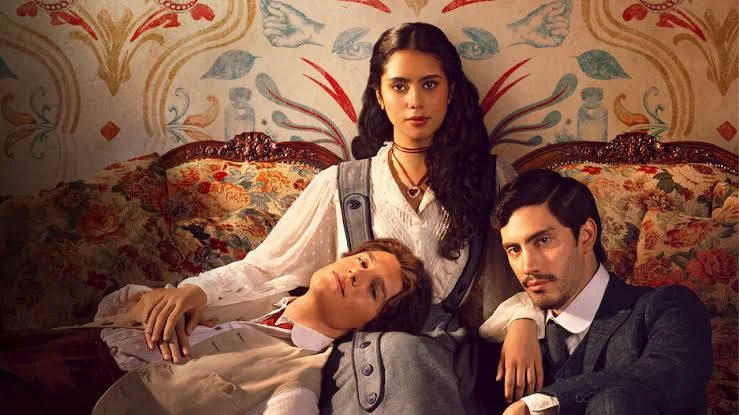

Emilia Sauri is surrounded by people willing to tell her what freedom should look like. The church has one answer, polite society another. Revolutionaries speak of national liberation, husbands invoke marital duty, universities decide who is permitted to learn, and families arrange futures that seem respectable precisely because the women living them have so little say. Lovesick places Emilia inside this crowded vocabulary of freedom and gives her the harder task of discovering which parts of it actually belong to her.
Set in Puebla as the Mexican Revolution approaches, the seven-episode drama initially presents Emilia as unusually fortunate for a woman of her time. Her father Diego lets her work in the family apothecary. Her aunt Milagros treats independence as a lived principle rather than an abstract idea.
Emilia already possesses enough medical knowledge to understand that healing people is the life she wants, rather than the domestic future expected of her. Yet knowledge and access remain different things. She can prepare remedies behind the counter, but entering medicine as a profession requires permission from institutions designed to deny it.
That distinction gives the series considerably greater weight than the familiar story of an exceptional woman refusing old customs. Emilia does refuse them, sometimes spectacularly, but personal courage alone cannot create the conditions she needs. A sympathetic father matters. Milagros matters.
Political change matters. Education matters. Men willing to recognize her ability matter. The uncomfortable implication is that female independence remains dependent on assembling an entire network of exceptions around a woman before society will allow her the freedoms men receive as ordinary privileges.
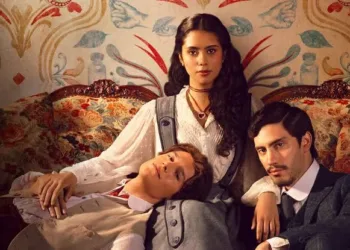
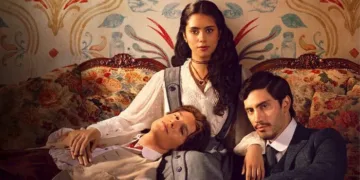
The romantic triangle works best when read through that same problem. Daniel Cuenca, Emilia’s childhood love, returns carrying the electricity of political rebellion. Their attraction is immediate, and Emilia’s willingness to sleep with him without treating marriage as the required moral payment gives the series one of its clearest declarations of sexual autonomy. Daniel also draws her toward revolutionary politics, a world built around the promise that entrenched authority can be overthrown.
Yet his politics gradually expose their own contradiction. Daniel can imagine Mexico freed from dictatorship far more easily than he can imagine Emilia’s life existing outside the gravitational pull of his cause. He disappears when politics demand it. He misses moments that matter to her. Later, when marriage has formally joined their lives, he assumes that his decision to flee to Spain should determine hers as well. His revolutionary ideals are sincere, but sincerity does not prevent him from reproducing another hierarchy at home.
Antonio Zavalza enters with far less fire and considerably greater practical consequence. Their early connection around medicine matters because it recognizes a part of Emilia that romance alone cannot contain. When Daniel’s wounded brother Salvador is brought to the apothecary after a protest, Emilia assists Antonio in removing the bullet. The image of her holding the bloody slug turns vocation into something tangible. Medicine stops being an aspiration discussed by enlightened relatives and becomes work performed under pressure.
Antonio later offers Emilia a place in his hospital and encourages her to take the medical examination she fears. She succeeds, and the series wisely makes professional competence something developed through practice rather than bestowed by romance. Antonio’s support still introduces a complication the drama cannot entirely escape.
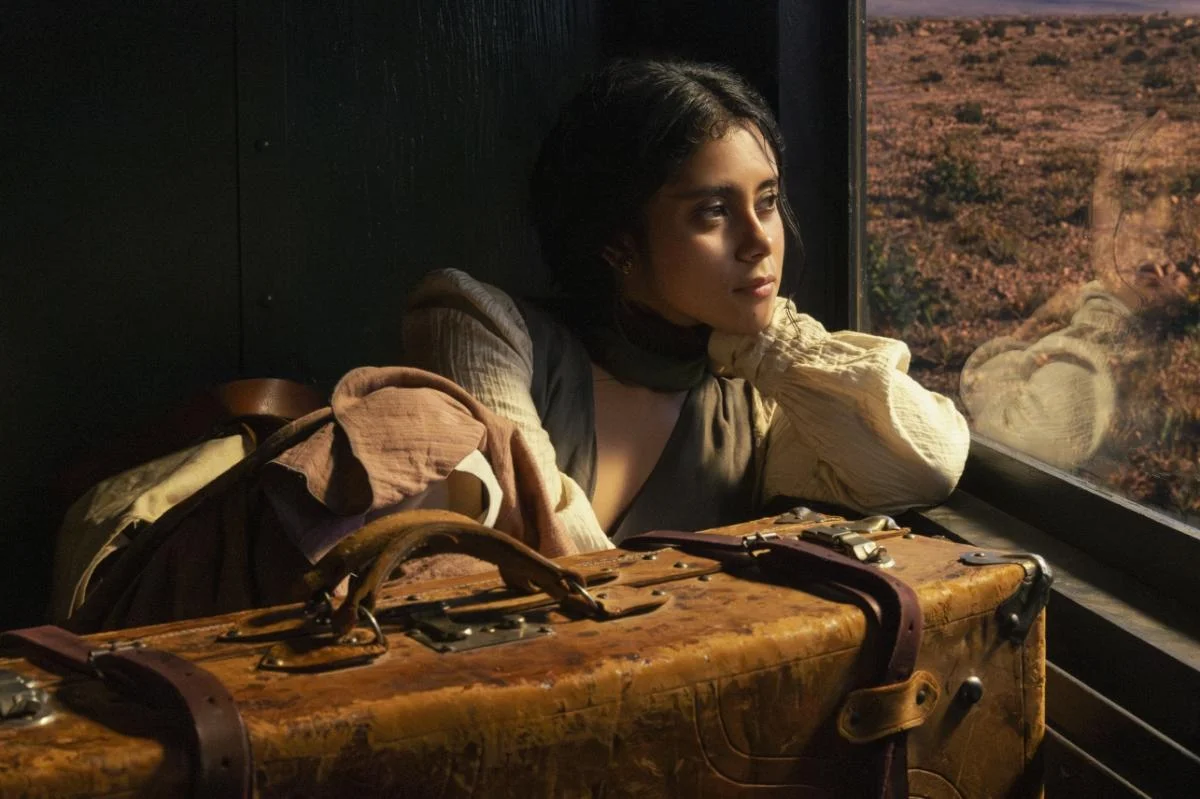
Emilia’s path into medicine becomes easier because the right man finally opens a door that other men kept shut. The relationship is healthier than the one she has with Daniel, but the surrounding culture has not suddenly become generous. It has merely produced a man willing to use his access differently.
This is why reducing Daniel and Antonio to passion versus stability undersells the material. Daniel represents a kind of liberation that can become self-absorbed. Antonio represents recognition, structure, and the possibility of building a life around Emilia’s intellectual ambitions. Both men care for her. What separates them is the space each leaves for her existence beyond their relationship.
The Mexican Revolution shadows this private struggle with an obvious historical parallel, though the series handles that parallel unevenly. Political meetings, police pursuit, wounded rebels, hunger, illness, and changing governments repeatedly intrude upon Emilia’s life. Her medical work puts her in contact with bodies carrying the cost of political upheaval, which is where the history feels most immediate. Salvador’s wound tells the story of revolution with greater force than speeches about revolution because Emilia has to place her hands inside its consequences.
Elsewhere, the historical material can feel strangely weightless. Large political developments sometimes arrive through conversation, headlines, aftermath, or compressed transitions. The series keeps Emilia at the center by refusing to become a battlefield chronicle, but the tradeoff is significant. Daniel is so closely defined by revolutionary activity that thinly dramatized politics inevitably thin him as well. A movement capable of reorganizing the country occasionally feels like an inconvenient appointment in the middle of a romance.
The women around Emilia reveal what the political storyline sometimes leaves abstract. Sol’s marriage offers a quieter system of coercion: a respectable arrangement built on emotional resignation. Milagros offers the opposite possibility. Unmarried, politically engaged, and largely uninterested in social approval, she gives Emilia a model of womanhood that does not require male validation to become legible. Cassandra Ciangherotti makes Milagros especially effective because her defiance never feels like a collection of slogans waiting to educate the audience. It has social cost, pleasure, humor, and history behind it.
Renata Vaca carries the same burden on a larger scale. Emilia could easily become a symbol disguised as a protagonist, the enlightened woman placed among reactionaries so the series can congratulate both her and itself. Vaca prevents that flattening. Her Emilia remains recognizably desirous, stubborn, wounded, professionally ambitious, and occasionally drawn toward choices that do not serve her future. Those contradictions matter because emancipation without contradiction is usually propaganda.
The series is less assured when its seven episodes have to contain the enormous distance Emilia travels. Marriage, separation, revolutionary upheaval, medical training, Milagros’s illness, Chicago, professional growth, and decades of emotional history accumulate quickly. The period design, apothecary interiors, costumes, and warm earth-toned palette create a persuasive physical world, but the editing sometimes treats years as connective tissue between milestones. Events arrive before their emotional consequences have fully settled.
That compression becomes especially noticeable in the late jump to an elderly Emilia and Antonio. The sequence reaches for bittersweet memory as Emilia watches her granddaughter and recalls childhood with Daniel. Its abruptness weakens the feeling, yet the idea behind it is one of the series’ better refusals.
Choosing Antonio does not require Emilia to declare Daniel meaningless. Loving one man did not invalidate loving another, and maturity does not rewrite desire into a neat moral lesson. The series leaves Emilia looking backward at the boy she once loved while sitting beside the man with whom she built a life, keeping her history from becoming a lesson about choosing correctly.
Lovesick premiered globally on Netflix on September 2, 2026. Set during the brewing Mexican Revolution, the period drama follows a young woman in Puebla striving to become a doctor while torn between two very different men.
Where to Watch Lovesick Online


Full Credits
Title: Lovesick
Distributor: Netflix
Release date: September 2, 2026
Rating: TV-MA
Running time: 60 minutes per episode
Director: Catalina Aguilar Mastretta
Writers: Catalina Aguilar Mastretta
Producers and Executive Producers: Catalina Aguilar Mastretta
Cast: Renata Vaca, Juan Pablo Fuentes, Iván Amozurrutia, Miguel Rodarte, Ofelia Medina, Arturo Barba, Mariana Gajá
The Review
Lovesick
Lovesick works best when Emilia’s romantic and professional choices expose how limited freedom remains inside supposedly progressive families, institutions, and political movements. Renata Vaca gives those contradictions emotional weight, while Cassandra Ciangherotti sharpens the series’ feminist argument through Milagros. The Mexican Revolution sometimes feels reduced to background machinery, and the seven episodes compress major changes too aggressively, yet the series resists turning Emilia’s life into a tidy lesson about choosing the right man. Her independence remains complicated, negotiated, and convincingly unfinished.
PROS
- Renata Vaca gives Emilia real complexity
- Milagros strengthens the cultural critique
- Romance reflects competing ideas of freedom
- Medical scenes make Emilia’s ambition tangible
- The ending preserves emotional ambiguity
CONS
- Revolutionary politics can feel dramatically thin
- Seven episodes compress major developments
- Daniel suffers from underdeveloped political material
- Some emotional consequences receive too little space