




























A film can carry mythology in its title and still struggle to make myth matter. Gandhari surrounds its central story with an unusually rich set of Indian references: the blindfolded queen of the Mahabharata, the child-rescuing goddess Chaumukhi, the demon Magrasur, Bahurupiya performers whose identities shift behind paint and disguise. These ideas give Devashish Makhija’s thriller a cultural vocabulary far richer than its familiar tale of a parent pursuing a trafficking network. The trouble is that the film often treats that vocabulary as decoration rather than dramatic structure.
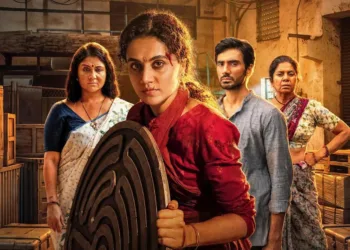
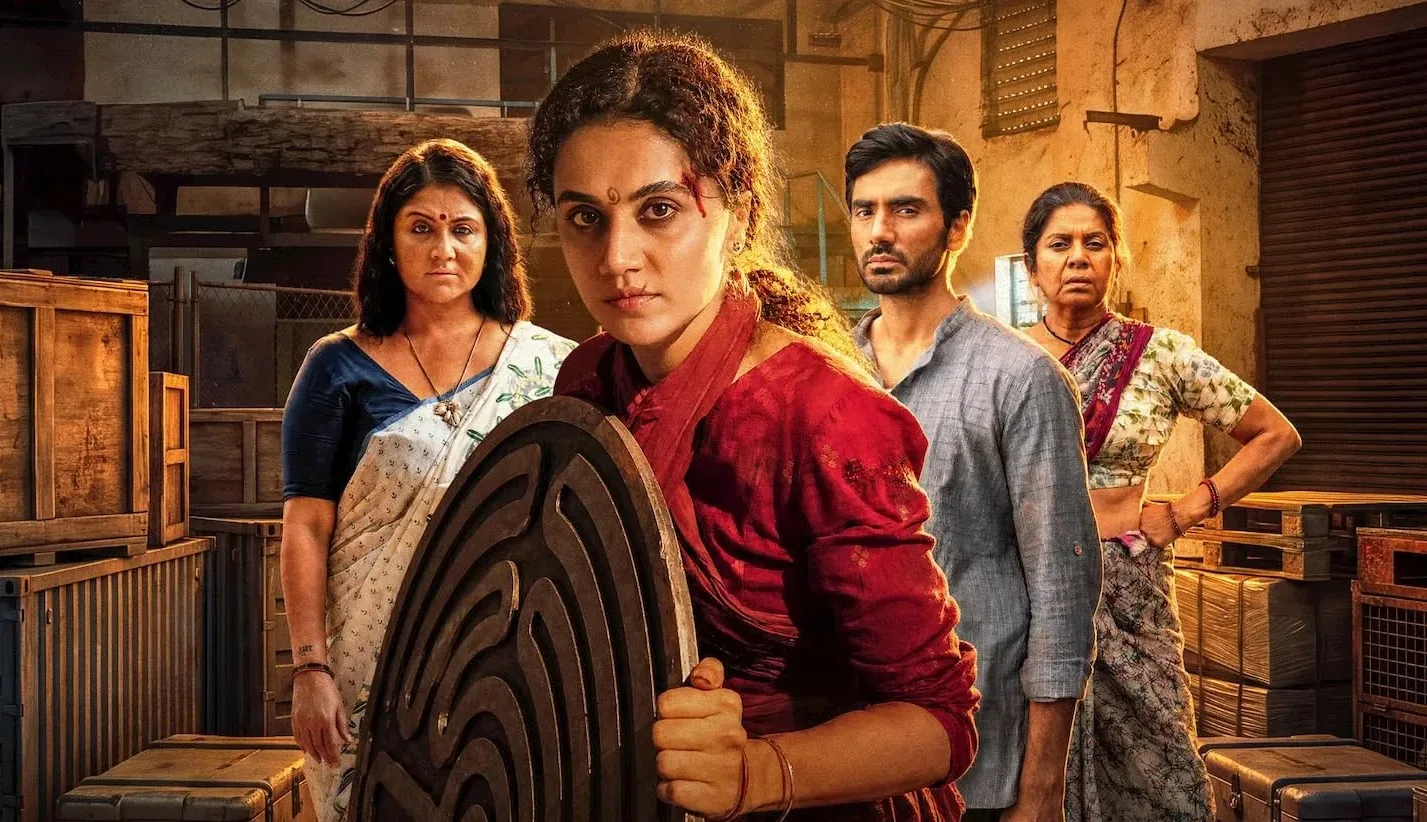
Bani and Gokul are travelling with their five-year-old daughter Mishty when the child disappears during a train ride. Bani races after the suspected kidnapper, injures herself badly and temporarily loses her eyesight. The search eventually leads the couple to Joypurra, a fictional town where the police offer little help and the kidnapping appears connected to Blackhole, a trafficking operation targeting young girls. From there, Bani begins moving through a community where helpful faces rarely remain what they first seem.
The title initially gives Bani’s blindness a clear mythological charge. Gandhari, queen of Hastinapura, chose to blindfold herself after marrying the blind Dhritarashtra. Bani receives no such choice. Her darkness comes through violence, during the very act of trying to protect her daughter.
That distinction gives the film an interesting opening between inherited mythology and contemporary female agency. One woman accepts blindness as an act of devotion; another is forced into it and then learns to weaponize the condition imposed upon her.
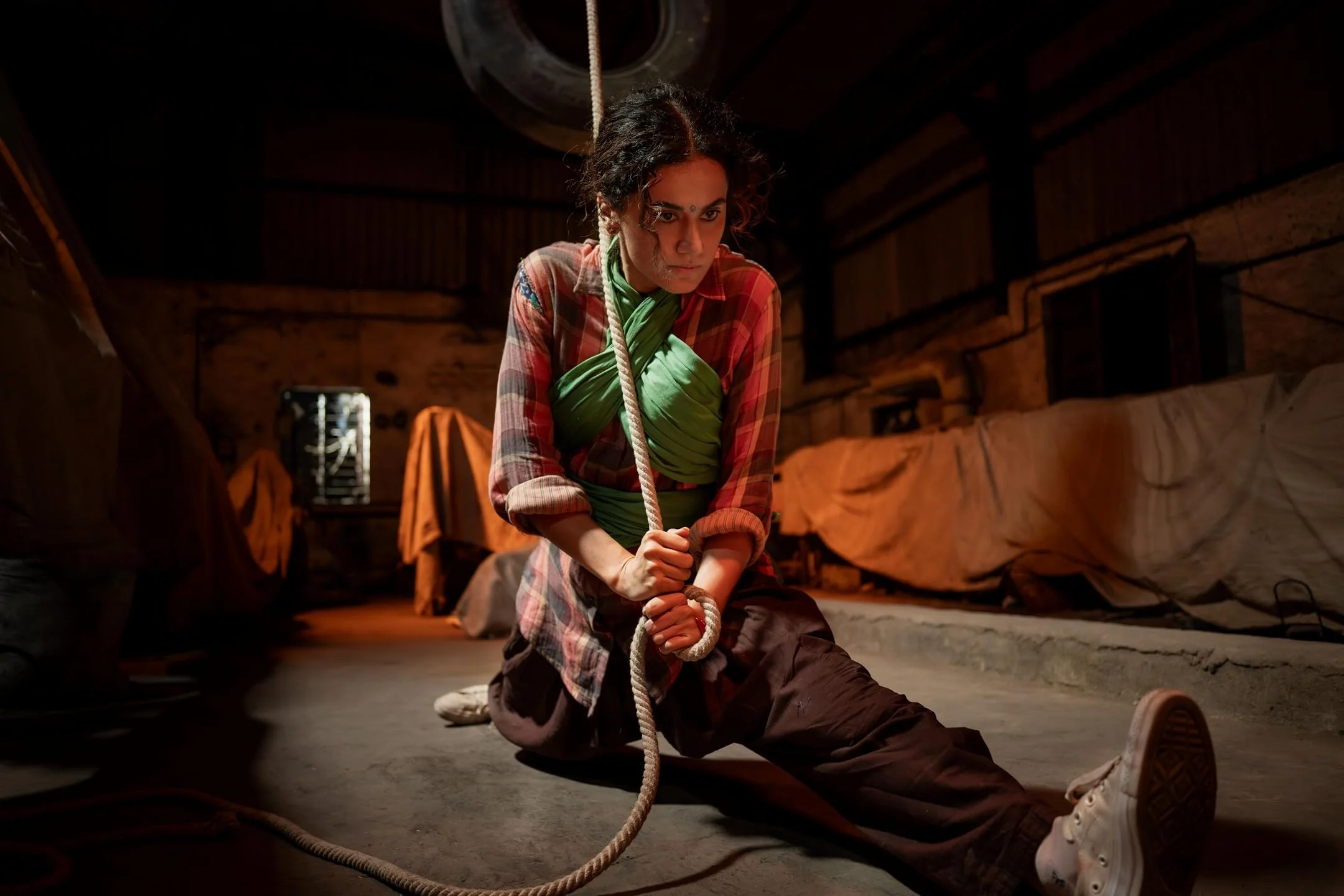
Some of Gandhari’s best ideas emerge from this difference. Bani trains herself to rely on her remaining senses, later concealing the return of her vision so those around her continue to underestimate her. Taapsee Pannu sells these passages through physical commitment.
Her falls, punches and sudden reactions have weight, and the action works best when Bani’s body still appears vulnerable enough for every encounter to carry risk. The film gradually leaves that vulnerability behind as Bani shifts toward another mythic figure, Chaumukhi, the goddess worshipped in Joypurra and associated with rescuing children from Magrasur.
An underground passage becomes a version of paatal lok. A late confrontation evokes the destruction of Mahishasura. The cultural logic is easy to understand: motherhood is being expanded into divine fury, with Bani recast as the woman who enters hell because institutions have failed to bring her child home. Hindi popular cinema has long transformed ordinary figures into mythic ones through image, music and performance.
Such elevation works when the human being remains visible beneath the icon. Gandhari has greater difficulty preserving that balance. The frightened mother from the train gradually becomes capable of increasingly extraordinary feats, and the closer the film pushes her toward divinity, the harder it becomes to recover the painfully ordinary terror that gave Mishty’s disappearance its force.
Joypurra could have complicated that transformation. The town’s most interesting feature is its relationship with Bahurupiya performance, an Indian tradition built around transformation, costume and assumed identity. Here, disguise should be richer than a thriller gimmick.
Bani meets people who seem protective, charitable or harmless, then discovers how unstable those impressions are. Jhunu Amba, Churni and Bani’s neighbour all become part of a world where appearances carry little certainty. The idea is elegant: a mother who cannot see enters a town in which seeing would not necessarily reveal the truth anyway.
The screenplay rarely trusts the metaphor enough. Instead, it keeps converting disguise into another surprise. Allies conceal motives. Personal histories return. The trafficking network widens. Betrayals pile up, followed by deaths, conspiracies and revelations staged with increasing insistence.
A few of these turns have genuine force, particularly when Bani is betrayed by someone close to her and when Gokul confronts a horrifying choice involving his daughter and other missing children. Elsewhere, the pattern becomes predictable. Once practically everyone might be wearing a figurative mask, the mask itself stops carrying much meaning.
Joypurra suffers from a similar problem. The tunnels, ritual imagery, performers and atmosphere give the fictional town an identity, yet the film sometimes reduces Bengal to a ready-made collection of mystery, menace and occult suggestion. That weakness becomes harder to ignore when the Bengali spoken by major characters lacks conviction. Regional detail cannot function solely as production texture. If a film wants language, performance traditions and religious imagery to define its world, those elements need the same care afforded to its action choreography.
Pannu remains the centre of nearly every movement, and that creates another contradiction. Gandhari places several women around Bani, yet their agency contracts as hers expands. Mita Vashisht gives Jhunu Amba a weary, difficult presence that hints at a life far larger than the screenplay permits.
Chhaya Kadam brings similar gravity to limited material, while Swastika Mukherjee’s Churni is introduced with enough mystery to suggest a larger dramatic purpose. Their paths narrow as Bani moves toward the role of sole avenger, concentrating the film’s idea of female strength almost entirely in one woman.
Ishwak Singh faces a related limitation as Gokul. A father searching for his abducted daughter could have created a parallel emotional track, especially once his decisions begin carrying moral consequences. Singh finds flashes of desperation and conflict, yet the story steadily pushes him outward so that Bani can occupy the heroic centre alone. Jatin Sarna’s police officer is similarly diminished by a plot in which official investigation matters less with every step Bani takes herself.
Makhija gives the action a dirtier physical character than the polished spectacle common to many star-led Hindi thrillers. Bani’s fights often look exhausting before they look heroic, while Amit Roy’s framing gives the action and ritual imagery a larger-screen ambition. The background score is less helpful, arriving on expected narrative cues rather than deepening the tension already present.
That friction runs throughout Gandhari. It wants the scale of popular action cinema, the darkness of a streaming crime thriller and the cultural specificity of a story rooted in Indian mythology and folk performance. Indian cinema has spent decades absorbing apparently incompatible forms and turning the collision into its own language.
Here, the pieces remain too visible as pieces. The goddess, the blind mother, the Bahurupiya, the secret tunnel and the trafficking thriller all enter the same world, but they rarely transform one another. Joypurra is full of people changing faces. Gandhari keeps changing faces too, searching for the one that might finally make all of them belong together.
Gandhari premiered worldwide on Netflix on September 3, 2026. The Hindi action thriller follows a desperate mother who loses her eyesight during a frantic search for her abducted young daughter, ultimately transforming into a relentless force against a dark child-trafficking ring.
Where to Watch Gandhari (2026) Online


Full Credits
Title: Gandhari
Distributor: Netflix
Release date: September 3, 2026
Rating: TV-MA
Running time: 1 hour 56 minutes (116 minutes)
Director: Devashish Makhija
Writers: Kanika Dhillon
Producers and Executive Producers: Kanika Dhillon
Cast: Taapsee Pannu, Ishwak Singh, Chhaya Kadam, Swastika Mukherjee, Mita Vashisht, Jatin Sarna
Director of Photography (Cinematographer): Amit Roy
Editors: Naman Arora
Composer: Shor Police, Clinton Cerejo, Bianca Gomes
The Review
Gandhari
Gandhari reaches for a striking fusion of Indian mythology, Bahurupiya tradition and contemporary action-thriller grammar, yet its cultural ideas too often remain visible as motifs rather than shaping the drama beneath them. Taapsee Pannu gives Bani’s physical transformation conviction, and Joypurra has flashes of genuine atmosphere, but repeated betrayals, uneven regional texture and an increasingly mythic heroine weaken the human fear that first gives the story power. The film has the ingredients for a distinctive Indian thriller without quite finding the form that can bind them together.
PROS
- Strong physical performance from Taapsee Pannu
- Rich mythological and folk-cultural material
- Tactile, grounded action
- Mita Vashisht brings weight to Jhunu Amba
CONS
- Mythology often functions as decoration
- Too many betrayals blunt their impact
- Joypurra’s regional texture feels uneven
- Supporting characters lose agency around Bani