



















• Latest
  • Trending
The Basics of Philosophy Review

The Basics of Philosophy Review: Paul Schrader Turns Moral Certainty Into Suspense

Falling Review

Falling Review: Warmth Makes the Betrayal Hurt

Angel and the Badman Review

Angel and the Badman Review: Too Little Weight Behind the Outlaw’s Charm

Homura: The Crimson Warriors Review

Homura: The Crimson Warriors Review: Hearts Are Easier to Read Than Battles

Elsbeth Season 4 Review

Elsbeth Season 4 Review: Smullen’s Skepticism Gets an Explanation

Haunted Hotel Season 2 Review

Haunted Hotel Season 2 Review: Ghosts Still Need Company

Doctor X Age of the White Mafia

Doctor X: Age of the White Mafia Review: Six O’Clock Is a Disciplinary Matter

Take Charge of My Heart Review

Take Charge of My Heart Review: Affection Beyond the Contract

Echo Weaver Review

Echo Weaver Review: Learning Your Way Back to Hope

14th

14th Review: Making Constitutional History Visible

Trust Me, I’m a Doctor Review

Trust Me, I’m a Doctor Review: Satire Caught in the Celebrity Spotlight

Keanu Reeves Hidari

Keanu Reeves’ Samurai Film “Hidari” Seeks New Partner After U.S. Funding Talks Collapse

10 hours ago
New Girl

“New Girl” Cast Reunites at Chrysalis Ball, Minus the Revival Greenfield Teased

10 hours ago
  • Home
  • Privacy Policy
  • Terms and Conditions
  • Gazettely Review Guidelines
Sunday, October 11, 2026
GAZETTELY
  • Home
  • Movie and TV News
    Keanu Reeves Hidari

    Keanu Reeves’ Samurai Film “Hidari” Seeks New Partner After U.S. Funding Talks Collapse

    New Girl

    “New Girl” Cast Reunites at Chrysalis Ball, Minus the Revival Greenfield Teased

    Rohan Campbell

    “Below” Star Rohan Campbell Plans Directorial Debut for Next Summer

    Blade Runner 2099

    “Blade Runner 2099” Trailer Pairs Michelle Yeoh and Hunter Schafer in a Replicant Hunt

    In a Violent Nature Part 2

    “In a Violent Nature: Part 2” Sets Valentine’s Weekend Release

    AI

    Joseph Gordon-Levitt: Fear the People Building AI, Not the Machines

    shadow rising

    Naruto Returns: Kishimoto Announces “Shadow Rising” Manga and Ninku Crossover Anime

    Misty Green

    Chris Rock’s “Misty Green” Arrives in Theaters, With Rosalind Eleazar Drawing the Raves

    Matthew Lillard

    Matthew Lillard Thought “Scream” Would Flop, and Planned a TV Career Instead

  • Movie and TV Reviews
    Falling Review

    Falling Review: Warmth Makes the Betrayal Hurt

    Angel and the Badman Review

    Angel and the Badman Review: Too Little Weight Behind the Outlaw’s Charm

    Elsbeth Season 4 Review

    Elsbeth Season 4 Review: Smullen’s Skepticism Gets an Explanation

    Haunted Hotel Season 2 Review

    Haunted Hotel Season 2 Review: Ghosts Still Need Company

    Doctor X Age of the White Mafia

    Doctor X: Age of the White Mafia Review: Six O’Clock Is a Disciplinary Matter

    Take Charge of My Heart Review

    Take Charge of My Heart Review: Affection Beyond the Contract

    14th

    14th Review: Making Constitutional History Visible

    Trust Me, I’m a Doctor Review

    Trust Me, I’m a Doctor Review: Satire Caught in the Celebrity Spotlight

    Ray Gunn Review

    Ray Gunn Review: Venus Nova Deserves Time Beyond the Mystery

  • Game Reviews
    Echo Weaver Review

    Echo Weaver Review: Learning Your Way Back to Hope

    Truckful Review

    Truckful Review: Careful Packing Meets Unreliable Directions

    AION 2 Review

    AION 2 Review: Building a Character, Waiting for Progress

    Clive Barker’s Hellraiser: Revival Review

    Clive Barker’s Hellraiser: Revival Review: Getting Hurt, Getting Stronger, Getting Stuck

    Order of the Sinking Star Review

    Order of the Sinking Star Review: Four Puzzle Worlds Learning From Each Other

    Forever Ago Review

    Forever Ago Review: Beautiful Places, Awkward Interactions

    Dragon's Dogma 2: Dark Arisen Review

    Dragon’s Dogma 2: Dark Arisen Review: Cold Weather, Consequential Choices

    The Posthumous Investigation Review

    The Posthumous Investigation Review: Curiosity Survives the Reset

    Kingdom Hearts Collection [I-III] Review

    Kingdom Hearts Collection [I-III] Review: KHII Holds Steady as Newer Entries Fluctuate

  • The Bests
No Result
View All Result
  • Home
  • Movie and TV News
    Keanu Reeves Hidari

    Keanu Reeves’ Samurai Film “Hidari” Seeks New Partner After U.S. Funding Talks Collapse

    New Girl

    “New Girl” Cast Reunites at Chrysalis Ball, Minus the Revival Greenfield Teased

    Rohan Campbell

    “Below” Star Rohan Campbell Plans Directorial Debut for Next Summer

    Blade Runner 2099

    “Blade Runner 2099” Trailer Pairs Michelle Yeoh and Hunter Schafer in a Replicant Hunt

    In a Violent Nature Part 2

    “In a Violent Nature: Part 2” Sets Valentine’s Weekend Release

    AI

    Joseph Gordon-Levitt: Fear the People Building AI, Not the Machines

    shadow rising

    Naruto Returns: Kishimoto Announces “Shadow Rising” Manga and Ninku Crossover Anime

    Misty Green

    Chris Rock’s “Misty Green” Arrives in Theaters, With Rosalind Eleazar Drawing the Raves

    Matthew Lillard

    Matthew Lillard Thought “Scream” Would Flop, and Planned a TV Career Instead

  • Movie and TV Reviews
    Falling Review

    Falling Review: Warmth Makes the Betrayal Hurt

    Angel and the Badman Review

    Angel and the Badman Review: Too Little Weight Behind the Outlaw’s Charm

    Elsbeth Season 4 Review

    Elsbeth Season 4 Review: Smullen’s Skepticism Gets an Explanation

    Haunted Hotel Season 2 Review

    Haunted Hotel Season 2 Review: Ghosts Still Need Company

    Doctor X Age of the White Mafia

    Doctor X: Age of the White Mafia Review: Six O’Clock Is a Disciplinary Matter

    Take Charge of My Heart Review

    Take Charge of My Heart Review: Affection Beyond the Contract

    14th

    14th Review: Making Constitutional History Visible

    Trust Me, I’m a Doctor Review

    Trust Me, I’m a Doctor Review: Satire Caught in the Celebrity Spotlight

    Ray Gunn Review

    Ray Gunn Review: Venus Nova Deserves Time Beyond the Mystery

  • Game Reviews
    Echo Weaver Review

    Echo Weaver Review: Learning Your Way Back to Hope

    Truckful Review

    Truckful Review: Careful Packing Meets Unreliable Directions

    AION 2 Review

    AION 2 Review: Building a Character, Waiting for Progress

    Clive Barker’s Hellraiser: Revival Review

    Clive Barker’s Hellraiser: Revival Review: Getting Hurt, Getting Stronger, Getting Stuck

    Order of the Sinking Star Review

    Order of the Sinking Star Review: Four Puzzle Worlds Learning From Each Other

    Forever Ago Review

    Forever Ago Review: Beautiful Places, Awkward Interactions

    Dragon's Dogma 2: Dark Arisen Review

    Dragon’s Dogma 2: Dark Arisen Review: Cold Weather, Consequential Choices

    The Posthumous Investigation Review

    The Posthumous Investigation Review: Curiosity Survives the Reset

    Kingdom Hearts Collection [I-III] Review

    Kingdom Hearts Collection [I-III] Review: KHII Holds Steady as Newer Entries Fluctuate

  • The Bests
No Result
View All Result
GAZETTELY
No Result
View All Result
The Basics of Philosophy Review

Bucking Fastard Review: Herzog’s Ireland Exists Somewhere Between Reality and Folklore

15/18 A Place to Heal Review: Who Gets to Define Recovery?

Home Entertainment Movies

The Basics of Philosophy Review: Paul Schrader Turns Moral Certainty Into Suspense

Caleb Anderson by Caleb Anderson
3 weeks ago
in Entertainment, Movies, Reviews
Reading Time: 6 mins read
A A
0
Share on FacebookShare on TwitterShare on PinterestShare on WhatsAppShare on TelegramSummarize with ChatGPTSummarize with Perplexity

Paul Schrader gives John Jorrisen a job built around asking difficult questions, then makes his private life depend on one he cannot answer cleanly. John teaches an introductory philosophy course, writes about Spinoza, and spends his days explaining ideas about morality and change to students who mostly seem to want an easy credit. The setup is almost aggressively plain.

Questions appear on classroom boards, philosophical arguments enter conversation directly, and John’s intellectual life keeps echoing whatever crisis the story has placed in front of him. I usually resist films that underline their themes this heavily, but here the obviousness has a purpose. John can name the problem long before he can face what it means.

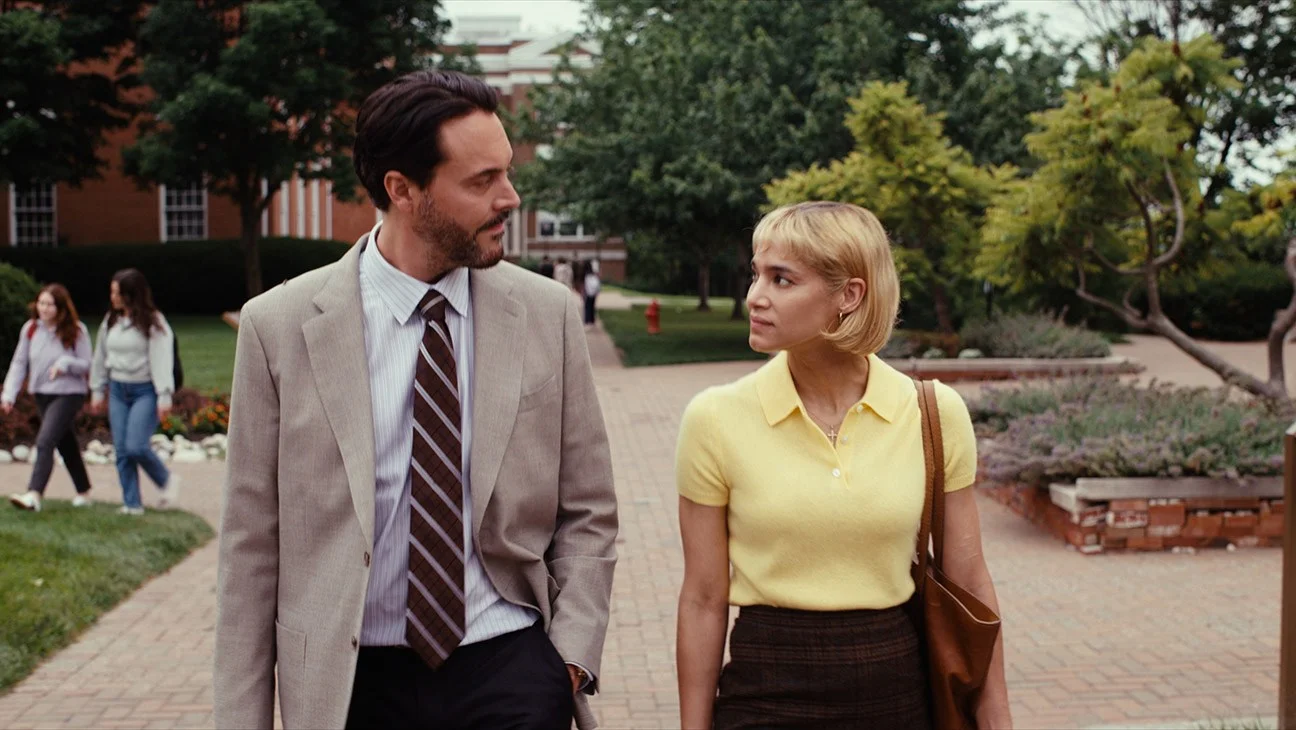
That gap gives The Basics of Philosophy its strongest tension. Jack Huston plays John with a carefully managed calm that makes him seem stable without ever making him relaxed. He is dating Rebecca Richards, a psychology professor played by Sofia Boutella, and has developed a comfortable relationship with her 14-year-old son. Yet their romance remains oddly chaste and formal.

John prefers controlled dinners, controlled conversation, controlled evenings that end before intimacy begins. Huston makes that control feel less like reserve than maintenance, as though John has spent years keeping a structure upright and knows exactly which wall cannot be touched. His father’s death finally puts pressure on that wall.
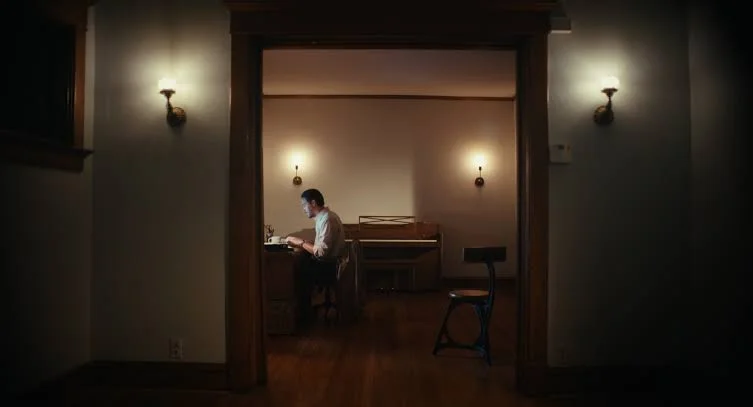
The Basics of Philosophy Review

At the funeral, John sees Miguel Vasque in the congregation. The recognition lands slowly, and Schrader lets the scene operate like a thriller reveal before giving us the information that makes it horrifying. Years earlier, when John worked as a piano teacher, he sexually abused Miguel, who was 14. John’s wealthy father, Melvyn, responded by financially supporting Miguel and his family, an act that reads at once as compensation and concealment.

The film returns to the past in black-and-white flashbacks. Black-and-white is doing a simple job here: it separates memory from the present instantly, so the audience never has to puzzle over chronology. That clarity matters because Schrader is less interested in hiding what happened than in watching John try to decide what the act says about the person he became afterward.

That is where the movie’s classroom language becomes dramatically useful. John keeps circling the question of change because his entire adult identity rests on an answer. He believes the assault belonged to the past. He believes he will never repeat it. He has built a profession around reason, a relationship around restraint, and a life around the idea that one terrible act does not have to become a permanent definition. Miguel’s return turns that belief from an intellectual position into a source of fear.

Schrader keeps the pressure surprisingly cinematic for a film this talkative. Eli Keszler’s score carries a nervous, thriller-like pulse beneath conversations that might otherwise sit still. Sean Price Williams’ cinematography also gives John’s orderly world moments of visual instability.

Much of the film is composed with the controlled framing associated with Schrader’s solitary protagonists, but bursts of stronger color and oversaturated light push certain spaces toward melodrama. The effect is useful because the images begin expressing something John refuses to do himself. His speech stays measured while the film around him grows less composed.

Huston understands that division. His performance rarely reaches for a large display of guilt. Instead, you notice small breaks in his presentation: the fixed gaze, the polished voice, the flicker of alarm when Miguel’s presence threatens to connect past and present. Even John’s work on Spinoza becomes part of that performance.

He sits writing about reason while researching Nembutal and thinking about suicide, turning philosophical discipline into something close to camouflage. A later scene in which Karl Glusman appears as Spinoza and talks with John makes Schrader’s method almost comically literal. It is an odd scene, but it also exposes the movie’s governing habit. Ideas do not remain ideas for long here. Schrader keeps giving them bodies, rooms, props, and consequences.

The difficulty comes when John starts questioning his sexuality alongside his fear of what his abuse of Miguel means. He follows Miguel into gay nightlife, enters a gay line-dancing bar, and later encounters Claude, a hustler whose characterization is pitched somewhere between sleaze, danger, and camp. These scenes are meant to extend John’s confusion about himself, but the film loses some of the precision it shows elsewhere.

The distinction matters. Adult same-sex desire has no inherent connection to abusing a child, yet the screenplay places those subjects close together because John himself is trying to explain his past. That could be a productive way to dramatize a damaged man’s self-misreading.

The problem is that Schrader does not always give the surrounding characters or spaces enough definition to keep John’s confusion clearly contained inside John. The gay bar material can feel dated and strangely artificial, and Claude is written with such eccentric shorthand that he becomes harder to read as a person than as another provocation dropped into John’s crisis.

Miguel is steadier, and Daniel Zovatto gives him a presence that complicates the film simply by refusing to behave like an extension of John’s guilt. His return carries an obvious danger for John, especially once Rebecca’s teenage son enters the moral equation.

Yet Miguel’s reasons for continuing contact are not always developed with the same care Schrader gives John’s spiraling self-analysis. That imbalance matters because a story about guilt changes depending on whose interior life receives the most space. Here, the perpetrator gets philosophy, voice, memory, fear, and metaphysical dread. The person he harmed often has to carry meaning through presence alone.

I kept returning to the film’s bluntness, because it is both what makes The Basics of Philosophy accessible and what keeps it from becoming as psychologically rich as its questions deserve. Schrader is very good at making the moral architecture visible. The whiteboard, the Spinoza manuscript, the flashbacks, John’s suicide research, and the score all point toward the same pressure: if a person has changed, how can that person know the change will hold? John can explain the logic. He can lecture on it. He can build a life that seems to prove it. None of those things settles the fear that his old self still exists somewhere inside the new one.

The queasy final stretch refuses to convert that fear into a clean lesson. The suspense comes from watching philosophy fail as a protective system: every concept John has used to organize his life now has to survive contact with Miguel, Rebecca, her son, and the knowledge John carries about himself.

Schrader loses precision when John’s confusion about sexuality spreads into the movie’s own dramatic language, but he does not let intellectual certainty repair the damage. By the final image, John still has all the language he needs to describe his predicament. What he lacks is any reliable way to prove that understanding it has changed what he is capable of doing.

The Basics of Philosophy had its world premiere out of competition at the 83rd Venice International Film Festival on September 4, 2026. The drama follows a repressed professor whose ordinary life is upended when a figure from a past transgression returns, forcing a tense reckoning with guilt and obsession.

Where to Watch The Basics of Philosophy (2026) Online

Unfortunately, we couldn't find any streaming offers.
Source: JustWatch

Full Credits

  • Title: The Basics of Philosophy

  • Distributor: Independent / Festival Release

  • Release date: September 4, 2026 (Venice International Film Festival)

  • Running time: 1 hour 34 minutes (94 minutes)

  • Director: Paul Schrader

  • Writers: Paul Schrader

  • Producers and Executive Producers: Braxton Pope, David M. Wulf, Martin Scorsese

  • Cast: Jack Huston, Sofia Boutella, Daniel Zovatto, Bill Pullman, Dana Delany, Shiloh Fernandez, Karl Glusman, Richard Gere

  • Director of Photography (Cinematographer): Sean Price Williams

  • Editors: Stephen Gurewitz

  • Composer: Eli Keszler

The Review

The Basics of Philosophy

7 Score

The Basics of Philosophy works best when Paul Schrader turns John’s intellectual certainty into dramatic pressure. Jack Huston’s controlled performance, Eli Keszler’s uneasy score, and Sean Price Williams’ restrained imagery give the film a quietly threatening pulse. Its treatment of sexuality is far less precise, and Miguel never receives the dramatic depth John does. Still, Schrader’s central question about change remains unsettling because the film refuses to let understanding count as absolution.

PROS

  • Jack Huston’s tightly controlled performance
  • Philosophy effectively drives the suspense
  • Strong score and visual restraint
  • An appropriately uneasy final stretch

CONS

  • Gay nightlife material feels dated and artificial
  • Sexuality and abuse are handled with insufficient precision
  • Miguel remains underdeveloped
  • Some thematic signaling is overly literal

Review Breakdown

  • Overall 0
Tags: 2026 Venice Film Festival83rd Venice International Film FestivalBill PullmanDana DelanyDaniel ZovattoDramaFeaturedIndependentJack HustonPaul SchraderShiloh FernandezSofia BoutellaThe Basics of Philosophy
Previous Post

Bucking Fastard Review: Herzog’s Ireland Exists Somewhere Between Reality and Folklore

Next Post

15/18 A Place to Heal Review: Who Gets to Define Recovery?

0 0 votes
Article Rating
Subscribe
Login
Notify of
guest
guest
0 Comments
Oldest
Newest Most Voted

This Week's Top Reads

  • Is This Seat Taken? Review

    Is This Seat Taken? Review: A Satisfying Mental Workout

    1347 shares
    Share 0 Tweet 0
  • Murder In A Small Town Season 2 Review: Politics and Police Work

    5 shares
    Share 0 Tweet 0
  • Trust Review: Squandered Potential and an Incoherent Plot

    6 shares
    Share 0 Tweet 0
  • The Reluctant Vampire Review: The BBC Invites Two Audiences to Dinner

    0 shares
    Share 0 Tweet 0
  • Carrie Review: Strong Characters Carry an Unsteady Tragedy

    0 shares
    Share 0 Tweet 0
  • Blue Lights Season 4 Review: Who Gets Exposed, Who Stays Protected

    1 shares
    Share 0 Tweet 0
  • Adult Supervision Review: Children Need Help Their Fathers Cannot Quite Give

    0 shares
    Share 0 Tweet 0

Must Read Articles

Angel and the Badman Review
Movies

Angel and the Badman Review: Too Little Weight Behind the Outlaw’s Charm

8 hours ago
Elsbeth Season 4 Review
TV Shows

Elsbeth Season 4 Review: Smullen’s Skepticism Gets an Explanation

8 hours ago
Matchbox: The Movie Review
Movies

Matchbox: The Movie Review: An Unfinished Gesture Beneath the Explosions

11 hours ago
Animals Review
Movies

Animals Review: Selective Solidarity in a Politician’s Home

11 hours ago
Other Mommy Review
Movies

Other Mommy Review: A Monster That Asks Permission

12 hours ago
Loading poll ...
Coming Soon
Which of Alfred Hitchcock's 1960s thrillers is your all-time favorite?

Gazettely is your go-to destination for all things gaming, movies, and TV. With fresh reviews, trending articles, and editor picks, we help you stay informed and entertained.

© 2021-2026 All Rights Reserved for Gazettely

What’s Inside

  • Movie & TV Reviews
  • Game Reviews
  • Featured Articles
  • Latest News
  • Editorial Picks

Quick Links

  • Home
  • About US
  • Contact Us
  • Advertise with Us
  • Review Guidelines

Follow Us

Facebook X-twitter Youtube Instagram
No Result
View All Result
  • Gazettely | Movie, TV & Game Reviews, News, and Rankings
  • Movies
  • Entertainment News
  • Movie and TV Reviews
  • TV Shows
  • Game News
  • Game Reviews
  • Contact Us

© 2024 All Rights Reserved for Gazettely

wpDiscuz
0
0
Would love your thoughts, please comment.x