





















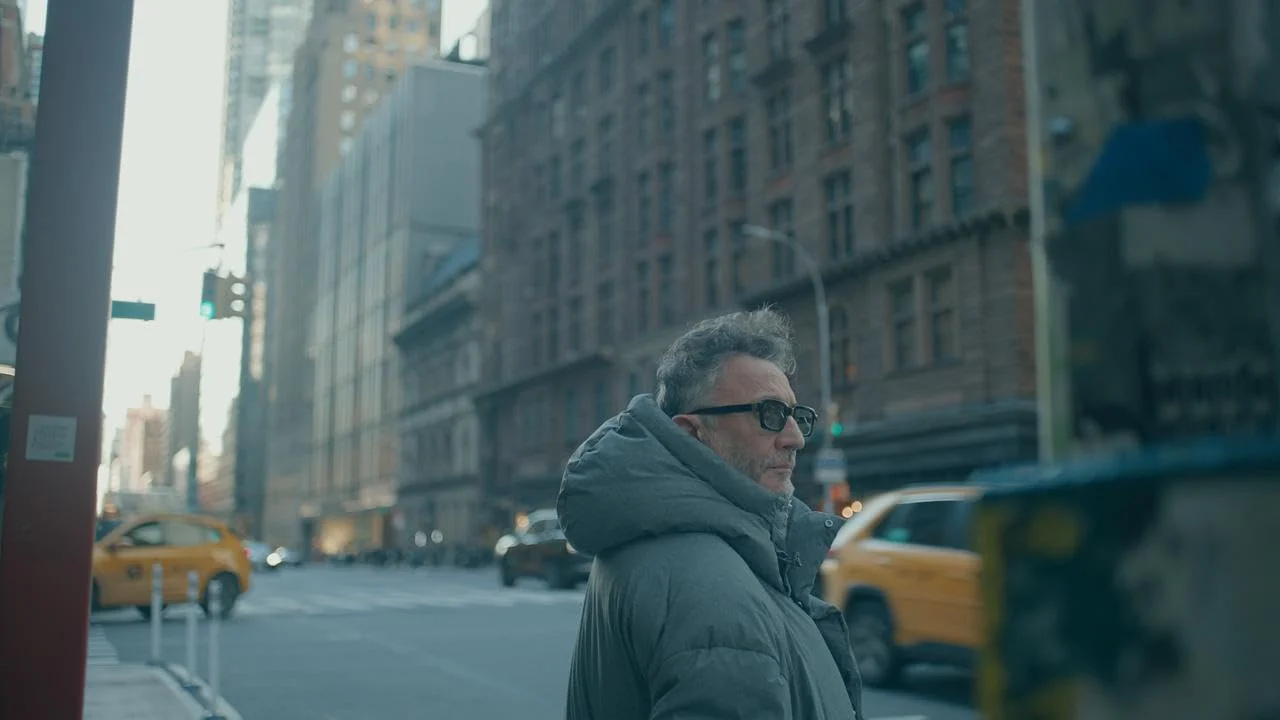

Fito Páez has already decided what a bad documentary about Fito Páez would look like. Early in Matías Gueilburt’s Fito Páez: The World Within a Song, he objects to musician portraits that polish away malice, failure, vanity, and whatever else might complicate sainthood. It is an appealing declaration from a man inviting a longtime friend to film him at close range. It is also a challenge the documentary spends nearly two hours trying to meet while its subject remains exceptionally skilled at controlling the room.
Gueilburt has access that many filmmakers would envy. His camera enters rehearsals, hotel rooms, recording sessions, family spaces and even the bathtub. Páez talks about addiction, death, love, artistic disappointment and the murders that devastated his family when he was young.
He is filmed with his children, Martín and Margarita, and with his then-partner Eugenia Kolodziej. The director follows him through Madrid, Mexico City, New York, London and other stops, placing the public musician beside an older man managing blood pressure, relationships and a body that has begun setting its own terms.
Physical proximity, though, is not the same thing as disclosure. Páez often appears aware of the camera as another audience. He talks beautifully, performs irritation beautifully, performs enthusiasm beautifully. Even his self-criticism can possess the polish of material that has been rehearsed through decades of interviews and songs. This does not make him dishonest. It makes Gueilburt’s problem harder. How do you photograph someone whose instinct is to turn experience into performance before you have finished observing it?
The sharpest scenes answer by doing very little. During rehearsals, Páez’s perfectionism can curdle into anger when the band fails to meet his expectations. Phone conversations after performances expose the same impatience. These episodes matter because the documentary does not need to accuse him of anything. Behavior occupies the frame, and the viewer is left to interpret it.
A smaller moment at Abbey Road is even better. Páez asks a driver to take him to the studio, then reacts with disbelief when the significance of the destination is not immediately understood, explaining that the Beatles recorded there. Nothing dramatic happens. Nobody confronts him. Yet the exchange quietly measures the distance between Páez’s cultural universe and somebody else’s. For a few seconds, fame loses control of scale.
Gueilburt occasionally finds an equally effective visual grammar. Music-making and reflective passages can open into wider compositions, giving Páez and his surroundings room to coexist, while conversational material sometimes contracts into a narrower television-like frame. The distinction changes our relationship with him. Space makes him one figure inside a world. Constriction restores him as the world.
The documentary understands this principle better than its editing sometimes allows. Its weakest habit is a nervous resistance to duration. Songs arrive in fragments. Archival material concerning grief, addiction and family catastrophe is frequently pushed through energetic cutting before the images have accumulated their full emotional weight. A film fascinated by intimacy keeps interrupting itself just as intimacy begins to form. Apparently two hours can still be afraid of silence.
That problem is especially frustrating because the archive itself appears formidable. Páez’s childhood in Rosario, his emergence through Argentine rock, his connections with Charly García and Luis Alberto Spinetta, his relationships with Fabiana Cantilo, Cecilia Roth and Romina Ricci, and the deaths that scarred his youth give Gueilburt decades of material. Yet biography sometimes remains biography. Events are presented, remembered and connected chronologically without always revealing how they changed the construction of the music.
The murders of Páez’s grandmother, great-aunt and another woman close to the family come closer to bridging that gap. Here, personal history and artistic identity cease behaving like separate documentary tracks. Loss is no longer background information about a famous songwriter. It becomes part of the pressure under which the songwriting exists. The film could have used far more passages built with that degree of connection.
Then Páez falls. The domestic accident in Madrid fractures several ribs, ends a tour and forces a lengthy recovery. It also fractures the documentary’s ability to remain completely controlled. Suddenly Gueilburt is filming circumstances that neither artist nor director planned: hospitalization, pain, opioids, cancelled performances, physical rehabilitation and the uncertain process of returning to work.
The camera changes character here because Páez’s body has changed the terms of the image. Artistic authority cannot negotiate with a rib cage. The man who can command musicians, narrate his own mythology and explain the cultural significance of Abbey Road cannot simply instruct recovery to proceed on schedule.
These passages carry an empathy missing from some of the more manufactured stretches. Gueilburt does not need to beautify vulnerability or interrogate it aggressively. He watches. The distinction is crucial. Páez becomes easier to see precisely when he has less control over how he appears.
His eventual movement back toward performance, including the rescheduled Zócalo concert, gains force from that physical limitation. This is less interesting as a conventional comeback than as an encounter between artistic identity and time. Páez has spent decades turning personal experience into material. Injury gives him an experience that initially refuses conversion. Before it can become story, it has to hurt.
That tension also gives Novela, the long-gestating project recorded at Abbey Road, added weight. A work conceived decades earlier re-enters the life of a musician in his sixties, linking the ambitious young artist to the older figure moving through streets where recognition now varies considerably. Archive and present-day footage quietly register that change. The crowds once waiting outside hotels belong to one scale of celebrity; the older Páez walking unnoticed through another city belongs to another.
The World Within a Song is at its strongest when it permits those scales to coexist without deciding which one constitutes the “real” Fito Páez. The demanding bandleader, grieving son, famous songwriter, difficult partner, affectionate father and theatrical raconteur do not cancel one another out.
Gueilburt gets close enough to record the contradictions, even if friendship and restless editing sometimes prevent him from pressing against them. The documentary keeps searching for the man behind the performer, yet its best images suggest he was never hiding there in the first place. The performer is part of the man, and the camera sees him most clearly during the brief moments when he forgets to direct it.
Fito Páez: The World Within a Song premiered globally on Netflix on September 3, 2026. The intimate documentary film follows renowned Argentinian rock star Fito Páez behind the scenes through recordings, tours, and personal reflections on his life and music.
Where to Watch Fito Páez: The World Within a Song (2026) Online


Full Credits
Title: Fito Páez: The World Within a Song
Distributor: Netflix
Release date: September 3, 2026
Rating: TV-MA
Running time: 1 hour 52 minutes (112 minutes)
Director: Matías Gueilburt
Cast: Fito Páez, Carlos Vandera, Mariela Vitale, Eugenia Kolodziej, Charly García, Luis Alberto Spinetta, Juan Carlos Baglietto, Fabiana Cantilo
The Review
Fito Páez: The World Within a Song
Fito Páez: The World Within a Song gets closest to its subject when control slips away. Matías Gueilburt’s access produces revealing glimpses of anger, vulnerability, recovery and artistic obsession, while restless editing and a reluctance to press Páez harder sometimes blunt the intimacy the camera has earned. The 2024 accident changes the film’s visual relationship with its subject, exposing a body and identity that cannot be directed on command. It is an imperfect portrait, but its contradictions often prove richer than its celebrations.
PROS
- Remarkably intimate access
- Strong recovery footage
- Effective use of framing and space
- Revealing unguarded moments
- Rich archival material
CONS
- Restless editing weakens emotional passages
- Songs are cut too quickly
- Limited interrogation of Páez
- Biography sometimes outweighs musical analysis